
Alpha Capital Group Review 2026
Our Overall
Score
3.04


Traders Score
—
$50
80%
5
Code ALPHA20
Paste the code at checkout. Affiliate link: MonkeyTrade may earn a commission if you use it, at no extra cost to you. It never affects our score. Your capital is at risk. Compensation disclosure
- Four Platforms
- No Time Limit
- Instant Funding Option
- Swing Program
- MT5 EAs Allowed
Basic info
- Reino Unido, Londres (Companies House 13719951)
- 2021
- Simulated capital
- Yes
- Sí
 Reino Unido, Londres (Companies House 13719951)
Challenge specs
- $50
- $50 - $1.097
- 10%
- 4%
- 6%
- 1
- 1–3
- No limit
- 80%
- Sí (incluida como performance fee en el primer pago al pasar a fondeada)
Features
- alpha-trader-coming-soon
- Varies by plan: Alpha Pro FX 1:100; Alpha One / Swing / Direct FX 1:30; Alpha Three (legacy) FX 1:50. Metals 1:9, Indices 1:10, Oil 1:10 across most plans. Note: FCA leverage caps for UK retail are 1:30 major FX, 1:20 indices, 1:5 equities; CFDs on crypto are prohibited for UK retail.
- Yes
- Qualified Account offers up to 90% performance fee; maximum combined allocation across accounts is $400,000. No standard profit-based capital scaling plan documented in sources.
- Bi-Weekly or On-Demand (chosen at checkout). Alpha Swing is on-demand only.
- Forex, Indices, Commodities
- Inglés
- 20% off with code ALPHA20
You trade under a simulated capital model — the account is simulated and you operate under an evaluation agreement, not with your own funds.
Summary
- Plan menu covers one-step, two-step, swing and instant
- Alpha Pro 10% offers a fair 1.0 target-to-drawdown ratio
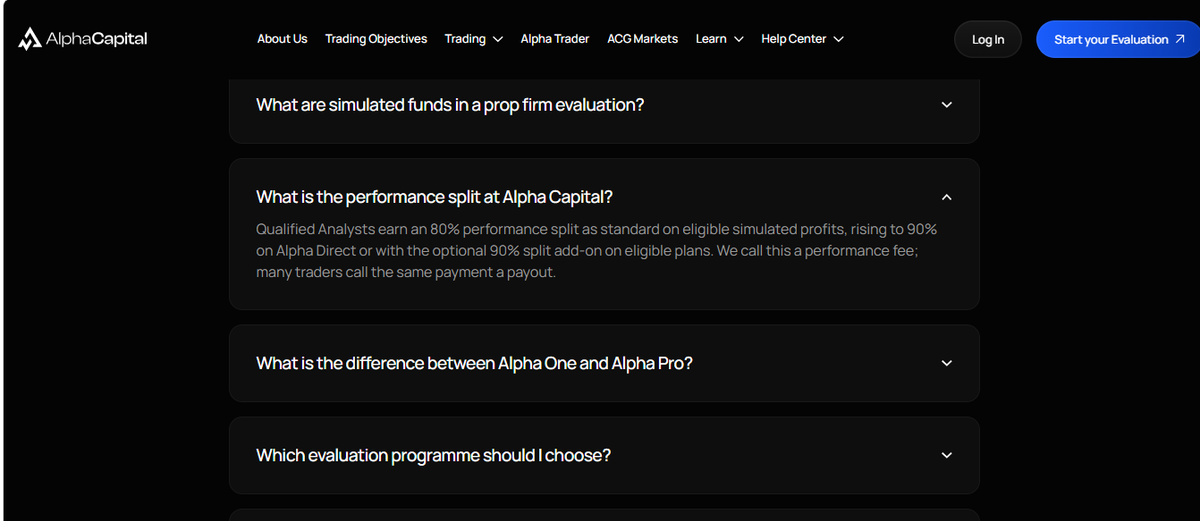
- Base profit split is 80%, up to 90% with add-on
- Reputation signals exist but could not be verified
Pros
- Four platforms: MT5, cTrader, DXTrade, TradeLocker
- Plan variety across one-step, two-step, swing and instant
- Selectable bi-weekly or on-demand payout cadence
- No time limit on evaluations
- Optional 90% profit split add-on at checkout
Cons
- UK operating entity not named on brand site
- Reputation signals exist but could not be verified
- Alpha One trailing drawdown ratio of 1.67 is tight
- Alpha Direct news and buffer rules are strict
- Pro FX leverage 1:100 exceeds FCA retail cap
Alpha Capital Group earns a middle-of-the-road score, and the caution is deliberate. The plan menu is genuinely broad across one-step, two-step, swing and instant, the platform choice is strong, and the payout cadence is flexible. The weak spots are structural: no named UK operating entity on the brand site, FX leverage on Pro that sits well above the FCA retail cap, a tight 1.67 trailing ratio on Alpha One, and reputation threads we could not verify. Pricing was not fully bound in our research, so confirm current fees on the firm's site. Consider with reservations, and only if you have tested the rules on a smaller plan first.
What to Know Before You Buy a Alpha Capital Group Challenge
Before putting money down on a challenge, a UK trader deserves a clear look at who exactly is on the other side of the contract. Alpha Capital Group runs a UK-facing brand site with detailed public rules, four live platforms, and a plan menu that spans one-step, two-step, swing and instant-funding evaluations, which places its product shelf ahead of most competitors in terms of sheer breadth. The caveats sit mostly around the brand and the operating entity rather than inside the mechanics of the challenges themselves.
Two signals should slow you down before you buy. The first concerns the operating entity: the UK brand pages do not name an operating company, the U.S. terms reference Alpha Capital Group, LLC via alphacapitalgp.com, and the affiliated ACG Markets is marketed as the broker side without any FCA authorisation confirmed in the sources reviewed. For a UK trader, that is a gap worth raising with support before any fee is paid. The second concerns independent reputation, which is unusually thin for a firm of this size. Several Reddit threads with titles alleging scam or warning exist on trader forums, yet the content was not accessible for verification during research, and Trustpilot pages across several regions failed to load. None of that constitutes proof of wrongdoing, though the usual community signals that would normally confirm payout reliability are simply absent from this pass.
Against those caveats, the mechanics are legible. The Alpha Pro 10% plan runs a 1.0 target-to-drawdown ratio, Alpha Direct offers instant funding with a 90% split, and payouts can be set to bi-weekly or on-demand at checkout. The rest of this review walks through the plan structure, the drawdown models, the profit terms and the trading environment so you can judge whether the trade-off fits your style.
Account Options and Pricing Structure
The plan menu is broader than most competitors, which helps if you have already decided what fits your trading style. The families are:
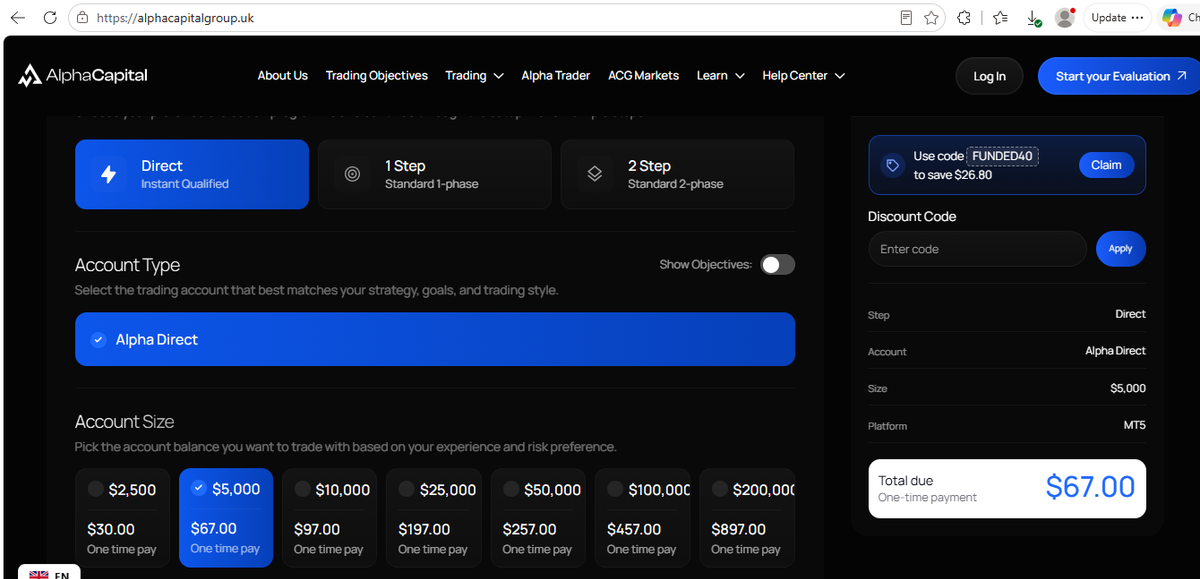
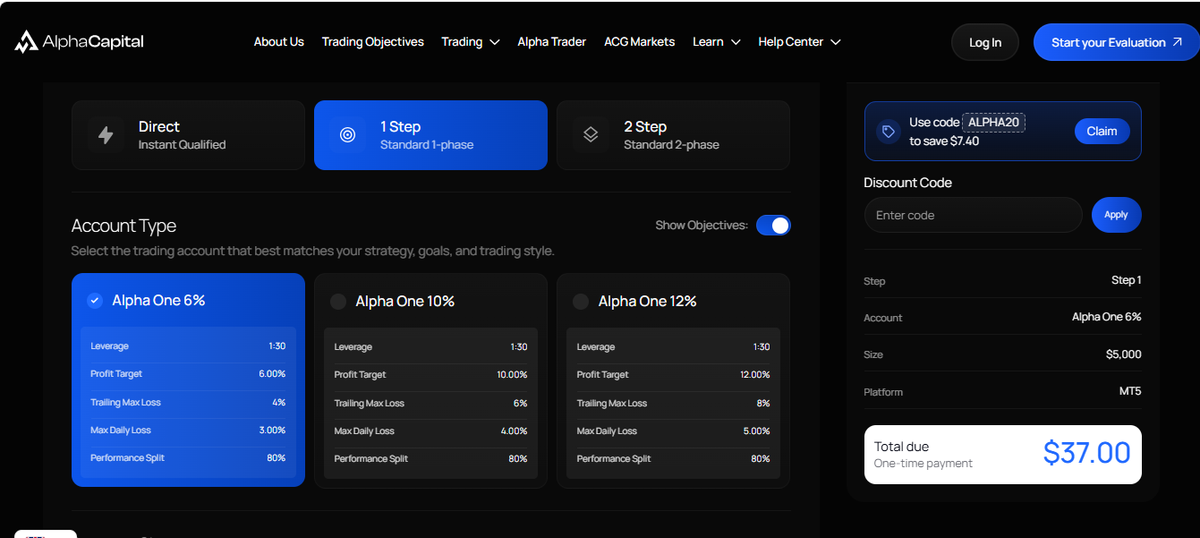
- Alpha One: a one-step evaluation with a 10% profit target. The 10% balance variant uses a 6% trailing drawdown, which gives a target-to-drawdown ratio of 1.67. That is demanding compared with a 1.0 ratio and tends to suit traders who can take profit quickly without large open drawdown.
- Alpha Pro 6%, 8% and 10%: two-step evaluations where the profit target and the total drawdown scale together. The 10% variant gives a 1.0 ratio, which is the fairest in the Pro range. The 6% and 8% variants are tighter but reach the Qualified Account faster.
- Alpha Swing: a two-step evaluation designed for traders who hold through sessions, including weekends during the evaluation phases.
- Alpha Direct: an instant-funding model with no evaluation, a 5% trailing total drawdown, a 90% native split and specific pre-payout conditions covered later.
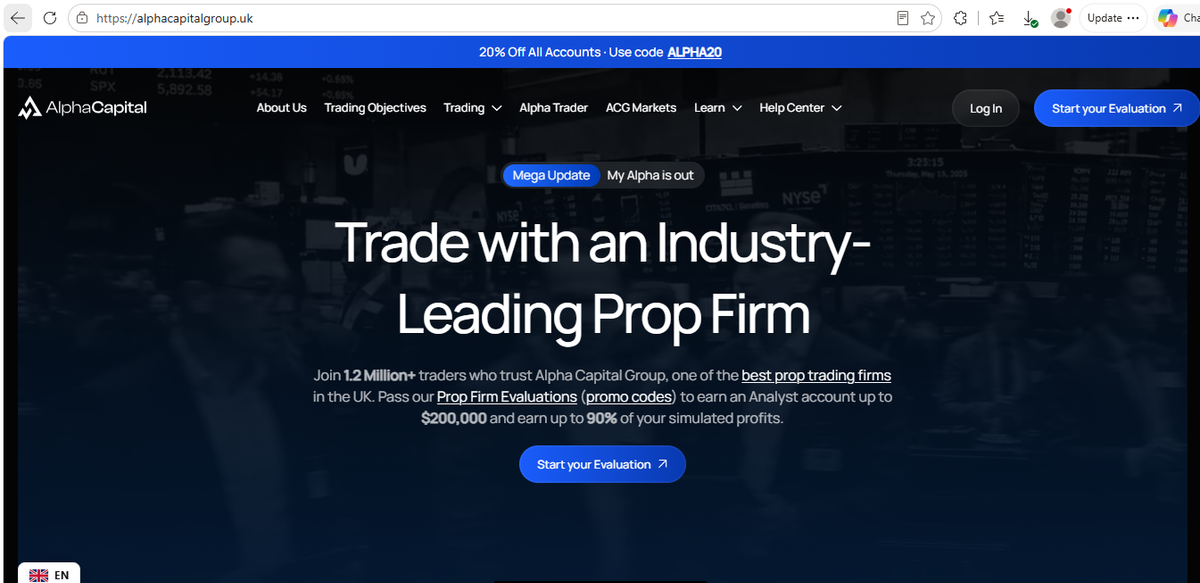
Evaluation fees are one-time payments, not recurring subscriptions, and the official product page states that fees start from $27. The final checkout price depends on account size, programme (Alpha One, Alpha Pro, Alpha Swing or Alpha Direct), the profit-target variant you choose, payout cadence, whether you add the optional 90% split (which adds roughly 10% to the on-demand price) and whether you add the swap-free option (which also adds roughly 10%). Promotional codes can change the final amount. The tables below reproduce the firm's published reference prices from its Spanish 2026 pricing-update article; treat them as reference values and confirm the current amount at checkout before you pay.
| Account size | One 6% | One 10% | One 12% |
|---|---|---|---|
| $5,000 | $37 | $50 | $57 |
| $10,000 | $67 | $97 | $107 |
| $25,000 | $157 | $197 | $217 |
| $50,000 | $237 | $297 | $347 |
| $100,000 | $397 | $497 | $587 |
| $200,000 | $647 | $997 | Not available |
Alpha One one-time fees by account size.
Alpha Pro bi-weekly (BW) and on-demand (OD) one-time fees:
One commercial detail is worth confirming at checkout: the combined allocation cap. Across your Alpha Capital accounts the maximum combined allocation is $400,000. If you plan to run several accounts in parallel, that ceiling shapes how you size each one.
Challenge Structure and Trading Rules
The rules table below carries the per-phase targets, daily loss, total drawdown, minimum days and time limit for each plan family. Two points are critical before you read it.
The drawdown type is not uniform across the firm. On Alpha One and Alpha Direct, the daily loss is calculated as balance or equity whichever is greater, which counts as the stricter calculation because it catches intraday equity swings even when your closed balance has barely moved. Alpha Pro 8% and 10%, together with Alpha Swing, apply a balance-based daily loss instead, giving more room to traders who hold through drawdown and let positions recover before closing.
The total drawdown also behaves differently depending on the plan. Alpha One (10% variant) and Alpha Direct apply a trailing drawdown tied to a high-water mark, so the loss floor rises as the account grows. Alpha Pro and Alpha Swing instead use a static drawdown that sits at a fixed level from the starting balance, and for a trader who takes profit and then draws down, that static model tends to be materially easier to manage over the course of a run.
Alpha Direct carries its own rule set because it skips the evaluation. The news window prohibits new or closing trades on the affected instrument from 5 minutes before to 5 minutes after a high-impact release. Alpha Swing uses a different structure: a trade opened within 2 minutes before or after a high-impact release, a 4-minute window in total, must stay open longer than 2 minutes to count as valid. On Alpha Pro, weekend holds are allowed during Phase 1 and Phase 2 but are not permitted on the Qualified Account stage, which changes how you plan Friday closes once you pass.
| Phase | Target | Max Daily Drawdown | Max Total Drawdown | Minimum Days | Time Limit |
|---|---|---|---|---|---|
| Alpha One (1-step) | 10% | 4% (One 6%) / 4% (One 10%) / 5% (One 12%), balance or equity | 6% trailing (One 10% variant; high-water mark) | 1 | Unlimited |
| Alpha Pro 6% (Phase 1) | 6% | 3% (balance or equity) | 6% static | 3 | Unlimited |
| Alpha Pro 6% (Phase 2) | 6% | 3% (balance or equity) | 6% static | 3 | Unlimited |
| Alpha Pro 8% (Phase 1) | 8% | 4% (balance-based) | 8% static | 3 | Unlimited |
| Alpha Pro 8% (Phase 2) | 5% | 4% (balance-based) | 8% static | 3 | Unlimited |
| Alpha Pro 10% (Phase 1) | 10% | 5% (balance-based) | 10% static | 3 | Unlimited |
| Alpha Pro 10% (Phase 2) | 5% | 5% (balance-based) | 10% static | 3 | Unlimited |
| Alpha Swing (Phase 1) | 10% | 5% (balance-based) | 10% static | 3 | Unlimited |
| Alpha Swing (Phase 2) | 5% | 5% (balance-based) | 10% static | 3 | Unlimited |
| Alpha Direct (Instant Funding, Qualified from purchase) | None | 3% (balance or equity) | 5% trailing (high-water mark) | n/a | n/a |
| Qualified Account (after evaluation) | — | Same as plan variant | Same as plan variant | — | — |
The target-to-drawdown ratio is the quickest way to read fairness across the menu. Alpha Pro 10% sits at a ratio of 1.0, which is the fair point in the Pro range, whereas Alpha One at 1.67 sits well on the tight end of the spectrum. For a trader new to the firm, the Pro 10% route usually offers a cleaner statistical shot at passing, even though the entry fee for it is higher.
Trading Environment and Conditions
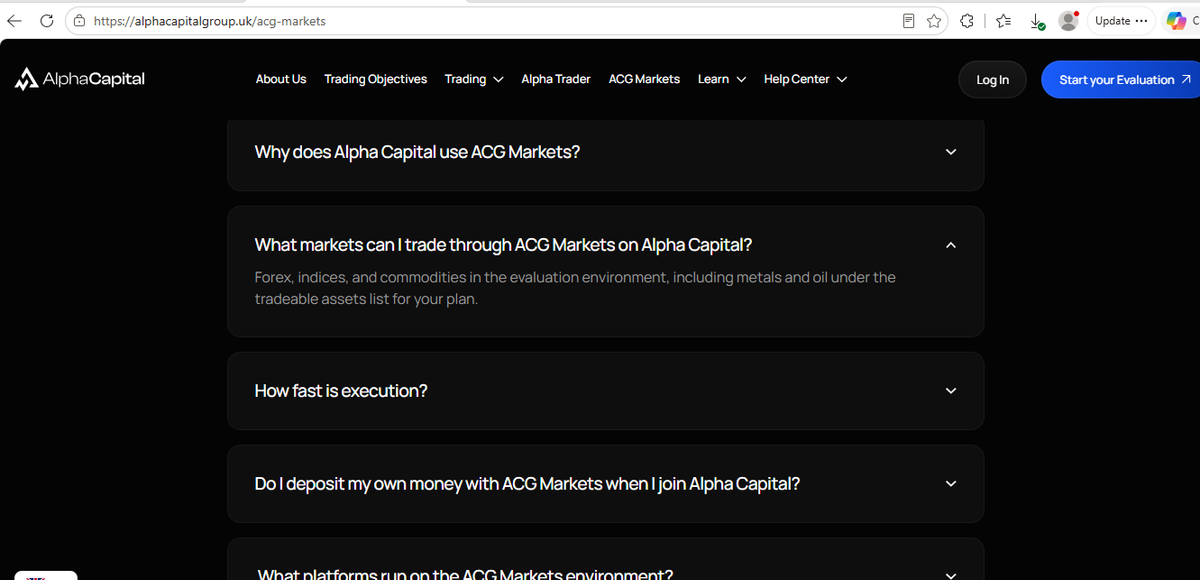
Four live platforms are offered:
- MetaTrader 5
- cTrader
- DXTrade
- TradeLocker
Alpha Trader is marketed as coming soon. That breadth of platform choice runs wider than the typical prop firm offering, where most houses settle on one or two platforms, and it is useful if you already run tooling or indicators on a specific stack.
Instruments cover:
- forex
- indices
- metals
- commodities
- oil
Crypto is not listed on the instrument set. For a UK retail trader that question is already settled, because CFDs on crypto are prohibited for UK retail by the FCA regardless.
Leverage is where the entity question becomes concrete:
- Alpha Pro: FX leverage up to 1:100
- Alpha One, Swing and Direct: FX leverage up to 1:30
- Metals: 1:9
- Indices: 1:10
- Oil: 1:10
The FCA retail caps for UK-authorised brokers are:
- 1:30 on major forex
- 1:20 on indices
- 1:5 on equities
A 1:100 FX offer sits outside those caps, which means UK retail onboarding on Alpha Pro would route through a non-UK entity. The firm does not clearly disclose which group entity onboards UK clients and under which licence; confirm the operating entity in the client agreement before you accept Pro leverage.
Execution type is not published in the sources reviewed. Raw spread with no commission is advertised at checkout, although specific spread values are not disclosed and should be measured on a demo before you commit to a platform.
Payouts, Profit Split and Scaling
The base profit split is 80%, with a paid add-on at checkout raising it to 90%, and Alpha Direct runs on 90% natively without the add-on. The split alone does not tell you much, since the eligibility rules shape when and how you actually get paid.
Payout cadence is selected at checkout. You can run bi-weekly, which is the standard rhythm across most Alpha Capital plans, or on-demand. Alpha Swing is on-demand only. The firm's marketing claims more than $100M in performance fees paid to analysts and more than 1.2 million traders onboarded, although independent payout proof was not verified during research. According to user reviews, questions have been raised in trader communities about payment flow, though the specific threads were not accessible for direct reading.
Alpha Direct carries three rules that shape your first payout:
- Profit buffer: a 3% profit buffer must be reached before you can request a performance fee, and the buffer stays in the account. The minimum request is 1% of gross profit.
- Best Day Rule: when you request a performance fee, no single trading day can contribute more than 15% of total profit. If one day sits above that share, you need to add more balanced days before you can withdraw.
- Max Risk per asset: on Alpha Direct, if the combined open loss on any single asset reaches 1% of account size, the account is closed. The threshold is measured on unrealised losses and includes commissions, swaps and slippage. Same-asset same-direction trades reopened within 10 minutes are aggregated. Profitable positions do not offset losing ones.
KYC timing depends on the plan. On evaluation plans (Alpha One, Alpha Pro and Alpha Swing), you complete the evaluation first, then receive an email with a link to verify your identity through Veriff. KYC and withdrawal details must be provided before the Qualified Analyst contract and credentials are issued, and the firm states this normally takes up to two working days. On Alpha Direct there is no evaluation stage, so first identity verification takes place when you become eligible to request a payout, and payout requests cannot be submitted before verification is complete.
Payout methods include Rise, Wise and bank transfer (WIRE, ACH and SWIFT). Direct cryptocurrency withdrawals are not facilitated, though crypto withdrawals may be possible through Rise. Performance fee requests are processed within two business days according to the firm, and accounts remain locked during payout processing before resuming after the balance reset.
Scaling is handled through the Qualified Account. The Qualified Account offers up to the 90% performance fee and sits inside the $400,000 combined allocation cap. The firm does not document a standard profit-based scaling plan in the sources reviewed, so if you expect automatic account growth after consistent months, that expectation is not supported by public rules.
Trader Experience and Support
The dashboard shows real-time drawdown, trade history and account statistics, which is the baseline you need to manage daily loss limits on plans where the daily loss is calculated as balance or equity whichever is greater.
Support channels are:
- Help centre
- Discord community
Published support hours for technical email support are weekdays, 08:00–20:00 GMT, and Discord and live chat responses may be delayed on weekends. The firm does not publish a chat SLA or guaranteed response time, so if speed is a decision factor you should test the channel before you buy. Alongside email (info@alphacapitalgroup.uk) and technical support (support@alphacapitalgroup.uk), live chat is available through the website and Help Centre.
Education is more substantial than most competitors. Alongside articles and guides, the firm references a Level 5 Advanced Diploma in Financial Trading delivered via the affiliated ACG Markets academy, plus trader interviews and videos. The diploma pathway is unusual in the prop space and may be useful if you want structured material.
Alpha Capital Group vs The Competition
The comparison that follows frames Alpha Capital against three firms that overlap with it on common evaluation styles. Across those three, Alpha Capital's clearest edge lies in plan breadth and platform choice, while its clearest weakness is a shortage of independently verified reputation data.
Against FTMO, Alpha Capital offers more plan families and more platforms, although FTMO carries a longer track record and a wider pool of community-documented payouts. If verified payout history is your deciding factor, that gap is real. Against FundingPips, Alpha Capital's entry prices are not published, so a direct cost comparison is not possible without checkout, although FundingPips is generally positioned at lower entry tiers. Against The5ers, Alpha Capital's instant-funding option through Alpha Direct is comparable in structure, though The5ers offers a more documented capital-scaling path for consistent performance.
The table above is best read as a shortlist. The right choice ultimately depends on which trade-offs you are willing to accept, whether that is entity transparency and reputation on one side, or plan menu and platform choice on the other.
Clearing Up the Misinformation
Two claims circulate about Alpha Capital Group that deserve a plain correction.
The first assumption is that passing the evaluation gives you a real funded account, when in practice both the evaluation and the Qualified Account run on simulated balances, and traders earn performance fees on simulated profits rather than live market P&L. That setup is a standard model across the prop industry and is in no way a mark against this firm specifically, though it changes how you should think about risk, taxation and the relationship between you and the firm. In practice, you are a contractor paid for simulated performance, with no live brokerage account held in your name.
The second claim is that Alpha Capital Group is FCA regulated as a broker, which is inaccurate: the prop firm itself is not a regulated broker, and although the affiliated ACG Markets is marketed as the broker side, FCA authorisation for either the prop firm or for ACG Markets is not confirmed in the sources reviewed. If regulated brokerage status is a hard requirement on your side, the sensible step is to check the FCA register directly against the exact legal entity you are contracting with before you buy.
Conclusion
Alpha Capital Group is a reasonable fit if you are an intermediate trader who wants a wide plan menu, four platforms and selectable payout cadence, and you can accept a firm whose independent reputation signals are not currently accessible. The Alpha Pro 10% route with its 1.0 target-to-drawdown ratio is the cleanest statistical shot at passing in the menu, and the instant-funding option through Alpha Direct is useful if you want to skip the evaluation and work against the buffer and Best Day rules directly.
You should wait if any of the following apply:
- You need an FCA-authorised broker on the counterparty side.
- You want a long, verifiable public payout history before you commit a fee.
- You trade on 1:100 FX leverage and need that leverage inside a UK-authorised entity.
The firm has real structure and detailed public rules behind it, so the day-to-day mechanics are perfectly workable. What is left to resolve, before committing the evaluation fee on any challenge, is the pair of gaps around disclosure and reputation covered earlier in this review.
Picture this: you buy an Alpha Pro 10% plan and, in Phase 1, you reach a 6% profit while keeping daily swings well inside the 5% balance-based daily loss. You then pass to Phase 2, hit the 5% target, and move to the Qualified Account on the static 10% total drawdown, where the ceiling does not trail your equity. From there, you request a bi-weekly payout at the 80% split, or at 90% should you have taken the add-on at checkout. The scenario only works cleanly because the drawdown is static and balance-based; the same path on Alpha One would carry a trailing 6% ceiling and an equity-based daily loss, which would change how you manage open positions on green days.
How we rate prop firms
Five weighted dimensions — trust, fairness, payout terms, platform quality, and customer support.
What are your odds here?
Load Alpha Capital Group’s rules into our Monte Carlo simulator, put in your own win rate and risk, and see how often that combination ends in a funded account — and which rule ends it when it doesn’t.
The full ranking
See how Alpha Capital Group stacks up against the other top-rated prop firms in our independent ranking.
Frequently asked questions
Is Alpha Capital Group regulated?
Is the funded account real capital?
What is the profit split?
How often are payouts?
Which drawdown model applies?
Can UK retail traders use the 1:100 leverage on Alpha Pro?
Trader reviews
Compare Alpha Capital Group
Add Alpha Capital Group to the comparison tool to put it side by side with other prop firms on fees, rules, and score.
Compare Alpha Capital Group →Other prop firms to consider
- FTMO4.59 / 5Beginner and intermediate traders comparing prop firms who prioritize documented payout history, transparent rules and a broad choice of trading platforms.
- FundedNext4.25 / 5Beginner and intermediate traders who want a large, transparent prop firm with static drawdown, no time limit and flexible payout options, and who accept an offshore simulated model outside FCA protection.
- The5ers4.24 / 5Best for intermediate to experienced traders who value a proven track record, no time limits, and serious scaling potential.
About the authors