

City Traders Imperium Review 2026
Our Overall
Score
3.82


Traders Score
—
$29
50%
8
- No Time Limit
- Balance-Based Drawdown
- Scaling To $4M
- CTI Academy Included
- MT5 & Match-Trader
Basic info
- Dubai, UAE (per competitor aggregator); London, UK (per propcoupouns.com)
- 2018
- Simulated capital
 Dubai, UAE (per competitor aggregator); London, UK (per propcoupouns.com)
Challenge specs
- 8%
- 5%
- 3
- Unlimited
- 50%
Features
- no publicado
- Scaling up to $4,000,000 total simulated capital, with VIP progression lifting profit share to 90% (Bronze) and 100% (Silver).
- First payout after 7 days (1-Step, 2-Step) or from day 5 (Instant, Direct Funding); payouts within 24 hours of request; weekly on Bronze VIP, on demand on Silver VIP
- Forex, Indices, Commodities, Cryptocurrencies
You trade under a simulated capital model — the account is simulated and you operate under an evaluation agreement, not with your own funds.
Summary
- Four programmes: 1-Step, 2-Step, Instant Funding and Direct Funding
- Balance-based drawdown: 5% trailing, 10% static or 6% static depending on programme
- News, overnight and weekend holding allowed on every programme
- Martingale and third-party EAs allowed on 1-Step only, with other programmes accepting personal EAs only
- CTI is a simulated-trading provider, not a regulated broker
Pros
- No time limit on any challenge
- News, overnight and weekend trading allowed on all four programmes
- Profit split scalable to 100% through VIP
- Scaling plan up to $4,000,000
- Operating since 2018, documented track record
Cons
- Not a regulated broker, with Comoros registration only
- Programme-specific EA and Martingale restrictions
- Instant Funding starts at 50% of advertised balance
- Mandatory visible stop-loss within 60 seconds
- No new US clients since April 2024
City Traders Imperium is an established simulated-trading provider running four distinct funding routes, namely 1-Step, 2-Step, Instant Funding and Direct Funding, with balance-based drawdown across all of them and a scaling path up to $4,000,000. News, overnight and weekend trading are permitted on every programme. EA and Martingale rules diverge sharply by product, and the starting profit share ranges from 50% on Instant Funding to 80% on the evaluation programmes, scaling to 100% at Silver VIP. CTI is not a regulated broker, and both of its entities disclose that neither accepts or manages client deposits, so this is simulated trading using virtual capital. New US clients have not been accepted since April 2024.
What you need to know about City Traders Imperium
Founded in 2018, City Traders Imperium (commonly shortened to CTI) has had several years to accumulate a documented track record in the simulated-trading space. The business is split between two entities with distinct remits: City Traders Imperium Limited, registered in the Comoros Union, runs the skill assessment programmes and the simulated demo trading, while CTI FZCO, registered at Dubai Silicon Oasis in the UAE, delivers educational trading courses. The core pitch sits on four pillars, namely four funding routes, consistent balance-based drawdown logic, no time limits on any challenge, and a scaling path that reaches up to $4,000,000.
The regulatory picture is worth stating in plain language. CTI does not operate as a broker, and both entities explicitly state that neither accepts nor manages client deposits, with all trading happening in a simulated environment using virtual capital. City Traders Imperium Limited holds a Comoros company number 15969 and licence L15969/CTI, which is a corporate registration rather than the kind of authorisation a recognised financial regulator issues to retail brokers. Anyone expecting FCA, ASIC or CySEC oversight of a prop firm should know that CTI makes no such claim, and this review will not imply one.
There is one operational point worth knowing upfront, which is that CTI stopped accepting new US-based clients in April 2024, so readers in the United States cannot open a new challenge. For everyone else, the attractive pieces of the proposition include the four-programme structure, pricing that starts as low as $29 on the 1-Step $2,500 tier, and payouts the firm advertises as processed within 24 hours of a request. On the other side of the ledger, the pieces worth examining closely include the programme-specific EA and Martingale rules, the starting profit share on each programme, and the fact that Instant Funding begins with half the advertised balance.

Account Options and Pricing Structure
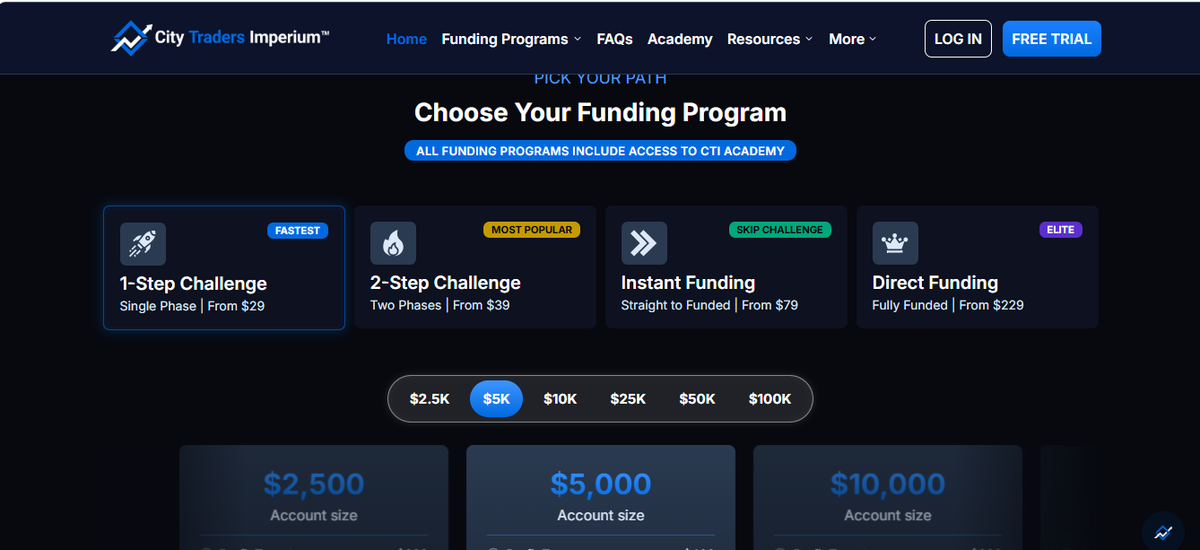
CTI sells four distinct products, and each one has its own pricing ladder running from a $2,500 account up to larger sizes:
- The 1-Step Challenge is the cheapest entry point, starting at $29 for the $2,500 account and $79 for the $10,000 account.
- The 2-Step Challenge starts at $39 for the $2,500 account and $99 for the $10,000 account.
Both of these are evaluation products, which means paying a one-time fee, hitting the targets across either a single phase or two phases, and moving to a funded (simulated) account on completion.
Instant Funding and Direct Funding both skip the evaluation entirely, though they occupy different positions in the lineup. Instant Funding starts at $79 for a $2,500 label and runs up to $1,599 for the $80,000 label, with the account beginning on 50% of the advertised balance active and the remaining capital unlocking through 10% profit milestones. Direct Funding starts at $229 for the $5,000 label and climbs to $3,999 for the $80,000 label, and the firm's own wording describes it as a product that "starts you on all of it: your full balance, active and tradeable, from the moment you sign up." Paying more for Direct Funding buys the full balance from day one together with a higher starting profit share of 70%, as against the 50% that opens an Instant Funding account.
What a trader is really paying for comes down to risk tolerance and the preferred drawdown model. The 1-Step is attractive for anyone wanting a single hurdle and comfortable with a 5% trailing drawdown. The 2-Step costs a little more and offers a static 10% drawdown in return, which tends to be more forgiving of swings during evaluation. Instant Funding suits traders who want immediate funded status at the lowest upfront cost and can live with starting on half the balance alongside a 50% split. Direct Funding occupies the premium slot in the lineup, offering the full balance from day one and a 70% starting split at a materially higher fee.
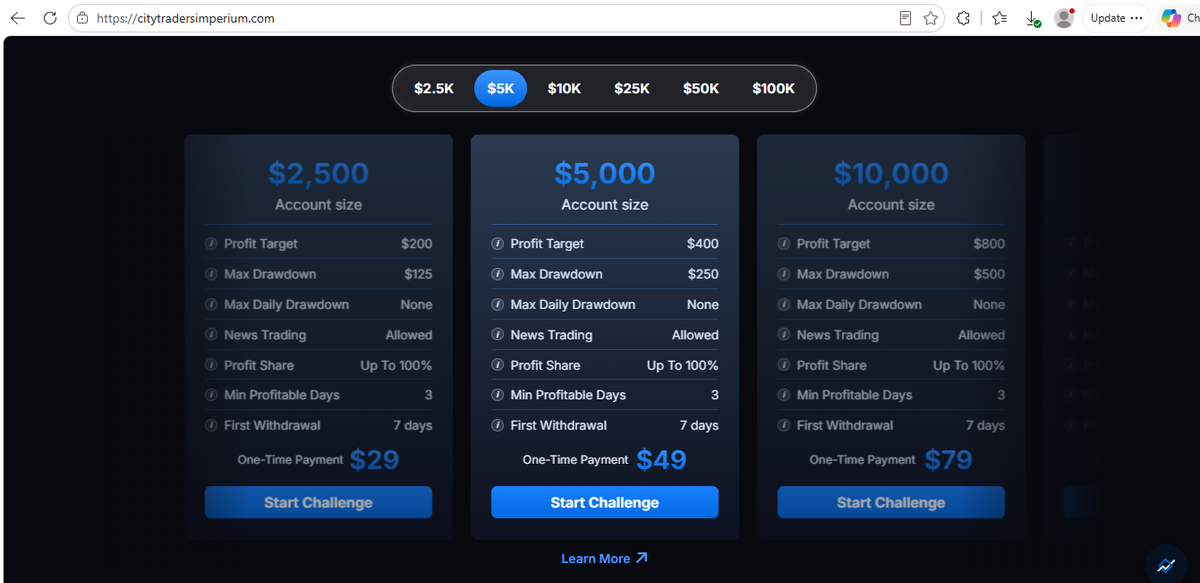
The table below sets out the exact pricing per account size across the four programmes. Prices are advertised as one-time payments rather than subscriptions, and promotional discounts at checkout may change from time to time.
| Account Size | 1-Step | 2-Step | Instant Funding | Direct Funding |
|---|---|---|---|---|
| $2,500 | $29 | $39 | $79 | Not listed |
| $5,000 | $49 | $59 | $139 | $229 |
| $10,000 | $79 | $99 | $259 | $399 |
| $20,000 | Not listed | Not listed | $449 | $999 |
| $25,000 | $159 | $199 | Not listed | Not listed |
| $40,000 | Not listed | Not listed | $849 | $1,999 |
| $50,000 | $299 | $329 | Not listed | Not listed |
| $80,000 | Not listed | Not listed | $1,599 | $3,999 |
| $100,000 | $449 | $549 | Not listed | Not listed |
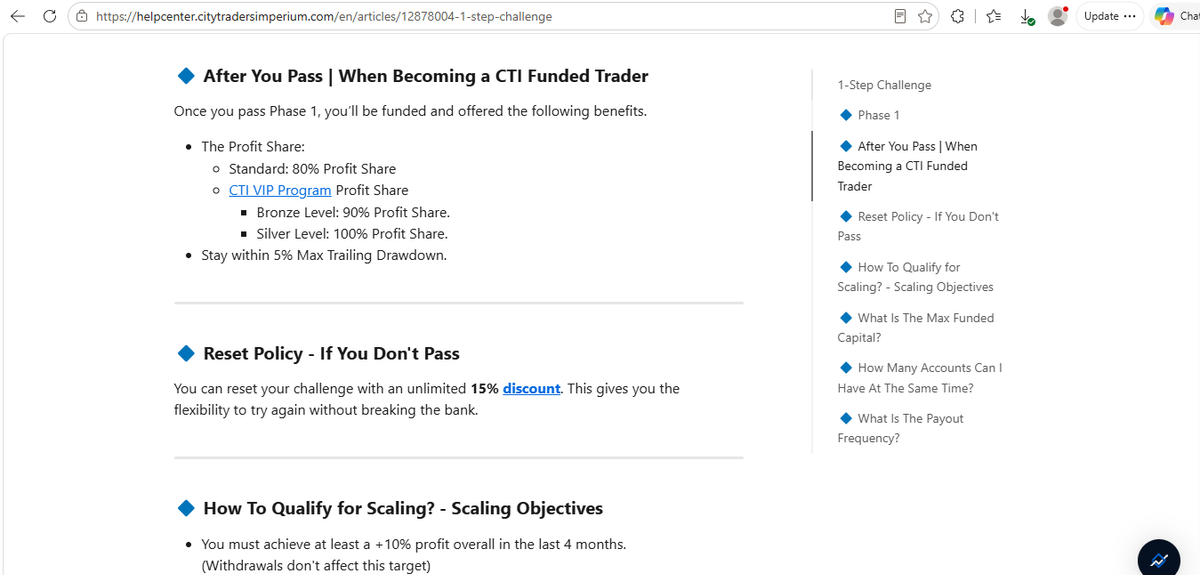
CTI advertises discounted resets, with the exact discount depending on the programme, and does not publicly disclose a fee refund policy on first payout, so it is worth confirming this with support before buying.
Challenge Structure and Trading Rules
The CTI rules are organised by programme, and the critical distinction across the four products concerns how drawdown is calculated and how much starting capital you receive. Every programme uses balance-based drawdown, which calculates the stop-out on closed trades only and ignores floating equity. For beginners, that behaviour tends to be easier to manage than equity-based models, because an open position moving against you will not immediately eat into your buffer.
On the 1-Step Challenge, the profit target sits at 8% and the maximum drawdown is 5%, trailing, with the trailing behaviour moving the drawdown level upward as your closed-trade balance makes new highs. There is no daily loss limit on the 1-Step, a minimum of 3 profitable days is needed before you can pass, and no time limit applies.
The 2-Step Challenge works differently:
- Phase 1 asks for a 10% profit target; Phase 2 asks for 5%.
- The maximum drawdown is 10% and it is static, which means it is fixed to your starting balance and does not trail.
- There is a 5% daily loss limit on both phases, and the same 3 profitable days minimum applies, with no time limit.
Instant Funding and Direct Funding both use a 6% static balance-based drawdown with no daily loss limit, and both ask for a 10% profit target per scaling milestone. Where they diverge is on starting capital: Instant Funding activates 50% of the advertised balance on day one, with further capital unlocking at each 10% milestone, while Direct Funding activates the full advertised balance from the moment you sign up.
Here is the key practical consequence. Suppose a trader is on a $10,000 2-Step account with a 10% static drawdown and builds $1,000 of profit: the stop-out would stay fixed at $9,000. Should that same $1,000 profit be earned on a 1-Step with trailing drawdown, the stop-out would shift upward with the closed highs, leaving a smaller buffer once in profit. Both models are workable in practice, and each tends to suit a different trading style.
Across every programme, the drawdown type is explicitly balance-based according to the firm's own published explanation, so any claim online that CTI uses equity-based drawdown should be set aside. For the exact per-phase figures and starting profit shares, the table above sets them out.
| Programme | Profit Target | Max Daily Drawdown | Max Total Drawdown | Minimum Profitable Days | Starting Profit Share |
|---|---|---|---|---|---|
| 1-Step Challenge | 8% | None | 5% (trailing balance-based) | 3 | 80% |
| 2-Step Challenge, Phase 1 | 10% | 5% | 10% (static balance-based) | 3 | 80% (on funded phase) |
| 2-Step Challenge, Phase 2 | 5% | 5% | 10% (static balance-based) | 3 | 80% (on funded phase) |
| Instant Funding | 10% per scaling milestone | None | 6% (static balance-based) | None | 50% |
| Direct Funding | 10% per scaling milestone | None | 6% (static balance-based) | None | 70% |
Trading Restrictions and Strategy Permissions
City Traders Imperium permits news trading, overnight positions and weekend holding across all four funding programmes. The programmes diverge sharply, however, once the discussion turns to automated trading and Martingale.
On Expert Advisors, the 1-Step Challenge accepts both personal and third-party EAs, which includes any bot bought from a marketplace. The 2-Step Challenge, Instant Funding and Direct Funding accept personal EAs only, and the firm reserves the right to request the source code at any time. Martingale strategies follow the same split, being allowed on the 1-Step and prohibited on the other three programmes.
Prohibited across every programme:
- Price-feed exploitation, including rollover scalping and strategies that take advantage of pricing errors.
- High-frequency trading and tick scalping.
- Latency, reverse and hedge arbitrage.
- Grid trading.
- Bracketing orders, meaning buy-stops and sell-stops placed on opposite sides of the market.
- Cross-account hedging, including opposite positions on correlated instruments across accounts.
- Concentrating the entire drawdown allowance on a single trade idea.
One rule applies to every trade on every programme, which is a visible stop-loss. CTI requires it set before entry, or added within 60 seconds of the position opening, and visibility must sit on the trading platform instead of being handled internally by an EA. Positions still lacking a stop-loss after 60 seconds are closed automatically.
VPS use requires prior approval from support, and once approved the connection cannot be routed through VPNs, proxies or IP-masking services. You are allowed to copy trades from your CTI account to other accounts you personally own under the published EA guidance, but third-party traders cannot share, rent or sell their EAs to other CTI traders.
The full rulebook sits on the EA trading rules page, with programme-specific permissions on the 1-Step, 2-Step, Instant Funding and Direct Funding pages.
Trading Environment and Conditions
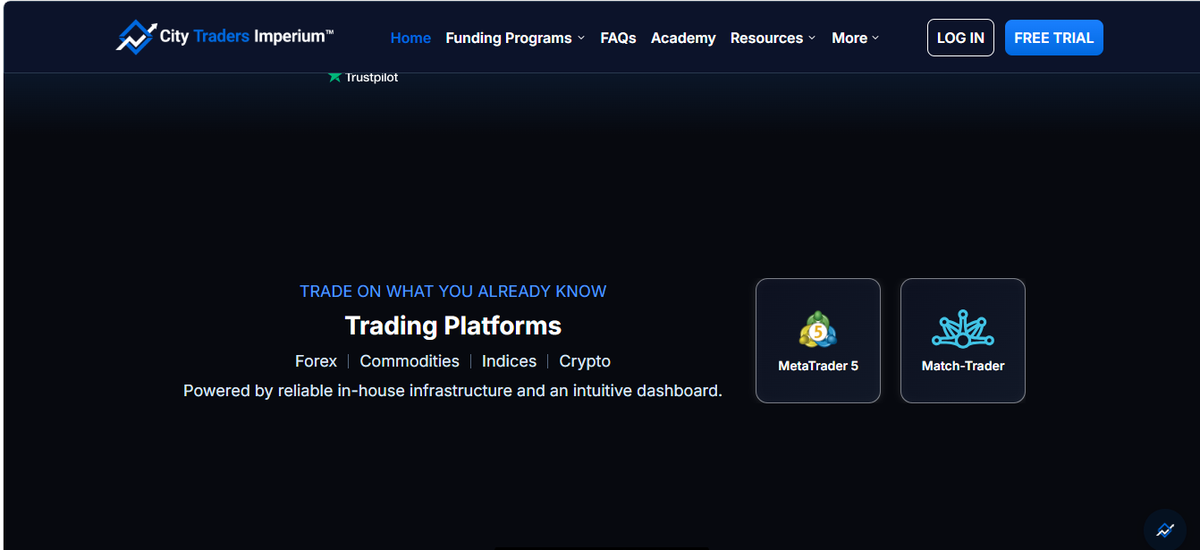
CTI runs on two platforms: MetaTrader 5 and Match-Trader. MT5 is available as a desktop application, a web terminal, and as iOS and Android apps. Both platforms provide charting, Expert Advisor support and the usual order types. Match-Trader offers a cleaner web interface, with a somewhat smaller ecosystem of custom indicators when compared against MT5. The firm does not advertise MetaTrader 4 as a supported platform.
The instrument range covers:
- Forex pairs
- Indices
- Commodities
- Cryptocurrencies
The September 2025 Terms & Conditions set commissions at $2.50 per lot per side on forex and commodities, $0.25 per lot per side on indices, and no commission on cryptocurrency. Those figures reflect a published contractual schedule rather than independently verified live execution pricing, so confirming that they remain applicable to your account configuration inside the dashboard is worth the effort. Spreads are not published on a per-instrument basis in the sources available for this review, and CTI notes that they may widen during periods of market volatility, so any specific EUR/USD, gold or crypto spread figure found elsewhere online should be treated as unverified until you check the live platform.
Two operational points go unpublished in the sources backing this review, specifically the maximum leverage offered on challenge or funded accounts, and the execution type (market, instant or ECN-style). Should leverage be important to your strategy, asking support directly before you buy is the sensible step. Slippage is acknowledged in the firm's own terms, which state that the company does not guarantee to compensate for slippage that may occur.
On the jurisdictional side, because CTI does not operate as a regulated broker, local retail-trading restrictions on products such as CFDs are a matter between you and your own regulator, with no involvement from CTI. Confirming that engaging with a simulated-trading provider in your jurisdiction is compatible with any local rules that apply to you is therefore part of the pre-purchase checklist.
Payouts, Profit Split and Scaling
CTI's starting profit share depends on which programme you bought. Instant Funding opens at 50%, Direct Funding at 70%, and both the 1-Step and 2-Step Challenges open at 80% once you reach the funded phase. From there, the VIP ladder lifts the share: Bronze pays 90% with weekly payouts, Silver pays 100% with on-demand payouts and priority processing, and Gold layers in additional coaching alongside a potential one-year monthly salary. The "up to 100% profit share" headline on the homepage refers specifically to the Silver VIP tier, and should not be read as the day-one split on any programme.
Timing is where CTI stands out in an industry otherwise dominated by monthly payout windows:
- On the 1-Step and 2-Step funded accounts, your first withdrawal is available 7 days after your first trade.
- On Instant Funding, the first payout is eligible after 5 days; Direct Funding's first payout is from day 5.
- After the first withdrawal, the standard-tier cadence will depend on the programme and your VIP level, with Bronze running weekly and Silver running on-demand, so unrestricted daily withdrawals are not a universal entitlement across every account.
CTI advertises payouts as processed within 24 hours of a withdrawal request, and that figure should be read as an advertised average rather than a guaranteed SLA.
Withdrawal methods are broader than the industry norm:
- Bank transfer
- Visa
- Google Pay
- Apple Pay
- PayPal
- Cryptocurrency (BTC)
- Skrill
- Neteller
The scaling plan goes up to $4,000,000 in simulated capital, with 10% profit milestones unlocking further allocation on Instant and Direct Funding. The detailed criteria between tiers live in your dashboard once you are funded.
On payout reliability, CTI publishes individual payout amounts on its site, and this review did not independently audit payout processing, so the picture should be taken as positive-leaning without being independently verified here.
On consistency rules, CTI does not publish a specific consistency-rule percentage in the sources available here, so should one apply to withdrawals on your product, confirming the threshold with support before planning around it would be prudent.
Trader Experience and Support
Support is the area where the public picture becomes thinnest. According to an industry aggregator, CTI offers 24/7 availability with live chat and email channels, and the support function is listed as multilingual. Direct verification of the support hours, the languages covered, and the size of the support team through the firm itself was not possible in the preparation of this review, so confirming any of these points with CTI before buying is advisable for anyone to whom they are decisive.
Response times are not publicly documented, so there is no advertised SLA available to hold the firm to. In practical terms, prop firm live chat tends to run faster during European business hours and slower overnight.
On the education side, CTI references a CTI Academy and a Prop School blog in its public materials. The exact contents, whether access is included on every funded account, and the depth of the curriculum are not fully detailed in the sources used for this review, so the educational offering is best treated as a bonus to explore while keeping the funding product itself as the main basis for a purchase decision.
The dashboard experience, including whether drawdown is tracked in real time, is not described in detail in the public sources available, so looking at a demo or screenshots on the official site is the sensible way to judge the interface before committing.
City Traders Imperium vs The Competition
Against the usual benchmarks in this space, CTI occupies a specific niche. Compared with FTMO, probably the most-recognised name in the sector, CTI is a smaller and younger brand, with FTMO holding the edge on scaling and brand recognition. In return, CTI's balance-based drawdown rulebook shows more consistency across its product line.
Against The Funded Trader, CTI's starting profit split comes in lower (80% compared with a higher starting split at The Funded Trader), and its rule structure is more conservative, which may suit cautious traders. The Funded Trader also accepts US clients, a door that CTI no longer keeps open for new signups.
FundedNext tends to offer a broader mix of account models, including profit share paid during the evaluation phase on some products. CTI's product mix is narrower, and the uniform drawdown model does make it easier to compare side by side across its own range.
To summarise the comparison honestly, CTI shows strongly on rules and payout timing, and less strongly on regulatory profile and brand scale. For a beginner choosing between these firms, the deciding factor usually comes down to the drawdown model and the entry price, both of which favour CTI on the 1-Step tier. Readers who need a regulated financial-services counterparty should also note CTI's own disclosure that it is not a broker and does not accept or manage client deposits, so the comparison with other prop firms is being drawn between simulated-trading providers, not between regulated brokerages.
Clearing Up the Misinformation
Three claims about this CTI prop firm circulate repeatedly online and deserve a direct answer.
The first claim is that CTI uses equity-based drawdown, when in fact the firm's own published explanation confirms that drawdown is calculated on closed-trade results across every programme, with floating losses on open positions remaining outside the drawdown limit until the trade is closed. This is the CTI drawdown model as published, and it reads as more lenient than equity-based alternatives.
The second claim is that the maximum drawdown is static on every CTI account, which only tells part of the story:
- The 2-Step Challenge uses a static balance-based drawdown, so the stop-out is fixed to your starting balance.
- The 1-Step uses a trailing drawdown, which moves upward with your closed-trade highs.
- Instant Funding and Direct Funding use static balance-based drawdown at a 6% level.
Knowing which product has been bought therefore shapes expectations, because the behaviour of the drawdown line differs between them.
The third claim is the belief that CTI accepts US-based traders, when in fact it stopped onboarding new US clients in April 2024 according to an industry report at the time, so US residents cannot open a new CTI account.
Conclusion
This review arrives at a balanced verdict. For a beginner or an intermediate trader who values a balance-based drawdown rulebook, no time limits, and a payout system that becomes on-demand after the first week, CTI stands up as a credible choice. The pricing on the 1-Step entry tier is competitive, the rules are published clearly per phase, and the firm has an operational track record going back to 2018.
The caveats are real and worth listing out:
- CTI is not FCA-authorised, so UK retail traders would be onboarded under an offshore entity and not under a regulated UK one.
- CTI itself discloses that neither of its entities is a broker and that neither accepts or manages client deposits, with trading taking place in a simulated environment using virtual capital, so expectations tied to a regulated brokerage do not carry across to this context.
- New US clients are not accepted.
- Several operational specifics are not fully published and will require direct confirmation from the firm, including maximum leverage, execution type, support team size, and the detailed consistency and scaling criteria.
For the right type of trader, CTI offers a credible non-FCA option, and anyone who needs a regulated counterparty will want to look elsewhere.
How we rate prop firms
Five weighted dimensions — trust, fairness, payout terms, platform quality, and customer support.
The full ranking
See how City Traders Imperium stacks up against the other top-rated prop firms in our independent ranking.
Frequently asked questions
Is City Traders Imperium legit?
Is City Traders Imperium regulated?
How long until my first city traders imperium payout?
What type of drawdown does CTI use?
Can US clients join a city traders imperium challenge?
What platforms does CTI support?
What happens if I breach the drawdown?
Trader reviews
Compare City Traders Imperium
Add City Traders Imperium to the comparison tool to put it side by side with other prop firms on fees, rules, and score.
Compare City Traders Imperium →Other prop firms to consider
- FTMO4.59 / 5Beginner and intermediate traders comparing prop firms who prioritize documented payout history, transparent rules and a broad choice of trading platforms.
- FundedNext4.25 / 5Beginner and intermediate traders who want a large, transparent prop firm with static drawdown, no time limit and flexible payout options, and who accept an offshore simulated model outside FCA protection.
- The5ers4.24 / 5Best for intermediate to experienced traders who value a proven track record, no time limits, and serious scaling potential.
About the authors