





Goat Funded Trader Review 2026
Our Overall
Score
2.91


Traders Score
—
$17
80%
3
- MT5 Supported
- No Time Limit
- News Trading Allowed
- Fully Simulated
- Proprietary Dashboard
Basic info
- Santa Lucía
- 2023
- Simulated capital
- Yes
- Sí
 Santa Lucía
Challenge specs
- $17
- $17 - $763
- 10%
- 5%
- 10%
- 0
- 1–3
- Unlimited
- 80%
- Sí (100% al primer pago, en todos los modelos)
Features
- MetaTrader 5proprietary-gft-platforms
- Up to 1:100
- Yes
- Marketing claims scale up to $2M in simulated capital. Specific scaling triggers not detailed in captured sources.
- Processed within 2 business days of request. Flex futures product uses fixed request windows (5th-8th and 20th-23rd of each month) with eligibility every 5 winning days.
- Forex, Stocks, ETFs, Cryptocurrencies, Indices, Futures
- Inglés
- Descuento habitual del 40-50%

You trade under a simulated capital model — the account is simulated and you operate under an evaluation agreement, not with your own funds.
Summary
- Offshore corporate structure (Hong Kong trade name; Saint Lucia operating entity) on a fully simulated model
- 2-Step comes in two variants: Standard (10%/5%, 5% daily DD) and GOAT (8%/6%, 4% daily DD), both with 10% static max loss
- First two rewards capped at 6% of initial account size or $10,000, whichever is lower
- 3% reward-processing fee applied to every reward, after the profit split
- Payout address must be unique to your GFT account; shared or duplicated payout addresses can block a withdrawal
Pros
- Wide instrument coverage across major asset classes
- MT5 plus proprietary platforms with dashboard
- 2-business-day payout processing claim
- $1,000 miss compensation on payouts
- No time limit on challenge phases
Cons
- Offshore Hong Kong/Saint Lucia entities, fully simulated model
- 2-Step Standard 10%/5% with 5% daily DD; 2-Step GOAT 8%/6% with 4% DD
- First two rewards capped at 6% of initial balance or $10,000 (lower)
- 3% reward-processing fee on every withdrawal, after the split
- $3,000 daily profit cap on funded accounts (excess deducted)
Goat Funded Trader runs a simulated model from an offshore corporate structure (Hong Kong trade name over a Saint Lucia operating entity), and the gap between its headline marketing and the help-center rulebook is wide enough to warrant caution. The 2-Step comes in two variants with different numbers (Standard: 10%/5% with 5% daily drawdown; GOAT: 8%/6% with 4% daily drawdown; both with 10% static maximum loss), and generic '10/4/6' shorthand does not describe either accurately. First-two-reward caps (6% of initial balance or $10,000, whichever is lower) and a 3% reward-processing fee calculated after the split meaningfully compress early paydays. The duplicate-payout-address rule is a real constraint for shared households. GFT is a credible option for traders who read the full help center before buying; the rulebook is the contract, not the sales page.
What to know before you buy a Goat Funded Trader challenge
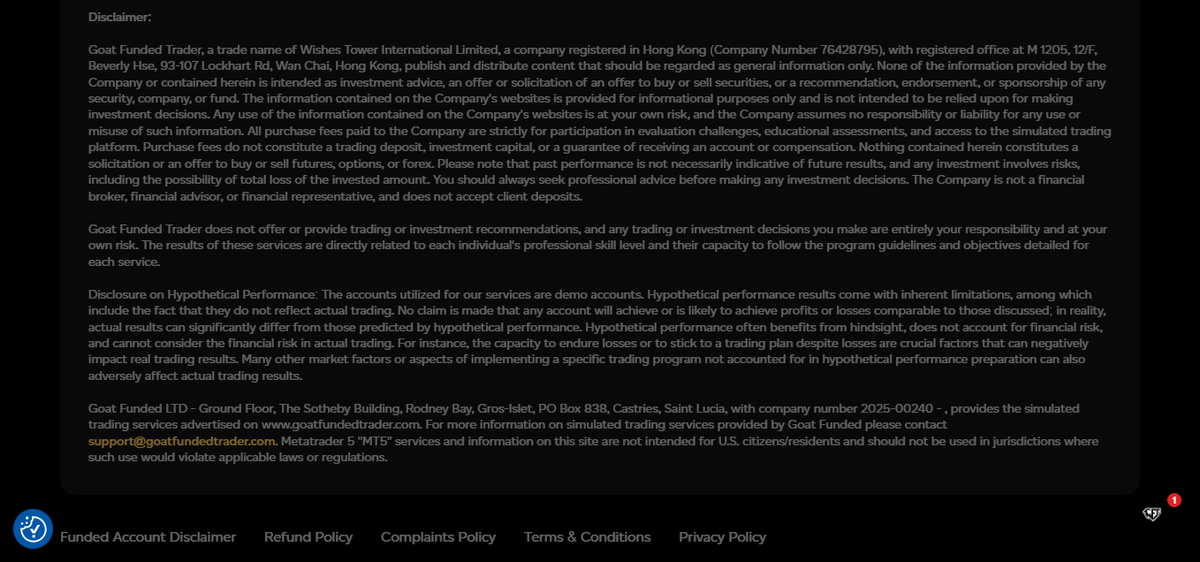
Before anything else in this Goat Funded Trader review, you should know that the firm you are evaluating is an offshore Hong Kong entity called Wishes Tower International Limited, Company Number 76428795, trading as Goat Funded Trader. The company states in its own disclaimer that it is not a broker, does not accept client deposits, and that every account on its platform is a demo account. The fees you pay buy you access to evaluation challenges and the simulated environment, nothing more.
Among its provisions you will find a 3% processing fee, a $3,000 daily profit cap, a cap on the first two rewards (6% of initial balance or $10,000, whichever is lower), consistency caps on funded accounts of 15%, 20% or 25% depending on plan, and a duplicate-payout-address rule that triggers an automatic breach with no appeal.
The challenge itself also runs tighter than many peers, with the 2-step model asking for a 10% profit target against a 6% maximum drawdown and 4% daily drawdown, which works out to roughly a 1.67 target-to-drawdown ratio against an industry benchmark closer to 1.0 on serious evaluations.
Mixed community signals, including a Forex Peace Army thread about a stuck Skrill payout and warnings in trader communities, add weight to the caution, so Goat Funded Trader becomes a firm worth considering only after reading the full rulebook with intent.
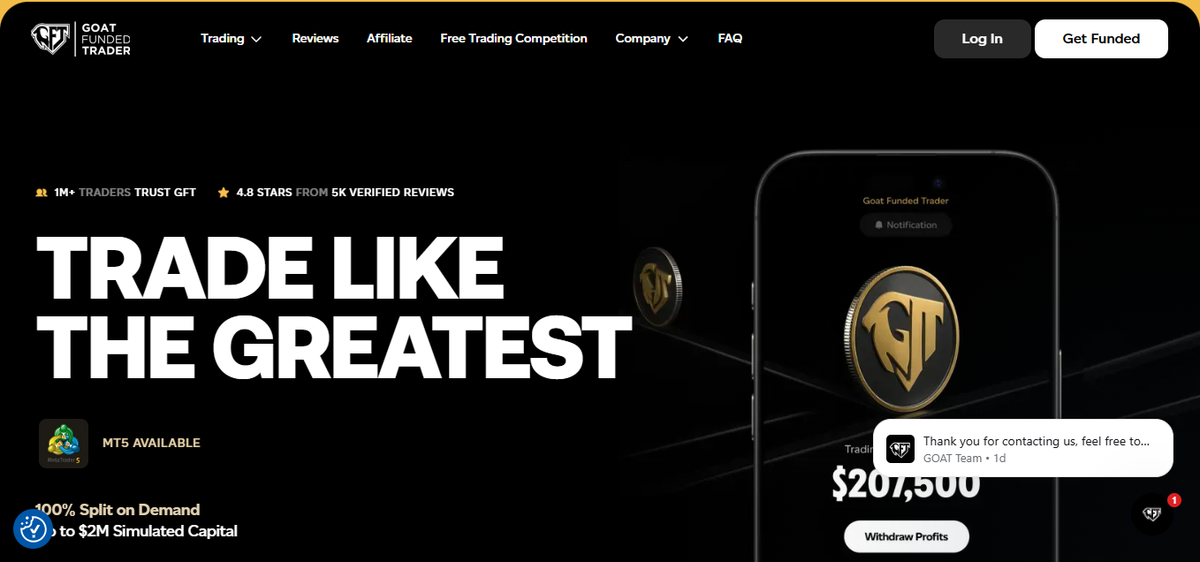
Account Options and Pricing Structure
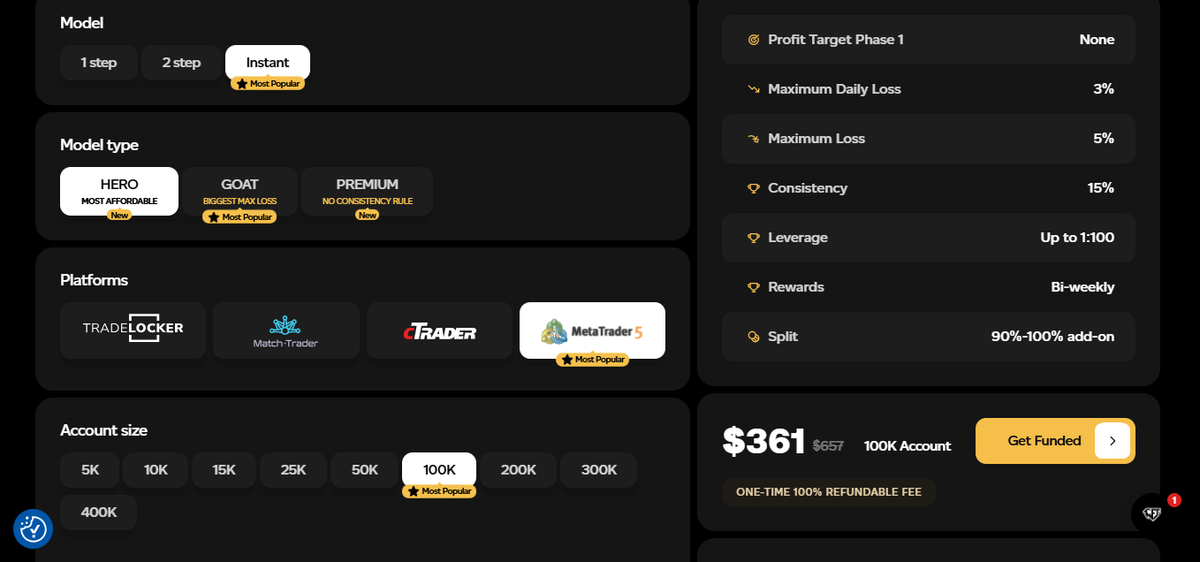
The flagship product is a 2-step evaluation leading to a simulated funded account. The $100,000 size is listed at $438.00 regular, with a promotional price of $263 cited on the firm's own pages. Smaller and larger account sizes exist across the broader Goat Funded Trader catalog, including Instant and Flex futures variants, each with its own ruleset.
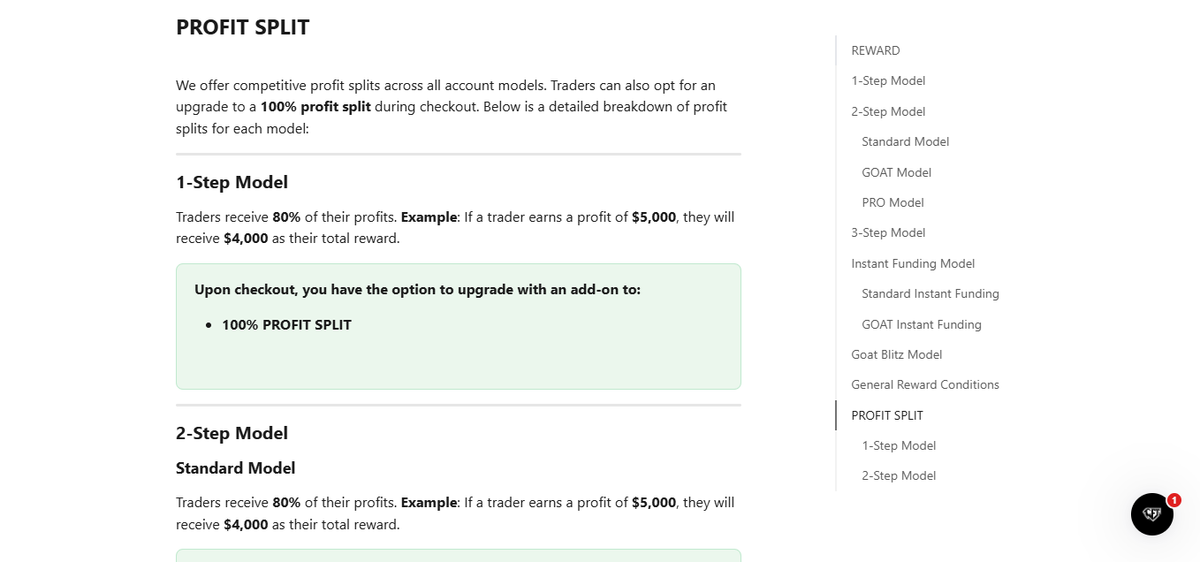
The headline 100% profit split belongs to specific scaled plans and promotional tiers rather than the default experience. On the Flex futures product, the default split sits at 80/20, with a paid add-on moving it to 90/10, and every reward request has a 3% processing fee deducted from the final reward amount after the split and any other deductions have been applied. If your planning assumes 100% retention, treat it as marketing shorthand, because the net you receive on any plan reflects the split, the processing fee, and any applicable withdrawal caps.
| Account Size | Price | Target | Total Drawdown | Profit Split | Platforms |
|---|---|---|---|---|---|
| $100,000 | $438.00 (promo $263) | 10% | 6% | Up to 100% | MT5 and proprietary platforms |
When you compare the headline price against the ruleset, the economics shift in a few interesting ways. A sub-$300 entry on a $100,000 account looks competitive at first glance, although the first two rewards are capped at 6% of initial balance or $10,000, whichever is lower. On a $100,000 account that means your first two paydays can total no more than $10,000 combined before the cap is removed, and from that gross amount the firm still takes the 3% processing fee. Factoring those caps into your plan will shift your break-even calculation accordingly.
Challenge Structure and Trading Rules
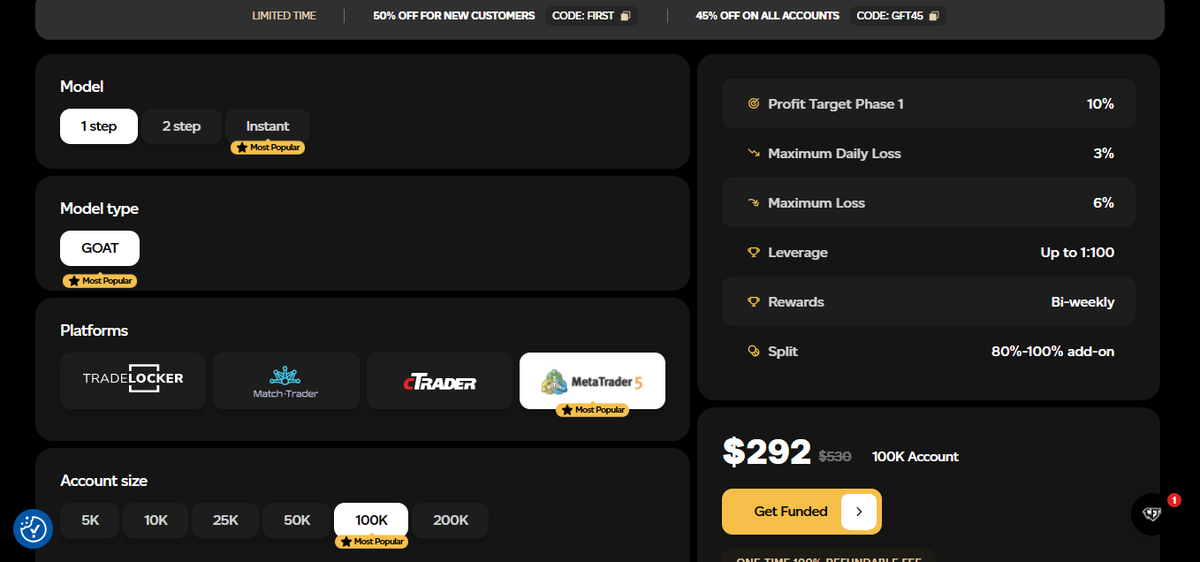
The 2-step evaluation applies the same core Goat Funded Trader rules in both phases:
- a 10% profit target
- a 4% daily drawdown
- a 6% maximum drawdown
- no time limit
There is no explicit minimum number of trading days published on the captured sources for the 2-step model, so you should confirm the current requirement on the firm's own help center before you buy.
| Phase | Target | Max Daily Drawdown | Max Total Drawdown | Minimum Days | Time Limit |
|---|---|---|---|---|---|
| Phase 1 (2-step model) | 10% | 4% | 6% | no publicado | Unlimited |
| Phase 2 (2-step model) | 10% | 4% | 6% | no publicado | Unlimited |
| Funded Account (2-step model) | — | 4% | 6% | — | — |
The captured documentation does not clearly specify whether the Goat Funded Trader drawdown on the 2-step model is calculated on balance or on equity.
The Flex futures product uses an end-of-day trailing drawdown that locks at the starting balance, which is a different mechanism and a different product. On the 2-step model specifically, confirm with the firm, before buying, whether the maximum drawdown moves intraday on equity or is anchored to the closing balance. The gap between those two interpretations can decide a volatile session.
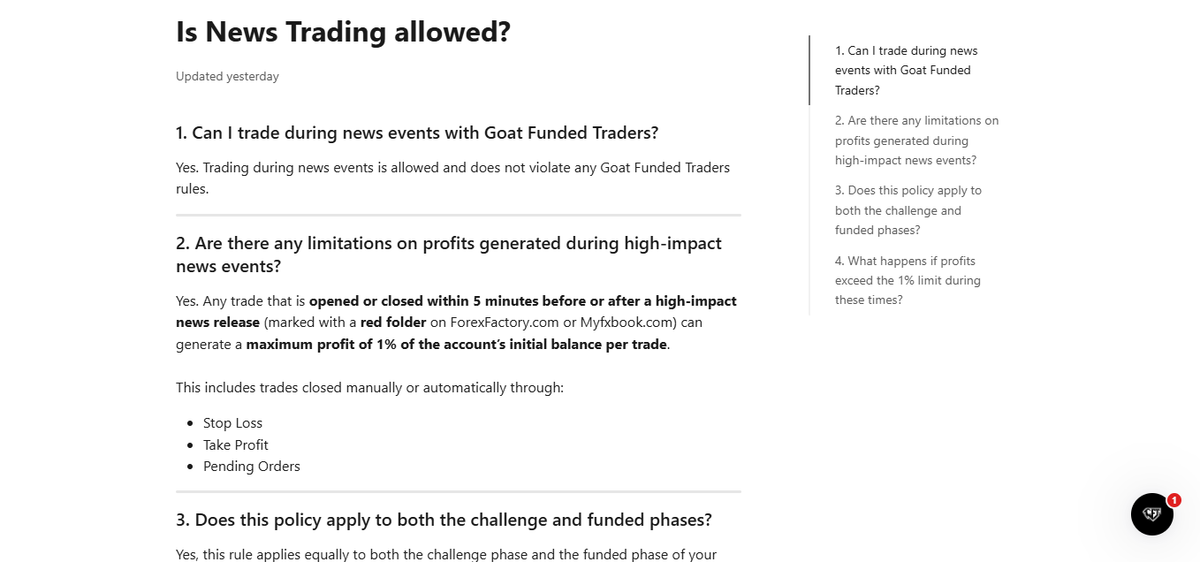
The target-to-drawdown ratio is the other number worth internalizing before you commit. A 10% target against a 6% max drawdown lands at roughly 1.67, whereas most mainstream evaluations sit at or near 1.0, meaning the profit target equals the total drawdown. A 1.67 ratio asks you to generate 67% more than the room you have to lose, which raises the statistical difficulty of passing even for a disciplined strategy. News trading is listed as permitted on the advertised conditions, so you keep flexibility around events, although the ratio remains the constraint that dominates risk planning.
Several strategies are explicitly prohibited:
- Tick scalping, defined as opening and closing within seconds for small tick profits, is reviewed and the profits deducted.
- Two-minute microscalping is deducted on EOD, 1-Day-Pass-Plan and Instant Classic plans.
- External or cross-account hedging between accounts or firms is prohibited.
- Deliberately gaming the payout qualifying-days rule by concentrating profit into one day and placing minimal trades on others is treated as a prohibited pattern.
Trading Environment and Conditions
You can trade through MetaTrader 5 or the firm's proprietary platforms. The instrument universe advertised covers:
- forex pairs
- stocks
- ETFs
- crypto pairs
- indices
- futures via Goat Funded Futures
Marketing materials claim raw spreads from 0.1 pips and zero commissions on indices and cryptos. The liquidity provider is not disclosed in the captured sources, and the execution model (A-book, B-book, hybrid) is also not publicly specified.
Leverage is advertised up to 1:100, and because every account is a demo on a simulated feed, this operates as a platform setting on a simulated environment. UK retail CFD leverage caps from the FCA do not come into play here, since there is no broker-client relationship: the firm itself states it is not a broker and does not take deposits, which changes your consumer position compared with buying CFDs from an FCA-authorised entity. You are purchasing a service and operating within a private rulebook, with no retail broker protections sitting behind the trading screen.
The prohibited-strategies list deserves a second reading alongside your edge. Should your approach rely on holding trades for under two minutes on specific Instant plans, the resulting profit is deducted, and if you plan to run correlated positions across GFT and another firm as a hedge, that is explicitly treated as prohibited. The rules remain reasonably standard for the segment, although they are enforced through profit deduction and, in the duplicate-address case, outright breach, so they operate as hard constraints you must respect.
Payouts, Profit Split and Scaling
The Goat Funded Trader payout rulebook is where this review earns its keep, since several of its clauses stack in ways that are not obvious from the homepage. The default profit split on Flex futures is 80/20, scaling up to 100% on headline forex plans per marketing, and every reward has a 3% processing fee deducted from the final reward amount after the split. For example, should you receive $5,000 gross after split, the fee would lower your net received amount by $150.
The advertised processing timeline is 2 business days from a valid request, with the firm stating a $1,000 compensation if that window is missed. The compensation specifically excludes delays attributable to KYC. On your first payout, identity verification runs first, and only once it is complete does the 2-business-day window begin. Each payout request must be for the full profit amount in the account; partial withdrawals are not accepted, and only one pending request can be open at a time per the firm's help center. A $100 minimum applies to each request.
The caps function as the main friction on the payout side, with the first two rewards limited to 6% of initial account balance or $10,000, whichever is lower, and any excess profit deducted. On $5,000 two-step Goat and Standard accounts purchased from July 25, 2025, the cap sits at 4%, and once the first two rewards clear it is removed. Funded accounts separately carry a $3,000 daily profit cap, under which any single-day profit above that figure is deducted from the account as a straightforward deduction, with no breach attached.
Consistency on funded accounts is enforced through account-type caps on your best single trading day:
- 15% of total profit on Instant GOAT and GOAT 1 Dollar
- 20% on Instant PRO and Pay Later
- 25% on Instant Blitz
According to the firm's published rule, should your best day exceed that share, the payout is held until additional profit brings the ratio back into range, which delays the payout while still allowing it to clear. On the Flex futures evaluation specifically, no single day may represent more than 50% of total evaluation profit.
Withdrawal methods have their own caps:
- Rise is listed as uncapped
- Bank transfer up to $10,000 in supported regions
- Skrill up to $5,000
- Crypto up to $3,000
The Goat Funded Trader profit split can read very differently once you walk a hypothetical through the rulebook. Consider the following scenario.
Imagine that you buy a $100,000 account on promo, pass both phases, and in your first payout cycle you generate $8,000 of qualifying profit with a best day representing 20% of total profit on an Instant GOAT plan. The 15% consistency cap for that account type would be exceeded, so the request would be held until additional profit lowered the best-day share. When it cleared, the first-two-rewards cap would limit the gross reward to the lower of 6% of $100,000 or $10,000, which would cap it at $6,000 at that balance stage, and a 3% processing fee would then be deducted from that gross figure.
The duplicate-address rule stands out as the single most unusual payout clause in this rulebook. Should the payout address on your request match an address already on another GFT account, the firm treats it as a breach with no appeal and no option to substitute a different address, which represents a concrete and non-trivial risk for shared households.
Trader Experience and Support
The trading side runs on MT5 or the firm's proprietary environment. Support is advertised through email ([email protected]), a help center with structured articles, and a Discord community. The firm's marketing lists 24/7 support availability. We could not verify, from the captured sources, the size of the support team, the shift structure behind the 24/7 claim or whether a live chat or phone channel is consistently staffed; confirm these details with the firm before buying.
The community signal on support is uneven, with Forex Peace Army carrying a thread referencing a stuck Skrill payout on a specific account number and allegations that responses came from an AI system in place of a human agent. One complaint thread by itself is not a verdict, although it fits a wider pattern of mixed reviews across public forums. Should you expect a dedicated account manager or guaranteed human escalation, ask explicitly before you buy and keep a written record of the response.
Support languages advertised include English alongside several others. For the audience of this review, English coverage is the baseline and the dashboard, help articles and emails are provided in English.
Goat Funded Trader vs The Competition
Against the main alternatives, Goat Funded Trader occupies a specific position in the market, combining a wide product shelf and aggressive marketing with a dense rulebook and an offshore corporate structure. The headline comparisons are:
- FTMO: a longer track record, an EU corporate entity in the Czech Republic, and a larger public record of processed payouts per community reporting.
- The5ers: a listed UK presence and an instant funding option on some programs that bypasses a full evaluation.
- FundedNext: comparable scaling claims with a simpler payout structure and, per publicly available documentation, no equivalent first-two-rewards percentage cap.
If your decision is anchored on counterparty profile and payout simplicity, the alternatives generally present fewer structural frictions, whereas if your decision is anchored on instrument breadth and promotional pricing on larger accounts, GFT remains competitive at the entry point, provided you accept the rulebook as it is written.

Clearing Up the Misinformation
Three gaps between the marketing and the written rules deserve to be called out directly, because each one changes how a buyer should read the headline promises.
First, consider the capital on offer. GFT markets the experience of being a funded trader, although the firm's own disclaimer states that all accounts are demo accounts and that it is not a broker, advisor or representative, and does not accept client deposits. Your fees pay for evaluation access and simulated-platform access, which puts the product in a different category from a regulated broker funding you with firm money, and that distinction changes the consumer protections that apply.
Second, consider the 100% profit split. The number is accurate for specific scaled or promotional tiers, although it is not the default across products: on the Flex futures product the default sits at 80/20 with a paid 90/10 add-on, every reward is subject to a 3% processing fee calculated on the final amount after the split, and the first two rewards face the 6% or $10,000 cap on top of that. Reading 100% as your effective take rate overstates what will land in your account on the first two cycles.
Third, consider the Goat Funded Trader consistency rule. The homepage marketing lists Consistency: NO on the headline product, although funded accounts apply account-type consistency caps of 15%, 20% or 25% on your best single trading day, and the Flex evaluation imposes a 50% single-day limit. A missing consistency rule on the sales page still leaves a consistency check in place at payout time.
Conclusion
Goat Funded Trader works as a credible option for a specific profile of buyer: an experienced trader who reads full help-center documentation before buying, accepts an offshore Hong Kong counterparty on a fully simulated model, and plans explicitly around a 1.67 target-to-drawdown ratio alongside the first-two-rewards and daily-profit caps. For a trader who wants instrument breadth across forex, indices, crypto and futures from a single provider and can live with the rulebook as written, the firm remains in the conversation.
You should avoid it should you share a payout address with other traders, because the duplicate-address auto-breach is severe and offers no appeal path. Looking elsewhere also makes sense for anyone who wants a target-to-drawdown ratio near 1.0, a regulated broker counterparty, or a payout flow without first-two-rewards percentage caps and the 3% processing fee on every withdrawal. The brand's marketing frames the product as frictionless, while the help center frames it as a tight contract, and both sets of words come from the firm itself. Treat the help center as your reference document when deciding whether to buy.
How we rate prop firms
Five weighted dimensions — trust, fairness, payout terms, platform quality, and customer support.
What are your odds here?
Load Goat Funded Trader’s rules into our Monte Carlo simulator, put in your own win rate and risk, and see how often that combination ends in a funded account — and which rule ends it when it doesn’t.
The full ranking
See how Goat Funded Trader stacks up against the other top-rated prop firms in our independent ranking.
Frequently asked questions
Is Goat Funded Trader legit?
What is the real profit split on Goat Funded Trader?
How long do payouts take?
What is the Goat Funded Trader consistency rule?
What triggers a duplicate-address breach?
Is the capital real on Goat Funded Trader?
Trader reviews
Compare Goat Funded Trader
Add Goat Funded Trader to the comparison tool to put it side by side with other prop firms on fees, rules, and score.
Compare Goat Funded Trader →Other prop firms to consider
- FundedNext4.25 / 5Beginner and intermediate traders who want a large, transparent prop firm with static drawdown, no time limit and flexible payout options, and who accept an offshore simulated model outside FCA protection.
- The5ers4.24 / 5Best for intermediate to experienced traders who value a proven track record, no time limits, and serious scaling potential.
- Instant Funding3.96 / 5Beginner to intermediate traders who want immediate funded account access without sitting through multi-phase evaluations, and experienced traders who value clean rules, aggressive scaling, and a hybrid model that covers both instant and traditional challenge accounts.
About the authors
