




IC Funded Review 2026
Our Overall
Score
3.29


Traders Score
—
$74
80%
2
- Static Drawdown
- No Time Limit
- MT5 and cTrader
- Identical Funded Rules
- Bi-weekly Payouts
Basic info
- Saint Lucia
- 2024
- Simulated capital
 Saint Lucia
Challenge specs
- $74
- $74–$2,999
- 10%
- 5%
- 10%
- 3
- 0–2
- No limit
- 80%
- $500K
- Yes on 1-Step and 2-Step (with the 3rd payout); Instant is non-refundable
Features
- 1:50
- Yes
- Advertised as "Scalable progression" only; no increments or triggers published. Allocation cap $500,000 per trader across all accounts.
- Bi-weekly, every 14 calendar days
- Forex, Indices, Commodities, Cryptocurrencies
You trade under a simulated capital model — the account is simulated and you operate under an evaluation agreement, not with your own funds.
Summary
- Static drawdown on 1-Step and 2-Step; Instant trails
- 80% split, up to 90% with a paid add-on
- Bi-weekly payouts every 14 calendar days
- Registered in 2024, short public track record
- Identical rules across evaluation and funded
Pros
- Backed by the established IC Markets Group
- Static maximum drawdown fixed from initial balance
- Identical rules in evaluation and funded
- 80% split, up to 90% with paid add-on
- No time limit on challenge phases
Cons
- Registered in 2024, short payout history
- Scaling increments not publicly specified
- Payouts only via RISE, no stated processing time
- Email and form support only, no live chat
IC Funded earns an honest, qualified nod. The IC Markets Group backing and broker-grade infrastructure are real advantages, and the static drawdown fixed from initial balance with identical rules across evaluation and funded is genuinely trader-friendly, as is the 80% split, which you can raise to 90% with a paid add-on. The caveats are equally real: the operating company was registered in 2024, so the public payout history is still thin, payouts go only through RISE, and Trustpilot shows an average 3.4 score. Consider with reservations: a reasonable option for traders who value institutional infrastructure and clear rules, provided you start small and confirm the current terms directly on the firm's site before you buy.
What you need to know about IC Funded
This IC Funded review covers a prop firm operated by IC Funded Evaluations Ltd, a Saint Lucia company (registration number 2024-00388) that describes itself as "Backed by IC", the group behind the long-established IC Markets brokerage. The product is an evaluation service: you pay a fee to attempt a trading challenge, and if you pass, you operate a simulated funded account and keep a share of the simulated profits paid out as cash.
The firm itself operates as a simulated trading service. According to its own FAQ, all trading at IC Funded happens in a simulated environment on demo accounts that replicate real market conditions, in both the evaluation and the funded stage. You are not sending orders to a live exchange, and the firm does not hold client deposits in the regulated sense that a brokerage does.
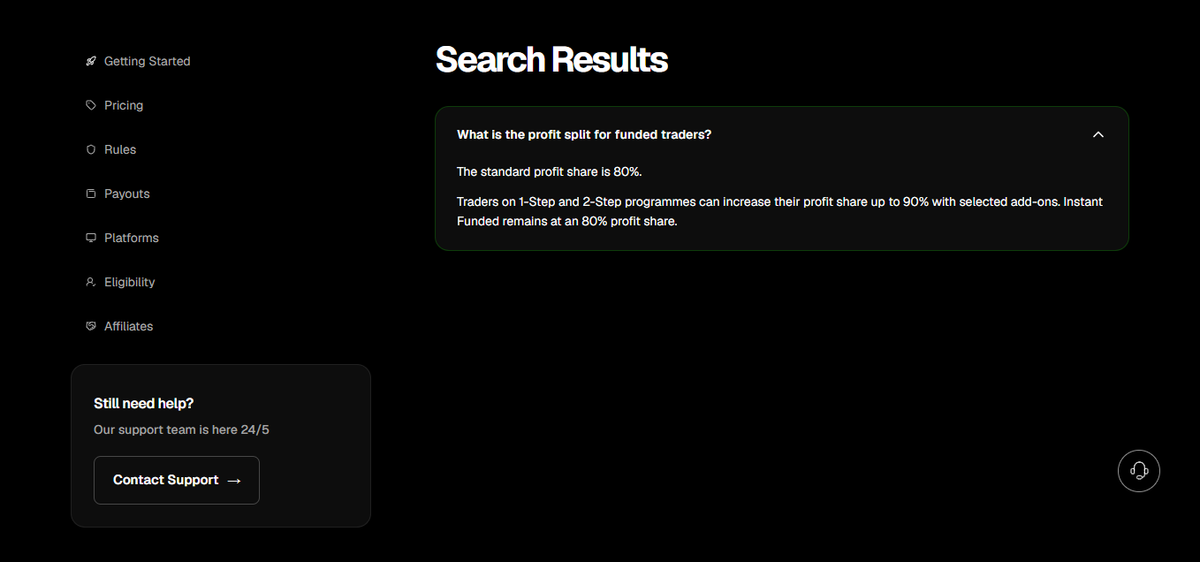
Two structural choices stand out, starting with a static maximum drawdown that is fixed from your initial balance and never trails your equity, which is friendly for traders who worry about having their safety buffer eaten by their own winning trades. The rules are identical across Step 1, Step 2 and the funded stage, so what you practise during the challenge is what you trade afterward. The standard profit split is 80%. On the 1-Step and 2-Step programmes you can raise it to up to 90% with a paid add-on, while Instant Funded stays at 80%. Payouts run on a bi-weekly 14-day cycle.
The honest counterweight is age: the operating company was registered in 2024, so its public payout track record is still thin. Its Trustpilot page shows a TrustScore of 3.4 ("Average") from 184 reviews as of October 2026, and we did not find independent payout proofs. The institutional parent gives operational credibility, although the prop firm itself has not yet accumulated the multi-year evidence base that older competitors have.
Account Options and Pricing Structure
IC Funded groups its accounts into three program families:
- 2-Step Professional, the traditional path, with a 10% target in Step 1, a 5% target in Step 2, and then a simulated funded account.
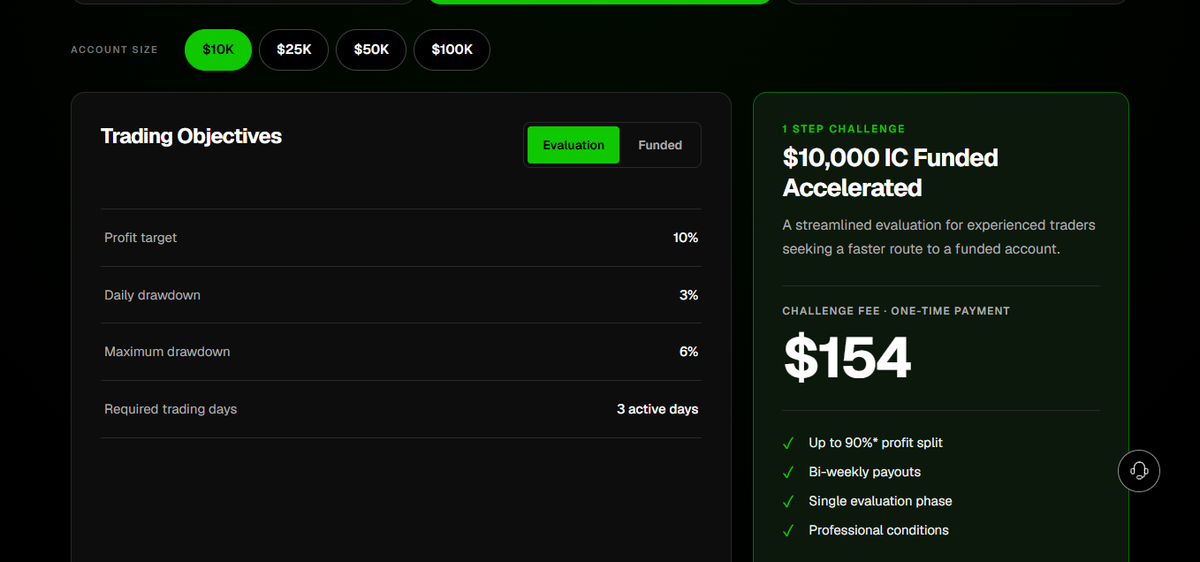
- 1-Step Accelerated, which compresses the process into a single phase with a 10% target, a 3% daily drawdown and a 6% maximum drawdown.
- Instant Funded, which removes the evaluation entirely and places you directly on a simulated funded account after purchase. In exchange you get tighter rules: a 3% daily drawdown, a 5% trailing maximum drawdown and an 80% profit split.
Across all account types, the firm applies a per-trader cap on total allocation. You may hold multiple IC Funded accounts simultaneously, although the combined simulated capital assigned to you is limited to $500,000. This cap applies to the total you can trade, and does not limit the total you can withdraw in profits.
IC Funded publishes its one-time fees on its pricing page: 2-Step Professional: $74 ($5K), $125 ($10K), $249 ($25K), $449 ($50K), $689 ($100K), $1,275 ($200K), $2,999 ($500K). 1-Step Accelerated: $154 ($10K), $309 ($25K), $469 ($50K), $809 ($100K). Instant Funded: $109 ($5K), $164 ($10K), $339 ($25K), $519 ($50K), $879 ($100K). There are no recurring fees, and if you fail you pay again for a new account. The 90% profit split and weekly payouts are paid add-ons at checkout, and the site does not list their prices. On the 1-Step and 2-Step programmes your challenge fee is refunded with your third payout; Instant Funded fees are non-refundable. Note that refunds are only granted if requested within 14 days of purchase, no trades have been placed, and no rule has been breached. This is separate from the fee refund you receive with your third payout on the 1-Step and 2-Step programmes.
Challenge Structure and Trading Rules
The 2-step is the reference program and the easiest to describe cleanly. In Step 1, you aim at a profit target on a simulated balance while respecting a daily drawdown limit and a maximum drawdown limit. In Step 2, the profit target drops to a lower level, with the same loss limits. Clear both phases and you move to the simulated funded account.
The IC Funded rules in detail, as the firm presents them on its rules page, use these ingredients:
- A 10% profit target in Step 1 and a 5% profit target in Step 2.
- A 5% daily drawdown referenced to end-of-day equity, reset at 00:00 server time (GMT+2 or GMT+3). Floating losses count in real time.
- A 10% maximum drawdown that is static and fixed from your initial balance, with no trailing against your highest equity. Floating losses count against it.
- A minimum of 3 active trading days per phase before you can pass.
- No time limit on either phase, so you can take as long as you need. Once funded, though, your account is breached after 30 consecutive calendar days without genuine trading activity.
The current figures, per the firm's rules page: 2-Step Professional: 10% target in Step 1 and 5% in Step 2, 5% daily drawdown, 10% static maximum drawdown in every stage, 3 minimum active days per phase, no time limit. 1-Step Accelerated: 10% target, 3% daily drawdown, 6% static maximum drawdown, 3 minimum active days, no time limit, and a 45% consistency rule during the evaluation only. Instant Funded: no target, 3% daily drawdown from the previous end-of-day equity, 5% maximum drawdown trailing your highest end-of-day equity, a hard 1.5% loss limit per trade idea and a 20% consistency rule on payouts. All programmes: no weekend holding (you must close positions before the Friday market close), and margin use must stay below 75% of equity. One inconsistency to note: a Help Centre answer gives the 2-Step Step 1 maximum drawdown as 8%, while the rules, pricing and how-it-works pages all show 10%. Confirm the figure on your account before you trade.
The IC Funded drawdown mechanics deserve a specific note, because this is where many prop firms differ. According to the firm's own rules, the maximum drawdown on the 1-Step and 2-Step programmes is static: the breach level is fixed as a percentage of your initial balance from day one and does not move upward as your account grows. It is monitored on equity, though, so an open losing trade can breach it before you close it. The daily drawdown is referenced to end-of-day equity. Instant Funded works differently: its 5% maximum drawdown trails your highest end-of-day equity until it locks at the initial balance. For a trader, this means your worst-case loss floor stays constant, and winning days do not shrink your remaining risk budget on the maximum drawdown line.
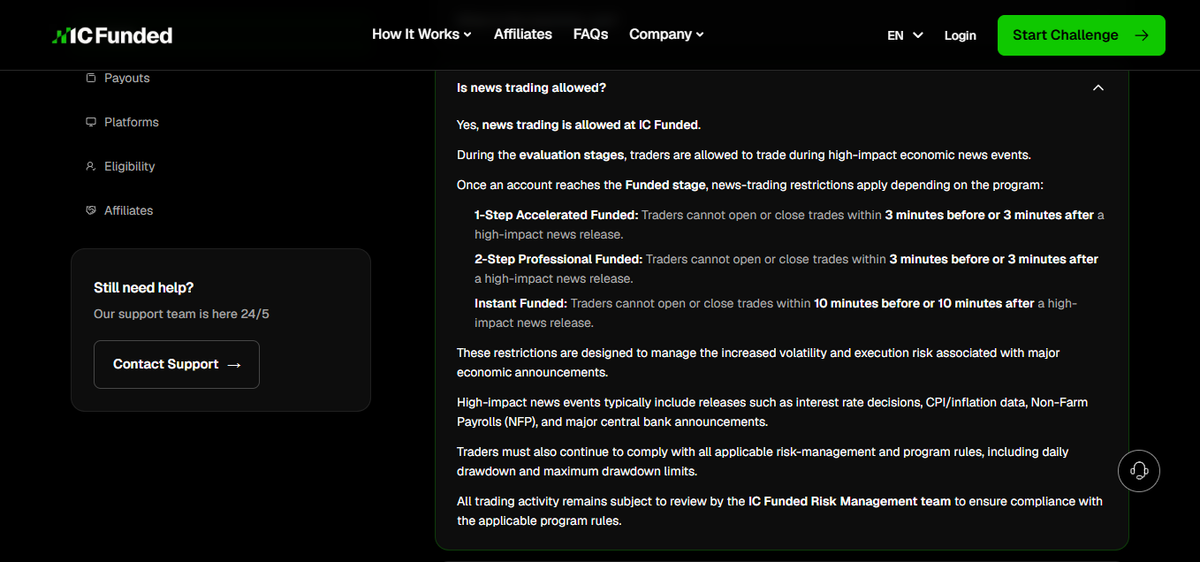
One more structural choice is worth highlighting: the rules stay the same when you move from Step 2 to the simulated funded account. The target, daily loss and maximum drawdown logic you learned during the challenge continues to apply, with two exceptions: the funded stage has no profit target to pass, and once funded you cannot open or close trades within 3 minutes before or after a high-impact news release.
Trading Environment and Conditions
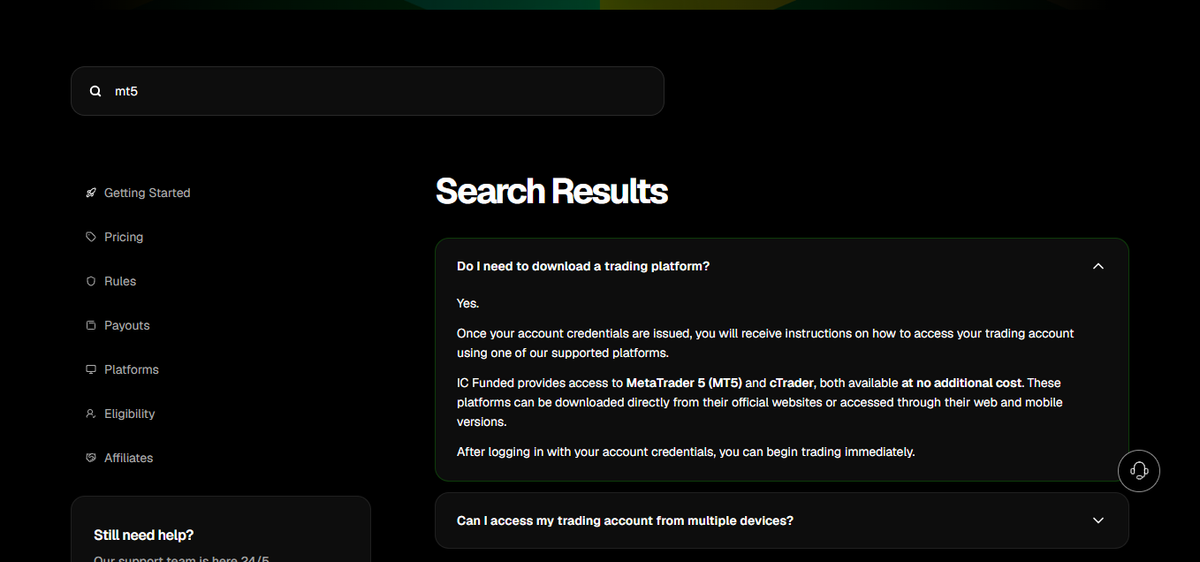
IC Funded gives you a choice between MetaTrader 5 and cTrader. Both are mature platforms with full charting, order management and algorithmic trading support. MT5 is the broader standard across the industry, and cTrader tends to be preferred by traders who want depth-of-market and transparent limit-order routing.
The instrument universe spans the main asset classes:
- Forex majors, minors and crosses.
- Global stock indices.
- Commodities including metals and energies.
- Cryptocurrencies.
- No individual shares: the current list covers CFDs on Forex, indices, metals, energies and cryptocurrencies only.
According to the current rules page, leverage caps on the 2-Step Professional programme are:
- Up to 1:50 on forex
- 1:20 on indices and commodities
- 1:2 on crypto On the 1-Step Accelerated programme forex leverage drops to 1:30, and on Instant Funded the caps are 1:30 on forex, 1:10 on indices and commodities and 1:1 on crypto.
An older IC Funded blog post lists different figures:
- 1:50 FX and gold
- 1:10 indices and commodities
- 1:5 equities
The rules page is the authoritative reference for current accounts. Treat the blog figures as outdated, especially the equities line, since the current instrument list has no individual shares.
Trading conditions are marketed as institutional-grade and "broker-backed", although the firm does not say whose execution infrastructure your demo account runs on. During the evaluation a simulated commission of $4 per standard lot round turn applies to forex, metals and energies, with no commission on indices. Specific spread figures are not published, so if execution quality is a decision factor for you, test it on a trial where possible.
The firm maintains a long list of prohibited strategies that you need to read carefully before you buy:
- Latency, hedge, reverse, rollover and gap arbitrage.
- Exploitation of price errors or off-market quotes.
- High-frequency trading and tick scalping.
- Copy trading, mirror trading and signal sharing between users.
- Shared IPs, VPS, proxies or any linked trading environments.
- Martingale, grid averaging and recovery-style sizing.
- Automated scripts or bots designed to exploit execution.
- Account sharing, renting or third-party management.
- Cross-firm hedging or coordinated external offsetting.
- Single-trade dependency or disproportionate profit concentration.
- Sudden strategy switching between evaluation and funded stage.
- Micro-lot filler trades placed only to satisfy minimum trading days.
The consistency clause is particularly worth noting. The firm expects you to keep your lot sizes, strategy, trading frequency and risk exposure broadly consistent across phases. Large, unjustified deviations can trigger a risk review and disqualification.
Payouts, Profit Split and Scaling
The standard IC Funded profit split is 80% on the simulated funded stage. On the 1-Step and 2-Step programmes you can raise it to up to 90% with a paid add-on at checkout, while Instant Funded stays at 80%. An older IC Funded blog post referenced a 75/25 split rising to 80/20 after the first month, which the current rules supersede.
The IC Funded payout schedule is bi-weekly: your first payout becomes eligible 14 calendar days after your funded account is activated, and later requests follow every 14 days. Weekly payouts are available as an add-on on the 1-Step and 2-Step programmes. The profitable-day requirement eases over time:
- First payout: 5 profitable trading days, minimum 14 calendar days.
- Second payout: 3 profitable trading days, minimum 14 calendar days.
- Third payout onward: no profitable-day requirement, just the 14-day cycle.
A profitable trading day is one that closes with a profit of at least 0.5% of your initial account balance. The minimum withdrawal is 1% of your account balance. The structure rewards consistency over the first month and then becomes a straightforward fortnightly cycle.
The firm advertises a scalable progression for traders who perform well, although the specific scaling increments, triggers and timelines are not published in the sources we reviewed. If scaling is central to your plan, confirm the mechanics directly with the firm before you buy, because the public documentation does not fully specify them.
Payouts are processed through RISE, a global payout platform, so you need an active RISE account. From there you withdraw using the options RISE offers. IC Funded charges no withdrawal fees of its own, you must pass KYC verification before any payout, and the firm does not publish a standard processing time.
The candid part of this IC Funded review sits on payout evidence. We did not locate independent, verifiable payout proofs in the sources reviewed. IC Funded's Trustpilot page shows a TrustScore of 3.4 ("Average") from 184 reviews as of October 2026, and no Reddit or Discord payout-proof threads were available in our research set. Because the operating company was registered only in 2024, the public body of evidence is simply young. The absence of complaints does not amount to the presence of a track record, and you should weigh that honestly.
Trader Experience and Support
The Terms and Conditions reference a user dashboard where you manage your account and monitor your performance. The specific analytics features, risk metrics and historical breakdowns offered through that dashboard are not detailed in the pages we reviewed.
IC Funded states that its support team is available 24/5. You can reach it by email at support@icfunded.com or through the contact form on its site, and affiliate questions go to partners@icfunded.com. No live chat is listed, and the site does not state support languages, team size or response times. This is one of the most frequently fabricated areas in prop firm reviews, so confirm it directly with the firm before buying by sending a test enquiry on your preferred channel.
On education, the firm runs an Insights blog with general trading articles on topics such as leverage, position sizing and trading psychology, but no structured course or webinar schedule. Treat IC Funded as a trading infrastructure provider, and bring your own method.
IC Funded vs The Competition
Set against the broader market, IC Funded positions itself as institutional-grade infrastructure with trader-friendly rules, at the cost of a shorter track record than the incumbents.
- FTMO is the obvious benchmark on reliability. It has been running since 2015, with a multi-year public payout history and a much larger independent review base. Its rules are tighter in some areas, notably the trailing structure on certain plans, and the profit split tops out lower than 90% on standard terms, although the evidence base for payouts is deeper.
- The5ers offers instant-funding routes on certain programs, which skip the evaluation entirely. That suits traders who prefer to pay more upfront and start on a live performance count, as opposed to the 2-step grind. IC Funded does offer an Instant program, although The5ers has longer operational history on that model specifically.
- Maven Trading is useful as a direct structural comparison. Its 2-step uses a static maximum drawdown like IC Funded, which is friendly, although its instant funded account uses a trailing equity-based drawdown, which is more punitive. IC Funded's 1-Step and 2-Step programmes keep a static drawdown across evaluation and funded stages, although its own Instant Funded account also trails, from your highest end-of-day equity.
If your decision rests on long-term payout evidence, FTMO carries more verifiable weight today. If you care about structural rule quality and institutional broker lineage, IC Funded is competitive on its own terms.
Clearing Up the Misinformation
Three points often get stated incorrectly about IC Funded, and all three are worth clarifying.
First, trading at IC Funded is simulated at every stage. Some marketing content around the broader prop industry gives the impression that passing a challenge places you on a real-money account at a brokerage. Per the IC Funded FAQ, all trading, in both the evaluation and the funded stage, is conducted in a simulated environment on demo accounts. The firm pays you cash from its own treasury based on your simulated performance; it does not route your orders to live markets.
Second, the current standard profit split is 80%, and you can raise it to up to 90% on the 1-Step and 2-Step programmes with a paid add-on. Older IC Funded blog content references a 75/25 split improving to 80/20 after the first month. The current rules supersede those figures. If you see the older numbers quoted on third-party sites, treat them as outdated.
Third, the maximum drawdown is static. There is a common assumption that prop firm drawdowns always trail equity. On the 2-Step Professional programme, the maximum drawdown is fixed from your initial balance across Step 1, Step 2 and the funded stage, and the 1-Step Accelerated programme works the same way with a 6% limit. The exception is Instant Funded, whose 5% maximum drawdown trails your highest end-of-day equity. Your floor does not move upward as your account grows, which is a materially different risk profile from a trailing model.
Conclusion
IC Funded is a credible emerging prop firm with a sensible rule set and the backing of a long-established brokerage group. The static maximum drawdown, the identical rules across evaluation and funded stages, and the 80% split (up to 90% with an add-on) on a bi-weekly cycle are genuine strengths. These are the structural choices an intermediate trader notices.
The caveat is age: with its operating company registered in 2024, the firm has not yet accumulated the multi-year, independently verifiable payout history that older competitors can show. For traders who require years of public evidence before placing capital at risk, the honest recommendation is to wait or to prefer a more established name. For traders comfortable with a young operation that has an institutional parent and transparent rules, IC Funded is a reasonable candidate.
As always, check the current pricing, the cost of any add-ons and the rule percentages for your programme on the firm's own site before you buy. The structural picture is clear; the operational details change more often than any static review can track.
How we rate prop firms
Five weighted dimensions — trust, fairness, payout terms, platform quality, and customer support.
What are your odds here?
Load IC Funded’s rules into our Monte Carlo simulator, put in your own win rate and risk, and see how often that combination ends in a funded account — and which rule ends it when it doesn’t.
The full ranking
See how IC Funded stacks up against the other top-rated prop firms in our independent ranking.
Frequently asked questions
Is IC Funded regulated?
Is trading on real money or simulated?
What is the profit split and how often do payouts happen?
Is the drawdown trailing or static?
How many profitable days do I need for my first payout?
What is the maximum capital I can hold with IC Funded?
What strategies are prohibited?
Trader reviews
Compare IC Funded
Add IC Funded to the comparison tool to put it side by side with other prop firms on fees, rules, and score.
Compare IC Funded →Other prop firms to consider
- FTMO4.59 / 5Beginner and intermediate traders comparing prop firms who prioritize documented payout history, transparent rules and a broad choice of trading platforms.
- FundedNext4.25 / 5Beginner and intermediate traders who want a large, transparent prop firm with static drawdown, no time limit and flexible payout options, and who accept an offshore simulated model outside FCA protection.
- The5ers4.24 / 5Best for intermediate to experienced traders who value a proven track record, no time limits, and serious scaling potential.
About the authors
