





Kraken Prop Review 2026
Our Overall
Score
3.80


Traders Score
—
$20
80%
3
- Crypto Contracts
- Static Drawdown
- Payouts in 24h
- No Time Limit
- Kraken Pro Terminal
Basic info
- British Virgin Islands (Payward Oceanic Ltd)
- 2023
- Simulated capital
- Yes
- Yes - 25% revenue share via Kraken's affiliate programme
Challenge specs
- $20
- $20 - $1,090
- 10%
- 3%
- 6%
- 0
- 1
- No time limit
- 80%
- $200K
- No - non-refundable once trading begins
Features
- Kraken Pro
- 1:10
- No
- None published
- On demand; review guaranteed within 24 hours
- Cryptocurrencies, Indices
- None active
Simulated — the account is a demo and you trade under an evaluation agreement.
Simulated — the account is a demo and you trade under an evaluation agreement.
Summary
- Every fee, target and drawdown is published on Kraken's own Prop page
- One step, no time limit, no consistency rule, no profit cap
- Drawdown is static, but breaches are measured on equity
- Evaluations are B-booked — simulated, not sent to the market
- Not available in Canada, India or the United Kingdom
Pros
- Whole plan grid published before you pay
- One step, no time limit, no consistency rule
- Static drawdown that never trails your peak
- Payouts reviewed in 24 hours, guaranteed
- Entry from $20 for a $5,000 wallet
Cons
- Counterparty is an unregulated BVI company
- Evaluations are B-booked, not sent to market
- Unrealised losses and fees count toward breaches
- No API, so no bots, EAs or copy trading
- No scaling; $200,000 caps all accounts combined
Kraken Prop is unusually transparent: the full plan grid is public, the evaluation is one step with no time limit, and payout reviews are guaranteed inside 24 hours. The catch is structural — an unregulated British Virgin Islands counterparty, simulated evaluation execution and no API access. A strong fit for discretionary crypto traders already on Kraken, a poor one otherwise.
What you need to know about Kraken Prop
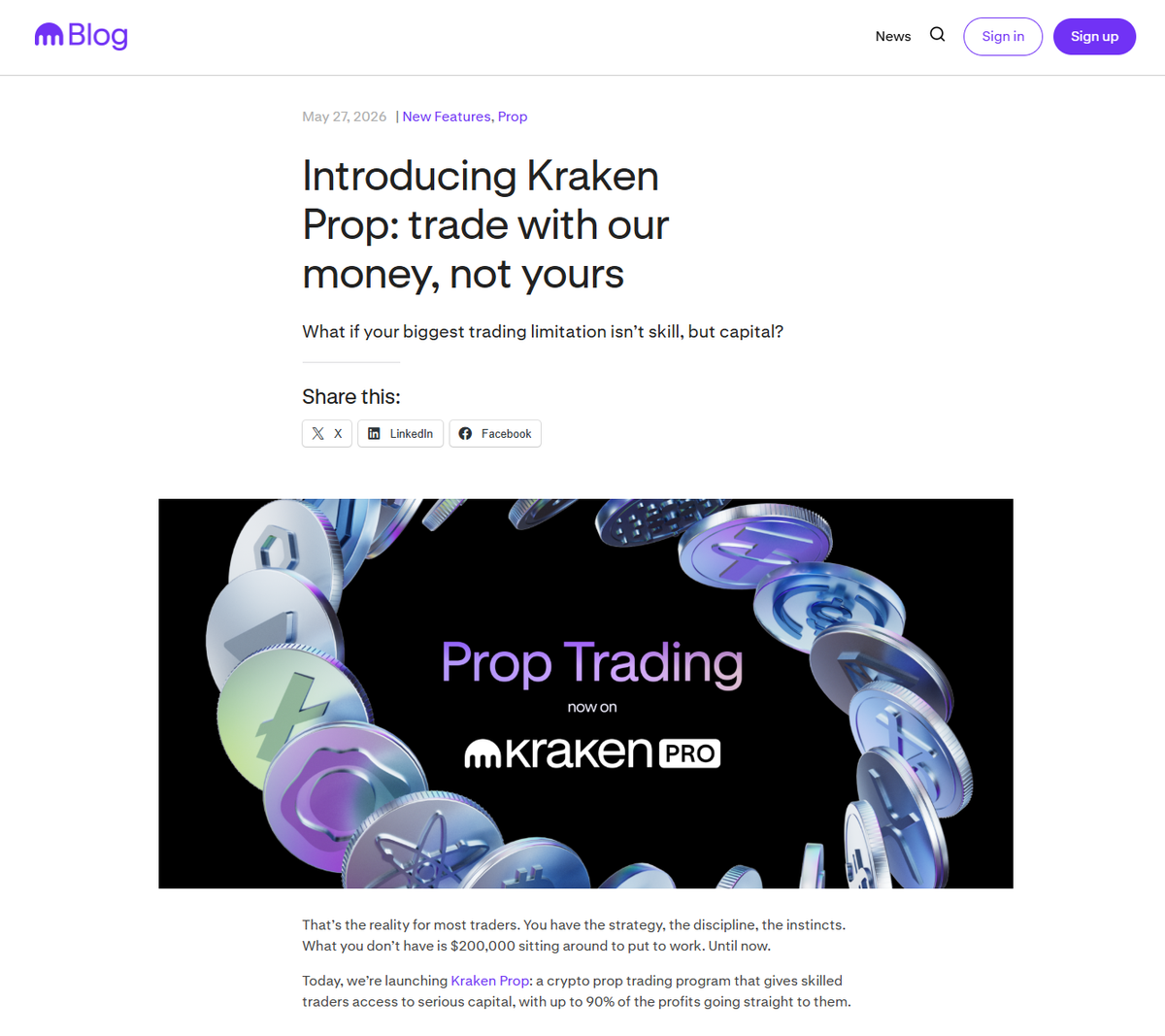
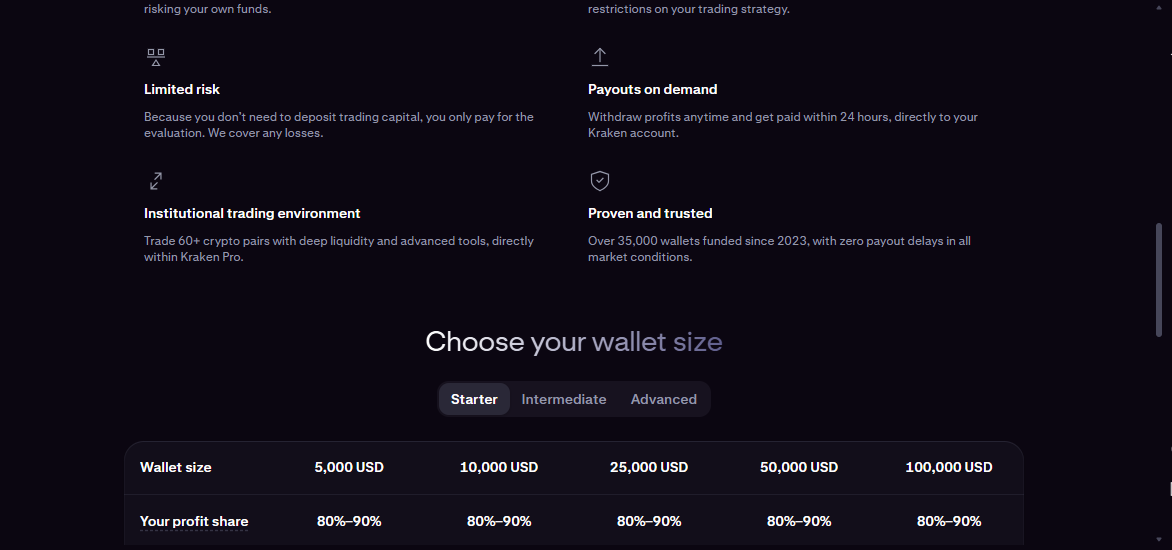
Kraken Prop is the funded-trader programme built into Kraken Pro, the Kraken exchange's professional terminal. The shape is specific: a one-step evaluation on wallet sizes from $5,000 to $200,000, no time limit, and profits you can request on demand once you are funded. What sets it apart from most of this market is that the whole grid — fee, profit target, daily loss limit and maximum drawdown for every plan — is published before you pay, alongside a help centre that documents the fee mechanics, the breach process and even how your orders are routed.
Kraken has run a crypto exchange since 2011 and says the funded programme has paid out across more than 35,000 funded wallets since 2023 with no payout delays. What you contract with, though, is not the exchange. Kraken's own documentation states that your funded account is provided by Payward Oceanic Ltd, a British Virgin Islands company inside the Kraken group but legally separate from the entity you trade crypto with, and that the programme is not a regulated investment product, is not supervised under any investment or consumer-financial regime, and carries none of the statutory investor protections that apply elsewhere on Kraken.
Three things are worth fixing in your head before you read further. Kraken states that evaluation accounts use B-book execution — simulated, and not sent to the market — while funded accounts may be A-book or B-book depending on plan size. There is no API access on either, so every order is placed by hand and bots, expert advisors and copy trading are out. And Kraken Prop is not available to residents of Canada, India or the United Kingdom.
Account Options and Pricing Structure
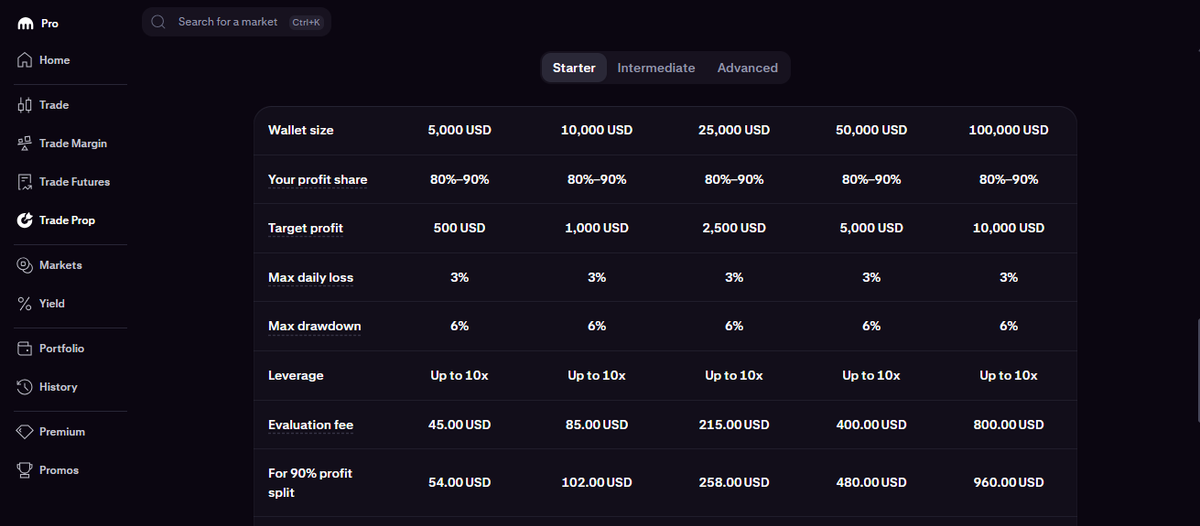
Kraken Prop sells six wallet sizes — $5,000, $10,000, $25,000, $50,000, $100,000 and $200,000 — and each size except the largest comes in three plan tiers: Starter, Intermediate and Advanced. The $200,000 wallet is offered as Intermediate or Advanced only. The tier is not a cosmetic label. It sets the profit target you have to reach and the drawdown you get to work inside, and it moves the price by more than a factor of two.
The pattern is identical at every size. Starter is the most forgiving and the most expensive: a 10% profit target against a 6% maximum drawdown. Intermediate raises the target to 12% and tightens the drawdown to 5%. Advanced asks the smallest target, 9%, against the tightest drawdown at 3% — the hardest ratio to trade and the cheapest plan on the shelf. On a $5,000 wallet that is $45, $33 and $20 respectively.
The default profit share is 80% in your favour. A 90% share exists, but only as an add-on chosen at the moment of purchase, priced at an extra 20% of the base plan fee — $24 instead of $20 on the cheapest wallet, $1,308 instead of $1,090 on the largest. Kraken's documentation is explicit that it cannot be added later, so a wallet you are already trading is locked at whatever you bought. Evaluation fees are non-refundable once trading begins. You can pay by card, Apple Pay or Google Pay with basic verification alone; paying from your Kraken balance requires full identity verification.
Kraken Prop plans as published on kraken.com/prop. The 90% split is an add-on chosen at purchase, priced at 20% above the base fee. Fees are non-refundable once trading begins.
| Wallet size | Plan tier | Evaluation fee | Fee with 90% split | Profit target | Max daily loss | Max drawdown |
|---|---|---|---|---|---|---|
| $5,000 | Starter | $45 | $54 | $500 (10%) | $150 (3%) | $300 (6%) |
| $5,000 | Intermediate | $33 | $39.60 | $600 (12%) | $150 (3%) | $250 (5%) |
| $5,000 | Advanced | $20 | $24 | $450 (9%) | $150 (3%) | $150 (3%) |
| $10,000 | Starter | $85 | $102 | $1,000 (10%) | $300 (3%) | $600 (6%) |
| $10,000 | Intermediate | $65 | $78 | $1,200 (12%) | $300 (3%) | $500 (5%) |
| $10,000 | Advanced | $40 | $48 | $900 (9%) | $300 (3%) | $300 (3%) |
| $25,000 | Starter | $215 | $258 | $2,500 (10%) | $750 (3%) | $1,500 (6%) |
| $25,000 | Intermediate | $150 | $180 | $3,000 (12%) | $750 (3%) | $1,250 (5%) |
| $25,000 | Advanced | $95 | $114 | $2,250 (9%) | $750 (3%) | $750 (3%) |
| $50,000 | Starter | $400 | $480 | $5,000 (10%) | $1,500 (3%) | $3,000 (6%) |
| $50,000 | Intermediate | $280 | $336 | $6,000 (12%) | $1,500 (3%) | $2,500 (5%) |
| $50,000 | Advanced | $180 | $216 | $4,500 (9%) | $1,500 (3%) | $1,500 (3%) |
| $100,000 | Starter | $800 | $960 | $10,000 (10%) | $3,000 (3%) | $6,000 (6%) |
| $100,000 | Intermediate | $545 | $654 | $12,000 (12%) | $3,000 (3%) | $5,000 (5%) |
| $100,000 | Advanced | $330 | $396 | $9,000 (9%) | $3,000 (3%) | $3,000 (3%) |
| $200,000 | Intermediate | $1,090 | $1,308 | $24,000 (12%) | $6,000 (3%) | $10,000 (5%) |
| $200,000 | Advanced | $660 | $792 | $18,000 (9%) | $6,000 (3%) | $6,000 (3%) |
Two details in that grid matter more than the headline prices. The maximum daily loss is a flat 3% of the wallet size on every plan and every tier, so the only thing the tier really moves is your lifetime drawdown. And $20 for a $5,000 Advanced wallet is a genuinely low entry ticket for this market — provided you can hit a 9% target inside a 3% total drawdown.
Challenge Structure and Trading Rules
The evaluation is one step. You buy a wallet, reach the profit target for your plan without breaching a loss limit, and you move to a funded account. There is no verification phase and no clock: Kraken states there is no time limit and no minimum number of trades or trading days. When your equity touches the target, open positions close automatically and the account is marked as passed.
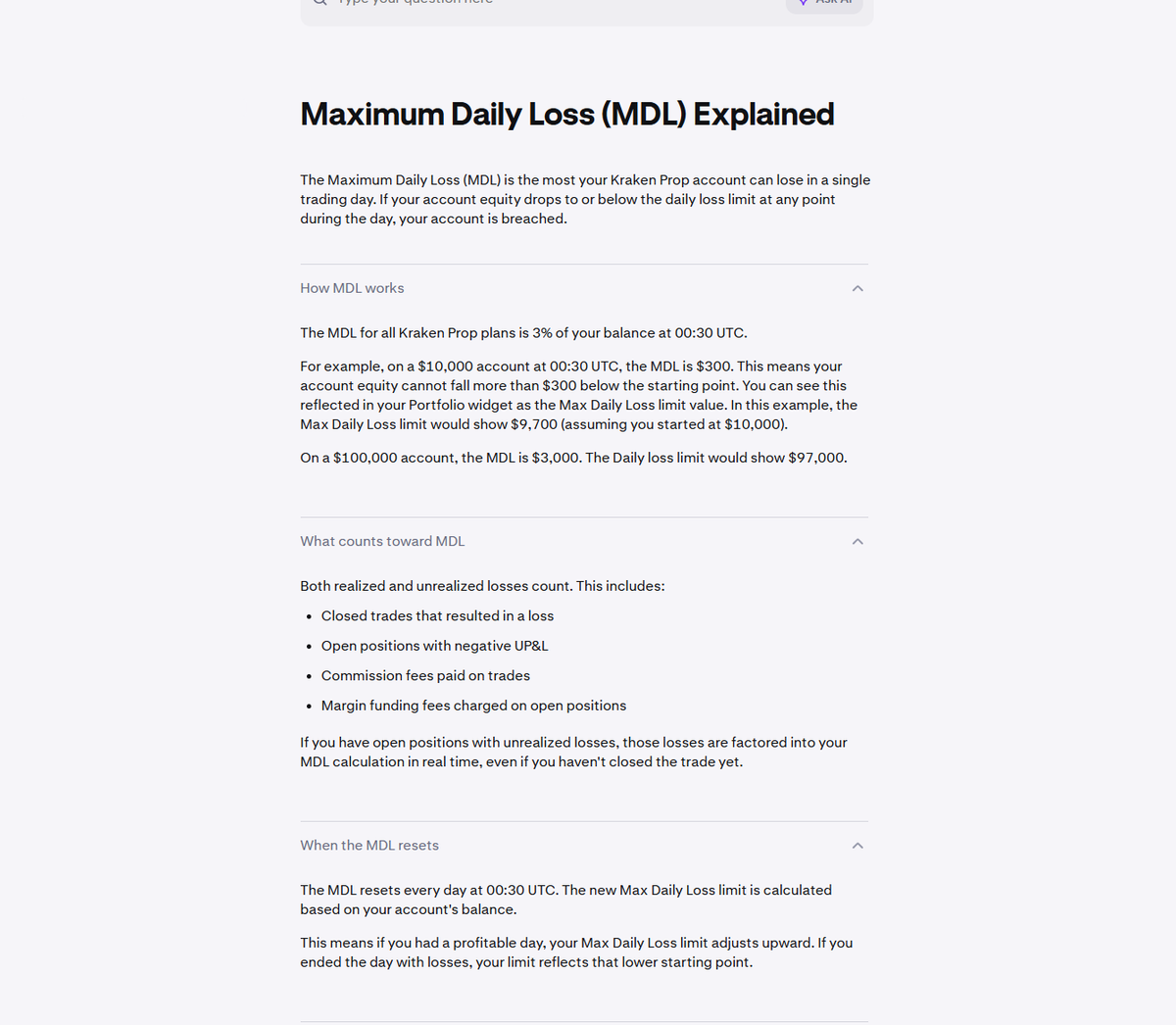
The rule that ends most evaluations is the daily one. The Maximum Daily Loss is 3% of your account balance measured at 00:30 UTC, and it resets on that same schedule each day rather than at your local midnight — so a profitable day raises tomorrow's floor and a losing day lowers it. On a $10,000 wallet that is $300; on a $100,000 wallet, $3,000. The same 3% rule continues to apply once you are funded.
The lifetime limit is the Maximum Drawdown, and Kraken's term for it is static: the limit sits at a fixed level below your starting balance and never moves, whatever profit you make. Starter plans get 6%, Intermediate 5% and Advanced 3%. Static is genuinely trader-friendly — the limit does not trail your peak, so every dollar you earn is a dollar of extra room. What is not friendly is how breaches are measured. Kraken defines both limits as equity levels and states plainly that realised losses, unrealised losses on open positions, commission fees and margin funding fees all count. An open trade sitting deep in the red can close your account before you ever click sell.
What is absent from the rulebook is as useful as what is in it. Kraken states there are no time limits, no consistency rules, no profit caps and no restrictions on your trading strategy. Two real restrictions do exist and are worth reading twice: there is no API access on evaluation or funded accounts, and copy trading and hedging across accounts are prohibited — both are explicitly checked in the manual review before your funded account is switched on and again before any payout is released.
Kraken Prop rules as published on kraken.com/prop and in Kraken's Prop help-centre articles.
| Rule | Evaluation account | Funded account |
|---|---|---|
| Phases | 1 step | — |
| Profit target | 9%, 10% or 12% by plan tier | No target |
| Max daily loss | 3% of balance at 00:30 UTC, resets daily | Same 3% rule |
| Max total drawdown | 3% (Advanced), 5% (Intermediate) or 6% (Starter) | Same as the plan bought |
| Drawdown style | Static — fixed below the starting balance, never trails your peak | Static |
| Breach measured on | Equity — unrealised losses and fees count in real time | Equity |
| Minimum trading days | None | None |
| Time limit | None | None |
| Consistency rule / profit cap | None | None |
| Copy trading / cross-account hedging | Prohibited | Prohibited |
| API / algorithmic trading | Not available | Not available |
| Leverage | Up to 5x on crypto, 10x on equity indices | Same |
| Order routing | B-book — simulated, not sent to market | A-book or B-book by plan size |
| Commission | 0.04% per side (0.08% round trip) | Same |
| Margin funding | 0.033% per day, charged every 4 hours | Same |
The consequence of a breach is narrow and automatic. Positions close, pending orders cancel, trading is disabled and the account is marked Breached, with an email and in-app notification giving you the reason, the timestamp and your equity at the moment it triggered. There is no warning beforehand and no appeal on the arithmetic. You owe nothing beyond the fee you already paid, the closed account stays visible for seven days, and you can buy a new evaluation whenever you like.
Trading Environment and Conditions
Kraken Prop runs inside Kraken Pro on web and mobile, in a dedicated Prop section beside your ordinary Kraken account, and you switch between them from the account dropdown. You get the full terminal — market, limit, stop-loss, stop-loss-limit, take-profit and take-profit-limit orders, all good-till-cancelled — plus a portfolio widget that shows your Daily loss limit, Drawdown limit and, once funded, the Available for payout figure.
What you are trading is worth being precise about. Kraken Prop lists crypto contracts rather than spot: derivatives that track the underlying price, never expire, and confer no ownership of the coin. Alongside them sit two equity index instruments, Nasdaq 100 and S&P 500, which are priced from an external venue, Hyperliquid, and so can diverge from the index you see on other platforms. Leverage is capped at 5x on the published crypto plan grid and fixed at 10x on the equity indices, and each market carries a maximum notional position size — $1,000,000 on the Nasdaq instrument, $2,000,000 on the S&P.
On order routing, Kraken is more candid than this industry usually manages. Evaluation accounts use B-book execution, which its documentation defines as simulated and not sent to the market. Funded accounts may be A-book, executed externally, or B-book, depending on the plan size, and Kraken says the choice is automatic. That is not a scandal — almost every prop firm B-books evaluations — but it does mean the phrase "trading on Kraken Pro" describes the interface rather than a promise about where your order ends up.
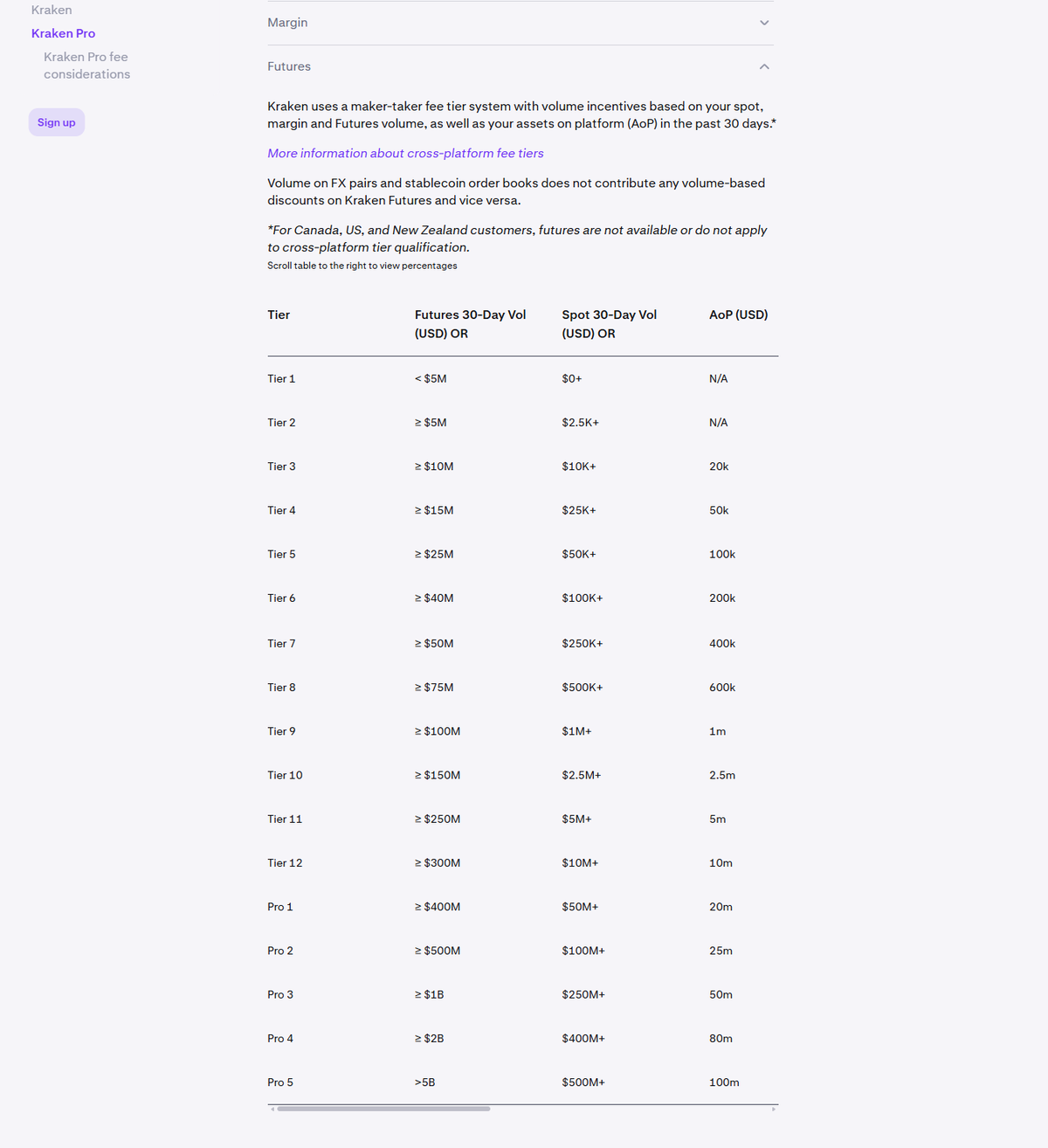
Costs are published in full and you should model them. Commission is 4 basis points (0.04%) of notional per side, so 0.08% on a round trip: $8 on a $10,000 position, $12 on a $15,000 one. Margin funding runs at 0.033% per day on open positions, charged every four hours on both longs and shorts, and shows up in your ledger as "Margin rollover". Both count against your balance, which means both eat directly into your daily loss buffer — on a $100,000 wallet with a $3,000 daily floor, a few large trades held overnight are not a rounding error.
One note on where you stand legally. Kraken states that the programme is not a regulated investment product, that Payward Oceanic Ltd holds no financial services licence in your jurisdiction, and that the investor protections applying to regulated financial services do not apply here. Kraken Prop is also not offered at all to residents of Canada, India or the United Kingdom.
Payouts, Profit Split and Scaling
Payouts are the part of Kraken Prop that reads best. Once funded you can request one at any time, with no minimum number of trading days first, and the published timing is genuinely tight: reviews are typically completed within 12 hours and guaranteed within 24. What you can request is the Available for payout figure in the portfolio widget, which is already net of the profit split.
There are conditions on the request itself, and they are easy to trip over. You must have no open positions, no open orders of any kind, and a balance equal to your equity — in other words a completely flat book. If any of that is untrue the payout button simply will not appear. Once submitted, the amount is locked out of your trading balance while the review runs, and the review checks your history for copy trading, cross-account hedging and system exploitation before releasing it.
Settlement is an internal ledger transfer in USD or USDG to your main Kraken wallet, not an on-chain payment. There is no option to send a Prop payout straight to an external address: the money lands in your Kraken balance first and then leaves through Kraken's ordinary withdrawal process, subject to whatever limits, verification state or holds already apply to that account. If you are new to Kraken, clear those before you need the money rather than after.
On the split, 80% is the default on every wallet size and tier. The 90% share exists only as a checkout add-on at 20% above the base fee, locked at purchase. Run the arithmetic before you tick it: on a $100,000 Intermediate plan it is $109 extra up front in exchange for ten more points of everything you subsequently earn, which pays for itself quickly if you pass and costs you only the premium if you do not.
There is no scaling programme. Kraken does not publish one, and $200,000 is a hard cumulative ceiling across every active evaluation and funded account you hold — $150,000 funded plus $50,000 in evaluations puts you at the limit and blocks further purchases. The way to trade more capital is to buy a bigger evaluation, not to grow into one.
Trader Experience and Support
Onboarding is the lightest in this market. Basic verification — an email address and your country — is enough to buy an evaluation with a card, Apple Pay or Google Pay. Full identity verification is only required when you pass and upgrade to a funded account, or if you want to pay from your Kraken balance. If you already trade on Kraken, there is effectively nothing to set up.
Activation after a pass takes a little longer than the trading does. You sign a Funded Trader Agreement sent by DocuSign, complete Kraken's identity verification if you have not already, and wait for a manual review of your evaluation trading. Kraken puts the whole sequence at typically 12 to 24 hours once your part is done. If that review finds a rule violation the upgrade can be rejected, leaving the funded account created but disabled.
Support runs through Kraken's standard help centre and in-app channels. There is no Prop-specific response-time commitment published, and no phone line, Discord or Telegram for prop traders; the only documented timings are the payout review and the funded activation window. Notifications are in-app and by email, including the breach message.
Documentation, on the other hand, is a genuine strength. Kraken's help centre carries a full Kraken Prop section covering how evaluations work, the daily loss and drawdown rules with worked examples, the fee schedule with arithmetic, the breach process, the account states, the dashboard widgets and the payout flow. It is reference material rather than a trader academy — there are no courses, mentors or webinars — but almost every question this review answers can be checked against it in a couple of minutes.
Kraken Prop vs The Competition
The honest comparison set for Kraken Prop is other crypto-focused funded programmes and the large multi-asset names, and it concedes breadth to both.
Against crypto-focused competitors, Kraken Prop trades instrument count and headline leverage for a published price grid, a decade-old parent exchange and a rulebook with almost nothing in it. Firms advertising 50x or 100x on crypto suit a different risk appetite entirely; a 5x cap against a 3% daily floor does not pretend to compete on that axis.
Against a multi-asset name like FTMO, the comparison is simpler still. FTMO runs a two-step evaluation across forex, indices, commodities, stocks and crypto with a long documented payout record. Kraken Prop does crypto contracts, two equity indices and one step. If you need forex or commodities, it is not a close call.
What Kraken Prop genuinely owns is the entry cost, the onboarding and the disclosure. Twenty dollars for a $5,000 wallet, no separate portal and no separate KYC to start, and a help centre that will tell you how your orders are routed before you pay. Set against that: an unregulated British Virgin Islands counterparty, no API, no scaling ladder, and three countries excluded outright.
So the fit is narrow but real. Discretionary crypto traders who already hold a Kraken account, trade by hand, and want the least possible friction between deciding to try a funded programme and actually trading one are the people this is built for. Anyone who needs multi-asset exposure, algorithmic execution, a scaling ladder or a regulated counterparty should look elsewhere.
Clearing Up the Misinformation
A few things get repeated about Kraken Prop that its own documentation does not support. Each one changes how you would plan, so they are worth clearing up.
The first is that Kraken Prop's prices and profit targets are only revealed at checkout. They are not. Kraken's own Prop page publishes every wallet size, every plan tier, the evaluation fee, the fee with the 90% split, the profit target, the daily loss limit, the maximum drawdown and the leverage cap before you create anything. The confusion comes from the help-centre pricing article, which defers those numbers to the purchase screen while the marketing page lists them in full.
The second is that the drawdown is balance-based, so floating losses cannot fail you. Kraken defines both the daily loss limit and the drawdown limit as equity levels, and states that unrealised losses on open positions count in real time, along with commission and margin funding fees. What is true is that the drawdown is static rather than trailing — it never follows your peak upward — and that is the advantage worth having.
The third is that Kraken Prop executes on the exchange's live order book and that payouts land in an external wallet. Neither holds. Evaluation accounts are B-booked and not sent to market by Kraken's own description, and funded accounts are routed A-book or B-book by plan size. Payouts settle as an internal ledger transfer in USD or USDG to your Kraken wallet, and leave only through Kraken's ordinary withdrawal flow.
Conclusion
Kraken Prop is a well-built and unusually transparent product from an operator with more history behind it than most prop firms can show. The published plan grid, the one-step evaluation, the static drawdown, the absence of consistency rules and profit caps, and a payout review guaranteed inside 24 hours are all real advantages, and a $20 entry ticket is about as cheap as finding out gets.
The reservations are structural rather than fixable. Your counterparty is an unregulated British Virgin Islands company with no financial services licence in your jurisdiction. Evaluations are simulated and not sent to the market. There is no API, no scaling programme, and unrealised losses and trading fees both count against a 3% daily floor, which is tighter in practice than it looks on paper.
That makes this a fit for a specific trader: crypto-focused, discretionary, already on Kraken, and comfortable that the funded balance is the programme's capital rather than a brokerage account. If you need multi-asset exposure, automated execution, a scaling ladder or a regulated counterparty, none of those are negotiable and this is not your firm. If you live in Canada, India or the UK, the question does not arise.
If you do try it, size the first attempt as an experiment rather than a plan. Take the cheapest wallet that matches your normal risk per trade, pick the tier whose drawdown you can actually respect, budget the 0.08% round trip and the overnight funding into your daily loss floor, and run one full cycle through to a completed payout before you commit to anything larger.
How we rate prop firms
Five weighted dimensions — trust, fairness, payout terms, platform quality, and customer support.
What are your odds here?
Load Kraken Prop’s rules into our Monte Carlo simulator, put in your own win rate and risk, and see how often that combination ends in a funded account — and which rule ends it when it doesn’t.
The full ranking
See how Kraken Prop stacks up against the other top-rated prop firms in our independent ranking.
Frequently asked questions
Is Kraken Prop legit?
How much does a Kraken Prop challenge cost?
How is the drawdown calculated?
Does Kraken Prop use real market execution?
What is the profit split, and how do payouts work?
Does Kraken Prop support API or algorithmic trading?
Who can use Kraken Prop?
Trader reviews
Compare Kraken Prop
Add Kraken Prop to the comparison tool to put it side by side with other prop firms on fees, rules, and score.
Compare Kraken Prop →Other prop firms to consider
- FundedNext4.25 / 5Beginner and intermediate traders who want a large, transparent prop firm with static drawdown, no time limit and flexible payout options, and who accept an offshore simulated model outside FCA protection.
- The5ers4.24 / 5Best for intermediate to experienced traders who value a proven track record, no time limits, and serious scaling potential.
- Instant Funding3.96 / 5Beginner to intermediate traders who want immediate funded account access without sitting through multi-phase evaluations, and experienced traders who value clean rules, aggressive scaling, and a hybrid model that covers both instant and traditional challenge accounts.
About the authors
