




Lux Trading Firm Review 2026
Our Overall
Score
3.08


Traders Score
—
£199
80%
6
- 1-Step Evaluation
- Static Drawdown
- Fee Refund
- A-Book Execution
- Risk Manager
Basic info
- 128 City Road, London EC1V 2NX, United Kingdom
- 2020
- Simulated capital
 128 City Road, London EC1V 2NX, United Kingdom
Challenge specs
- 80%
Features
- The Lux Trader (TLT)Match-Trader
- Not confirmed under the current post-22 September 2025 rules; an older rules page lists 1:30 on forex, indices, metals and commodities and 1:5 on stocks and crypto, which may not apply to current accounts.
- Scaling at each 10% gain on funded accounts, from $100,000 up to $10,000,000 Fund Manager level. INSTA accounts do not scale.
- Instant withdrawals, no fixed cycle. Trader requests payout at any time while in profit and with no open positions.
- Forex, Indices, Commodities, Stocks, Cryptocurrencies
You trade under a simulated capital model — the account is simulated and you operate under an evaluation agreement, not with your own funds.
Summary
- UK Companies House registered, not FCA authorised
- Static 6% balance-based drawdown with a floor
- 80% split, instant withdrawals, no fixed cycle
- INSTA accounts pay a one-off, not ongoing
- Mandatory stop loss and 5% single-trade cap
Pros
- UK Companies House registered legal entity
- Static 6% balance-based drawdown, no trailing
- One-step evaluation with no minimum days
- 80% profit split from first funded trade
- Instant withdrawals with no fixed cycle
Cons
- Not FCA authorised as a broker
- Mandatory stop loss sized by classification
- Strict 5% single-trade profit cap
- INSTA accounts pay a one-off
- Limited independent proof-of-payout evidence
Lux Trading Firm shows real credentials: a UK Companies House registered entity with multi-year activity, a static 6% drawdown, one-step evaluation and an 80% split with instant withdrawals. The caveats are equally real. It is not FCA authorised, the mandatory stop loss by classification and the 5% single-trade cap are unusually prescriptive, INSTA accounts pay only once, and we could not independently verify payout history or exact pricing against the firm's own site. Consider it with reservations: suitable for disciplined traders comfortable with strict risk rules who treat the scaling plan as the real prize, and who verify current pricing and rules directly before paying.
What you need to know about Lux Trading
This review is written for a reader who wants a plain answer before paying for an evaluation. Lux Trading Firm Ltd is a UK Companies House registered company (number 13160991), based in London and operating since 2020. It is not FCA authorised because it runs a prop evaluation model and does not act as a broker to retail clients.
The product is straightforward in shape and prescriptive in detail. Imagine that you buy a one-step evaluation on a demo account, hit a profit target without breaching a static 6% balance-based drawdown, and move to a funded stage with an 80% profit split from the first trade. Withdrawals on funded accounts are instant and sit outside a fixed cycle: you request a payout while the account is in profit and no positions are open.
A beginner should understand two caveats right away. The INSTA account is a separate product that pays 80% of its profit target as a one-off, with no ongoing share and no scaling. The rule book is strict: every trade must carry a stop loss sized to your trader classification, a single trade can realise at most 5% of the stage profit target, and correlated positions count as one trade. These rules are published and consistent, although they constrain how you trade, especially if you scalp or hedge.
Reputation signals are mixed and limited. Third-party trackers report a Trustpilot score around 4.1 to 4.2, and no systemic payout failure pattern surfaced in the sources reviewed. Independent proof-of-payout threads were gated during research, so community sentiment could not be fully verified.

Account Options and Pricing Structure
Lux Trading splits its catalogue into three offerings:
- The standard 1-Step Evaluation.
- The INSTA instant-funding product.
- A separate Prediction Markets offering, which is a different product and should not be confused with the funded-trader route.
The two routes covered in this review are the 1-Step Evaluation and INSTA, since Prediction Markets sits outside the funded-trader programme.
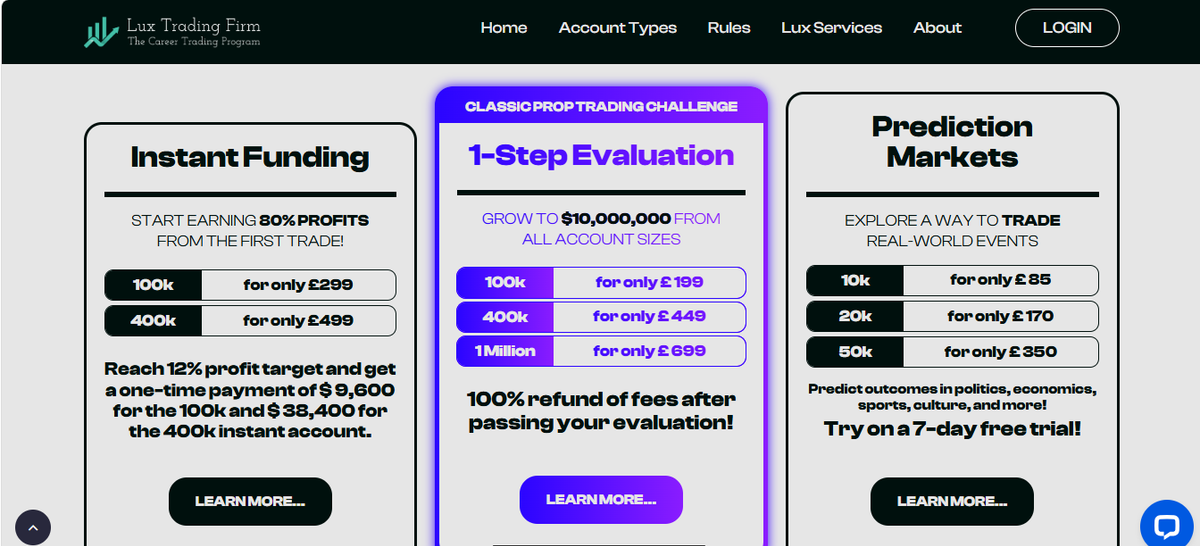
The 1-Step Evaluation is the main route into funded trading. You pay a one-time fee, trade a demo account to a profit target without breaching the static 6% drawdown, and progress to a funded stage with an 80% split. The firm's Current Rules of Engagement publish three evaluation sizes with the following headline fees: £199 for a $100,000 account, £449 for a $400,000 account and £999 for a $1,000,000 account. The evaluation fee is advertised as 100% refundable after passing stage one, subject to the firm's compliance and risk-desk review.
Within the standard track, the firm has described higher-tier plans with compressed servicing timelines and earlier access to a personal risk manager. The exact structure of those tiers should be checked against the current rules and checkout pages, because the post-22 September 2025 terms replaced earlier plan structures.
INSTA is a different product that beginners frequently confuse with a funded account. Several points are worth separating:
- INSTA fees are non-refundable.
- The account begins on demo.
- Once you hit the profit target without breaching the rules and the risk desk reviews the account, you receive 80% of the profit target as a single payment, which is a calculated upper bound ($9,600 on the $100,000 INSTA and $38,400 on the $400,000 INSTA) rather than a guaranteed sum.
- INSTA accounts do not scale and do not progress into the career-plan funding ladder.
INSTA pricing is advertised at £299 for the $100,000 account and £699 for the $400,000 account, per the Current Rules of Engagement and Article 16.5 of the Terms and Conditions. Reset fees under Article 16.5 are £209 for the $100,000 INSTA and £549 for the $400,000 INSTA. Confirm the figure at checkout for the specific account you are buying.
1-Step Evaluation and INSTA account pricing, targets and risk limits. Source: Lux Trading Firm Current Rules of Engagement; INSTA pricing per Terms and Conditions, Article 16.5.
| Account | One-time fee | Profit target | Maximum loss | Fixed breach floor | Fee refund |
|---|---|---|---|---|---|
| $100,000 1-Step Evaluation | £199 | $10,000 (10%) | $6,000 (6%) | $94,000 | 100% after passing, subject to review |
| $400,000 1-Step Evaluation | £449 | $48,000 (12%) | $24,000 (6%) | $376,000 | 100% after passing, subject to review |
| $1,000,000 1-Step Evaluation | £999 | $150,000 (15%) | $60,000 (6%) | $940,000 | 100% after passing, subject to review |
| $100,000 INSTA | £299 | $12,000 (12%) | $6,000 (6%) | $94,000 | No refund on passing or failing |
| $400,000 INSTA | £699 | $48,000 (12%) | $24,000 (6%) | $376,000 | No refund on passing or failing |
Challenge Structure and Trading Rules
The evaluation is a single stage on a demo account. Suppose you trade to a profit target without breaching a static 6% drawdown. The firm states there is no minimum or maximum number of trading days on the evaluation, so you can take as long or as short as the rules allow.
The drawdown is balance-based, and it is static with a published floor by account size. In plain terms, your maximum loss is measured against your account balance, and it does not trail your profits upward. That gives you room to hold winning trades through pullbacks without the drawdown line chasing you, which is one of the more trader-friendly aspects of the Lux rule set.
The rules that constrain how you actually place trades are more prescriptive than at many competitors:
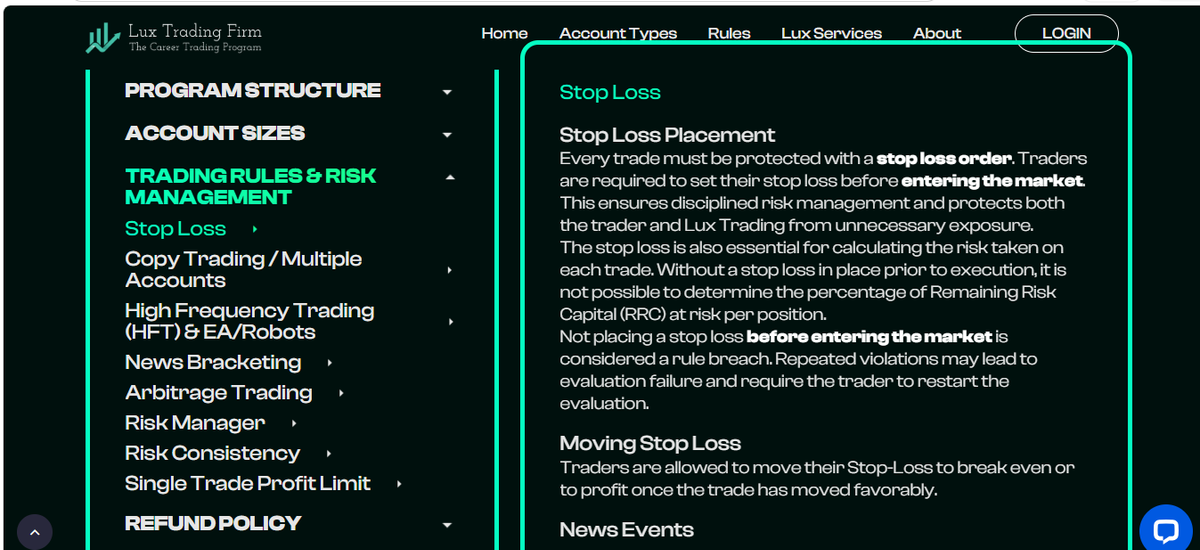
- Mandatory stop loss on every trade. You must set a stop loss before entering the market. The sum of your open stop losses must stay within the 6% drawdown limit. Lux classifies traders as scalper, day trader or swing trader, and uses that classification to size the stop-loss requirements it expects you to respect.
- 5% single-trade profit cap. Any individual trade can realise at most 5% of the stage profit target. Concurrent same-direction positions in the same symbol, or in correlated or inversely correlated symbols, are treated as a single trade. Splitting entries to bypass this cap is treated as cheating.
- News-window stop-loss rule. Stop-loss adjustments are not allowed in the window immediately before and after a news event, which prevents traders from widening risk into volatility.
- High-frequency trading ban. HFT is prohibited, including generating more than 2,500 server messages within 24 hours or using fully automated systems that create excessive trades.
- Multiple account limits. You may hold up to 5 evaluation accounts and up to 5 INSTA accounts at a time. Copy trading between evaluation accounts is allowed; running similar or correlated trades across INSTA accounts, or between INSTA and evaluation accounts, is forbidden.
Challenge-rule summary for the current 1-Step Evaluation and INSTA products. Source: Lux Trading Firm Current Rules of Engagement and INSTA rules; Terms and Conditions for refund and payout conditions.
| Rule | Verified condition |
|---|---|
| Evaluation structure | One-step demo evaluation before funded status |
| Drawdown | Static 6% of starting balance; breach floors fixed at $94,000 / $376,000 / $940,000 |
| Profit targets | 10% ($100k), 12% ($400k), 15% ($1m) on the 1-Step Evaluation; 12% on both INSTA sizes |
| Trading days | No minimum or maximum on the current 1-Step Evaluation sizes |
| Profit split | 80% to the trader on funded accounts |
| Scaling | Standard funded accounts can scale toward $10,000,000; INSTA accounts do not scale |
| Evaluation fee refund | 100% after passing stage one, subject to compliance and risk-desk approval |
| INSTA fee refund | No refund on passing or failing |
| Stop loss | Must be set before entering a trade |
| Risk consistency | Risk allocation must remain consistent through each stage |
| Maximum risk | 5% of Remaining Risk Capital (RRC), with aggregate concurrent risk constrained to the same threshold |
| Single-trade profit cap | 5% of the stage's profit target, including aggregated correlated or inverse-correlated positions |
| High-frequency trading | More than 2,500 server messages per 24 hours, or prohibited automated trading, can result in termination |
| News bracketing | Prohibited |
| Arbitrage | Prohibited, including exploiting price-feed discrepancies and latency |
| Withdrawals (funded) | All positions must be closed; no fixed cycle; subject to the published rules and review |
| Withdrawals (INSTA) | One-off payment of 80% of the profit target after target hit, rules complied with and risk-desk review |
In practical terms, the 5% single-trade profit cap is calculated against the stage's profit target rather than the account balance. Consider the three evaluation sizes:
- A $100,000 evaluation with a $10,000 target gives a cap of $500 per qualifying trade group.
- A $400,000 account with a $48,000 target gives $2,400.
- A $1,000,000 account with a $150,000 target gives $7,500.
Correlated or inverse-correlated positions are aggregated into the same cap, and moving a stop to breakeven or splitting entries does not reset it.
Trading Environment and Conditions
On the funded stage, Lux states that accounts route to liquidity providers under an A-Book execution model, with no dealing-desk intervention. Because this is the firm's stated model rather than an independently audited statement, it should be read as a positioning claim worth noting.
INSTA accounts begin on demo, and the firm reserves the right to move an INSTA account to A-Book live routing at the risk desk's discretion, which is a different arrangement from the career-plan funded stage.
The instrument range covers several asset classes:
- Forex
- Indices
- Metals and other commodities
- Stock CFDs
- Crypto CFDs
Leverage caps under the current post-22 September 2025 rules were not confirmed in the sources reviewed. An older Lux rules page lists 1:30 on forex, indices, metals and commodities and 1:5 on stocks and crypto, but these figures predate the current rules and should not be assumed to apply to a new account without checking the account-specific documentation.
If you are a UK retail reader, there is a separate point to understand that is not specific to Lux. The FCA prohibits CFDs on crypto for UK retail clients, so even where a prop firm's internal menu lists crypto, your access as a UK retail client is restricted by that rule. For context, the FCA retail leverage caps that act as a yardstick once Lux's own current leverage is confirmed at checkout are the following:
- 1:30 on major forex.
- 1:20 on indices.
- 1:5 on equities.
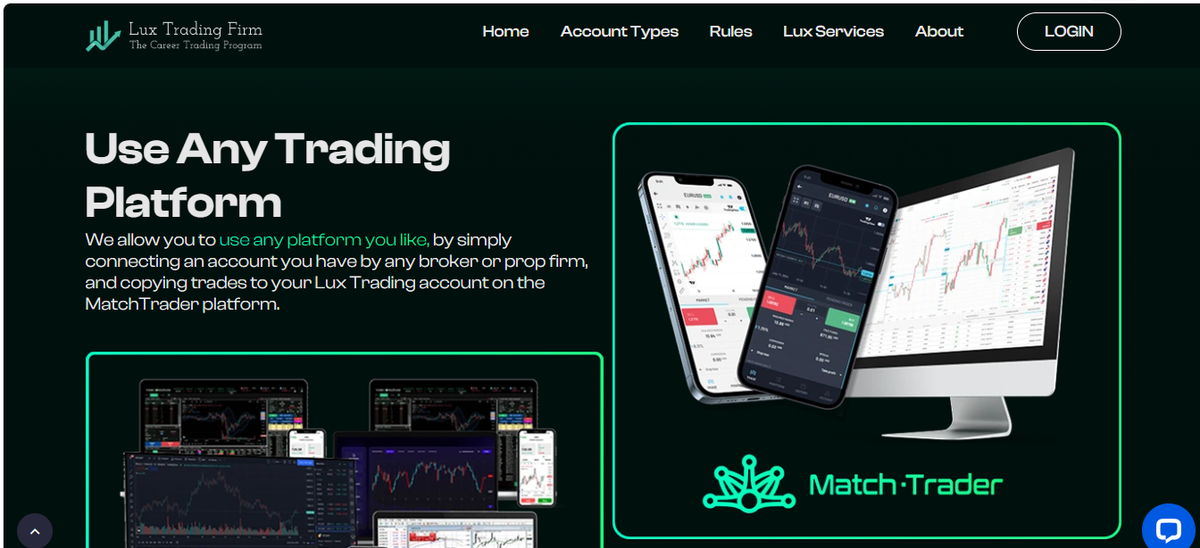
The firm's materials reference three trading platforms:
- The Lux Trader (TLT), the firm's proprietary platform, advertised with TradingView charting.
- MetaTrader 5.
- Match-Trader.
Availability can depend on account type and size, so confirm which platform is attached to the specific account you are buying at the point of checkout.
Payouts, Profit Split and Scaling
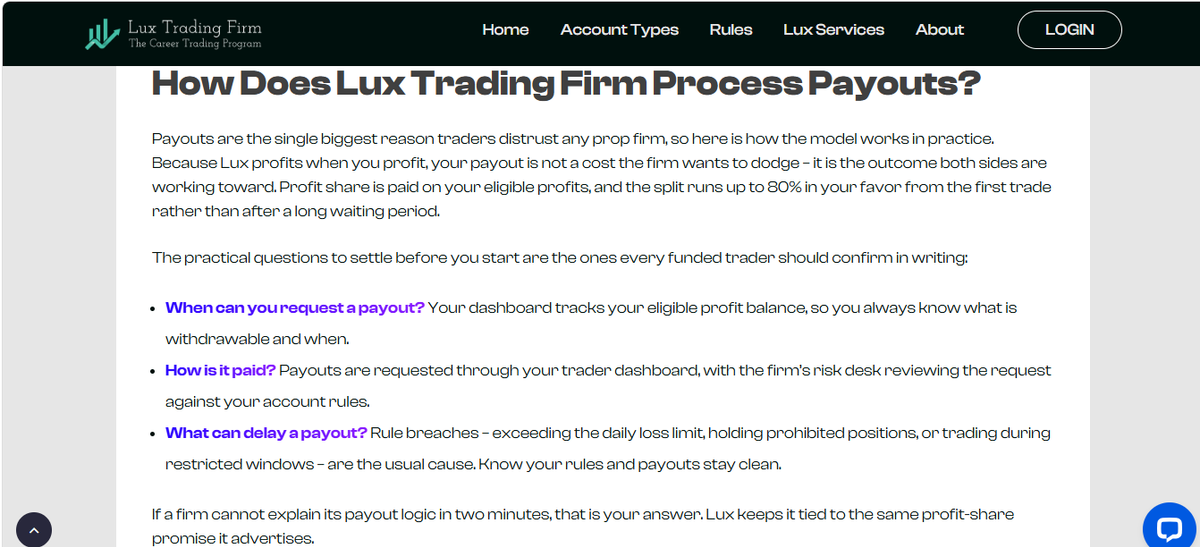
On career-plan funded accounts, the profit split is 80% to the trader from the first trade. Withdrawals are instant and sit outside a 14-day or monthly cycle: you can request a payout at any time while the account is in profit and no positions are open. There is no minimum number of trading days before a first payout under the published rules.
The scaling plan starts at a $100,000 funded account and progresses with each 10% gain, climbing through intermediate tiers up to a $10,000,000 Fund Manager level. Scaling applies to career-plan funded accounts, and does not extend to INSTA.
INSTA accounts work on a different logic. You can only request a withdrawal once the account has hit its required profit target, no rules have been broken, and there are no open positions. The payout is 80% of the profit target as a one-off payment, after the risk desk's review. There is no ongoing split, no scaling, and the INSTA fee is not refunded.
An older Lux rules page lists a 75% split under an earlier programme structure. The current Rules of Engagement set the funded split at 80%, so if you see 75% quoted on third-party pages, treat it as outdated and defer to the current rules page.
Withdrawal methods are not clearly published in the sources reviewed. Confirm which payment rails (bank transfer, e-wallets or others) are supported before you buy, especially if you are outside the UK, because currency conversion and fees on payout can meaningfully change the economics.
No systemic pattern of unpaid withdrawals surfaced during research. At the same time, independent proof-of-payout evidence was limited: a Reddit thread specifically asking about Lux legitimacy was blocked, and Myfxbook reviews were gated. Trustpilot sits around 4.1 to 4.2 across trackers, a moderate positive signal.
Trader Experience and Support
The dashboard is the main point of day-to-day contact. Lux publishes a trader area for managing your evaluation and funded accounts. Specific features and layout should be confirmed on the firm's own site, as the sources reviewed did not detail them.
A personal risk manager is part of the servicing model on the firm's higher-tier plans. The exact stage at which the risk manager is assigned differs by plan and should be checked in the current rules. Treat the risk manager as a compliance-and-coaching contact, used for rule guidance and account oversight.
The firm describes trading education as part of its offering. The format, depth and delivery of that education are not detailed in the sources reviewed, so take any claim about course quality with the usual caution and sample the free material before you weigh it in your decision.
Published support channels include sales, technical, trading and marketing email addresses on the Lux Trading Firm Contact page, a UK telephone number (+44 (0)20 7167 8107) and website live chat. Support hours and the size of the support team were not detailed in the sources reviewed.

Lux Trading vs The Competition
Against the better-known alternatives, Lux occupies a specific niche:
- FTMO is a larger and longer-established prop firm with a two-step evaluation and a profit share that can rise toward 90% after scaling. It has extensive community-documented proof of payouts. Lux counters with a one-step evaluation, a static 6% drawdown with a floor, a UK Companies House registration and a full evaluation fee refund on standard plans.
- The5ers offers instant and lower-cost funding routes and a bootcamp-style progression. Lux's differentiators against The5ers are the UK registration, its stated A-Book execution model on funded career-plan accounts (INSTA begins on demo and may be moved to A-Book at the risk desk's discretion) and the explicit scaling ladder up to $10,000,000.
- FundingPips typically prices evaluations lower and uses a trailing drawdown. Lux's static 6% drawdown with a fixed floor is more forgiving if you tend to build and hold profits through drawdown periods, at the cost of a stricter single-trade and stop-loss rule set.
None of this makes Lux objectively better or worse than those alternatives. Your choice should rest on whether the static drawdown and UK registration are valuable enough to you to justify accepting the mandatory stop-loss and 5% single-trade constraints.
Clearing Up the Misinformation
Three claims circulate about Lux that are worth correcting against the firm's own Rules of Engagement.
The first claim is that Lux funds you with real capital from day one, when evaluation accounts actually run on demo. On funded career-plan accounts the firm states execution routes to A-Book liquidity providers, while INSTA accounts begin on demo and may be moved to live at the risk desk's discretion. The practical implication is that during evaluation you are proving performance on simulated conditions, so expect realistic though not identical fills on the live stage.
The second claim is that the profit split is 75%, a figure that appears on an older rules page describing a previous programme. Because the current Rules of Engagement set the funded split at 80%, any 75% quoted on a third-party page should be treated as outdated.
The third claim is that INSTA accounts pay an ongoing 80% profit share. INSTA pays 80% of the profit target as a one-off, once the target is hit, the rules have been respected and the risk desk has reviewed the account. There is no scaling, no second withdrawal cycle, and no refund of the INSTA fee. If you want an ongoing share, the career-plan funded route is the correct product.
For each of these, the Lux Rules of Engagement page is the source you should check before buying.
Conclusion
For a disciplined trader who wants a transparent one-step evaluation and a static balance-based drawdown, Lux Trading is a credible option. The UK Companies House registration provides a corporate anchor, the static 6% drawdown with a floor is more forgiving than trailing structures when you hold winners, and the 80% split with instant withdrawals is competitive on funded career-plan accounts.
The caveats carry equal weight for your decision. Lux is not FCA authorised, which means retail-client protections that apply to UK-regulated brokers do not apply here, and the rule set remains prescriptive across mandatory stop losses sized to your trader classification, a 5% single-trade profit cap and an HFT ban. Scalpers, HFT users and anyone who expects an ongoing INSTA profit share should look elsewhere, and because evaluation accounts are demo and independent proof-of-payout evidence is limited, additional verification before buying is sensible.
Treat this review as a starting point. Before committing, verify the account-specific fee, the applicable rules version (pre- or post-22 September 2025 per Terms and Conditions clauses 9.3–9.4), platform selection, leverage and withdrawal costs on the firm's own site, since numerical spreads, commissions, swaps and withdrawal fees were not established as current values in the sources reviewed.
How we rate prop firms
Five weighted dimensions — trust, fairness, payout terms, platform quality, and customer support.
The full ranking
See how Lux Trading Firm stacks up against the other top-rated prop firms in our independent ranking.
Frequently asked questions
Is Lux Trading Firm legit?
Is Lux Trading regulated by the FCA?
How does the 6% drawdown work?
What do INSTA accounts actually pay?
Can you use EAs or scalp on Lux Trading?
How fast are payouts?
What happens if you fail the evaluation?
Trader reviews
Compare Lux Trading Firm
Add Lux Trading Firm to the comparison tool to put it side by side with other prop firms on fees, rules, and score.
Compare Lux Trading Firm →Other prop firms to consider
- FundedNext4.25 / 5Beginner and intermediate traders who want a large, transparent prop firm with static drawdown, no time limit and flexible payout options, and who accept an offshore simulated model outside FCA protection.
- The5ers4.24 / 5Best for intermediate to experienced traders who value a proven track record, no time limits, and serious scaling potential.
- Instant Funding3.96 / 5Beginner to intermediate traders who want immediate funded account access without sitting through multi-phase evaluations, and experienced traders who value clean rules, aggressive scaling, and a hybrid model that covers both instant and traditional challenge accounts.
About the authors
