





SuperFunded Review 2026
Our Overall
Score
3.46


Traders Score
—
$33
90%
—
- No Evaluation Time Limit
- TradeLocker & DXtrade
- Simulated Environment
- 700+ Instruments
Basic info
- Seychelles
- Simulated capital
- Yes
- Yes, up to 15%
 Seychelles
Challenge specs
- $33
- $33–$1,469
- 10%
- 5%
- 10%
- 4
- 1–2
- No limit
- 90%
- $200K
- Yes
Features
- TradeLocker
- 1:50 (2-Step) and 1:30 (1-Step)
- Yes
- No (maximum $600K via multiple accounts)
- Bi-weekly
- Forex, Commodities, Indices, Cryptocurrencies, Stocks
- English, Portuguese, Japanese, +10

You trade under a simulated capital model — the account is simulated and you operate under an evaluation agreement, not with your own funds.
Summary
- Operated by Eightcap International Ltd (Republic of Seychelles) — the same corporate group that supplies the trading conditions, not an independent broker partner.
- Offers 1-Step and 2-Step challenges, account sizes from $3,000 to $200,000, with no maximum time limit.
- Over 700 tradable assets across forex, indices, stocks, metals, oil and crypto, on TradeLocker and DXtrade.
- Profit share is a flat 80% on 1-Step; on 2-Step it runs 70% then 80%, reaching 90% only from the third payout, on a 14-day cycle.
- No formal scaling plan, no live chat support, and minimal educational resources are notable limitations.
Pros
- Ultra-low challenge fees from $33
- Full rules published in a downloadable document
- No time limit on evaluation challenges
- 700+ tradable assets across 6 classes
Cons
- Profit cap of 5% limits the first three payouts
- No formal scaling plan available
- 1-Step profit share capped at 80%
- News trading restricted at funded stage
- Limited educational resources for traders
- Maximum account size capped at $200K
SuperFunded offers affordable access to simulated prop trading, with entry fees among the lowest in the sector, which suits beginner and intermediate traders. The service is operated by Eightcap International Ltd, a company incorporated in the Republic of Seychelles and named in the firm's terms and conditions. That is worth stating precisely: the group supplying the underlying trading conditions is the same group that operates the firm, not an independent broker partner. SuperFunded is not regulated as a prop firm, and broker licences held elsewhere in the group cover neither this entity nor the evaluation programme itself. Low entry fees, two challenge structures and rules published in full stand out, while limited capital allocation, no formal scaling plan, profit caps and thin educational support may frustrate more ambitious traders.
What Makes SuperFunded Different?
If you have been exploring the prop trading space, you already know that challenge fees add up fast, particularly when a failed attempt means paying full price again from scratch. SuperFunded targets that frustration directly by offering some of the lowest entry fees around, starting from just $33 for a 2-Step $3,000 account. That lowers the barrier considerably for traders who want to prove their skills without putting hundreds of dollars on the line upfront.
SuperFunded is operated by Eightcap International Ltd, a company incorporated in the Republic of Seychelles. The entity is named in the opening paragraph of the firm's website terms and conditions and appears in the running footer of every legal document it publishes. The privacy policy additionally identifies the group's regional representatives: Eightcap Group Limited (registration 12448314, 40 Gracechurch Street, London) for the UK, and Eightcap EU Limited (registration 246/14, Limassol) for the EU and EEA. The firm does not publish a founding date for the SuperFunded brand, so treat its operating history as short and unverified.
The trading conditions are supplied through Eightcap, and the nature of that relationship matters more than the marketing suggests. Eightcap is not an arm's-length partner whose regulatory standing rubs off on the firm: the operating entity named in SuperFunded's own legal documents is Eightcap International Ltd, so the firm and its liquidity source are the same corporate group. Other companies in that group hold broker licences in other jurisdictions, but those licences cover those entities and their brokerage business. They do not extend to the Seychelles entity that runs SuperFunded, and no broker licence covers prop-firm evaluation activity in any case.
The firm offers both 1-Step and 2-Step challenge models, giving traders flexibility depending on their style and risk tolerance. Account sizes range from $3,000 to $200,000, and there is no maximum time limit on evaluations, so you can trade at your own pace. With over 700 tradable assets spanning forex, indices, stocks, metals, oil, and crypto, the instrument selection is broader than what many competitors in a similar price range provide.
What the firm does publish is a full Rules and Conditions document setting out the profit-share ladder, drawdown mechanics and funded-stage restrictions in one place. Having those terms in a downloadable document rather than scattered across marketing pages makes them straightforward to check before you buy, which is more than some competitors offer. For budget-conscious beginner and intermediate traders looking for a low-cost entry point into simulated prop trading, SuperFunded positions itself as a credible option.
The Bottom Line
SuperFunded fits beginner and intermediate traders who want affordable access to simulated prop trading. The low entry fees, two challenge structures and fully published rules make it a reasonable place to prove your skills without significant upfront cost. That said, traders seeking higher capital allocations, formal scaling plans or comprehensive educational support will likely find the firm's limitations restrictive and should look at more established alternatives.
Account Options & Pricing Breakdown
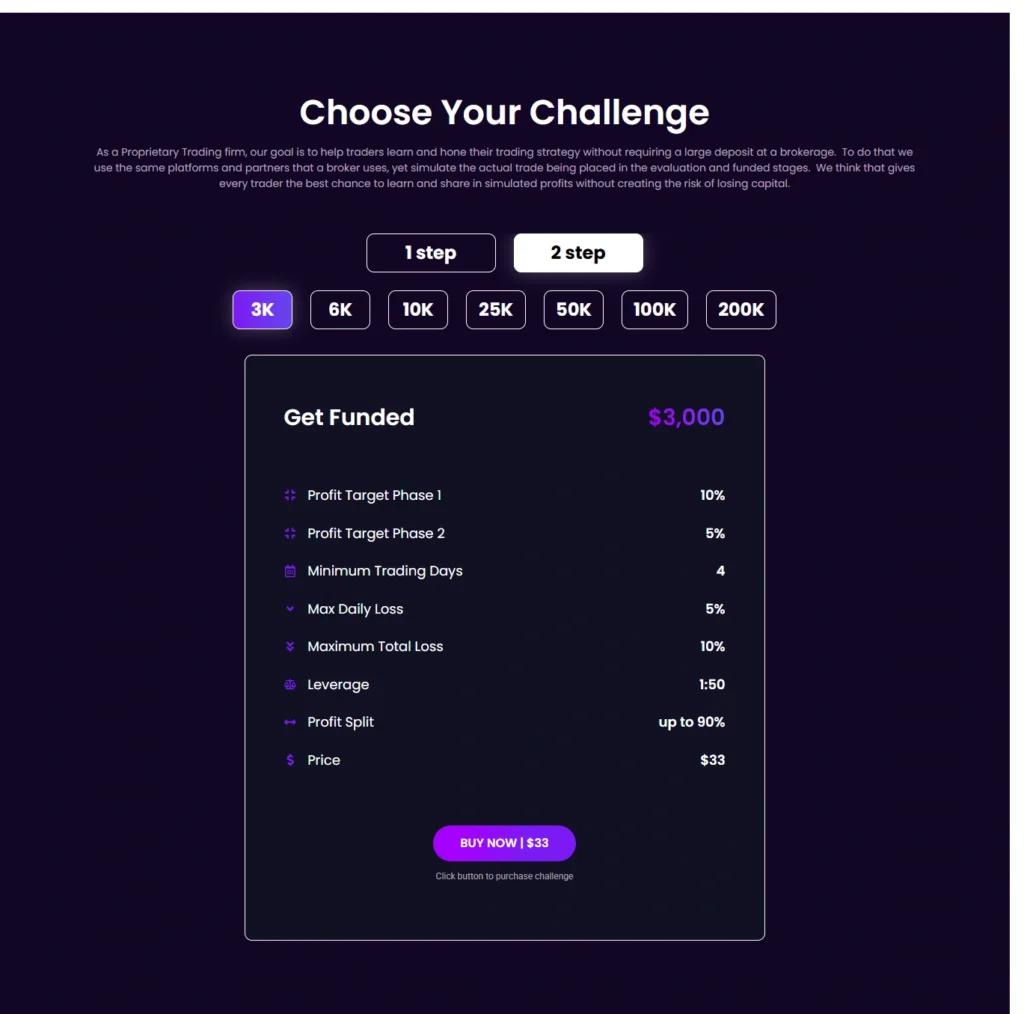
SuperFunded offers two distinct challenge paths, each with multiple account sizes. According to the firm's official challenges page, all fees are one-time payments with no monthly subscriptions or hidden costs.
1-Step Challenge Pricing
| Account Size | Fee | Profit Target | Daily Drawdown | Max Total Loss | Leverage |
|---|---|---|---|---|---|
| $5,000 | $55 | 8% | 3% | 5% (trailing) | 1:30 |
| $10,000 | $99 | 8% | 3% | 5% (trailing) | 1:30 |
| $25,000 | $165 | 8% | 3% | 5% (trailing) | 1:30 |
| $50,000 | $299 | 8% | 3% | 5% (trailing) | 1:30 |
| $100,000 | $599 | 8% | 3% | 5% (trailing) | 1:30 |
| $200,000 | $1,469 | 8% | 3% | 5% (trailing) | 1:30 |
2-Step Challenge Pricing
| Account Size | Fee | Phase 1 Target | Phase 2 Target | Daily Drawdown | Max Total Loss | Leverage |
|---|---|---|---|---|---|---|
| $3,000 | $33 | 10% | 5% | 5% | 10% (static) | 1:50 |
| $6,000 | $66 | 10% | 5% | 5% | 10% (static) | 1:50 |
| $10,000 | $99 | 10% | 5% | 5% | 10% (static) | 1:50 |
| $25,000 | $158 | 10% | 5% | 5% | 10% (static) | 1:50 |
| $50,000 | $298 | 10% | 5% | 5% | 10% (static) | 1:50 |
| $100,000 | $550 | 10% | 5% | 5% | 10% (static) | 1:50 |
| $200,000 | $1,299 | 10% | 5% | 5% | 10% (static) | 1:50 |
Commission Structure
Trading commissions are set by Eightcap, the same corporate group that operates the firm, and apply across both the evaluation and funded stages. According to the SuperFunded FAQs, the breakdown is: $7 per lot for most instruments, 0.01% for crypto (based on trade volume and opening price), $2 per lot for US stocks, and 0.1% for non-US stocks. The firm does not disclose any markup beyond these commissions.
Challenge Structure & Trading Rules
Understanding the differences between SuperFunded's two challenge types matters before committing to a purchase. Each model has distinct drawdown mechanics, minimum trading day requirements, and funded-stage restrictions that can significantly affect your approach.
1-Step Challenge
The 1-Step challenge is a single-phase evaluation requiring an 8% profit target. You must trade on a minimum of 3 trading days (a day counts only when you open a trade, not when you close one). The daily drawdown is capped at 3%, and the maximum total loss is set at 5% using a trailing drawdown model.
The trailing drawdown is a critical detail. As your account balance grows, the drawdown threshold adjusts upward with it. For example, on a $10,000 account, the drawdown starts at $9,500. If your balance reaches $11,000, the threshold moves to $10,500. If your equity then drops below $10,500, the challenge is breached, even though you are still above the original starting balance. This makes the 1-Step challenge tighter from a risk management perspective. On the upside, the 1-Step model does allow scalping and grid trading at the funded stage, which the 2-Step does not.
2-Step Challenge
The 2-Step challenge requires passing two phases. Phase 1 has a 10% profit target, and Phase 2 requires 5%. You must trade on a minimum of 4 trading days per phase. The daily drawdown is more generous at 5%, and the maximum total loss is 10%, calculated as a static drawdown. This means the loss limit is anchored to the initial balance and does not trail upward with profits.
The static drawdown is generally more forgiving for swing traders and those who hold positions over longer periods. On a $100,000 account, your equity must not fall below $90,000 at any point, regardless of how much profit you have built up. Leverage is also higher on the 2-Step at 1:50 compared to 1:30 on the 1-Step.
Universal Rules
Both challenge types share several rules. There is no maximum time limit, meaning you can take as long as needed to hit the profit target. Your challenge will, however, automatically fail after 30 days of inactivity. Drawdown is measured on the lower of balance or equity, so open trade exposure matters.
Funded Stage Restrictions
At the funded stage, SuperFunded prohibits several strategies: high-frequency trading (manual or automated), tick scalping, latency arbitrage, reverse arbitrage, martingale strategies, data feed manipulation, and hedging across accounts. Scalping and grid trading are only permitted on 1-Step funded accounts, not on 2-Step. News trading is restricted within 10 minutes before and after high-impact events as marked on the FXStreet economic calendar. The firm also enforces a gambling-style trading prohibition where the projected or realized loss on a single trade (including all simultaneous positions) must not exceed 2.5% of the account balance.
Trading Environment & Conditions
Platforms
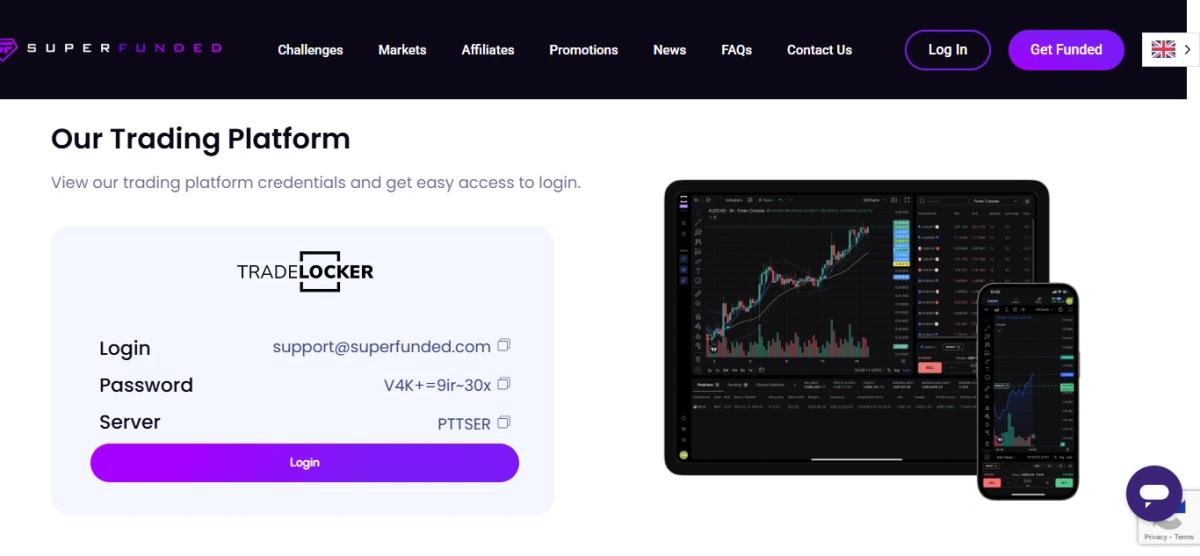
SuperFunded offers two platforms: TradeLocker and DXtrade. TradeLocker is available as a desktop application, a mobile app for iOS and Android, and a web version. Note that the firm's FAQs state Expert Advisors are not currently available on DXtrade, so if your strategy depends on automation, confirm which platform supports your setup before buying a challenge.
TradeLocker provides TradingView-powered charting, giving traders access to a wide range of technical indicators and drawing tools.
Instruments
According to the SuperFunded website, the firm offers over 700 tradable assets across six classes: forex (40+ currency pairs), indices, stocks (US, Australian, London Stock Exchange, and XETRA-listed equities), metals (gold and silver), oil (Brent and WTI crude), and cryptocurrencies. This is a broader selection than many competitors at this price point. For reference, Fintokei does not currently offer crypto or stock trading.
Leverage
Maximum leverage is 1:50 for the 2-Step challenge and 1:30 for the 1-Step. These levels apply uniformly across all instrument classes. They sit below what many offshore prop firms advertise, which is worth weighing against the drawdown rules described above rather than reading as a safety guarantee.
Execution and Spreads
Because the trading conditions are supplied from within the same corporate group, the environment inherits Eightcap's pricing and execution model rather than sourcing it from an unrelated broker. We were not able to independently verify spread or latency figures for the simulated environment, so treat headline numbers quoted elsewhere as unconfirmed.
What matters for your cost per trade is that pricing is modelled on a live brokerage feed rather than an arbitrary simulated one, which keeps commission drag predictable for active traders. It is worth being clear about the limit of that, though: no order reaches a real market. The firm's General Terms and Conditions state at clause 7.3 that funded accounts remain simulated only, so tight modelled spreads are not evidence that a live fill would behave the same way.
Payouts, Profit Splits & Scaling
Profit Split
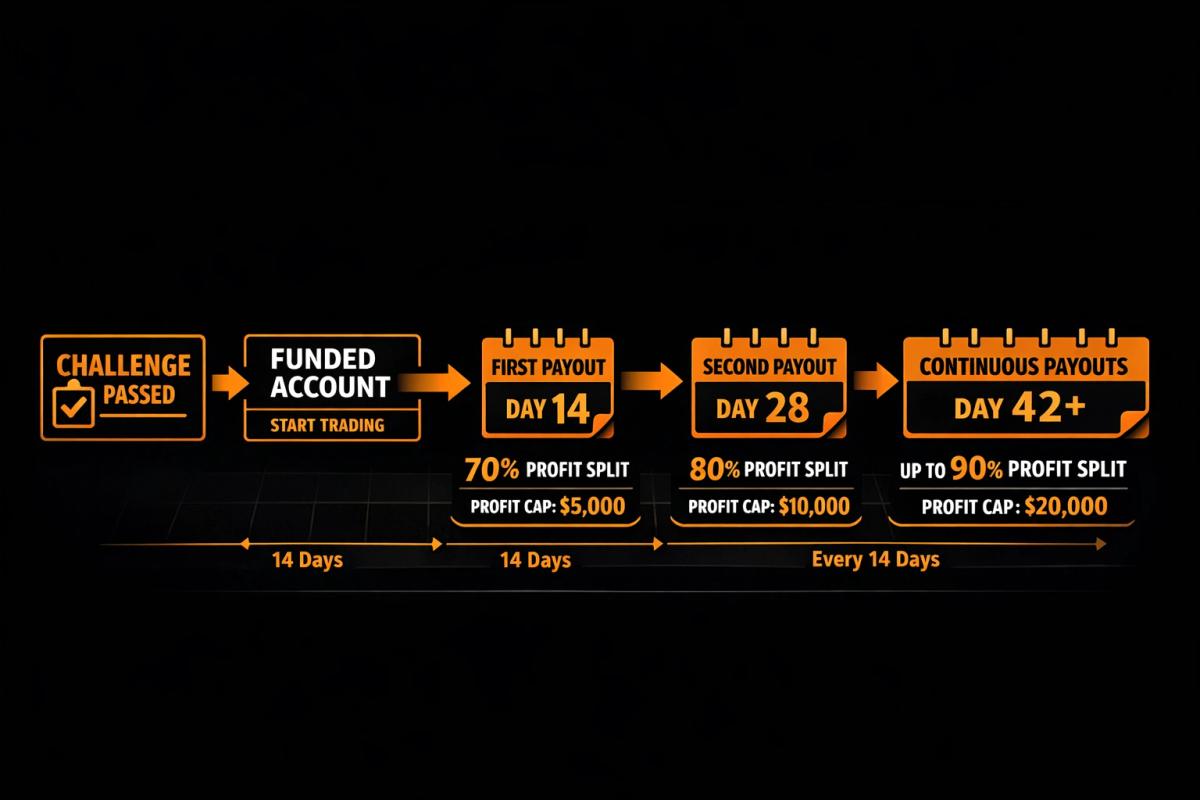
The profit share is a ladder rather than a flat rate, and it differs by challenge type. Per the firm's published Rules and Conditions (V2.0), a 1-Step funded account pays a flat 80% and never rises above it. A 2-Step account starts at 70% on the first payout, moves to 80% on the second, and reaches 90% only from the third payout onward. The headline 90% figure is therefore achievable on 2-Step accounts from the third payout, and not at all on 1-Step — worth factoring into the cost comparison before you choose a model.
Payout Schedule
Your first withdrawal becomes available 14 days after receiving your funded account. Subsequent withdrawals follow the same 14-day cycle. If you are on a 2-Step challenge, you can purchase an optional "7 Withdrawal Days Add-on" to reduce the first payout waiting period to 7 days after getting funded.
To request a withdrawal, your account must end in a positive balance at the end of the 30-day trading period. KYC verification is required once your cumulative withdrawals exceed $1,000.
Profit Cap
This is an important limitation to be aware of. The profit cap restricts the maximum profit you can withdraw per payout cycle during the first three successful payouts. For 1 step challenges, 5% profit cap applies to all account sizes for the first 3 successful payouts. For 2 step challenges, the profit cap for all account sizes is 5%. Any amount exceeding the cap is not paid out and does not carry over to the next cycle. This is a notable downside that reduces your effective earnings during the early funded period.
Profit Distribution Rule
SuperFunded also enforces a profit distribution rule at the funded stage. No single calendar day can account for more than 40% of your requested profit (30% for accounts of $50K and above). Profits exceeding this daily limit are deducted upon review. The rule is designed to discourage windfall-style trading and reward consistency.
Scaling and Maximum Capital
SuperFunded does not offer a formal scaling plan. There is no pathway to increase your individual account size based on performance. The maximum single account size is $200,000, and you can hold multiple accounts up to a combined total of $600,000. For traders looking to grow their capital beyond this level, competitors like The5ers (scaling up to $4 million) or FTMO (scaling up to $2 million) offer considerably more room.
Withdrawal Methods
Payouts are available via bank wire transfer or cryptocurrency, including USDT ERC20, USDT TRC20, BTC, and DOGE.
Trader Experience & Support
Dashboard and Interface
SuperFunded provides a proprietary dashboard accessible via desktop and mobile. The dashboard offers real-time data, low-latency performance monitoring, challenge tracking, funded account statistics, and login management. Account login credentials are typically delivered within 5 minutes of payment, according to the FAQs page.
Support Channels
Customer support is available by email at support@superfunded.com and through an online contact form, and the firm maintains an active Discord community. There is no live chat or phone support listed on the website, which may frustrate traders who want immediate assistance.
Public review-platform coverage of SuperFunded exists but is thin next to long-established firms, and we were unable to re-verify a specific aggregate score at the time of this update. Treat any single headline rating on a brand with a short and undated operating history as a weak signal, and weigh it against the fact that payout evidence is self-published.
Educational Resources
SuperFunded's educational offering is thin. The firm does not provide dedicated training materials, courses, or mentorship programs. Multiple third-party reviewers have flagged this gap. For traders who rely on educational resources as part of their development, this is a real absence. Firms like FTMO and The5ers offer significantly more in this area, including trading journals, statistical tools, and community-based learning.
Language and Community
The website is available in English, Japanese, and Brazilian Portuguese. The Japanese management team provides native-language support for Japanese traders. Community engagement takes place primarily through Discord, Instagram, and X (formerly Twitter).
SuperFunded vs The Competition
When choosing a prop firm, it helps to see how SuperFunded measures up against established competitors. The table below compares key features across SuperFunded, FTMO, and The5ers.
| Feature | SuperFunded | FTMO | The5ers |
|---|---|---|---|
| Cheapest Challenge Fee | $33 (2-Step $3K) | ~€89 ($10K) | $22 ($2.5K) |
| Max Account Size | $200,000 | $200,000 | $250,000+ |
| Max Scaling Capital | $600K (multiple accounts) | $2,000,000 | $4,000,000 |
| Profit Split | Up to 90% | Up to 90% | Up to 100% |
| Challenge Types | 1-Step, 2-Step | 1-Step, 2-Step | 1-Step, 2-Step, 3-Step |
| Platforms | TradeLocker | MT4, MT5, cTrader, DXtrade | MT5, cTrader |
| Payout Frequency | Every 14 days | On demand (after 14 days) | Every 14 days |
| Scaling Plan | No | Yes | Yes |
| Time Limit | No limit | No limit | No limit |
Traders who prioritize low upfront cost and straightforward evaluation rules will find SuperFunded appealing. Those who need higher capital potential, platform variety (MT4/MT5), or a structured growth path should weigh the alternatives carefully.
Conclusion
SuperFunded offers one of the most affordable entry points in prop trading, with challenge fees starting at $33. Two challenge structures, no time limit on evaluations and a rule set published in full give beginner and intermediate traders a foundation for testing their skills without significant financial risk. The environment is simulated throughout, and the operating entity is Eightcap International Ltd of the Republic of Seychelles.
The firm suits budget-conscious traders who want low-cost access to simulated funded trading across a wide instrument range. If you need scaling beyond $200,000, prefer MT4 or MT5, or want comprehensive educational resources, alternatives like FTMO or The5ers may serve you better.
Visit SuperFunded to explore current challenge options and pricing.
Risk Warning: Trading involves significant risk. Prop firm challenges are simulated trading environments, and the challenge fee is at risk if you do not pass the evaluation. Only trade with funds you can afford to lose.
How we rate prop firms
Five weighted dimensions — trust, fairness, payout terms, platform quality, and customer support.
What are your odds here?
Load SuperFunded’s rules into our Monte Carlo simulator, put in your own win rate and risk, and see how often that combination ends in a funded account — and which rule ends it when it doesn’t.
The full ranking
See how SuperFunded stacks up against the other top-rated prop firms in our independent ranking.
Frequently asked questions
What platforms does SuperFunded use?
What is the cheapest SuperFunded challenge?
How long do SuperFunded payouts take?
Does SuperFunded allow EAs?
Is SuperFunded regulated?
What is SuperFunded's profit cap?
Trader reviews
Compare SuperFunded
Add SuperFunded to the comparison tool to put it side by side with other prop firms on fees, rules, and score.
Compare SuperFunded →Other prop firms to consider
- The5ers4.24 / 5Best for intermediate to experienced traders who value a proven track record, no time limits, and serious scaling potential.
- Instant Funding3.96 / 5Beginner to intermediate traders who want immediate funded account access without sitting through multi-phase evaluations, and experienced traders who value clean rules, aggressive scaling, and a hybrid model that covers both instant and traditional challenge accounts.
- FunderPro3.91 / 5Beginner to intermediate traders who want flexible challenge structures, no evaluation time pressure, and access to a proprietary platform ecosystem, particularly those open to instant funding or daily payout options.
About the authors
