




ThinkCapital Review 2026
Our Overall
Score
3.68


Traders Score
—
$39
80%
2
- Broker-Backed
- Commission-Free
- TradingView Integration
- Static or Trailing
- No Time Limit
Basic info
- no published
- 2024
- Simulated capital
Challenge specs
- 80%
Features
- thinktradertradingview-integration-via-thinktrader
- no published
- Scaling plan lifts allocation up to $1.5 million (ThinkTrader programs) and up to $500,000 on Bolt instant accounts. Overall funded cap $600,000 across Lightning, Dual Step and Nexus combined.
- Biweekly (every 14 days); payouts processed within 3 business days of request.
- Forex, Commodities, Indices, Cryptocurrencies
You trade under a simulated capital model — the account is simulated and you operate under an evaluation agreement, not with your own funds.
Summary
- Operated under the ThinkMarkets regulated broker group
- 80% profit split with biweekly payouts
- Static drawdown on Dual Step and Nexus
- Trailing drawdown on Lightning and Bolt
- Scaling up to $1.5 million allocation
Pros
- Backed by the ThinkMarkets broker group
- Commission-free trading on ThinkMarkets infrastructure
- ThinkTrader platform with TradingView integration
- Biweekly payouts processed in 3 business days
- 80% profit split, advertised scalable to 90%
Cons
- Tight 3% to 4% daily loss limits on every program
- Not regulated as a prop firm itself
- Riseworks payout method carries monthly fee
- Education limited to a public FAQ and blog
- News trading restricted by default on every program except Dual Step Swing
ThinkCapital leans on the credibility of a regulated broker parent, which raises its baseline above most standalone prop firms, and backs it with commission-free trading on ThinkTrader with TradingView, published pricing and rules, and biweekly payouts on an 80% split. The honest counterweight is tight daily loss limits (3% on Lightning and Bolt, 4% on Dual Step and Nexus), profit targets that are high relative to total drawdown, a single platform with no MT5 or cTrader, and a Trustpilot profile that is currently unrated. Consider with reservations, suitable for disciplined traders who respect tight daily loss limits.
What you need to know about ThinkCapital
This ThinkCapital review walks you through what the firm actually offers, where it earns its reputation and where you need to pay attention before buying a challenge. ThinkCapital is a prop firm operated under the ThinkMarkets broker group. Both the evaluation stage and the funded stage run on simulated accounts, and the firm pays profits from its own capital when you hit a payout cycle.
The baseline picture here is unusual in this industry. Most prop firms are standalone operations with no broker parent. ThinkCapital sits inside an established, regulated broker group, which gives you confidence that the infrastructure, liquidity and execution come from a company with a long operational history. Trustpilot lists just over 600 reviews, most of them four or five stars, but it currently shows no overall rating for the firm: Trustpilot says the rating is unavailable due to a breach of its guidelines and that it has removed a number of fake reviews, so treat that review count with caution.
There are two tensions you should understand before paying for a challenge. The first is that the firm itself is not regulated as a prop firm, because the evaluation model is not a brokerage service. The regulated status belongs to the parent, ThinkMarkets, and not to the funded account you trade. The second is that every program runs a strict daily loss limit that is tighter than what you find at competitors such as FTMO: 3% on Lightning, Bolt and Bolt Flex, and 4% on Dual Step and Nexus. On the Dual Step program, for example, a 4% daily cap means a single bad session can end your run even when your total drawdown is still healthy.
The result is a profile that will suit some traders very well and frustrate others. If you trade with controlled daily risk and want broker-grade execution, you are in the right place. If you need wider daily breathing room, you need to look elsewhere.
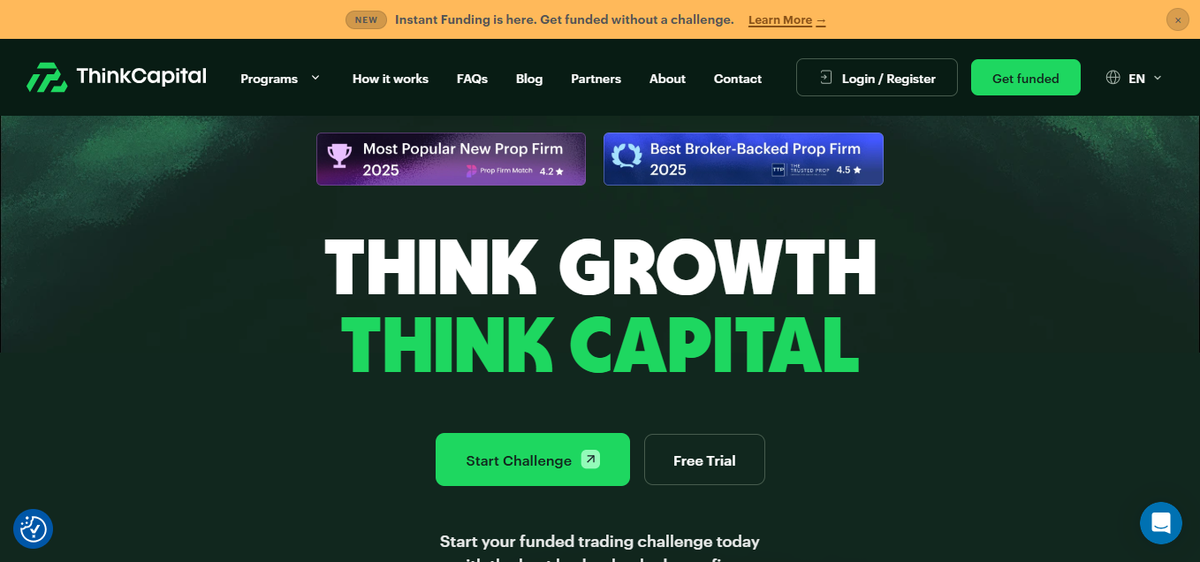
Account Options and Pricing Structure
ThinkCapital organises its offer into four program families, each aimed at a different style of trader:
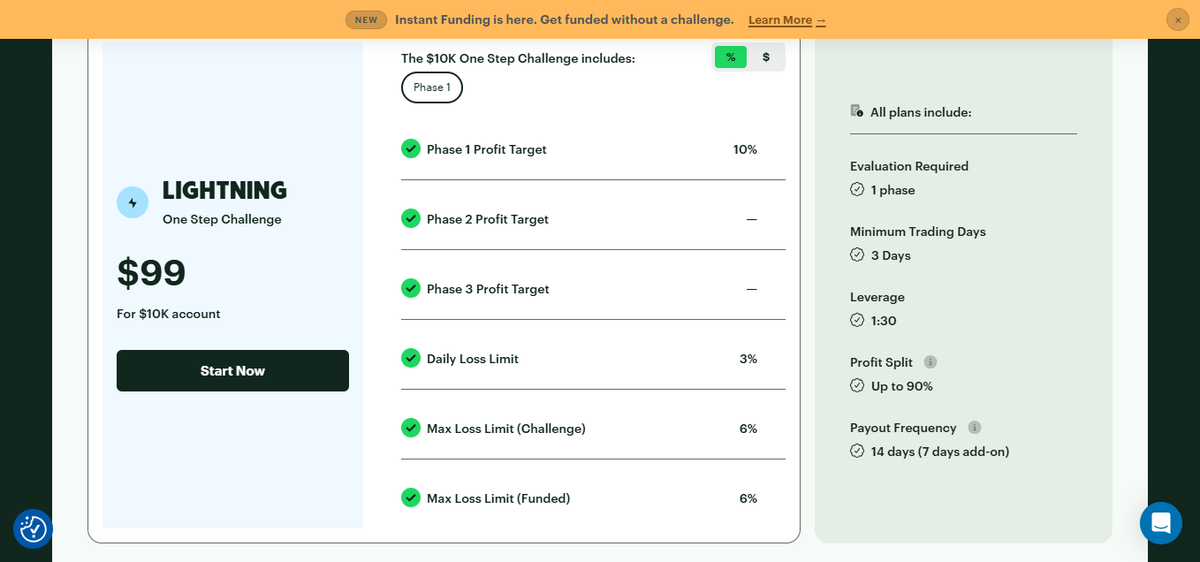
- Lightning: a one-step evaluation with a 10% profit target and a trailing drawdown model based on your balance.
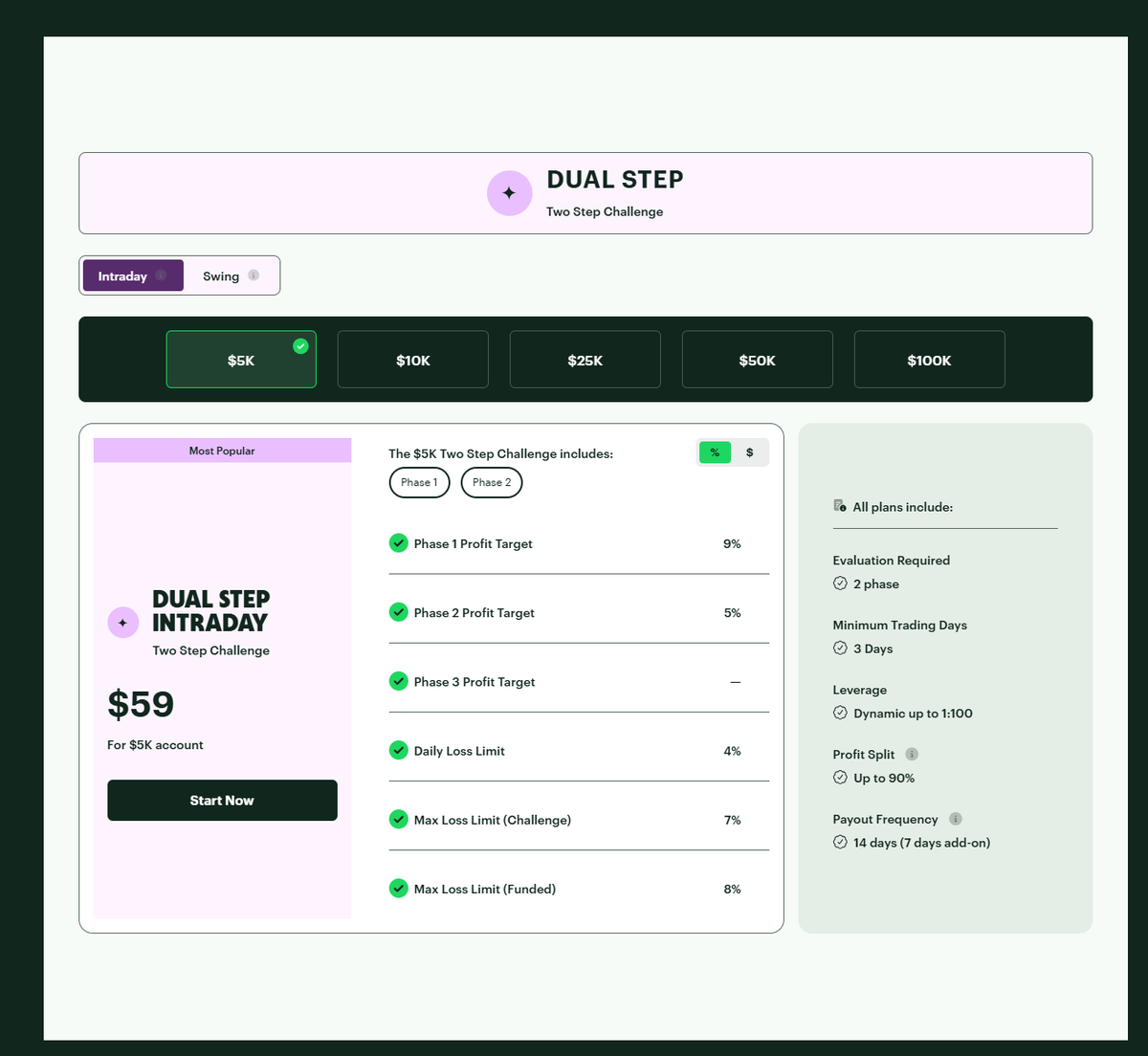
- Dual Step: a two-step evaluation with a static drawdown model, sold as an Intraday version with news and weekend holding restrictions and a Swing version without them.
- Nexus: a three-step evaluation that also uses a static drawdown model.
- Bolt: instant funding with no evaluation, sold as Bolt (6% trailing drawdown based on equity) and Bolt Flex (7% trailing drawdown based on balance). Cryptocurrency trading is excluded on both.
The firm publishes base challenge fees for every program and account size on its program pages. Add-ons such as a 90% split, faster payouts or weekend holding cost extra:
Lightning: $59 ($5K), $99 ($10K), $199 ($25K), $299 ($50K), $499 ($100K) Dual Step Intraday: $59 ($5K), $99 ($10K), $199 ($25K), $299 ($50K), $499 ($100K) Dual Step Swing: $82 ($5K), $138 ($10K), $278 ($25K), $418 ($50K), $698 ($100K) Nexus: $39 ($5K), $79 ($10K), $139 ($25K), $199 ($50K), $349 ($100K) Bolt: $39 ($2.5K), $71 ($5K), $127 ($10K), $279 ($25K), $479 ($50K), $899 ($100K) Bolt Flex: $59 ($2.5K), $107 ($5K), $191 ($10K), $419 ($25K), $719 ($50K) Prices change with promotions, so check the current fee at checkout.
What we can confirm from the firm's documentation is the allocation ceiling, which is the amount of simulated capital you can run across funded accounts. On the ThinkTrader programs (Lightning, Dual Step and Nexus combined) the maximum funded allocation is $600,000. Through the published scaling plan, that cap can grow up to $1.5 million. Bolt and Bolt Flex share a combined limit of $192,500, which counts toward the $600,000 total, and can scale together up to $500,000.
Two structural rules on allocation shape how you plan your path. Account splitting is not allowed, so once you pass a given size you cannot divide the account into smaller units. Account merging is also not allowed, so you cannot pool several passed accounts into one larger allocation. If you intend to run multiple funded accounts, you need to plan the sizes from the start.
Challenge Structure and Trading Rules
The single most important thing to understand before you pay for a ThinkCapital challenge is how the drawdown works, because the rules are not uniform across the four programs. The firm runs two different drawdown mechanics depending on which program family you buy.
- Dual Step and Nexus: static drawdown. The maximum loss line is fixed at a percentage of your starting balance and does not move as your account grows. This is friendlier for traders who build profit and want their loss limit to stay anchored to the entry balance.
- Lightning, Bolt and Bolt Flex: trailing drawdown. The maximum loss line follows your account up and then locks. On Lightning it is a 6% line that trails your highest closed balance; on Bolt it is a 6% line that trails your highest equity in real time, including floating profit. Both lock at your initial balance once the account is 6% up. Bolt Flex uses a 7% line based on balance that locks once your balance is 7% up.
The firm publishes the same percentage rules for every account size within a program:
Lightning (one step): 10% profit target, 3% daily loss (balance-based), 6% trailing maximum loss, minimum 3 trading days. Dual Step (two steps): 9% then 5% profit targets, 4% daily loss (equity-based on Intraday, balance-based on Swing), 7% static maximum loss in the challenge and 8% once funded, minimum 3 trading days. Nexus (three steps): 7%, 6% and 5% profit targets, 4% daily loss (balance-based), 8% static maximum loss, minimum 3 trading days. Bolt (instant funding): no evaluation, 6% profit needed for the first payout, 3% daily loss (equity-based), 6% trailing maximum loss, best day capped at 20% of total profit. Bolt Flex (instant funding): no evaluation, 7% profit needed for the first payout, 3% daily loss (balance-based), 7% trailing maximum loss, best day capped at 25% of total profit. No program has a maximum time limit, but you must place at least one trade every 30 days to keep an account active.
On the Dual Step program, the critical rule to study is the daily drawdown. The Dual Step daily loss limit is 4% (equity-based on Intraday, balance-based on Swing), lower than the daily caps you see on comparable programs at some larger competitors.
A few general rules apply across the programs:
- Stop losses are not mandatory in the firm's documentation, although putting a large share of your balance on one trade without a stop loss counts as an all-in strategy, which the firm treats as prohibited gambling and punishes with warnings, account resets and, after two resets, a ban.
- News trading is restricted by default on Lightning, Nexus, Dual Step Intraday, Bolt and Bolt Flex. You cannot open or close trades from 2 minutes before to 2 minutes after a high-impact release (5 minutes either side on Bolt and Bolt Flex), and a violation is a hard breach. Dual Step Swing allows news trading, and Lightning and Nexus offer a news trading add-on. Dual Step Intraday closes any position still open at Friday 21:00 UTC, and Bolt and Bolt Flex accounts are breached by weekend positions unless you buy the Weekend Holding add-on. If you carry positions through the weekend, Lightning, Nexus and Dual Step Swing allow it by default.
- Crypto trading is excluded on Bolt and Bolt Flex accounts.
Trading Environment and Conditions
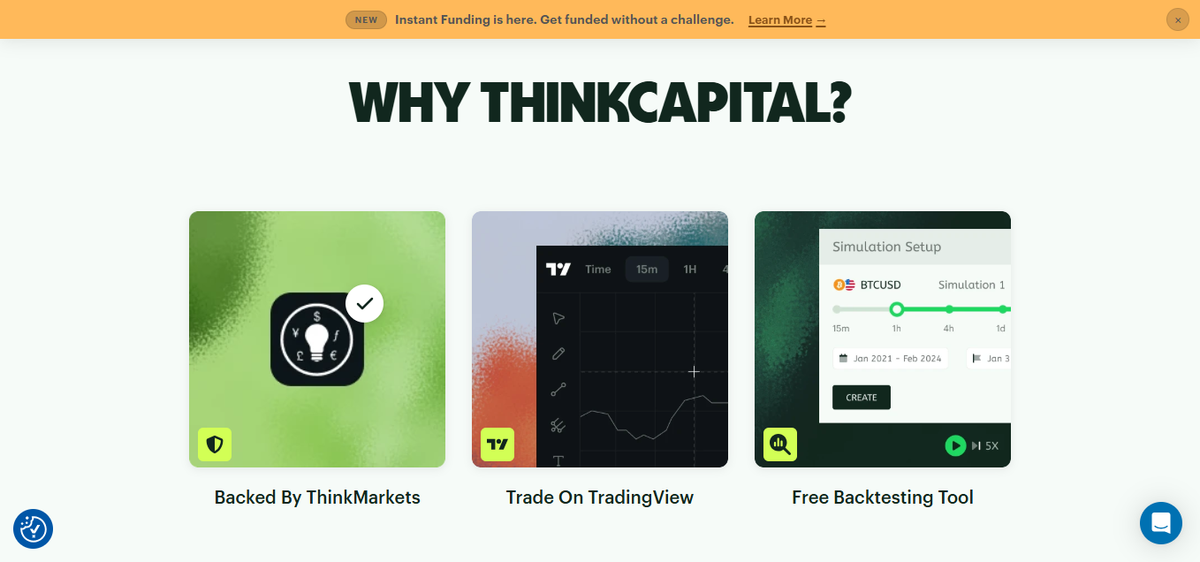
The trading infrastructure is one of ThinkCapital's stronger cards, and it is where the ThinkMarkets backing shows through. All accounts run on a single platform, ThinkTrader, from the first challenge phase through to the funded stage:
- ThinkTrader: the broker's proprietary platform.
- TradingView integration: connect your TradingView profile and trade or manage your account directly from TradingView on the web or mobile.
Trading is commission-free with standard spreads. The firm points you to the public ThinkTrader web demo so you can inspect live spreads before buying a challenge, which is a reasonable due diligence step.
The instruments covered include:
- forex
- commodities
- indices
- cryptocurrencies (excluded on Bolt and Bolt Flex accounts)
Leverage depends on the program. Lightning uses fixed leverage of 1:30 on forex, 1:10 on metals and oil, 1:5 on indices and 1:1 on crypto. Dual Step and Nexus use dynamic leverage up to 1:100 on forex, which steps down as your open lot size grows. Bolt and Bolt Flex have their own dynamic schedule, and the firm's program page and leverage FAQ quote different maximums (1:50 and 1:100 on forex), so check the current figure before you trade.
A genuine strength is that the trading environment does not change after you pass. Your account stays on ThinkTrader from the challenge to the funded stage, so the platform and instrument access you experience during the evaluation are the ones you will trade on the funded account. The one rule that changes is on Dual Step, where the maximum loss widens from 7% in the challenge to 8% once funded. This has real consequences for strategy design, because any edge you prove in the evaluation should carry through to the paid stage without recalibration.
On restrictions, the key rules to internalise are the default news trading window on most programs, the weekend limits on Dual Step Intraday and Bolt, together with the general prohibition on strategies that the firm classifies as reckless or gambling behaviour, such as all-in trades without a stop loss. Copy trading is also banned on every account.
Payouts, Profit Split and Scaling
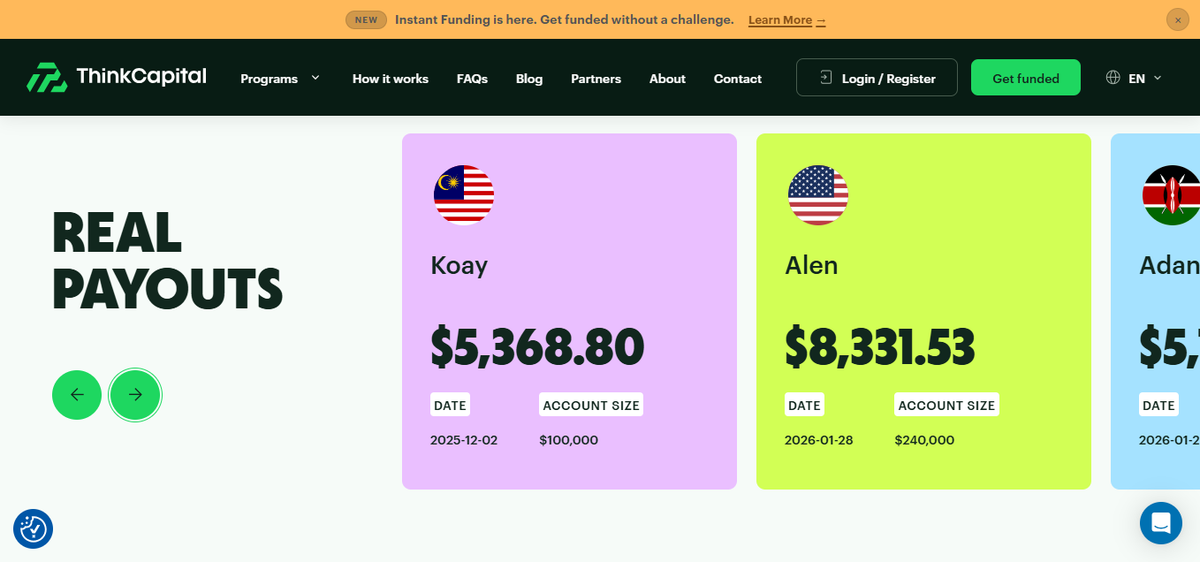
The payouts system is one of the areas where the firm earns most of its positive community feedback. The headline numbers are straightforward: an 80% base profit split, advertised as scalable up to 90% through add-ons and the scaling plan, with a biweekly payout cycle.
The profit split works on a 14-day rhythm. Once you request a payout, processing is completed within 3 business days according to the firm's documentation. Trustpilot lists just over 600 reviews, mostly positive, but it currently shows no overall rating for the firm because of a breach of its guidelines and says it has removed fake reviews, so weigh that feedback with care.
There are three withdrawal methods available:
- Cryptocurrency (USDT TRC20 or ERC20).
- Riseworks.io: an email-based payout service that carries a $50 flat monthly fee you need to factor into your net return, especially on smaller accounts.
- Transfer to a ThinkMarkets personal live account: available only in eligible countries.
There are two rules on payout eligibility that you absolutely must understand before you request a withdrawal, because missing them can cost you the payout even after a profitable cycle:
- All positions closed before the request. You must close every open position before submitting a payout request. From the moment you submit it, the account is locked and you cannot trade until the payout is paid or rejected. On Lightning, Bolt and Bolt Flex, once your drawdown floor has locked at the initial balance, a payout that takes your balance down to that floor counts as a breach, so always leave part of your profit in the account.
- Minimum payout amount of $100. There is no cap on how much you can withdraw, but the minimum payout is $100 on every program, and transaction charges are your responsibility. If your cycle profit is below that threshold, you cannot withdraw.
Account splitting and merging are not allowed, so you cannot restructure allocations around payouts to game the sizing. The scaling plan lifts your maximum allocation progressively up to $1.5 million across ThinkTrader programs and up to $500,000 on Bolt instant accounts. The combined cap across Lightning, Dual Step and Nexus funded accounts sits at $600,000 before scaling.
Trader Experience and Support
The trader experience is built around the firm's dashboard, which is where you track your drawdown, review your trade history and manage your accounts. ThinkCapital markets the dashboard as a core part of its offer, although we cannot describe every module in detail from the primary documentation on file, so your best check is to view the public demo credentials the firm makes available.
On support, the channels published are email (support@thinkcapital.com) and live chat. The firm accepts email submissions 24 hours a day, with replies during business hours. We could not verify the specific business hours window, the full list of languages covered beyond English, or the size of the support team. Confirm this with the firm before buying if any of those points are decisive for you.
Aggregated third-party reviews describe support positively, and specific agents are named as helpful by traders in community posts. That signal is consistent with what you would expect from a prop firm operated under an established broker group, where customer service infrastructure already exists at the parent level.
Education is the clear weak point. The firm's publicly accessible educational resources are limited to a FAQ knowledge base and a blog with weekly market previews. If you are a beginner looking for structured learning content, video tutorials or coaching, you need to source that elsewhere. ThinkCapital is set up for traders who already have a method and want infrastructure, and it is less suited to traders learning from scratch.
ThinkCapital vs The Competition
It helps to position ThinkCapital against three well-known competitors so you can see the trade-offs clearly.
- FTMO: operates with a wider daily and total drawdown envelope on its comparable two-step programs. The practical consequence is that at the same 1% risk per trade, FTMO can absorb one more losing trade per day than the Dual Step box before a daily breach. The trade-off is that FTMO is a standalone prop firm without a broker parent of ThinkMarkets' profile.
- The5ers: offers instant funding routes without a traditional evaluation on some programs. If you dislike the two-step model and prefer to pay more upfront for immediate funded status, The5ers caters to that style in a way ThinkCapital's Bolt program also tries to serve, with different mechanics.
- FundedNext: carries a broader program menu with wider daily drawdown lines on its mainstream challenge, giving you more room to absorb variance day to day.
The honest framing is a trade-off. ThinkCapital gives you broker-grade infrastructure through the ThinkMarkets group and a clean payout track record on biweekly cycles. Competitors in the same price range typically give you more drawdown headroom without a broker parent of the same calibre. Your choice depends on what you weight more: execution quality and operational reassurance, or room to breathe on a bad day.
Clearing Up the Misinformation
Two claims circulate about ThinkCapital that are worth addressing with the actual documentation.
Claim: ThinkCapital uses a single drawdown model across all its challenges. Reality: this is false, because the drawdown type depends on the program family. Dual Step and Nexus use static drawdown, which anchors the loss line to your starting balance and does not move as you grow the account. Lightning and Bolt use a trailing drawdown model that follows the equity curve up to a lock point. Before you buy, you need to know which model applies to the program you are purchasing, because this changes how you manage profits and open risk.
Claim: Passing a ThinkCapital challenge means you trade real capital on the funded account. Reality: this is also false, because funded accounts remain simulated. What changes after passing is that the firm pays you a share of the profits made on that simulated account from its own capital. This is standard in the modern prop firm model, and ThinkCapital documents it clearly in its FAQ. Being honest with yourself about this point helps you treat the activity as a performance contract with the firm, in the way a brokerage relationship manages third-party capital.

Conclusion
ThinkCapital is a credible, broker-backed prop firm with reliable biweekly payouts and strong execution infrastructure through the ThinkMarkets group. The 80% profit split, the scaling plan up to $1.5 million and the clean withdrawal process are genuine strengths that show up consistently in community feedback.
The program fits you well if you are a disciplined intraday trader who manages daily risk tightly and values execution quality over wider loss limits. If your style depends on absorbing larger daily drawdowns while you work out a longer trade or hold through a volatile session, the Dual Step daily cap will frustrate you, and you will be better served by a competitor with a wider daily envelope.
For beginners who need structured education, this is not the right starting point. For experienced traders who want broker-grade conditions and have the discipline to respect a tight daily line, ThinkCapital earns a fair hearing.
How we rate prop firms
Five weighted dimensions — trust, fairness, payout terms, platform quality, and customer support.
The full ranking
See how ThinkCapital stacks up against the other top-rated prop firms in our independent ranking.
Frequently asked questions
Is ThinkCapital legit?
What drawdown type does ThinkCapital use?
How long do ThinkCapital payouts take?
What is the minimum payout at ThinkCapital?
Can you scale your account at ThinkCapital?
Are expert advisors and automated strategies allowed?
What happens if the account breaches during a payout request?
Trader reviews
Compare ThinkCapital
Add ThinkCapital to the comparison tool to put it side by side with other prop firms on fees, rules, and score.
Compare ThinkCapital →Other prop firms to consider
- FTMO4.59 / 5Beginner and intermediate traders comparing prop firms who prioritize documented payout history, transparent rules and a broad choice of trading platforms.
- FundedNext4.25 / 5Beginner and intermediate traders who want a large, transparent prop firm with static drawdown, no time limit and flexible payout options, and who accept an offshore simulated model outside FCA protection.
- The5ers4.24 / 5Best for intermediate to experienced traders who value a proven track record, no time limits, and serious scaling potential.
About the authors
