




Revolut Review 2026
Our Overall
Score
3.27


Traders Score
—
$0
Tier 1
11
- UK trading entity authorised by the FCA
- Fractional shares in UK and US markets
- Multi-currency account with integrated FX
- In-app KYC with same-day onboarding
- Instant GBP funding via Faster Payments
Basic info
- London, United Kingdom
- 2015
- Revolut Trading Ltd (FCA · 933846)
- FCA (United Kingdom)
- Tier 1 — Strict regulation (group-level)
- Yes
- No
 London, United Kingdom
Trading conditions
- $0
- No leveraged products
- consultar en plataforma
- Bonds
- Standard
Features
- No
- No
- English
Summary
- Revolut Trading Ltd is FCA-authorised under FRN 933846
- No CFDs, no leveraged forex and no MT4 or MT5
- No minimum deposit to open an account
- FSCS deposit protection up to £120,000 via Revolut Bank UK Ltd from March 2026
- No UK ISA or SIPP wrappers available
Pros
- FCA-authorised across e-money, investment and banking
- No minimum deposit required
- Integrated banking, FX and investing in one app
- Fractional US and European shares available
- 50 million registered users globally
Cons
- No CFDs or leveraged forex offered
- No MT4, MT5 or third-party platforms
- No UK ISA or SIPP tax wrappers
- Commodities services not FCA-regulated or FSCS-covered
- Basic education and research versus specialist brokers
Revolut sits in Tier A with Revolut Trading Ltd FCA-authorised under FRN 933846, and from March 2026 deposits held with Revolut Bank UK Ltd carry FSCS cover up to £120,000. The super-app bundles banking, FX and fractional US and European shares with no minimum deposit, which suits casual investors. There are real limits: no CFDs, no leveraged forex, no MT4 or MT5, no UK ISA or SIPP wrappers, and commodities services sit outside FCA regulation and FSCS cover. We also could not verify live spreads or commissions on a funded account. Recommended for beginners wanting simple spot investing alongside banking; active traders should consider specialist brokers.
What you need to know about Revolut
This Revolut review is written for a UK reader weighing up whether the Revolut app is enough for stocks, crypto and currency exchange, or whether you need a dedicated broker alongside it. Revolut is a London-headquartered financial technology company that bundles banking, payments, foreign exchange, savings and investment services inside a single app. In the UK, investments in shares, ETFs and bonds are provided by Revolut Trading Ltd (FCA FRN 933846), while cryptocurrency and commodities services are provided by Revolut Ltd and banking services by Revolut Bank UK Ltd. The group reports 50 million registered users globally at the end of 2024, so you are dealing with a well-established business.
The breadth of the proposition also sets its boundaries. Through the Revolut app you can hold multi-currency balances, spend on a card in 90+ currencies, buy fractional US and UK-listed shares, ETFs, bonds, Money Market Funds and spot cryptocurrency, and hold exposure to precious metals, all inside the same banking interface. Revolut operates as a retail investment and banking app rather than a proprietary trading firm, so funded accounts, profit targets and challenge programmes sit outside its remit. The UK app also leaves out several products a dedicated trading platform would typically carry:
- a CFD
- leveraged forex
- a margin account
- an MT4/MT5 platform
Revolut Trading Ltd does provide a UK Stocks and Shares ISA alongside the General Investment Account for eligible UK residents, but there is no SIPP wrapper, and commodities services sit outside FCA regulation.
Beginners who want light investing attached to a current account will find Revolut one of the easier places to start, while active traders who need leverage, advanced charting or tax wrappers are better off treating it as a complement to a specialist UK broker.
Regulation and Safety
Tier assigned by regulator (Tier 1: FCA/ASIC/NFA/SEC/MAS; Tier 2: CySEC/MFSA/BaFin; Offshore: FSA Seychelles/SCB/IFSC).
| Regulator | Entity | License number | Tier |
|---|---|---|---|
| FCA | Revolut (group) | 981170 | Tier 1 |
| PRA | Revolut (group) | 981170 | Offshore |
| FCA | Revolut (group) | 933846 | Tier 1 |
| FCA | Revolut (group) | 900562 | Tier 1 |
Regulatory Licences
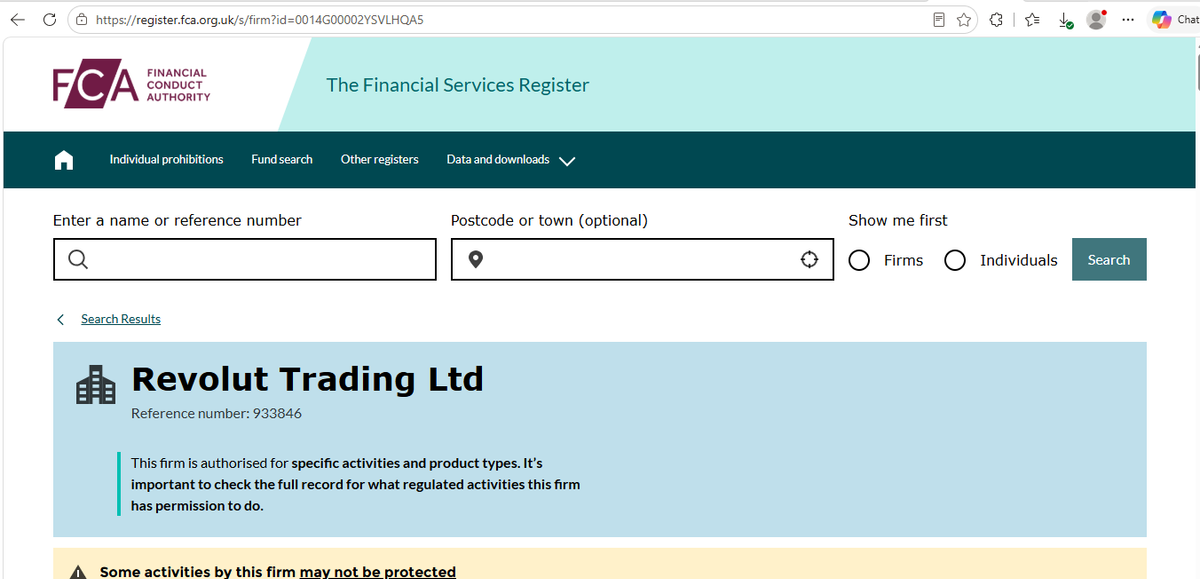
For a UK client, three group entities are relevant, and all three are identifiable on the FCA Financial Services Register. Revolut Ltd is authorised by the FCA under FRN 900562 as an electronic money institution with permissions for certain investment services. Revolut Trading Ltd is FCA-authorised for investment services under FRN 933846, and this is the entity that handles the stocks and ETFs side of the app. Revolut Bank UK Ltd is authorised by the PRA and regulated by the FCA under FRN 981170, with its full UK banking licence granted on 11 March 2026 after an earlier mobilisation stage from July 2024.
On top of these authorisations, Revolut was added to the FCA list of registered cryptoasset businesses in September 2022, which is the regime under which the spot crypto service operates. Internationally, the group also holds:
- A Lithuanian banking licence through Revolut Bank UAB, supervised by the Bank of Lithuania under the European Central Bank
- A Mexican banking licence from January 2026
- An Indian Prepaid Payment Instruments licence granted in April 2025
- An in-principle UAE payments approval from September 2025
For you as a UK client, the relevant counterparties remain the UK entities, and the EU bank in Lithuania sits outside the UK onboarding chain.
Client Fund Protection
From March 2026, cash deposits held with Revolut Bank UK Ltd are protected under FSCS up to the deposit limit of £120,000, following the full UK banking licence. Before that date, Revolut operated under safeguarding rules for e-money, without FSCS deposit protection. The move into the standard UK banking protection regime brings client cash under a stronger set of prudential rules than e-money safeguarding alone provides.
Two caveats are worth stating plainly before moving on:
- The FCA prohibits CFDs on crypto for UK retail clients, so leveraged crypto is off the table on Revolut and on any other platform serving UK retail investors.
- Commodities services on Revolut are provided by Revolut Ltd and, in Revolut's own words, are "not regulated by the FCA, and are not covered by the Financial Ombudsman Service (FOS) or protected by the Financial Services Compensation Scheme (FSCS)".
That commodities exclusion is specific to the metals exposure. For stocks, ETFs and bonds held through Revolut Trading Ltd, eligible claimants may qualify for FSCS protection up to £85,000 per eligible person, per firm, should Revolut Trading fail and be unable to return money or instruments it holds for them. FSCS does not cover ordinary investment losses.
Company History and Reputation
Revolut has grown from a card and FX startup in 2015 to a group reporting £1.3 billion in net income in 2025. A compact timeline helps as context:
- December 2018: EU banking licence via the Bank of Lithuania
- 2020: Launch in the United States
- September 2022: FCA cryptoasset registration
- July 2024: UK mobilisation banking status
- 11 March 2026: Full UK banking licence granted
User reviews online cover the full spectrum, as you would expect for a platform of this scale, and support bottlenecks come up more often than product complaints.
Account Types and Fees
Revolut uses a tiered subscription model. The published tiers are:
- Standard (free)
- Plus
- Premium
- Metal
- Ultra
- Business accounts (available separately)
There is no minimum deposit to open an account, so you can set it up, verify your identity and move money in before deciding whether a paid plan is worth it.
The recurring charges you will actually feel as a UK user tend to be:
- Currency, crypto and commodities exchange fair-usage fee: 1% on Standard and 0.5% on Plus above a combined £1,000 per month
- Weekend FX mark-up applied to currency exchange outside market hours
- ATM cash withdrawals above the plan allowance on Standard: 2%, minimum £1 per transaction
- Monthly subscription cost on paid plans (Plus, Premium, Metal, Ultra), which varies by plan and region
Stock trading commissions vary by plan, with a number of free trades per month included and a per-trade fee charged after that allowance is used. Those thresholds are set out in the pricing page and are covered in the trading costs section below. In broad terms, paid plans trade off a lower per-trade cost against a higher fixed monthly subscription, so your break-even depends on how often you actually trade.
Trading Platforms and Tools
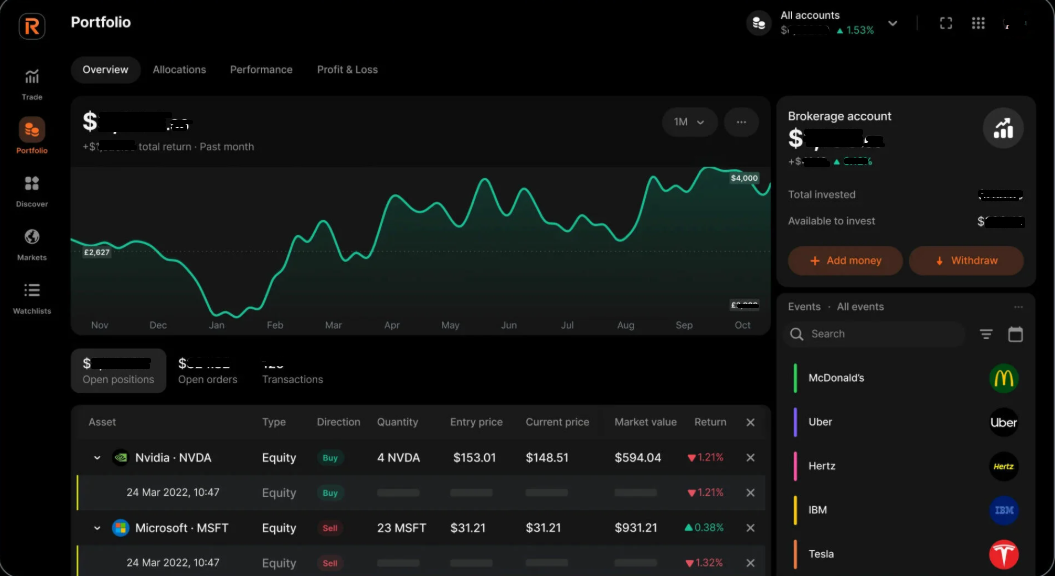
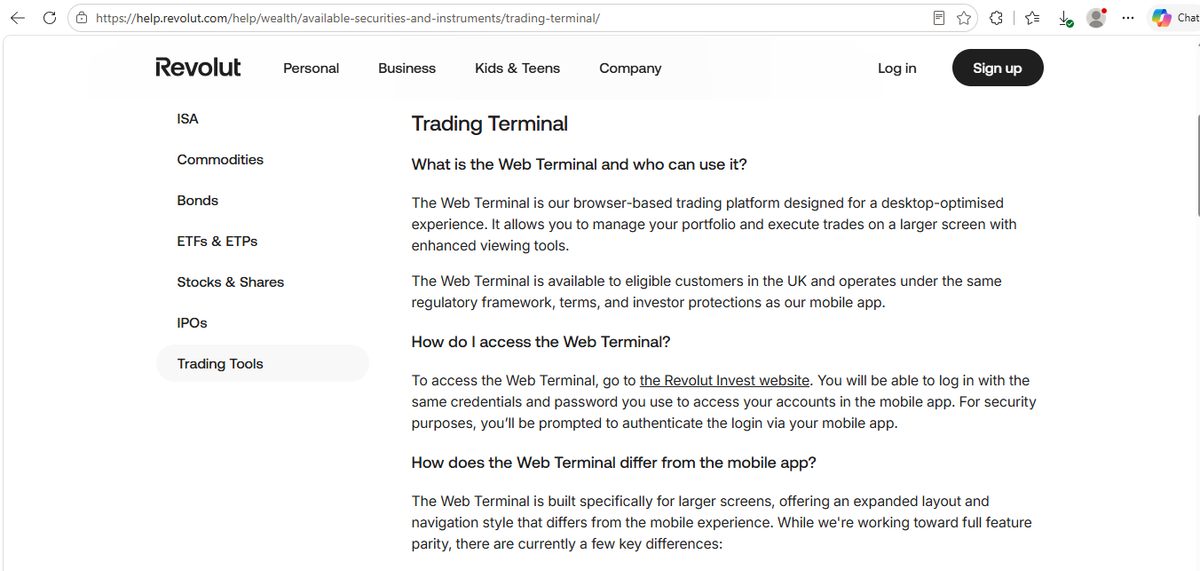
Revolut Trading Ltd states in its official risk disclosure that it "provides the investment service exclusively via the 'Invest' tab (investment platform) in the Revolut mobile app and Revolut web app". In addition, Revolut publishes a browser-based Web Terminal for eligible UK investment customers, described in its Help Centre as "our browser-based trading platform designed for a desktop-optimised experience". The Web Terminal does not have complete feature parity with the mobile app: opening a new investment account, completing initial appropriateness tests, and commodities and portfolio transfers remain mobile-only. Revolut X, a separate crypto exchange product, provides an order-book interface with its own onboarding.
Beginners benefit from one of the easier onboarding experiences in the market, since the same app that holds a current account also holds investments, so moving money from salary to shares takes only a few taps. Anyone used to professional tools will quickly feel the limits, because the charts, watchlists and price alerts on offer sit well short of the depth found on a dedicated trading platform.
On third-party trading platforms, Revolut Trading's investment terms state that "you can only submit orders and enter into transactions with us via the investment platform, and not via a third party platform". That positions Revolut as a proprietary execution environment for securities. Revolut does not publish a product-specific list that addresses integration with MT4, MT5, cTrader or TradingView, so this review stops at the terms' own statement rather than making individual claims about those platforms. Traders who want scripted strategies, scanners or a dedicated desktop terminal with Expert Advisors will typically run Revolut alongside a specialist broker that offers those tools.
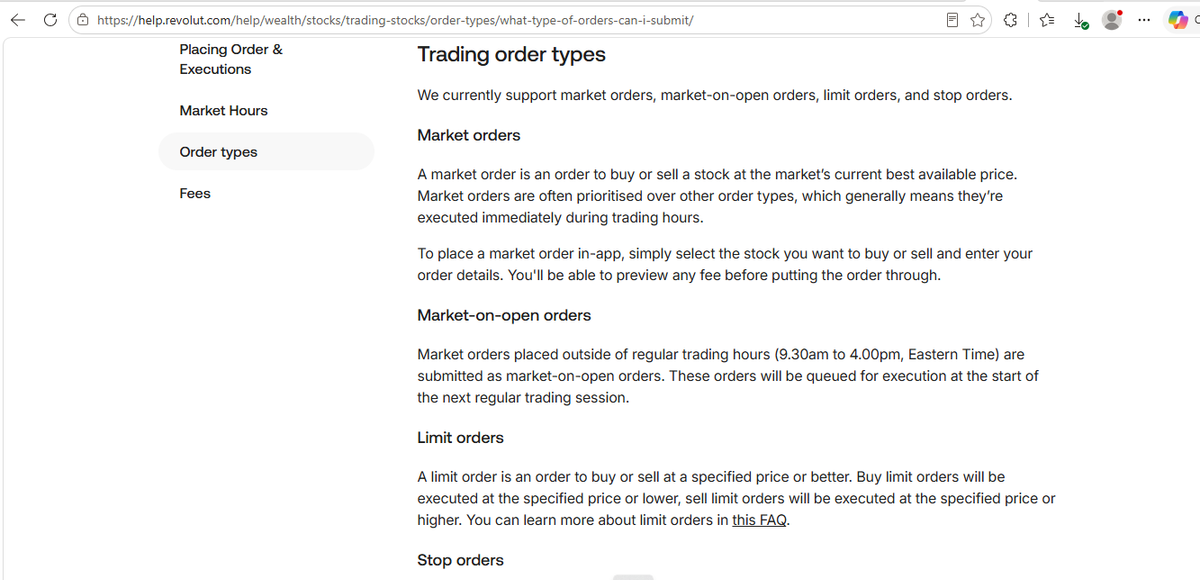
Inside the investment platform you also get a set of research and order-management tools that lift it above a plain buy-and-sell screen. Revolut publishes historical price data, company and sector pages, industry trend summaries, analyst ratings and price targets, costs and charges reports and portfolio statements, and layers on its own Revolut Suggestions with Buy, Hold and Sell classifications that combine fundamental analysis with external analyst inputs. These are informational research tools and not personalised investment advice, which Revolut Trading explicitly disclaims. On order management, the Help Centre confirms that the platform supports market, market-on-open, limit and stop orders, with recurring buy for scheduled purchases of eligible stocks and ETFs and extended-hours orders for eligible instruments. Not every order type is available for every instrument: the terms restrict certain limit and stop orders on bonds and fractional instruments, so what you can actually place depends on what you are trading.
Markets and Instruments
The investable universe inside Revolut Trading's investment platform, per the UK terms of business, covers publicly listed shares, fractional shares and other fractional instruments where available, Exchange-Traded Funds (ETFs), Exchange-Traded Notes (ETNs), Crypto ETNs (cETNs), Exchange-Traded Commodities (ETCs), government and corporate bonds, and Money Market Funds. Not every instrument is available to every customer. Alongside securities, you can access:
- US-listed NYSE and Nasdaq shares, including fractional shares, routed through DriveWealth
- London Stock Exchange shares, fractions and bonds, routed through GTN Asia Financial Services
- Tradegate Exchange instruments, routed through Upvest Securities GmbH
- Spot cryptocurrency via the standard Revolut crypto service, provided by Revolut Ltd
- Revolut X, a dedicated crypto trading venue with an order book where "you are transacting with other users of the Revolut X Services" and Revolut "does not act as counterparty"
- Precious-metal exposure in gold (XAU), silver (XAG), platinum (XPT) and palladium (XPD) through Revolut Ltd (not FCA-regulated, not covered by FSCS)
The list of products that sit outside the Revolut offer is worth setting out just as explicitly. The UK platform does not carry:
- CFDs on indices, forex pairs or shares
- Margin forex or any other leveraged product
- Funded accounts or prop-firm style challenges
On crypto, Revolut's own terms describe buying and selling cryptoassets through the standard service, with Revolut X operating as an order-book venue where users transact with other users. We describe the service as spot crypto on that basis, rather than inferring it from the FCA's retail CFD restrictions.
For UK investors used to tax-wrapped accounts, Revolut Trading Ltd does offer a UK Stocks and Shares ISA alongside the General Investment Account for eligible UK residents aged 18 or over, with the ISA sharing instruments and commission-free order allowance with the GIA. The annual subscription allowance follows HMRC rules. Revolut does not currently offer a SIPP in the UK, so if building a pension pot is part of your plan, you will need a UK-specialist broker to sit alongside Revolut.
Trading Costs and Conditions
Spread Comparison Table
The broker does not publish typical spreads on its official site, so real conditions should be verified before trading. The absence reflects Revolut's business model as a retail investment and banking app rather than a CFD or forex broker, which means there is no pip-based spread table in the traditional sense. Trading costs instead come from three streams:
- Commission on stock trades, above the monthly free-trade allowance of your plan
- Built-in spreads and fees on crypto
- FX mark-ups on currency conversion above the fair-usage limit
On stocks and ETFs, each subscription plan includes a monthly allowance of free trades. Once that allowance is used, a per-trade fee applies, and the specifics are published on the Revolut pricing page. Low-frequency traders will typically find the Standard plan enough, while heavier activity can be cheaper on a paid plan where the lower per-trade cost offsets the fixed subscription fee, so the sensible step is to run the maths against your real trading frequency.
Imagine placing 15 share trades per month on the Standard plan. If 3 of those sit inside the free allowance, the per-trade fee would apply to the remaining 12. Should a paid plan raise the monthly free allowance enough to cover all 15, the next check would be whether the subscription cost comes in below those 12 per-trade fees before deciding to switch.
On currency exchange, including conversions you need to buy foreign shares in their native currency, the fair-usage fee kicks in once your combined monthly exchange across currency, crypto and commodities exceeds £1,000. Above that line you pay 1% on Standard and 0.5% on Plus. There is also a weekend FX mark-up when markets are closed, which is standard practice but worth planning around if you tend to deposit or convert on Saturdays.
On crypto, pricing includes a built-in spread between buy and sell quotes. There is no leverage and no margin, so the costs you encounter are the quoted price and any applicable network fee on movements. Non-trading fees of note include ATM withdrawal costs of 2% with a £1 minimum above the Standard plan allowance.
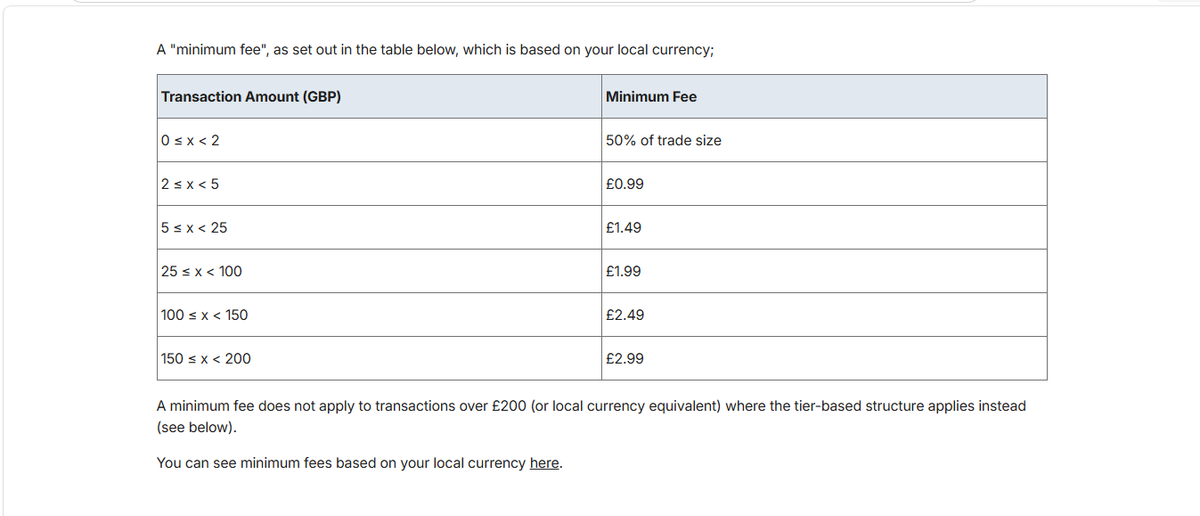
The stock-commission structure is published explicitly. Each plan carries a monthly commission-free allowance that is shared between the GIA and the ISA and resets on the rolling monthly billing cycle: 1 order on Standard, 3 on Plus, 5 on Premium and 10 on Metal and Ultra. Orders above the allowance are charged at 0.25% of order value on Standard, Plus, Premium and Metal, and 0.12% on Ultra, with a £0.01 minimum commission. On top of commission, you may also encounter ADR pass-through fees of roughly USD 0.01 to 0.05 per share, applicable regulatory transaction fees, currency conversion costs when the instrument trades in a different currency to your base, and underlying ETF, ETN, ETC or fund management charges where applicable. On commodities, Revolut's own Help Centre explains that the quoted price includes a spread with two components, the market spread and Revolut's own mark-up applied per order, so the effective cost shifts with liquidity, volatility, order size and the metal involved.
| Category | Description | Amount | Conditions |
|---|---|---|---|
| withdrawal | ATM withdrawals above the monthly fair-usage allowance on the Standard plan | 2% (minimum £1) per transaction | Applies after the rolling monthly limit for Standard customers; higher plans have larger allowances |
| conversion | Fair-usage fee on currency, crypto and commodities exchange above £1,000 per month | 1% (Standard) or 0.5% (Plus) on exchanges above the fair-usage limit | Combined monthly fair-usage limit of £1,000 across currency, crypto and commodities; weekend FX mark-ups also apply |
Taken together, Revolut's cost structure rewards light-touch investors who stay inside their monthly FX allowance and place a modest number of trades. If you convert large sums regularly or trade several times a week, run a cost estimate against your actual pattern before committing to the free plan.
On execution, Revolut Trading generally receives and transmits customer orders to external brokers rather than running its own exchange membership, with DriveWealth handling US-listed shares, GTN Asia Financial Services handling London Stock Exchange instruments and bonds, and Upvest Securities GmbH handling Tradegate. The best-execution disclosure commits to taking "all sufficient steps to obtain the best possible result" across price, costs, speed, likelihood of execution and settlement, order size and other relevant factors, and it specifically identifies the possibility of OTC execution, which introduces additional counterparty and liquidity considerations. In practice, this is an order-routing model rather than ECN access or direct market access of the kind professional trading platforms provide, and the exact routing varies by instrument and executing broker.
Deposits and Withdrawals
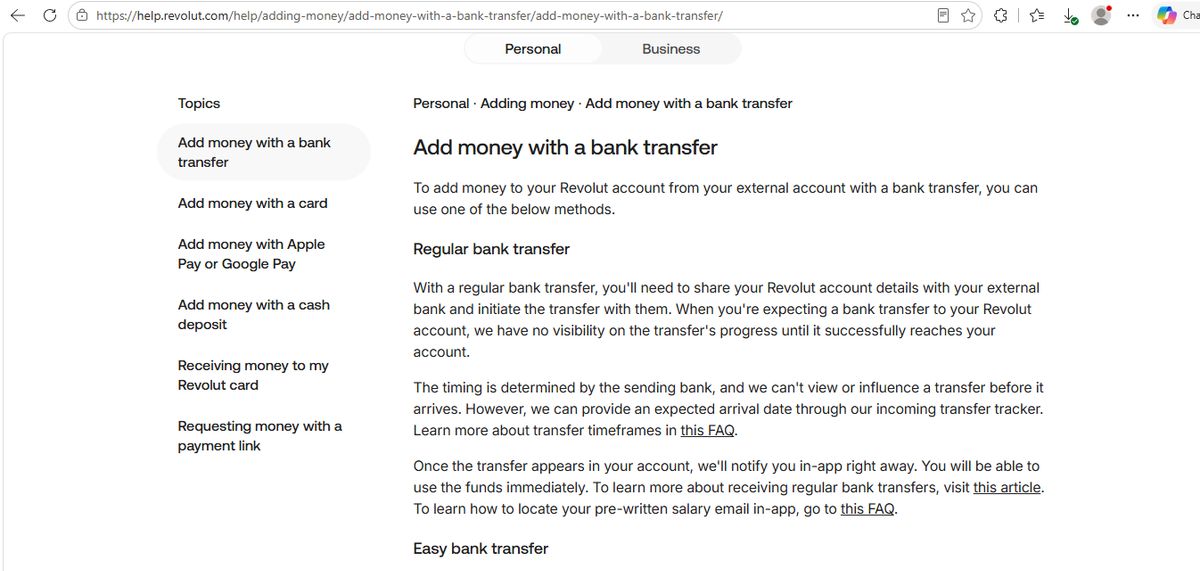
Funding your account as a UK client is one of Revolut's clearest advantages, because the banking rails are built into the same app. You have three main top-up routes:
- Faster Payments bank transfer from an external UK bank
- Linked UK debit card (Visa or Mastercard)
- Instant Revolut-to-Revolut transfers from other users
There is no minimum deposit to open or fund the account. For withdrawals, you have two main paths:
- Transfer back to your linked UK bank account via standard payment rails
- Spend or withdraw cash with your Revolut debit card, subject to your plan's ATM allowance and the 2% minimum £1 fee above it
Before you can trade, you need to complete KYC verification inside the app, which involves submitting a photo ID and a selfie liveness check. This is standard for a UK-regulated firm and should feel familiar if you have opened any UK bank account recently. Processing times for deposits via Faster Payments are usually fast within normal UK banking hours, and withdrawals to a UK bank follow standard clearing times.
Customer Support and Education
Support is delivered primarily through in-app chat, with English confirmed as a supported language in the broker record. Revolut also operates security channels for urgent card issues such as card blocking, and a Help Centre knowledge base covers payment, card and investing topics.
Trader-specific support is where the service shows its clearest gap, since there is no dedicated dealing desk and no phone broker for trading queries, so complex order questions or unusual market events get routed through the same channels used for general banking enquiries. Response times vary with queue depth, and investment-specific questions typically require escalation through those general channels, with no direct line to a specialist desk.
On education, Revolut provides introductory articles and in-app explainers aimed at beginners. The library sits well short of what a specialist UK broker offers in terms of research depth, so if you want fundamental analysis, strategy content or professional market commentary, you will need to source it elsewhere.

Revolut vs The Competition
Competitor data taken from our broker profiles; n/d when the data is unavailable.
| Feature | Revolut | Tickmill | FP Markets | GO Markets |
|---|---|---|---|---|
| Regulators | FCA, PRA, FCA, FCA | FCA (United Kingdom), CySEC (Cyprus), DFSA (Dubai), FSCA (South Africa), FSA (Seychelles) | ASIC (Australia), CySEC (Cyprus), FSCA (South Africa), cma, FSA (Seychelles), FSC (Mauritius), SCB (Bahamas) | ASIC (Australia), CySEC (Cyprus), fsc, fsa |
| Minimum deposit | $0 | $100 | $100 | $0 |
| Max leverage | No leveraged products | 1:1000 | 1:500 | 1:500 |
| Platforms | Revolut mobile app, Revolut web app | MetaTrader 4, MetaTrader 5, TradingView | MetaTrader 4, MetaTrader 5, cTrader, TradingView, IRESS | MetaTrader 4, MetaTrader 5, cTrader, TradingView |
| Spread from | check in platform (FX mark-up applies) | 0.0 pips | 0.0 pips | 0.0 pips |
| Score | 3.27 | 4.25 | 4.18 | 4.05 |
To put Revolut in context for a UK investor, three dedicated platforms serve as the usual comparison points:
- On commission-free stock trading, Trading 212 is the closest match, with a broader instrument range inside a dedicated investing-first app, where Revolut counters with banking integration.
- Against Freetrade, the conversation turns to tax wrappers: Freetrade offers UK-focused ISA and SIPP accounts that Revolut currently lacks in the UK, which can prove decisive for long-term investors who want to use their annual allowances efficiently.
- Set alongside eToro, the discussion shifts into social and copy trading, with eToro also carrying a wider CFD and crypto catalogue outside the UK, bearing in mind that crypto CFDs remain banned for UK retail clients regardless of platform.
Taken as a whole, the trade-off is reasonably clear across these comparisons. Revolut tends to lead on everyday user experience and on the ability to run banking, FX and light investing from one app, where a dedicated broker typically has the edge on product range, tax wrappers and trading tools. Many UK investors end up running Revolut for day-to-day money and a specialist platform for serious investing in parallel, with both sitting side by side.
The comparison block below places Revolut alongside Tickmill, FP Markets and GO Markets, which represent a different corner of the market built around CFDs and forex. Reading across those platforms makes the obvious point clear: for traders focused on leveraged FX, CFDs or MT4/MT5, Revolut sits in a separate category of product entirely, and the comparison is useful mostly to confirm that.
Conclusion
For a beginner or casual investor, this Revolut review lands in a straightforward place. The app suits anyone looking for a banking experience with light investing in stocks, ETFs, bonds and spot crypto, backed by FCA oversight on investment services and PRA regulation on the new UK banking entity. Several points tilt the balance in its favour for everyday users:
- No minimum deposit to open or fund an account
- Integration between the current account and the investment platform
- Group-level scale and capital position behind the service
The fit is weaker for anyone whose needs include any of the following:
- CFDs or leveraged forex
- MT4 or MT5 and third-party trading platforms
- UK ISA or SIPP tax wrappers (noting that Revolut does provide a Stocks and Shares ISA but not a SIPP)
- Professional charting and research tools
Two further points are worth keeping in mind: commodities on Revolut sit outside FCA regulation and FSCS protection, and crypto CFDs are prohibited for UK retail clients across every platform. Where any of those features are deal-breakers, the pragmatic route is to shortlist a specialist UK broker and keep Revolut for banking and casual investing.
How we rate brokers
Five weighted dimensions, two analysis levels, and a framework built for retail traders (FCA, ASIC, CySEC, NFA).
What does a pip cost you here?
Spreads are quoted in pips, which only becomes a cost once you know your lot size and pair. Put both into our pip value calculator to see what Revolut’s spread is worth per trade in your account currency.
The full ranking
See how Revolut stacks up against the other top-rated forex brokers in our independent ranking.
Frequently asked questions
Is Revolut regulated by the FCA for UK traders?
Does Revolut offer CFDs or leveraged forex to UK clients?
Are my funds protected by FSCS on Revolut?
Can I use MT4 or MT5 with Revolut?
Does Revolut offer a UK ISA or SIPP?
What does it cost to exchange currency on Revolut?
Is Revolut suitable for active day traders?
Trader reviews
Compare Revolut
Add Revolut to the comparison tool to put it side by side with other options on costs, conditions, and score.
Compare Revolut →Other brokers to consider
- Tickmill4.25 / 5Active forex traders, scalpers, and algorithmic traders who prioritize ultra-low Raw account spreads, fast execution, and zero-fee funding under strong Tier-1 regulation, over broad multi-asset coverage or weekend support.
- FP Markets4.18 / 5Intermediate to advanced traders who want platform variety (MT4, MT5, cTrader, TradingView, Iress) and broad market access (10,000+ instruments) at competitive ECN pricing, provided they register under the ASIC or CySEC entity.
- GO Markets4.05 / 5Intermediate to advanced traders who prioritise low raw-spread commissions, ASIC regulatory oversight, and platform choice across MT4, MT5, cTrader, and TradingView over structured beginner education or US/Canadian access.
About the authors
