


CFD Trading · Advanced · 8 min read
Options vs Futures: Key Differences for Retail Traders
The core distinction: obligation versus choice
At the heart of this comparison sits a legal distinction with consequences for every downstream mechanic. An option grants the holder a right that can be exercised or allowed to lapse, with any loss sealed at the premium paid on entry. A futures contract binds both parties to transact at the agreed price when the contract expires, whether through cash settlement or physical delivery of the underlying.
That asymmetry propagates through every other mechanic:
- pricing
- margining
- risk shape
- tax treatment
- exit behaviour
An options buyer pays for optionality upfront, while a futures trader rents exposure through margin and absorbs the full P&L of the underlying move. Derivatives comparison literature often blurs these contracts because both are exchange-listed and leveraged instruments with daily mark-to-market cycles. The obligation gap, however, is what determines whether your downside is a known cheque or an open tab that keeps billing until you close the position.
Futures markets in their modern form trace back to the Chicago Board of Trade in 1848, according to the CFTC, which is why their contract architecture still revolves around standardized delivery of a physical underlying.
Choosing where to trade carries real weight alongside the strategy itself; see the best forex brokers and their conditions.
How premium, margin, and leverage work differently
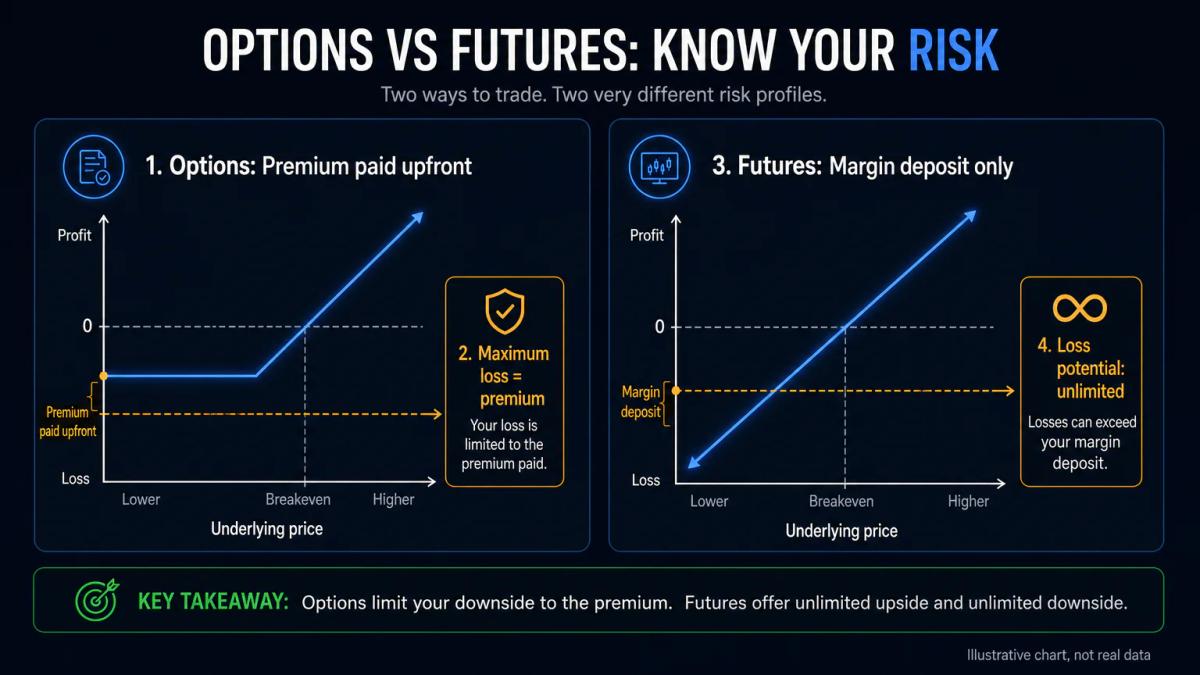
Option buyers pay a premium: an upfront debit that reflects intrinsic value plus time value plus implied volatility. That cash leaves your account on entry and defines the maximum loss on a long position. Writers (sellers) collect the premium but post margin against the obligation they have taken on, which behaves closer to a futures-style exposure.
Futures operate on a different mechanic. According to the CFTC, futures traders post initial margin that is typically between 2 and 10 percent of the total contract value, with variation margin marked to market daily. No upfront premium changes hands, so the full notional move flows through your equity each session.
The implications for leverage:
- A long option gives you fixed-cost, asymmetric exposure. Delta changes with price, so effective leverage drifts as the underlying moves.
- A futures contract gives you linear 1:1 exposure to the underlying, financed by a small performance bond.
- Writing options combines both: linear risk with a capped credit.
Consider an index future carrying 5% initial margin: it would deliver roughly 20:1 gross leverage on notional. An at-the-money option on the same index may offer higher percentage returns on premium while keeping the dollar outlay fixed and known. The useful question to ask yourself concerns the shape of leverage you want to hold overnight, since both instruments provide amplification through very different mechanisms.
Expiration, settlement, and what happens at the deadline
Both contracts expire and both can settle to cash or physical delivery, though the terminal behaviour of each diverges sharply at the deadline. An option that finishes out of the money expires worthless, and the position vanishes with the premium already paid. In the money, it is either auto-exercised, as with equity options, or cash-settled against a final reference price, as with most index options.
Futures carry a louder expiry process. If you hold a physically delivered contract past the last trading day, you enter the delivery cycle, which involves:
- notices
- warehouse receipts
- allocation
Retail traders rolling CL (crude), ZW (wheat) or similar need to close or roll before first notice day, which precedes final expiry by one to two weeks depending on the contract.
Cash-settled futures (equity indices, Eurodollar replacements, most FX futures) mark to the official settlement print, and the position is closed automatically. Should a long call move against you, the cost is capped at the premium already paid. A long future moving against you, by contrast, keeps billing your margin account until you flatten the position or variation margin calls stop you out.
Underlying assets, contract sizes, and notional value
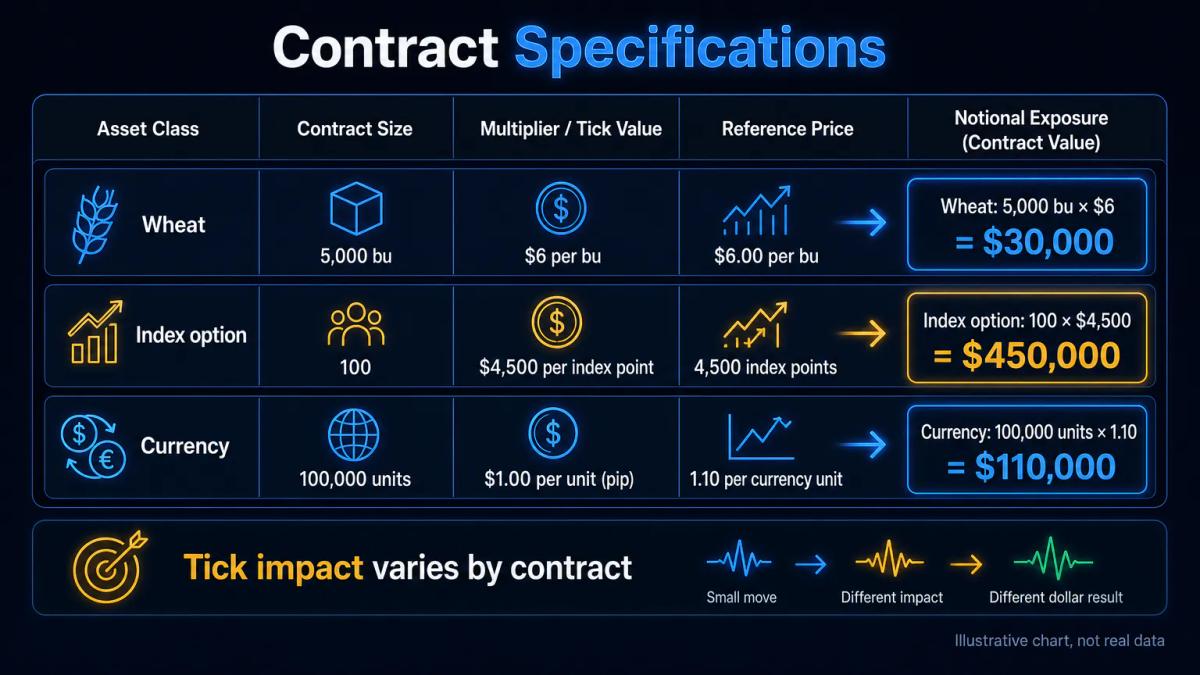
Contract specifications are where the derivatives comparison gets concrete. According to the CFTC, a standard CBOT wheat futures contract represents 5,000 bushels of wheat for delivery in Chicago. At a reference price of $6 per bushel, that would translate to $30,000 of notional per contract, with a single tick of 0.25 cents moving the P&L by $12.50.
Standard contract footprints compared:
| Contract | Underlying | Multiplier | Notional at reference price |
|---|---|---|---|
| ZW (CBOT wheat future) | Wheat | 5,000 bushels | ~$30,000 at $6 |
| ES (E-mini S&P 500 future) | S&P 500 index | $50 x index | ~$250,000 at 5,000 |
| MES (Micro E-mini S&P 500) | S&P 500 index | $5 x index | ~$25,000 at 5,000 |
| SPX option | S&P 500 index | $100 x index | ~$500,000 at 5,000 |
| Equity option (standard) | 100 shares | 100 x share price | Share-dependent |
An option's notional often exceeds that of its sibling future, though you only post the premium, which inverts the capital-at-risk ratio. Micro contracts (MES, MNQ, MCL) have narrowed the gap for retail accounts, allowing you to size exposure in increments of a few thousand dollars of notional, which sits well below the tens of thousands required by standard contracts.
Risk profiles: capped downside versus open-ended exposure
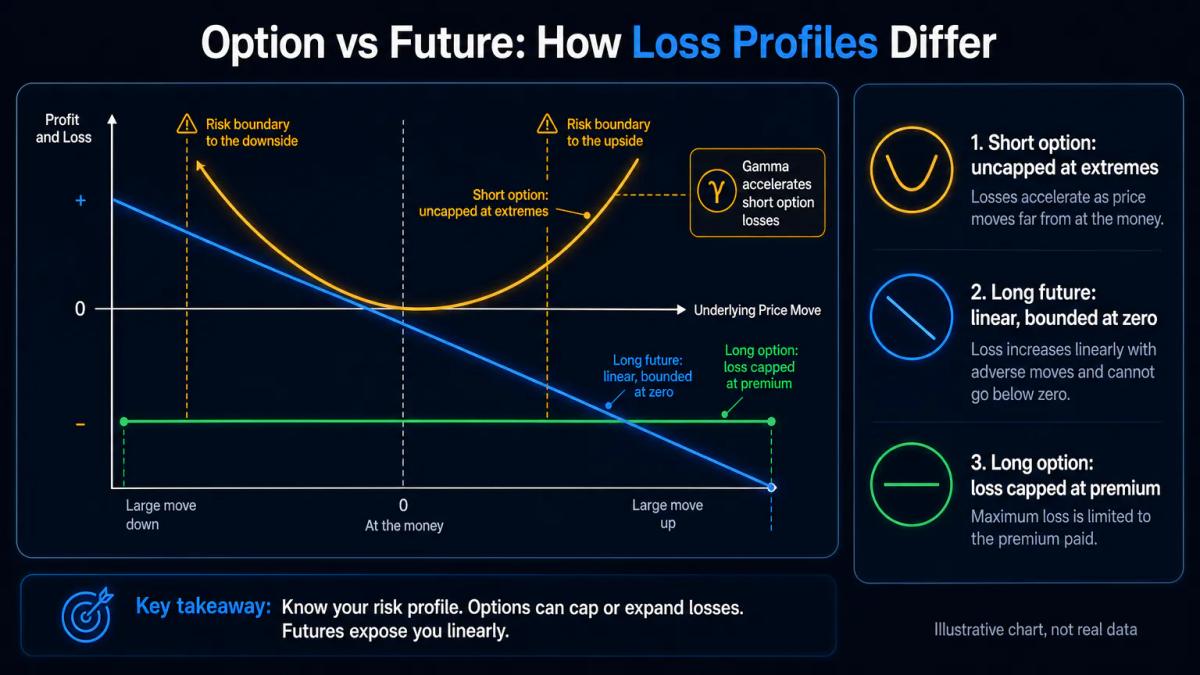
Asking which is riskier between options and futures only yields a useful answer once you specify the leg. A long option has a mathematically bounded loss equal to the premium paid at entry. A long or short future carries a loss curve that is linear and, in principle, unbounded on short positions and bounded only by zero on longs.
Short options sit between these poles, pairing a capped credit with an uncapped debit on the wrong tail. A short naked call on an index can behave worse than a short future at the extremes, since gamma accelerates losses into the move while delta rises toward one.
Margin calls amplify the asymmetry. A futures account hit by adverse variation margin can be liquidated at the broker's discretion inside the session, often at the worst price of the day. An option buyer holding a long position avoids margin calls altogether: the premium is sunk, and the broker has nothing further to demand.
For position sizing, price long options off premium at risk, and price futures off notional multiplied by a worst-case adverse excursion, with two to three times recent ATR serving as a workable floor.
Hedging and speculation: when to use each
Both instruments can hedge and both can speculate, so the choice between them turns on cost structure and on the shape of the payoff you want to carry.
Imagine you hold 500 shares of a stock trading at $200 and want three months of downside protection. Buying five 190-strike puts at $4 each would cost $2,000 and cap the loss below $190. Selling three equity index futures against a diversified book would cost no premium, though any upside above the hedge level would be given back on the futures leg.
Use options when:
- You want to retain upside while flooring downside.
- The move's timing is uncertain and you accept paying theta for optionality.
- Event risk is binary (earnings, central bank decision) and implied volatility is tolerable.
Use futures when:
- You want linear, low-cost exposure to a directional view.
- You are hedging a correlated book and the opportunity cost of giving up upside is acceptable.
- You need deep liquidity in size and immediate fills, which the top-of-book futures contracts provide.
Swing traders often blend the two instruments, using futures for the directional core and layering options on top as defined-risk tactical overlays around events.
Liquidity, bid-ask spreads, and execution reality
Front-month futures in major contracts (ES, NQ, CL, ZN, 6E) trade with one-tick spreads and depth measured in hundreds of contracts at top of book. Options liquidity, by comparison, fragments across strikes and expirations. An at-the-money weekly on a liquid index trades with pennies of spread, while a far out-of-the-money quarterly on a mid-cap stock can show spreads reaching 20% of mid.
For execution, that profile means futures tolerate market orders in retail size on the front month, while options demand limit orders and often mid-price work-ups. Deferred futures months are thinner, so rolling to the front month before taking directional exposure keeps slippage under control.
Which instrument fits your experience level and trading goals
Tax treatment adds a final filter to the decision. In the United States, Section 1256 contracts (broad-based index options, most futures, and futures options) receive 60/40 treatment: 60% long-term and 40% short-term capital gains regardless of holding period. Standard equity options follow ordinary short-term or long-term rules based on how long the position is held. For an active trader, the 1256 blended rate can meaningfully improve after-tax returns on index and futures strategies.
Matching instrument to profile:
- Day traders with small accounts: micro futures (MES, MNQ) for linear exposure, or defined-risk option spreads to avoid overnight margin.
- Swing traders: equity options for single-name directional and event trades; index futures for macro views.
- Long-term hedgers: options for insurance on concentrated equity holdings; futures for portfolio-level delta adjustments.
Retail traders also face different rules than institutions around pattern day trading, portfolio margin thresholds and position limits, which tends to bias smaller accounts toward defined-risk option structures and micro futures.
For a concrete example of costs and platform, the IC Markets review goes through them line by line.
Frequently Asked Questions
Can you lose more money trading futures than options?
Yes, on long positions. A long option's loss is capped at the premium paid. A long or short futures position has linear exposure to the underlying, and short futures carry theoretically unlimited loss. Short options sit between: capped credit, uncapped debit on the wrong tail.
Do options and futures have the same expiration dates?
They expire on set calendars but not identical ones. Equity options expire monthly and weekly; index options add quarterlies. Futures follow contract-specific cycles (quarterly for indices, monthly for most commodities) with first notice days preceding final expiry on physically delivered contracts.
Which costs less to trade: options or futures?
Per unit of notional exposure, futures are usually cheaper. There is no premium, exchange and clearing fees are low, and bid-ask spreads on front-month contracts are tight. Options carry premium outlay plus wider spreads on less liquid strikes, though micro and weekly options have narrowed the gap.
Can you use options and futures to hedge the same position?
Yes. A long equity book can be hedged with short index futures for linear downside protection, or with long index puts for asymmetric protection that preserves upside. Futures hedges are cheaper and give back upside; options hedges cost premium and keep it.
What is the difference between a futures contract and an options contract in terms of obligation?
A futures contract is a binding agreement to buy or sell the underlying at the agreed price on the expiry date. An options contract gives the buyer the right, not the obligation, to buy (call) or sell (put) at the strike price. The option writer is obligated if the buyer exercises.
About the authors


Put this into practice
Brokers we have reviewed
Scored on the same five dimensions. Here are three of them — the full list is on the brokers page.

Related articles
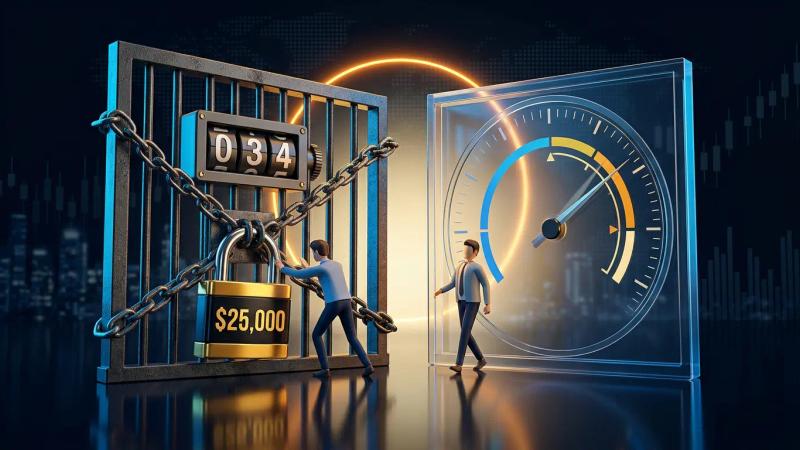
PDT Rule: What Changed and How the New Intraday Margin Framework Affects You
The PDT rule no longer forces you to hold $25,000 to day trade US equities. A new intraday margin framework has replaced it, with a $2,000 minimum and real-time monitoring.
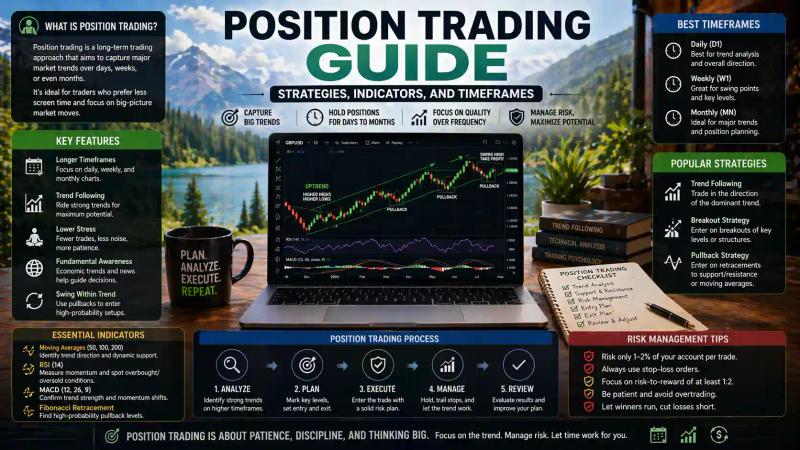
Position Trading Guide: Strategies, Indicators, and Timeframes
Learn in this position trading guide the strategies, indicators, and timeframes for capturing large market moves. Includes risk management tips
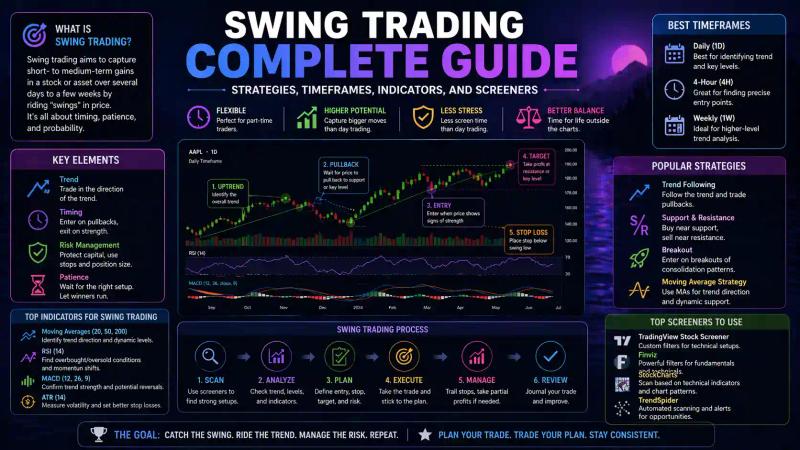
Swing Trading Complete Guide: Strategies, Timeframes, Indicators, and Screeners
Learn swing trading from timeframes and indicators to screeners and risk management. Covers stocks, forex, strategies, and building a repeatable system.
0 comments