



How to Create a Risk Management Strategy: A Step-by-Step Guide
Trading without a risk management strategy is like driving without brakes: you might get away with it for a while, but the outcome becomes predictable. A well-constructed risk management strategy protects your trading capital, helps you survive losing streaks, and provides the discipline to trade consistently over time.
This guide walks you through building your own risk management system from scratch. By the end, you’ll have a clear framework and a set of rules you can implement in your very next trading session.
This content is for informational and educational purposes only and does not constitute financial advice. Risk parameters and strategies should be tailored to your individual circumstances.

What Is a Risk Management Strategy?
A risk management strategy is a structured set of rules that determine how much capital you expose to potential loss on any given trade, day, or week. It defines the boundaries within which you operate, establishing clear parameters for position sizing, loss limits, and acceptable risk levels.
Think of it as a personal operating manual for protecting your account. Rather than making impulsive decisions based on emotion, a risk management strategy provides a predetermined framework for every scenario you might encounter:
- How much should I risk on this trade?
- When should I exit a losing position?
- At what point should I stop trading for the day?
These questions get answered before they arise.
The goal is ensuring that no single loss, or series of losses, can significantly damage your ability to continue trading.
Why Every Trader Needs a Risk Plan
Without a risk plan, traders often fall into reactive decision-making. A losing trade leads to frustration, which leads to a larger position on the next trade to “make it back,” which leads to an even larger loss. This cycle is called revenge trading, and it has ended more trading careers than any market condition.
A risk plan breaks this cycle by removing emotion from critical decisions. When your rules are set in advance, you don’t need to deliberate about how much to risk. You already know. This consistency protects you during both winning and losing periods.
A risk plan also creates accountability. When your rules are documented, you can review your adherence to them. Did you follow your position sizing rules? Did you respect your stop-loss? This kind of self-assessment is only possible when you have a clear standard to measure against.
Professional trading firms and prop firms require traders to follow strict risk parameters for exactly this reason. The rules are designed to ensure longevity.
Prop firms test exactly this discipline: compare the best prop firms.
Core Components of a Risk Management System
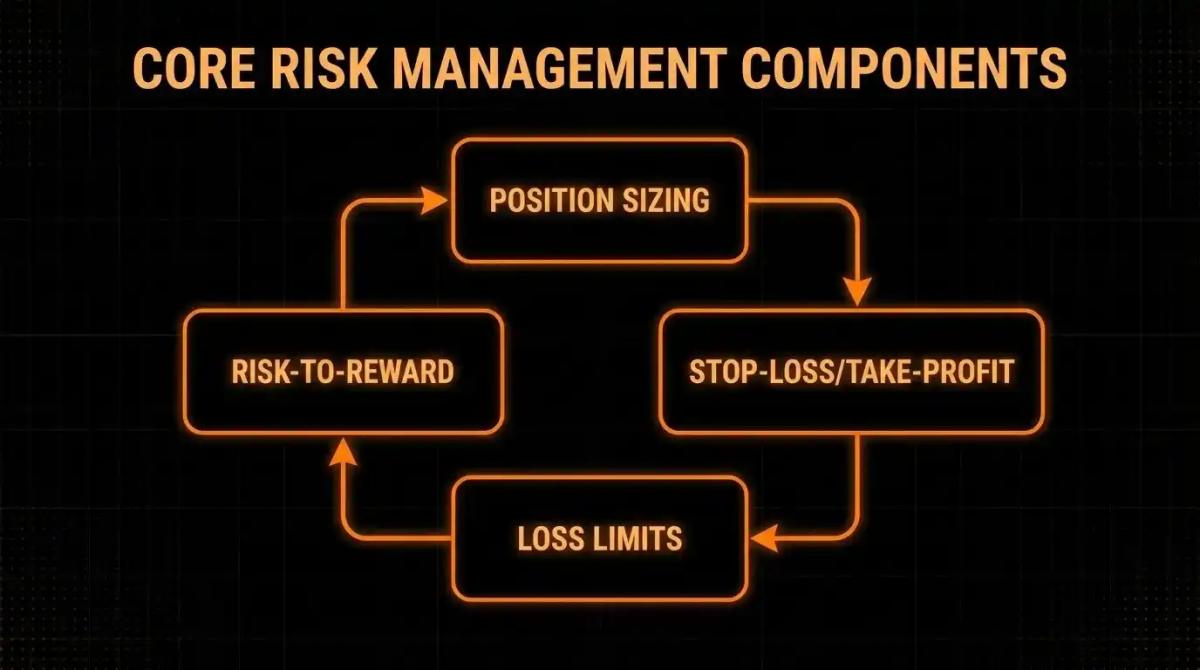
Every effective risk management system contains several interconnected elements. These components work together to create a comprehensive safety structure around your trading activity.
Position Sizing Rules
Position sizing determines how large each trade should be relative to your total trading capital. It’s arguably the most important element of risk management because it directly controls how much you stand to lose on any single trade.
Common approaches include:
- Fixed percentage risk: Risking a set percentage of your account on each trade (for example, 1% or 2%)
- Fixed dollar amount: Risking the same dollar amount regardless of account size
- Volatility-based sizing: Adjusting position size based on the volatility of the instrument being traded
The fixed percentage approach is widely used because it scales naturally with your account. As your account grows, position sizes grow proportionally. As your account shrinks, position sizes decrease: a built-in protection mechanism during drawdowns.
To calculate position size using fixed percentage risk, you need three inputs: your account balance, the percentage you’re willing to risk, and the distance to your stop-loss in price terms. The formula divides your dollar risk by the per-unit risk to determine how many units you can trade.
Stop-Loss and Take-Profit Parameters
A stop-loss is a predetermined price level at which you exit a losing trade. It limits your downside on any single position and prevents small losses from becoming catastrophic ones.
Setting effective stop-losses requires balancing two concerns. Place them too tight, and normal market fluctuations will stop you out of otherwise good trades. Place them too wide, and you risk more capital than necessary on each position.
Common methods for determining stop-loss placement include:
- Technical levels (support, resistance, swing points)
- Volatility-based measurements (ATR multiples)
- Fixed pip or point distances
- Percentage-based distances from entry
Take-profit levels work similarly but in reverse. They define where you’ll exit a winning trade. Predetermined take-profit levels help you lock in gains rather than watching profitable trades reverse into losses.
Maximum Daily and Weekly Loss Limits
Beyond individual trade risk, effective risk management includes broader loss limits that pause or stop your trading activity after reaching certain thresholds.
A daily loss limit might specify that if you lose a certain percentage of your account in a single day, you stop trading until the next day. A weekly loss limit applies the same logic over a longer timeframe.
These limits serve several purposes:
- They prevent a bad day from becoming a disastrous day
- They force you to step away when you’re likely trading emotionally
- They ensure you preserve capital to trade another day
The specific percentages vary by trader. Some use 2–3% daily limits and 5–6% weekly limits; others prefer different thresholds. The right numbers depend on your trading style, strategy, and personal tolerance for drawdowns.
Risk-to-Reward Ratio Standards
The risk-to-reward ratio compares how much you stand to lose on a trade versus how much you stand to gain. A trade with a 1:2 risk-to-reward ratio risks one unit to potentially gain two units.
Understanding risk-to-reward helps you evaluate whether a trade makes mathematical sense. Even with a modest win rate, favorable risk-to-reward ratios can produce profitable results over time. Poor risk-to-reward ratios, conversely, require very high win rates to remain profitable.
Many traders establish minimum risk-to-reward standards as part of their rules. They might refuse to take any trade that doesn’t offer at least a 1:1.5 or 1:2 ratio. This filter eliminates marginal opportunities and focuses attention on higher-quality setups.
Steps to Build Your Risk Management Strategy
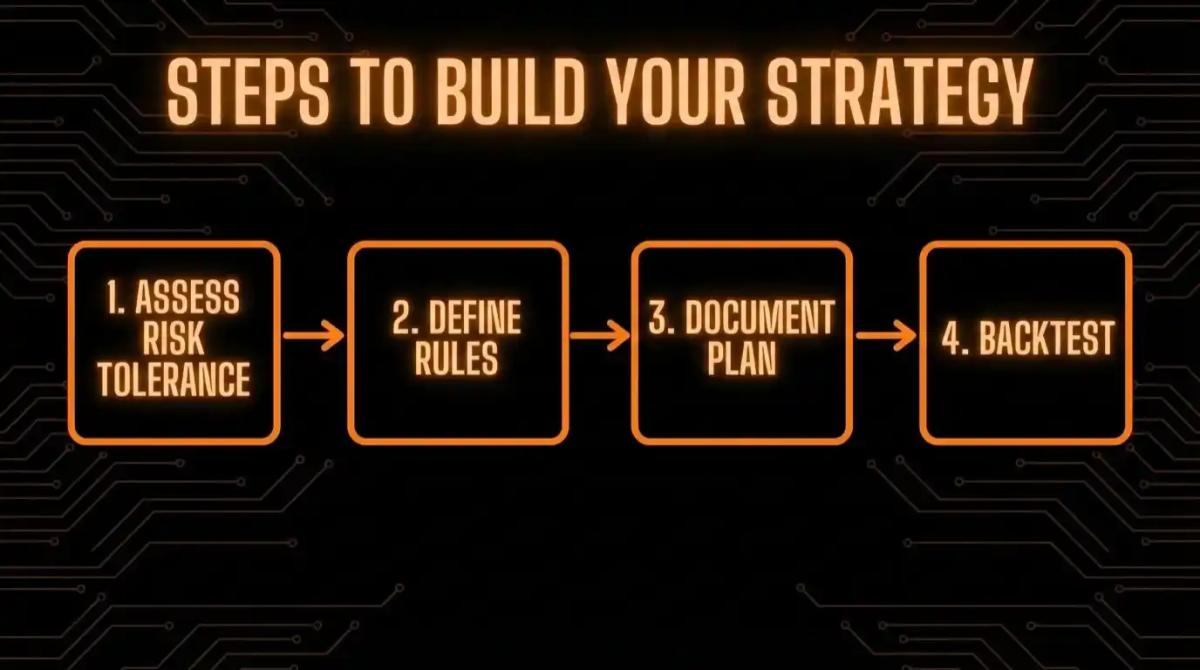
Building a risk management strategy requires honest self-assessment, clear documentation, and ongoing refinement. The following steps provide a framework you can adapt to your own situation.
Assess Your Risk Tolerance
Before setting any rules, you need to understand your own relationship with risk. Risk tolerance is personal: it depends on your financial situation, your psychological makeup, and your trading goals.
Consider questions like:
- How much of a drawdown can you endure before your decision-making becomes impaired?
- What’s the maximum percentage of your trading account you could lose without it affecting your life outside of trading?
- How do you typically react to losing trades? Do you become more aggressive or more cautious?
Be honest here. There’s no virtue in claiming high risk tolerance if you’ll actually abandon your strategy after a few losing trades. Your risk parameters need to align with what you can genuinely sustain, not what you think you should be able to handle.
Define Your Risk Rules
With your risk tolerance understood, you can define specific rules. These should cover:
- Maximum risk per trade (percentage of account)
- Stop-loss requirements (how will stop-losses be determined?)
- Daily loss limit (at what point do you stop trading for the day?)
- Weekly loss limit (at what point do you pause for the week?)
- Minimum risk-to-reward ratio for trade entry
- Maximum number of concurrent positions
- Maximum exposure to correlated instruments (if applicable)
Each rule should be specific and measurable. “Risk a small amount per trade” is not a rule. “Risk no more than 1% of account equity per trade” is.
Document Your Risk Plan
Writing down your rules transforms them from intentions into commitments. A documented risk plan creates a reference you can consult during trading and a standard you can measure yourself against afterward.
Your documentation should include:
- All risk rules with exact parameters
- The reasoning behind each rule
- Specific scenarios and how they should be handled
- Procedures for what happens when rules are violated
Keep this document accessible. Some traders print it and place it near their trading workspace. Others save it digitally and review it before each session.
Backtest and Validate
Before implementing your risk management strategy with real capital, validate it against historical data. This means checking whether your risk parameters would have protected your capital through various market conditions.
Review historical drawdown periods and ask: Would my daily and weekly loss limits have protected me? Would my position sizing rules have preserved enough capital to recover?
If possible, forward-test your risk management rules in a demo environment or with very small position sizes. This allows you to experience following the rules in real-time before significant capital is at stake.
Common Risk Management Mistakes to Avoid
Even traders who understand risk management intellectually often make errors in execution. Awareness of these mistakes can help you sidestep them.
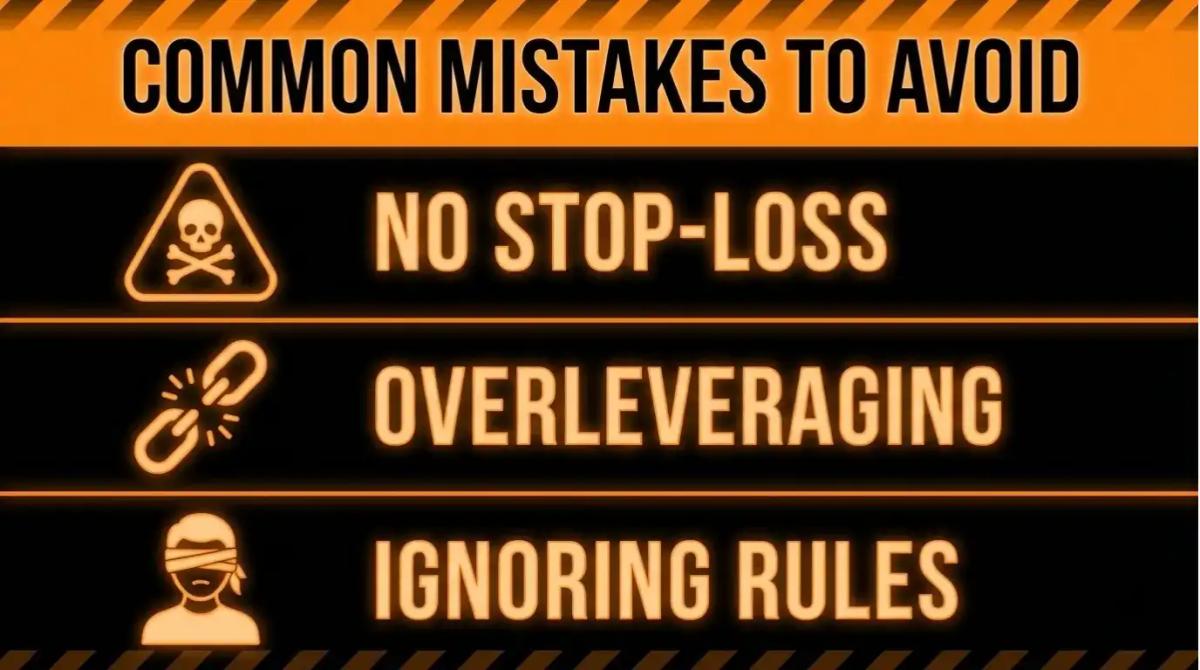
Moving stop-losses further away: When a trade moves against you, the temptation to move your stop-loss to avoid being stopped out can be strong. This single mistake has caused more damage to trading accounts than almost any other behavior. Your stop-loss was placed for a reason: moving it invalidates your original risk assessment.
Increasing position size after losses: The urge to “make back” recent losses by trading larger is a form of emotional trading. This approach often accelerates losses rather than recovering them.
Abandoning rules during winning streaks: Risk management can feel unnecessary when everything is going well. But markets cycle, and the winning streak will end. Maintaining consistent risk parameters during profitable periods ensures you keep those gains when conditions change.
Setting rules but not following them: Having a risk plan is meaningless if you override it in the moment. This often happens gradually: one small exception leads to another, until the rules exist only on paper.
Using arbitrary or unrealistic parameters: Risk rules should be based on your actual risk tolerance and trading style, not copied wholesale from someone else. Parameters that don’t fit your situation will be difficult to follow consistently.
How to Stick to Your Risk Rules
Creating rules is easier than following them. The discipline required to adhere to a risk management strategy, especially during stressful market conditions, is what separates successful traders from those who struggle.
Several practices can strengthen your discipline:
Pre-session review: Before each trading session, review your risk rules. This primes your mind to follow them and surfaces any rules you might have started to neglect.
Checklists before trade entry: Create a simple checklist that must be completed before entering any trade. Include risk-related items: Is my position size correct? Is my stop-loss set? Does this trade meet my minimum risk-to-reward requirement?
Post-session journaling: After each session, record not just your trades but your adherence to your risk rules. Did you follow every rule? If not, what happened? This creates accountability and reveals patterns in your behavior.
Automated enforcement where possible: If your trading platform allows it, consider using features that automatically enforce some of your rules. Hard stops, automatic position sizing calculators, and daily loss circuit breakers remove the need for willpower in certain situations.
Accept that some losses are correct: A trade that hits your stop-loss isn’t a failure, it’s your risk management working as intended. Reframe rule-following as success, regardless of whether individual trades win or lose.
When to Revise Your Risk Management System
A risk management strategy isn’t permanent. As your trading evolves, your account size changes, or market conditions shift, your rules may need adjustment.
Consider revisiting your strategy when:
- Your account size has changed significantly (grown or shrunk)
- You’ve changed trading styles or timeframes
- You’ve identified patterns in your trading journal suggesting certain rules are too tight or too loose
- External circumstances have changed your financial situation or risk tolerance
When making revisions, avoid changing rules impulsively in response to short-term results. A few losing trades don’t necessarily mean your rules are wrong. Give any set of rules adequate time to demonstrate their effectiveness before modifying them.
Document all changes along with your reasoning. This creates a record that helps you understand the evolution of your approach and prevents you from repeating unsuccessful changes.
The goal is continuous improvement, not constant tinkering. Revise thoughtfully and infrequently, always with reference to data rather than emotion.

About the authors


Put this into practice
Related articles

How to Find the Right Risk-Reward Ratio for Your Trades
Learn how to calculate risk-reward ratio, understand what makes a good RRR, and choose the right ratio for day trading or swing trading strategies.

How to Plan an Exit Strategy for Trading
Learn how to build an exit strategy for trading. This guide covers take profit rules, stop losses, and how to plan exits before entering any trade.

Market Volatility Explained: What It Is and Why It Matters
Learn what market volatility means, how it's measured, and why it matters. Understand price fluctuations and make informed trading decisions
0 comments