



Trading Plan Guide: What It Is and How to Create One
Most traders figure this out the hard way: technical skill alone won’t make you consistent. The gap between traders who find their footing and those who keep spinning their wheels usually comes down to something more fundamental: a trading plan.
A trading plan is your personal rulebook for the markets. It takes the guesswork out of decisions and provides structure when emotions threaten to take over. In other words, it gives you a framework for disciplined execution.
This guide covers what goes into a trading plan, why it matters, and how to build one from scratch. By the end, you’ll have a clear structure to adapt to your own style and goals.

What Is a Trading Plan
Definition and Purpose
A trading plan is a document that spells out your complete approach to trading. It defines what you’ll trade, when you’ll trade, how you’ll get in and out of positions, how much you’ll risk, and how you’ll measure your performance over time.
Think of it as a business plan for your trading. A business owner wouldn’t operate without understanding their costs, revenue targets, and procedures. Traders benefit from the same kind of documented guidelines governing their market activity.
Beyond organization, a trading plan serves three core functions:
- Decision framework: Clear criteria for taking or passing on trades, eliminating ambiguity from your process
- Emotional buffer: Predetermined rules that help override impulsive reactions when markets get choppy
- Performance benchmark: Measurable standards for evaluating results and spotting areas that need work
Why Traders Need a Written Plan
Plenty of traders carry a general idea of their approach in their heads but never write it down. The problems with this tend to surface gradually.
Without a written plan, decisions drift. A setup that looked compelling on Monday might get ignored on Thursday just because your mood changed. This inconsistency makes it nearly impossible to tell whether your strategy has merit or whether sloppy execution is dragging down your results.
Writing things down also creates accountability. When rules exist only in your head, rationalizing deviations becomes effortless. A documented plan gives you something concrete to compare against your actual behavior.
There’s another benefit: the writing process itself forces clarity. Traders who sit down to document their approach often find gaps: situations they hadn’t considered, rules that contradict each other. Better to discover these on paper than in a live trade.
Strict risk rules are how funded traders survive — see the best prop firms.
Key Components of a Trading Plan
A complete trading plan covers several interconnected elements. Each serves a distinct purpose, and together they form a comprehensive framework for your trading activity.

Trading Goals and Objectives
Start with clearly defined goals. These give you direction and a way to measure progress.
Effective trading goals are specific and measurable, not vague wishes. Think about both process goals and outcome goals:
- Process goals center on behaviors within your control: following your entry rules on every trade, completing market analysis before the session opens
- Outcome goals relate to results: hitting a certain return percentage, maintaining a target win rate
Goals also need to be realistic given your experience, capital, and time. Unrealistic targets breed frustration and often push traders toward excessive risk.
Risk Management Rules
Risk management is the backbone of any sustainable trading approach. This section defines how you’ll protect your capital from excessive losses.
Address these elements:
- Maximum risk per trade: The percentage of your account you’re willing to lose on any single position (commonly between 0.5% and 2%).
- Maximum daily or weekly drawdown: The threshold that triggers a break from trading, preventing emotional decisions during losing streaks.
- Maximum portfolio exposure: Limits on total capital deployed at any given time.
- Correlation considerations: Rules about holding multiple positions in related instruments.
Your risk management rules should be specific enough to apply consistently, without room for interpretation in the moment.
Entry and Exit Criteria
This component defines exactly when you’ll open and close positions. Vague criteria like “buy when the trend looks good” lead to inconsistent execution. Specify conditions that leave minimal room for subjectivity.
Entry criteria might include:
- Specific technical patterns or price action setups.
- Indicator readings or combinations.
- Fundamental conditions or news events.
- Time-of-day or session requirements.
Exit criteria should cover both winners and losers:
- Stop-loss placement: Where you’ll exit to cap losses, and whether stops are fixed or trailing.
- Take-profit targets: How you determine where to close winning positions.
- Time-based exits: Whether you close positions after a set period regardless of outcome.
- Scaling rules: Whether you exit full positions at once or piece them out.
Position Sizing Guidelines
Position sizing determines how large each trade will be relative to your account. This connects directly to your risk management rules, translating your maximum risk per trade into actual quantities.
Include a clear method for calculating position size based on:
- Your predetermined risk amount.
- Your risk-reward ratio.
- The distance to your stop-loss.
- The instrument’s characteristics (lot size, point value, etc.).
Consistent sizing prevents a common trap: trading too large on high-conviction setups and too small when you’re less sure.
Market and Instrument Selection
Define which markets and instruments you’ll trade. Trying to follow too many typically leads to shallow analysis and missed opportunities.
Specify:
- Which asset classes you’ll focus on (forex, equities, futures, crypto, etc.).
- Specific instruments within those classes (particular currency pairs, indices, commodities, or stocks).
- Criteria for adding or removing instruments from your watchlist.
- Any instruments or sectors you’ll specifically avoid.
This focus lets you develop real familiarity with how your chosen markets behave.
Trading Schedule and Timeframes
Define when you’ll trade and analyze the markets:
- Trading sessions: Which market hours you’ll be active.
- Chart timeframes: Which timeframes you use for analysis and entry.
- Analysis schedule: When you conduct research and prepare for upcoming sessions.
- Off-limits periods: Times you won’t trade: around major news events, during personal commitments.
Matching your trading schedule to your lifestyle and peak performance hours makes a real difference in consistency.
Record Keeping and Review Process
A trading plan without a review process is incomplete. Define how you’ll track trades and evaluate performance.
Include:
- What you’ll record for each trade (entry, exit, reasoning, emotional state, screenshots, etc.).
- How often you’ll review results (daily, weekly, monthly).
- What metrics you’ll track (win rate, average win vs. average loss, expectancy, maximum drawdown, etc.).
- How you’ll spot patterns in your performance.
Keeping a trading journal gives you the data to improve systematically rather than relying on memory..
How to Create a Trading Plan Step by Step
Building a trading plan means working through each component systematically. Here’s a structured approach.
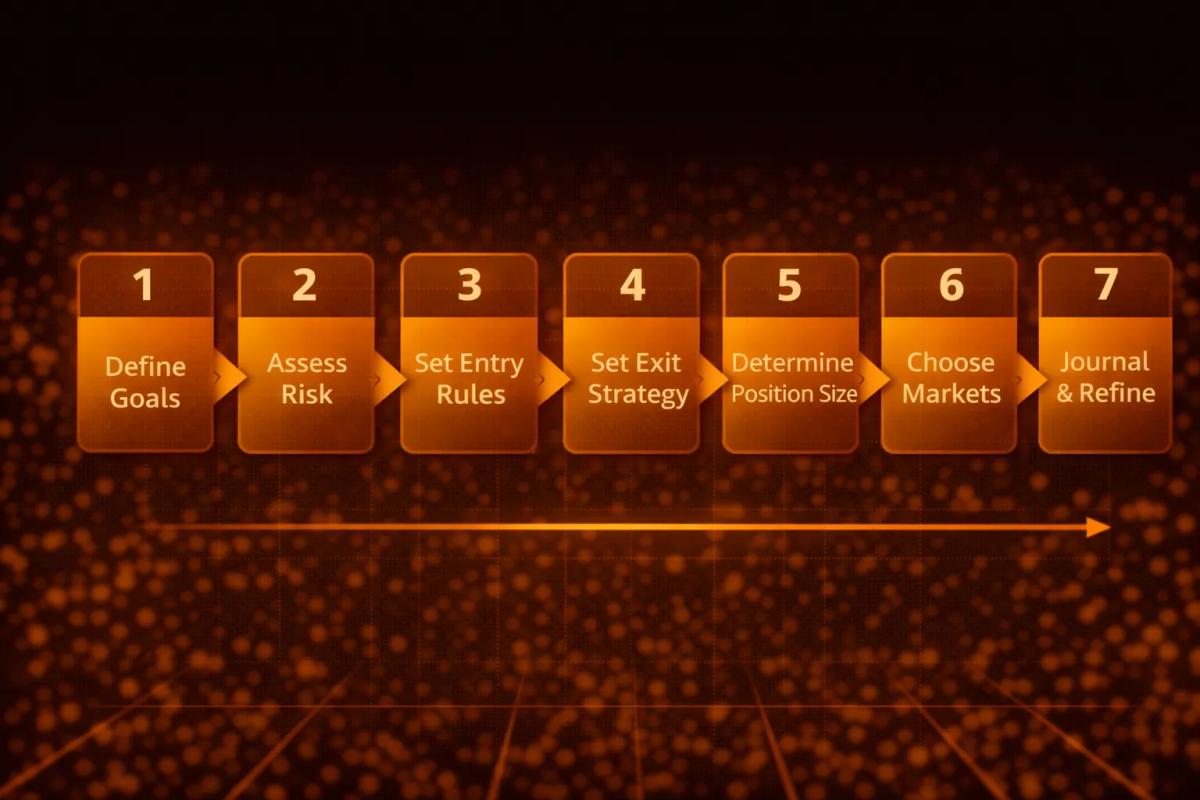
Step 1: Define Your Trading Goals
Start by clarifying what you want from trading. Write down both long-term objectives and shorter-term milestones.
Ask yourself:
- What am I trying to accomplish? (Income, wealth building, skill development, etc.)
- What return targets are realistic given my experience and capital?
- What process improvements do I want to focus on over the next 30, 90, and 180 days?
- How much time can I realistically commit each week?
Document your answers in specific, measurable terms. “Become profitable” is too vague. “Achieve positive expectancy over 50 trades while keeping drawdown under 10%” gives you something to work toward.
Step 2: Assess Your Risk Tolerance
Figure out how much capital you can risk without it affecting your emotional stability or daily life. This requires honest self-reflection.
Consider:
- What percentage loss would cost you sleep or push you toward irrational decisions?
- How would a 10%, 20%, or 30% drawdown affect your psychology?
- What’s your current financial situation, and how does it shape your risk capacity?
Based on this, set your maximum risk per trade and drawdown limits. These numbers need to feel sustainable during losing streaks, not just acceptable when you’re winning.
Step 3: Choose Your Markets and Instruments
Select markets based on your schedule, capital, and interests.
Consider:
- Market hours and whether they fit your availability
- Capital requirements and leverage characteristics
- Volatility and whether it matches your risk tolerance
- Your existing knowledge or curiosity about specific markets
Start narrow. It’s easier to expand later than to spread yourself thin from the start.
Step 4: Establish Entry and Exit Rules
Define the specific conditions required before entering a trade. Be precise.
For each setup you plan to trade, document:
- What market conditions must exist (trend direction, volatility level, etc.)
- What specifically triggers your entry
- Where your stop-loss goes relative to your entry
- How you’ll determine profit targets or exit criteria
- Any conditions that would invalidate the setup
Test your rules against historical charts to confirm they identify the situations you intend to trade.
Step 5: Set Position Sizing Parameters
Create a consistent method for determining position size. The most common approach calculates size based on your risk percentage and the distance to your stop.
Example calculation:
- Account size: $10,000
- Risk per trade: 1% = $100
- Stop-loss distance: 50 pips
- Position size: $100 ÷ 50 pips = $2 per pip (adjust for your specific market)
Write out your formula so you can apply it mechanically every time.
Step 6: Create a Trading Journal System
Design a record-keeping system that captures what you need for meaningful review.
Essential fields:
- Date and time of entry and exit
- Instrument and direction
- Entry price, stop-loss, and target
- Position size and risk amount
- Reason for taking the trade
- Outcome (profit or loss in currency and R-multiple)
- Notes on execution and emotional state
- Screenshots at entry and exit
Your journal can be a spreadsheet, dedicated software, or a structured notebook. Format matters less than actually maintaining it.
Step 7: Test and Refine Your Plan
Before committing real capital, test your plan through paper trading or very small positions. This surfaces practical issues and builds confidence.
During testing:
- Follow your plan exactly as written
- Note any situations where rules feel ambiguous
- Flag any rules that prove impractical in real-time
- Track results to verify performance
After sufficient testing, refine based on what you learned. This cycle of testing, reviewing, and adjusting should continue throughout your trading career.
Common Trading Plan Mistakes to Avoid
Even traders who create plans often undermine them through predictable errors.
Making the plan too complex. Dozens of rules and conditions become impossible to follow consistently. Start with essentials and add complexity only when genuinely needed.
Creating rules you can’t follow. A 0.25% risk per trade sounds conservative, but if you routinely break this limit, it serves no purpose. Rules must match your actual behavior.
Failing to define exceptions. What if news breaks while you’re in a position? What if your platform glitches? Plans without provisions for common exceptions leave you improvising.
Never updating the plan. Markets shift. Your skills develop. A plan written years ago may no longer fit current conditions or your improved abilities. Schedule regular reviews.
Ignoring the plan during winning streaks. Discipline erodes when things go well. Traders start taking setups outside their plan or sizing up because they’re on a roll, then give back gains when conditions revert.
Treating the plan as permanent. Some traders resist modifications, viewing changes as admitting failure. A trading plan should evolve based on evidence, not stay frozen out of stubbornness.
How to Stick to Your Trading Plan
Creating a plan is the easy part. Following it consistently is harder. A few practices help.
Keep your plan visible. Print it or keep it on screen while trading. Physical proximity makes deviation a conscious choice rather than an unconscious slide.
Use checklists. Before any trade, run through a checklist confirming all criteria are met. This simple step catches impulsive trades before they happen.
Start each session with intention. Review your plan before the market opens. Remind yourself of your rules and mentally commit to following them.
Conduct post-session reviews. After each session, compare your trades against your plan. Note any deviations and what prompted them.
Create accountability. Share your plan with a trading partner or mentor. Knowing someone will review your adherence raises the stakes.
Address emotional triggers. If certain conditions consistently cause you to deviate, identify those patterns and build specific protocols for handling them.
Trading psychology plays a significant role here. Accepting that emotional impulses will arise, and preparing strategies to manage them, makes consistency more attainable.
Trading Plan Template Overview
A template provides structure for organizing your plan. Here’s an outline of what a comprehensive version typically includes.
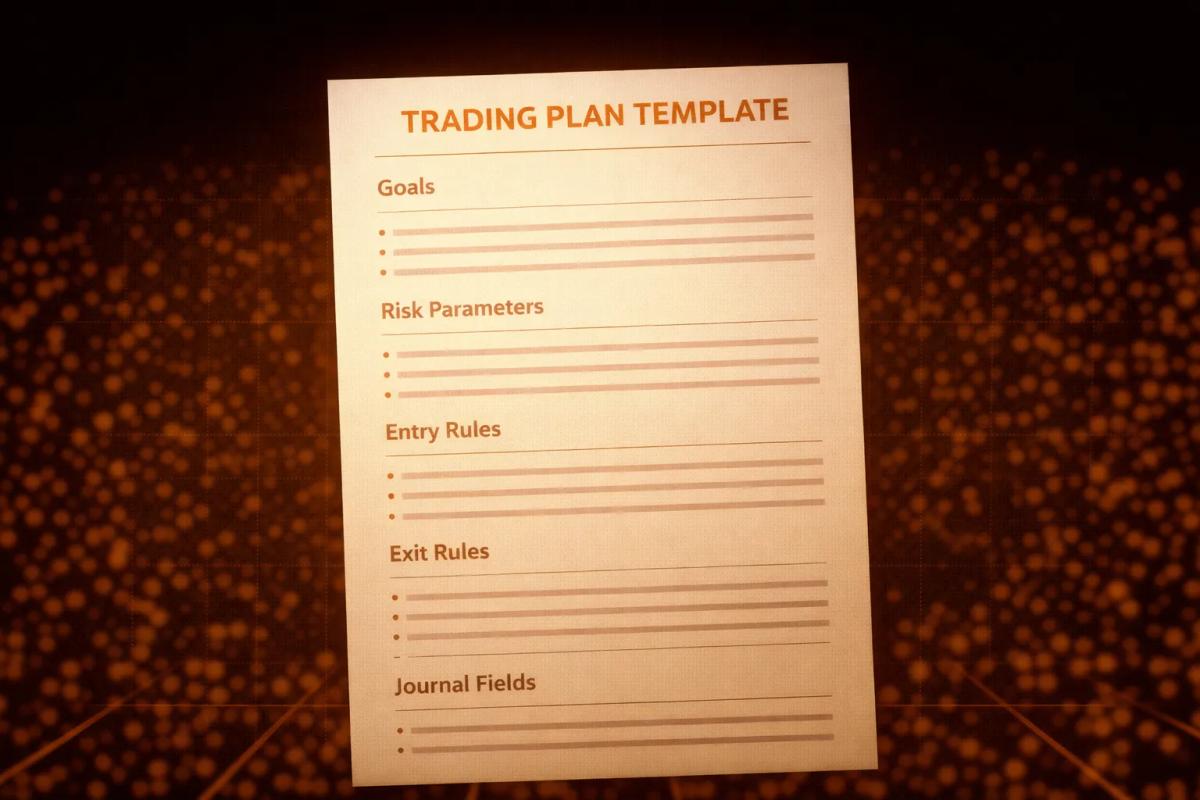
Trader Profile and Goals
- Trading objectives (short-term and long-term)
- Time commitment and schedule
- Experience level and ongoing education plans
Risk Parameters
- Maximum risk per trade
- Maximum daily and weekly loss limits
- Maximum portfolio exposure
- Drawdown management rules
Market Selection
- Instruments traded
- Criteria for watchlist inclusion
- Markets and conditions to avoid
Entry Rules
- Setup definitions with specific criteria
- Confirmation requirements
- Invalidation conditions
Exit Rules
- Stop-loss placement methodology
- Profit target approach
- Trailing stop rules (if applicable)
- Time-based exit conditions
Position Sizing
- Calculation method
- Adjustment rules for volatility or account changes
Trading Journal Fields
- Required data points for each trade
- Performance metrics to track
- Review schedule
Plan Review and Updates
- Frequency of plan review
- Criteria for rule modifications
- Version tracking
Adapt this structure to your trading style and requirements. The template is a starting point, not a rigid format.
Warning: This content is for educational purposes only and does not constitute financial advice. Trading involves substantial risk of loss and is not suitable for all investors. Past performance does not guarantee future results. Consider your financial situation and risk tolerance carefully before trading.
Frequently Asked Questions
How long should a trading plan be?
Length matters less than completeness and clarity. What counts is covering all essential components in enough detail to apply your rules consistently without guessing.
Do professional traders use trading plans?
Professional traders and institutions typically operate with extensive documentation governing their activity. Formats vary, but the principle of written rules for decision-making is standard among consistent performers.
How often should I update my trading plan?
Review at least quarterly, or whenever you spot consistent problems with your current rules. Base updates on evidence from your journal rather than reactions to single trades. Avoid changes during emotional periods or right after losses.
Can I have multiple trading plans for different strategies?
Yes. Traders running multiple strategies often maintain separate plans or distinct sections within a master plan. Each strategy should have its own rules for entries, exits, risk, and applicable conditions.
What if my plan isn't working?
First, figure out whether the problem is the plan or your execution. Check your journal: did you follow your rules consistently? If execution was solid but results are poor, consider whether conditions have changed or whether your rules need adjustment. Make changes methodically, based on data, not after a rough week.
Is a trading plan the same as a trading system?
A trading system usually refers to specific rules for identifying and executing trades: your entry and exit criteria. A trading plan is broader: it includes your system along with risk management, goals, scheduling, journaling, and other operational elements. Your system is one piece of the larger plan.
About the authors


Put this into practice
Related articles

Trailing Stop Loss: Definition and Usage
Learn how trailing stop losses work, when to use them, and how to set the right trail distance. Practical guide covering mechanics, advantages, and common mistakes.

VIX Fear Index: What It Is, How It Works, and What It Tells Traders
Learn what the VIX Fear Index measures, how it's calculated from S&P 500 options, how to interpret its readings, and how traders use it for sentiment and hedging.

What Is Your Trading Risk Profile?
Learn what a trading risk profile is, discover the three main types, and find out how to assess your own risk tolerance to make smarter trading decisions
0 comments