



What is Risk Management in Trading?
Risk management in trading is the process of identifying, assessing, and controlling potential losses across your trading activity. It encompasses the strategies, techniques, and rules traders use to protect capital from significant drawdowns while still participating in market opportunities.
Every trade carries uncertainty. Prices move against positions due to volatility, unexpected news, or sentiment shifts that no analysis could anticipate. Risk management acknowledges this reality and builds safeguards around it. Rather than trying to avoid losses entirely (which is an impossible goal) effective risk management keeps losses small and manageable relative to overall capital.
The core idea is straightforward: preserve your ability to keep trading. A trader who loses 50% of their account needs a 100% return just to break even. A trader who limits losses to small, controlled amounts maintains the flexibility to recover and capitalize on future opportunities. This mathematical reality underpins every serious approach to trading risk management.
This article is for educational purposes only and does not constitute financial advice. Readers should consult a qualified professional before making any trading decisions.

Why Risk Management Matters in Trading
The Role of Capital Preservation
Capital is your primary tool as a trader. Without it, you cannot participate in markets, test strategies, or act on favorable setups. Capital preservation is about ensuring no single trade or series of trades can eliminate your ability to trade.
Think of capital as inventory for a business. A retailer who loses all their inventory in one bad decision cannot continue operating. A trader who risks too much on any single position faces the same possibility: catastrophic loss that ends their trading activity entirely.
Preserving capital also preserves optionality. Markets present opportunities continuously, but acting on them requires available funds. Traders who manage risk effectively stay in the game long enough to encounter favorable conditions and compound results over time.
Why Most Traders Fail Without It
Studies and industry data consistently show that a large majority of retail traders lose money. While many factors contribute, inadequate risk management ranks among the most significant.
Traders without structured risk controls often fall into predictable patterns:
- Risking inconsistent amounts, sometimes betting heavily on high-conviction ideas that turn out wrong
- Holding losing positions too long, hoping for recovery rather than accepting small losses
- Increasing position sizes after losses to recover quickly, which often accelerates drawdowns
- Lacking predefined rules, leading to emotional decisions under pressure
Without risk management, even a trader with sound analytical skills can suffer account-ending losses. One or two large mistakes can undo months of careful work. Risk management transforms trading from gambling into a structured activity with defined boundaries.
Prop firms test exactly this discipline: compare the best prop firms.
Core Principles of Trading Risk Management
Risk Per Trade
The risk-per-trade principle establishes a maximum amount you’re willing to lose on any single position, typically expressed as a percentage of total trading capital.
A widely referenced guideline suggests risking no more than 1–2% of your account on any single trade. With a $10,000 account and a 1% rule, your maximum loss on any trade would be $100.
This approach offers several benefits:
- A string of losing trades, inevitable for every trader, won’t devastate your account
- Emotion is removed from position sizing decisions
- Consistency allows you to evaluate strategy performance over many trades
The specific percentage depends on your circumstances, trading style, and risk tolerance. Some traders use 0.5%; others go up to 2%. What matters is establishing a consistent limit and sticking to it.
Risk-to-Reward Ratio
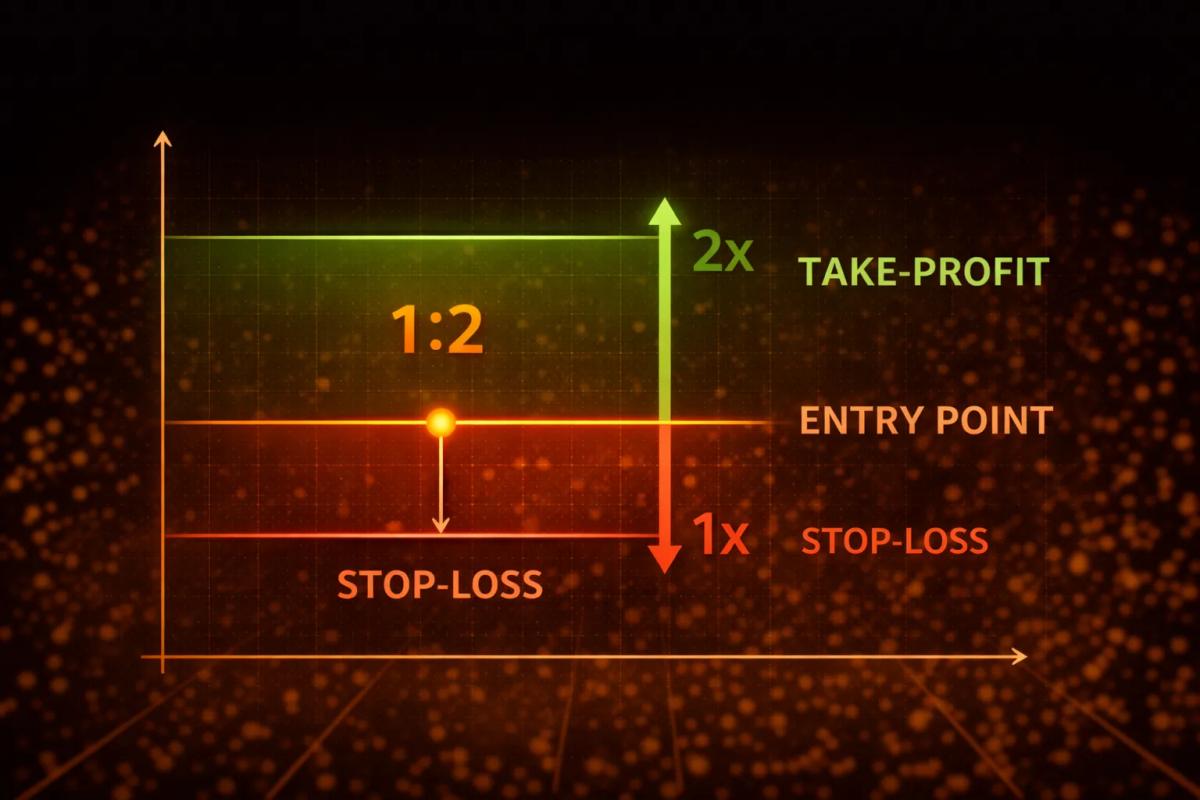
The risk-to-reward ratio compares potential loss to potential gain, expressed as a ratio like 1:2 or 1:3.
A 1:2 ratio means risking one unit to potentially gain two. If your stop-loss represents $100 of risk, your profit target would be $200.
This matters because it determines how often you need to be right to stay profitable. With a 1:2 ratio, you can be wrong on half your trades and still break even (excluding transaction costs). With a 1:3 ratio, you only need to be right once in every four trades to break even.
Traders evaluate risk-to-reward before entering a position. If a setup doesn’t offer an acceptable ratio (because the logical stop-loss is too far from entry or the realistic profit target is too close) many traders will pass on the trade entirely.
Position Sizing
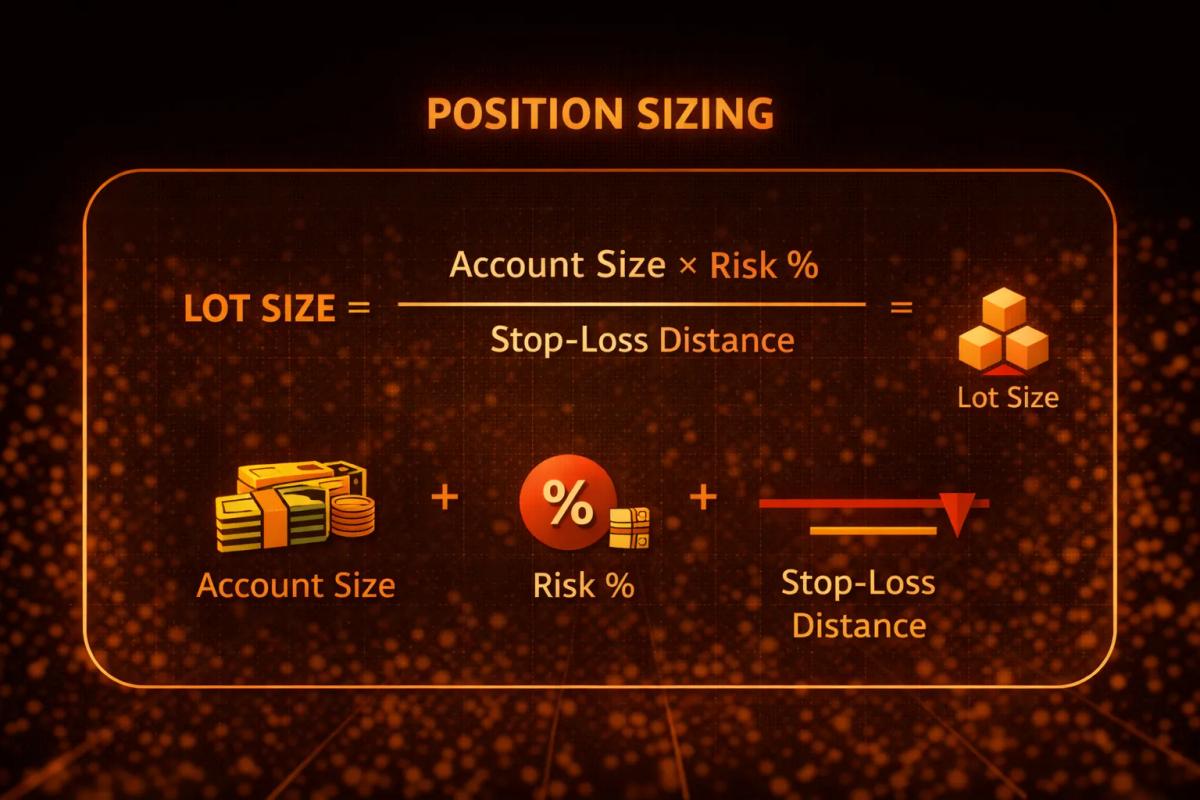
Position sizing determines how large your trade should be given your risk parameters. It connects your risk-per-trade limit to the specific conditions of each trade.
The basic calculation considers three factors:
- Your account size
- Your risk percentage per trade
- The distance between entry price and stop-loss price
If you have a $10,000 account, risk 1% per trade ($100), and your stop-loss sits 50 pips away on a forex trade, your position size would be calculated so that a 50-pip loss equals exactly $100.
Position sizing ensures your predetermined risk limit translates into an actual dollar amount, regardless of instrument or volatility. A volatile asset with a wide stop-loss requires a smaller position than a stable asset with a tight stop-loss to maintain the same dollar risk.
Essential Risk Management Techniques
Stop-Loss Orders
A stop-loss order instructs your broker to close your position automatically when price reaches a specified level. It marks the point where your trade thesis is invalidated and you accept the loss.
Stop-losses serve several functions:
- They define maximum loss before you enter the trade
- They remove the need for constant monitoring
- They prevent emotional decision-making when a trade moves against you
- They ensure one bad trade cannot cause unlimited damage
Placement typically reflects technical levels (below support for long positions, above resistance for shorts) or volatility-based calculations. The goal is placing the stop where, if reached, the trade setup is genuinely no longer valid.
Some traders avoid stop-losses, believing they get “stopped out” just before price reverses. While this frustration is understandable, trading without stops exposes you to catastrophic losses during gap moves, flash crashes, or unexpected news events.
Diversification
Diversification means spreading exposure across different assets, markets, or strategies rather than concentrating in a single position or correlated set of positions.
The principle is straightforward: when multiple positions are correlated, they tend to move in the same direction simultaneously. If you hold five positions that all respond similarly to the same market factor, you effectively have one large position with five times the intended risk.
Practical diversification considerations include:
- Trading instruments across different asset classes (equities, forex, commodities)
- Avoiding concentration in a single sector or theme
- Considering correlation between positions before adding new exposure
- Recognizing that apparent diversification can mask hidden correlations, especially during market stress
Diversification can reduce the impact of any single position moving sharply against you.
Managing Leverage
Leverage allows you to control a larger position than your capital would otherwise permit. While this amplifies gains, it equally amplifies losses.
With 10:1 leverage, a 10% move against your position eliminates your entire capital. With 50:1 leverage, a 2% adverse move does the same. Many retail traders are drawn to high leverage for its profit potential without fully appreciating how quickly it can destroy an account.
Prudent leverage management involves:
- Understanding the actual leverage your position represents, not just the maximum offered
- Sizing positions so effective leverage remains modest
- Recognizing that high leverage and sound risk management are often incompatible
- Being especially cautious with leverage during volatile conditions or around major news events
Many experienced traders use far less leverage than is available, preferring capital protection over maximizing potential returns.
How to Build a Risk Management Plan
Define Your Risk Tolerance
Risk tolerance is the amount of loss you can sustain (financially and psychologically) without affecting your ability to trade rationally or meet personal obligations.
Financial risk tolerance considers your overall financial situation. Trading capital should generally be money you can afford to lose without impacting essential expenses or financial security.
Psychological risk tolerance considers your emotional response to losses. Some traders accept drawdowns calmly; others become anxious or make poor decisions after relatively small losses. Understanding your own responses helps you set appropriate limits.
Your risk tolerance should inform your risk-per-trade percentage, overall market exposure, and the types of instruments and strategies you employ.
Set Rules Before You Trade
A written trading plan with risk management rules removes ambiguity and reduces emotional decision-making. Before entering any trade, you should know:
- Your maximum risk per trade
- Where your stop-loss will be placed
- Your profit target and the risk-to-reward ratio
- How much capital will be exposed to the market at any time
- Under what conditions you’ll reduce exposure or stop trading
Writing these rules down creates accountability. When a trade moves against you and emotions run high, predetermined rules provide a framework for action that doesn’t depend on in-the-moment judgment.
Review and Adjust
Markets and account sizes change, and your understanding of your own trading evolves.
Regular review should include:
- Examining whether actual risk per trade matches intended risk
- Assessing whether stop-loss placements are appropriate
- Evaluating whether overall exposure has grown beyond comfortable levels
- Considering whether market conditions warrant adjustments
Traders who keep a journal often find patterns in their risk management behavior, like consistently moving stops or exceeding risk limits in certain situations. This awareness enables targeted improvements.
Common Risk Management Mistakes to Avoid
Even traders who understand risk management principles fall into common traps. Recognizing these patterns helps you sidestep them.
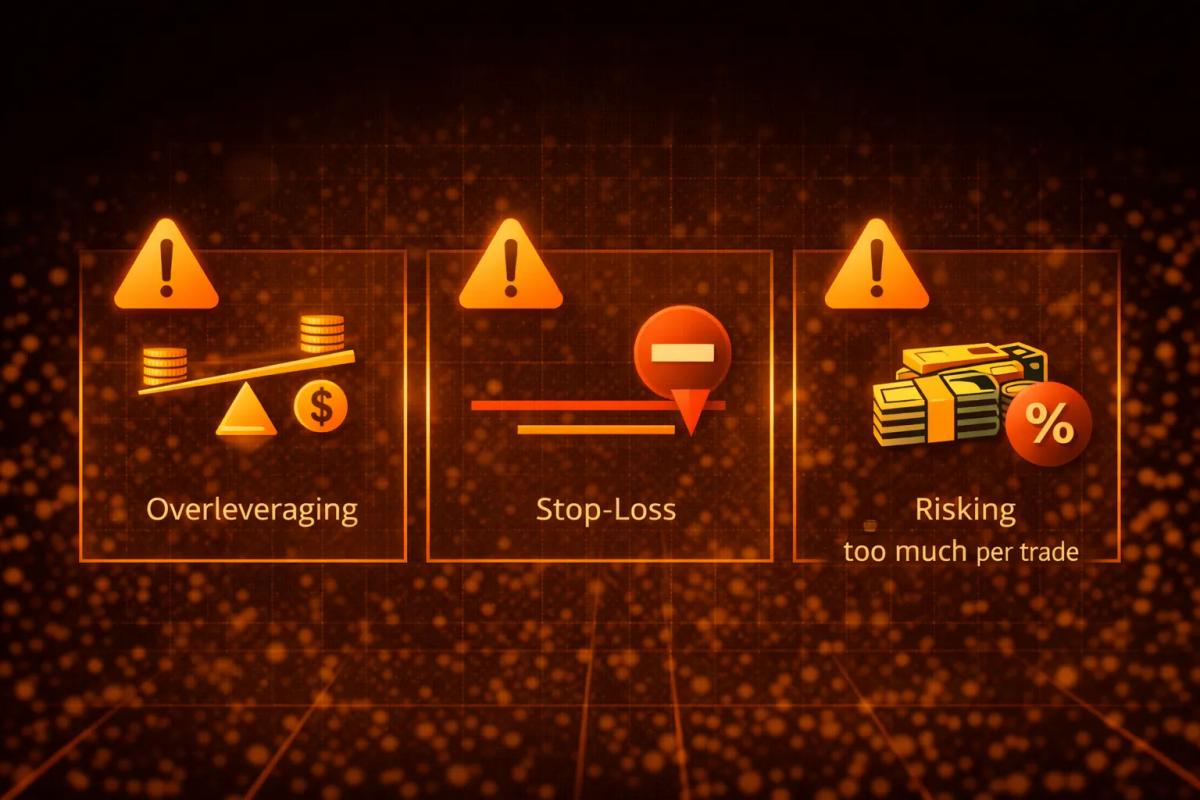
Risking too much per trade. Exceeding your predetermined risk limit, especially on trades that feel certain, is one of the fastest ways to damage an account. No trade is certain, and outsized positions on “sure things” have ended many trading careers.
Moving or removing stop-losses. When a trade approaches your stop level, the temptation to give it “more room” can be strong. This transforms a defined, limited loss into an undefined, potentially unlimited one. If your stop placement was logical at entry, moving it usually reflects hope rather than analysis.
Averaging down on losing positions. Adding to a losing position to improve your average entry price increases exposure to a trade already moving against you. While this occasionally works, it more often magnifies losses.
Ignoring correlation. Holding multiple positions that respond similarly to the same market factor (without recognizing this) can result in unexpected concentrated losses.
Trading without a plan. Improvising risk decisions in the moment leads to inconsistent outcomes and makes it difficult to evaluate or improve your approach.
Overleveraging. Using excessive leverage to chase larger profits often results in rapid account depletion when trades move adversely.
Frequently Asked Questions
What is the 1% rule in trading?
The 1% rule is a risk management guideline suggesting traders should not risk more than 1% of total trading capital on any single trade. With a $10,000 account, your maximum loss on any trade would be $100. This approach helps ensure a series of losing trades doesn't significantly deplete your capital.
How do I calculate my position size?
Divide your dollar risk amount by the distance to your stop-loss. If you have a $10,000 account, risk 1% ($100), and your stop-loss is $2 away from entry, divide $100 by $2 to get a position size of 50 shares or units. The specific calculation varies by instrument type.
Can risk management guarantee I won't lose money?
No. Risk management cannot prevent losses. They're an inherent part of trading. What risk management does is limit individual losses and protect overall capital so you can continue trading and recover from inevitable losing trades.
What is a good risk-to-reward ratio?
Many traders aim for a minimum of 1:2, targeting profits at least twice the size of potential loss. The right ratio depends on your win rate and trading style. A trader with a high win rate might accept lower ratios, while a trader with a lower win rate needs higher ratios to remain profitable.
Should I always use a stop-loss?
Using stop-losses is generally considered fundamental to risk management. While some advanced strategies employ alternatives, for most traders (especially those newer to markets) stop-losses provide essential protection against large, unexpected losses. Traders considering capital allocation through prop firms or funded trading programs will typically find strict risk management is required.
How often should I review my risk management plan?
Regular review is advisable. Many traders do so weekly or monthly. Review after any significant drawdown, changes to account size, or notable shifts in market conditions. Your plan should evolve as your trading and circumstances change.
About the authors


Put this into practice
Related articles

Cognitive Bias in Trading: How Mental Blind Spots Hurt Your Results
Learn how cognitive biases like confirmation bias and loss aversion affect your trading decisions. Discover practical techniques to recognize and overcome them.

Common Trading Mistakes and How to Avoid Them
Learn the most common trading mistakes that cost beginners money. Discover how to identify and avoid these errors to protect your capital and improve results.

Forex Risk Management: How to Protect Your Trading Capital
A practical guide to forex risk management: position sizing, stop losses, hedging, FCA leverage caps and the psychology that keeps your rules intact.
0 comments