



Trading Basics · Intermediate · 7 min read
Equity vs Balance in a Trading Account: What's the Real Difference
The core difference: static money versus real-time value
Open any MT4, MT5 or cTrader terminal, and in the account window two figures sit side by side where you might expect one. They often match to the cent, which is why many new traders assume the platform is showing the same number twice. In reality, each figure measures a distinct aspect of your account, and the design decision to display both is deliberate.
Balance records the cash you have deposited, adjusted for the profit or loss on trades you have already closed. Equity, by contrast with that static ledger figure, represents what your account would be worth right now if every open position were settled at the current market price, which is why it moves with every tick. With no positions open, the two figures line up exactly; the moment a single trade is live, they begin to drift apart, and the space that opens up between them is where risk, margin and forced liquidation operate.
The figure your broker's risk engine watches is equity, because equity reflects what you would actually have in the account if every open trade closed at the next tick. Many traders instinctively anchor on balance, since it looks like the money they put in and it only moves when a trade is settled, so the gap in perspective between trader and platform tends to widen in exactly the moments when it should narrow.
Putting this into practice means opening an account: start with the best forex brokers our team reviewed.
How balance stays fixed while equity moves
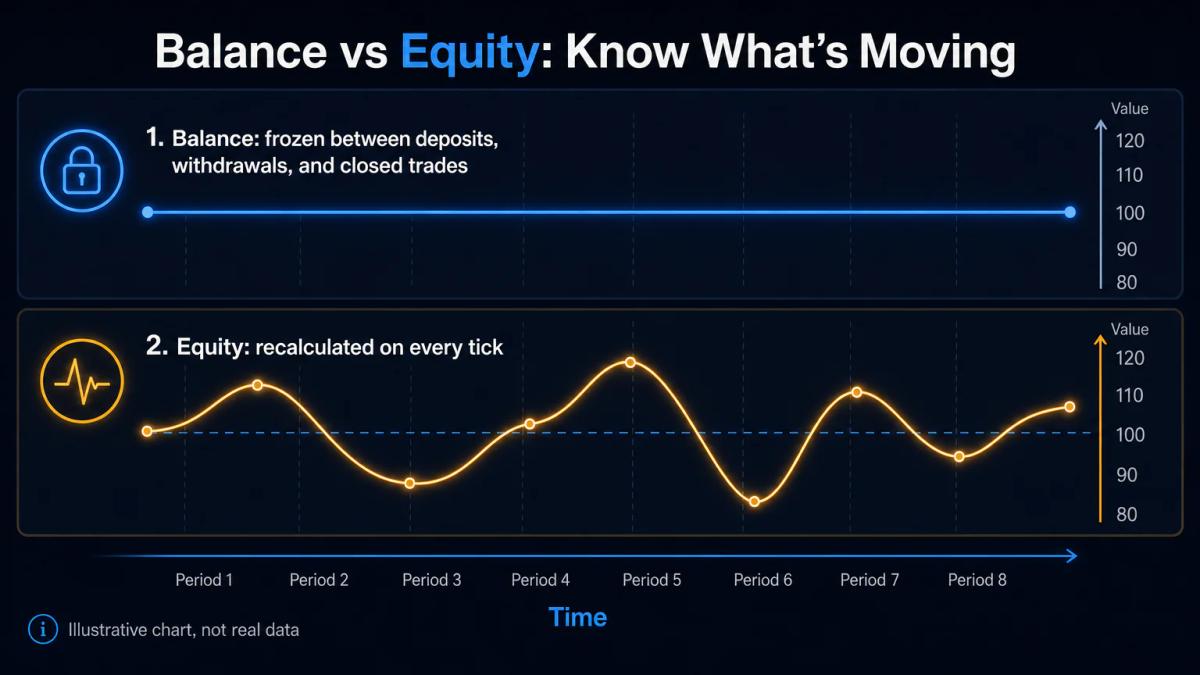
Think of balance as a ledger entry that only updates when a cash event hits the account, whether that is a deposit, a withdrawal, or the closure of a trade that locks in a realised profit or loss. Between those events, the figure sits still, and you can watch EUR/USD swing fifty pips in either direction without the balance line twitching at all.
Equity, meanwhile, is a live calculation that your platform recomputes on every price tick for every instrument you hold, taking your balance and adding the floating profit or loss on each open position. Imagine that you are long one lot of GBP/USD and the quote moves against you by ten pips: equity drops immediately by the pip value of those ten pips, while the balance figure stays exactly where it was.
Consider two accounts that both show a balance of $10,000. The first trader holds no open positions and therefore shows equity of $10,000 as well. The second trader is sitting on a losing position that carries $2,000 of unrealised loss, which drags equity down to $8,000. Both accounts look identical on the balance line, yet only one of them is a bad tick away from a margin call, which is why reading equity alongside balance tells you something the balance figure alone cannot.
Floating profit or loss, sometimes labelled unrealised P&L, is the live gap between your entry price and the current market price on each open position, multiplied by position size.
Floating profit and loss: the bridge between the two
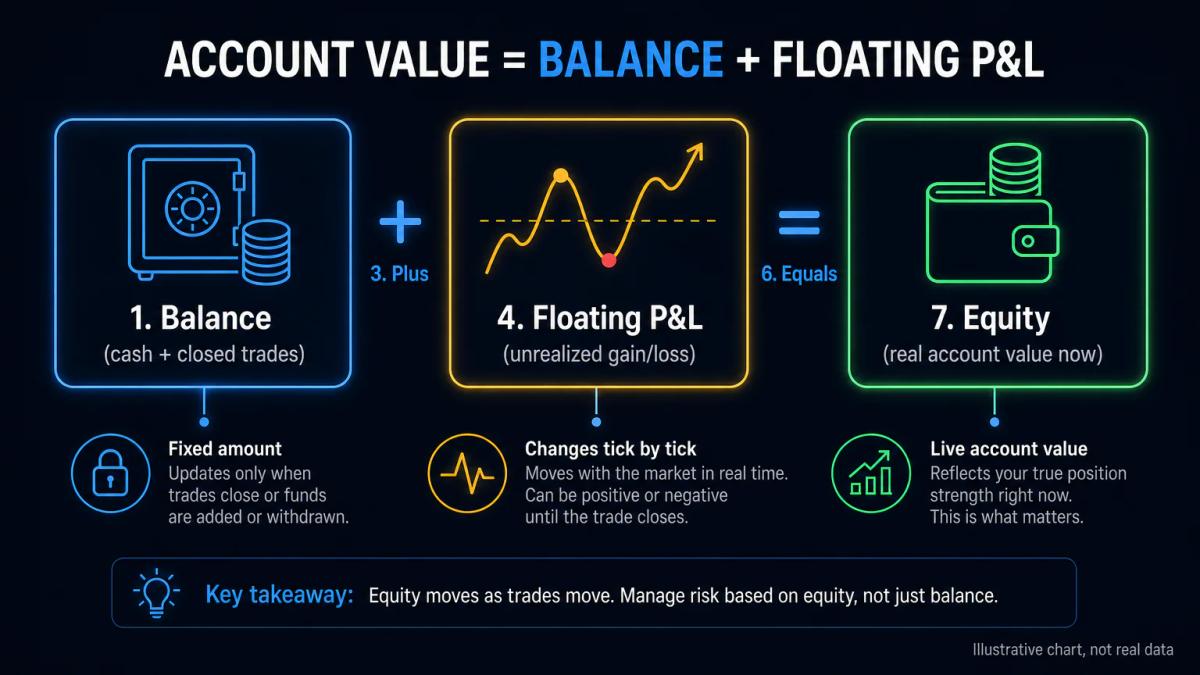
Floating profit or loss is the component that explains why equity drifts away from balance, since it captures the unrealised gain or loss on every open position in your account currency and feeds that figure directly into the equity line. The formula your platform runs continuously is straightforward enough to write out: equity equals balance plus floating P&L, less any accrued swap and commission that have yet to be realised.
At the moment you close a trade, the floating P&L on that position collapses to zero and transfers across to balance as a realised result. Equity itself tends to stay roughly where it was in the instant before the close, because it had already been reflecting that profit all along, and what you see is balance moving up to catch equity rather than equity jumping to catch anything.
Suppose that you deposit $5,000 and open a long position on EUR/USD. The quote moves in your favour, and the platform shows $300 of floating profit, so your balance remains at $5,000 while equity reads $5,300. Should you close the trade at that point, balance moves up to $5,300 and equity sits at the same figure. If instead the trade reverses and you close out at a $200 loss, balance drops to $4,800 and equity follows it down.
Why equity drives margin calls on your account
Your broker monitors equity because that figure reflects the real value sitting in the account at any given instant, and if equity falls below the margin requirement you face a margin call or forced liquidation irrespective of what the balance line happens to show at the time. The rule is applied consistently across every regulated venue, which is as close to non-negotiable as anything in retail trading gets.
Two related figures live in the same corner of the account window, and both are worth being able to read on sight:
- Used margin: the portion of your capital that is locked as collateral against your open positions.
- Free margin: equity minus used margin. It is the capital available to open new positions or absorb further floating losses.
Free margin is calculated from equity, which means that an open trade bleeding against you shrinks free margin in lockstep with the equity line. Once that cushion gets thin enough, the broker's risk engine first blocks new orders and then starts closing positions on your behalf, and the trigger is usually expressed as a margin level percentage, defined as equity divided by used margin, multiplied by 100.
Under FCA rules for UK retail clients, brokers are required to apply a margin close-out at 50% of initial margin on a per-account basis for CFD positions. Put more plainly, when your equity falls to half the margin that was required to open your positions, the broker is obliged to begin liquidating them. Leverage caps also bind here, with the main thresholds set out as follows:
- 1:30 on major forex
- 1:20 on major indices
- 1:5 on individual equities
- CFDs on cryptoassets are prohibited for UK retail
Watching only the balance figure through all of this leaves you reading the account at the wrong level of detail, and you will keep misjudging how close you actually are to that close-out threshold.
Equity behavior during overnight holds, swaps, and commissions
Swap, the overnight financing charge or credit for holding a leveraged position past the daily rollover, hits equity before it hits balance. The same applies to commission on ECN-style accounts, where a per-lot fee is debited at trade open.
When a position is held overnight, the swap is deducted from equity straight away at rollover, while balance stays where it was until the trade is eventually closed, at which point the accumulated swap is folded into the realised result. Equity can therefore drop between Wednesday and Thursday morning, with a triple-swap entry for the weekend value date on most forex pairs, even in a session where the market price has barely moved against you, and a trader who tracks only the balance figure never sees that steady drip at all.
Commission behaves similarly on raw-spread account types: it appears as a negative floating item until the trade closes.
How account type affects equity and balance mechanics
Standard, micro and Islamic accounts all calculate equity in the same underlying way, though the mechanics differ in two specific places that are worth laying out side by side.
| Account type | Lot size | Overnight swap | Commission | Equity formula |
|---|---|---|---|---|
| Standard | 100,000 units | Yes | Spread-only or per-lot | Balance + floating P&L, swap, commission |
| Micro | 1,000 units | Yes | Spread-only or per-lot | Balance + floating P&L, swap, commission |
| Islamic (swap-free) | 100,000 or 1,000 units | No swap | Often an admin fee after a grace period | Balance + floating P&L, admin fee, commission |
Islamic accounts replace the interest-based swap with an administration fee that typically kicks in after a set number of days, and that fee still debits equity before it reaches balance, so what you see in the terminal looks identical in shape to a standard account, with the line item simply carrying a different label. Micro accounts work the other way around, shrinking the pip value so that both balance and equity move in smaller increments, while the ratios between them and the trigger points for margin calls remain the same as on a standard account.
Monitoring equity for drawdown and recovery planning
Drawdown, defined as the fall from a capital peak to the trough before a new peak is set, is best measured on the equity curve rather than tracked purely against balance. Experienced traders tend to follow equity drawdown because it exposes the true peak-to-trough decline in account value, including the drag of open losing positions that have yet to be closed out.
A balance-based drawdown chart tends to flatter the trader looking at it, since it smooths over every unrealised loss by waiting until a trade is closed before registering anything. An equity curve exposes the full depth of each drawdown and the recovery arithmetic that follows from it, and the arithmetic is unforgiving in a way that is easy to underestimate when you only ever see the balance line.
- To put rough numbers on that recovery arithmetic:
- A 20% equity drawdown requires roughly a 25% gain on the reduced equity to return to the previous peak.
- A 50% equity drawdown requires a 100% gain to recover.
Sizing positions off balance when equity is already 15% below peak tends to lead traders to add exposure at exactly the wrong moment, since the risk being taken on fresh trades is measured against a cushion that no longer exists.
Part of what makes balance such a comforting figure to watch is that it only ever reports on trades you have already chosen to close, which filters out most of the moment-to-moment discomfort of being in a position. Spending time with the live equity line instead trains you to treat the unrealised portion of the account as part of the real score, and that same habit is what allows you to size positions sensibly before the trade is on rather than only in hindsight.
To see these conditions applied by a regulated broker, read our Axi review.
Frequently Asked Questions
Can equity be higher than balance in a trading account?
Yes. Whenever you have an open position in profit, floating P&L is added to balance to produce a higher equity figure. The moment you close the trade, that unrealized profit is realized and balance rises to meet equity. If instead the trade reverses before you close, equity falls back toward balance or below it.
What happens to equity and balance if all my trades are closed?
When no positions are open, floating P&L is zero, so equity equals balance. Free margin also equals equity, and used margin is zero. The two numbers only diverge again the next time you open a position, or when a swap or commission is debited on a still-open trade.
Why does my equity drop even when the market hasn't moved against me?
The most common cause is swap at daily rollover: the overnight financing charge is debited from equity immediately, including the triple-swap entry on Wednesday night for most forex pairs. On raw-spread accounts, a per-lot commission is also booked against equity when the trade opens. Balance only reflects these costs once the position closes.
How do I calculate my free margin if I know my balance and equity?
Free margin is equity minus used margin, not balance minus used margin. If your equity is $9,500 and your used margin on open positions is $1,000, free margin is $8,500. Balance is not part of the formula, which is precisely why traders who anchor on balance misjudge how much room they have left before a margin call.
Does equity or balance determine whether I get a margin call?
Equity. Brokers compute the margin level as equity divided by used margin, multiplied by 100. When that percentage falls below the broker's close-out threshold, which under FCA rules for UK retail CFD accounts is 50% of initial margin, positions begin to be liquidated. Balance is irrelevant to that calculation.
About the authors


Put this into practice
Brokers we have reviewed
Scored on the same five dimensions. Here are three of them — the full list is on the brokers page.



Related articles

Forex Broker Scam Warning Signs: How to Spot a Fake Before You Deposit
Learn the key forex broker scam warning signs before you deposit. Check regulation, spot red flags, and protect your funds with this verification guide.

Forex Trading Sessions: Times, Overlaps and How to Trade Them
A plain-English guide to the four forex trading sessions, when they overlap, and how liquidity and spreads change across the 24-hour cycle.

How to Calculate the Real Cost of a Forex Trade Across Different Brokers
Learn how to calculate the true cost of a forex trade, including spread, commission, and swap, to compare brokers accurately and trade smarter.
0 comments