


Trading Basics · Beginner · 8 min read
Forex Lot Sizes: Standard, Mini and Micro Lots Explained
The smallest unit of currency you can trade
Lot size in forex is the volume of currency you buy or sell in a single trade, measured in units of the base currency (the first currency in a pair, for example EUR in EUR/USD). One standard lot equals 100,000 units, a mini lot equals 10,000 units, and a micro lot equals 1,000 units. Your choice of lot size determines how much money moves with each pip (the smallest standard price increment, typically the fourth decimal in most pairs), which in turn sets your real risk per trade.
Before you click buy or sell, you need to know what each unit costs you if the price moves one tick in the wrong direction. That number is pip value, and lot size is the lever that controls it.
If you still need a broker, our guide to the best forex brokers compares the regulated options side by side.
What is the difference between standard, mini, and micro lots in forex trading?
A standard lot is 100,000 units of the base currency, a mini lot is 10,000 units, and a micro lot is 1,000 units. Each step down the ladder divides your market exposure, and the monetary value of every pip movement, by ten. That tenfold reduction is what makes smaller lots the usual entry point for retail traders.
Some brokers also offer nano lots of 100 units for very small accounts or for strategy testing on live capital. Minimum trade sizes vary by broker and platform: many MT4 and MT5 accounts allow trading in increments of 0.01 lots, which equals one micro lot, while cTrader often displays volume in raw units.
| Lot type | Units of base currency | Standard notation | Typical minimum step |
|---|---|---|---|
| Standard | 100,000 | 1.00 lot | 1.00 |
| Mini | 10,000 | 0.10 lot | 0.10 |
| Micro | 1,000 | 0.01 lot | 0.01 |
| Nano | 100 | 0.001 lot | 0.001 (select brokers) |
The notation on your trading platform usually follows the standard-lot scale, so a value of 0.10 in the volume box means one mini lot, not one-tenth of a mini lot.
How pip value changes with lot size
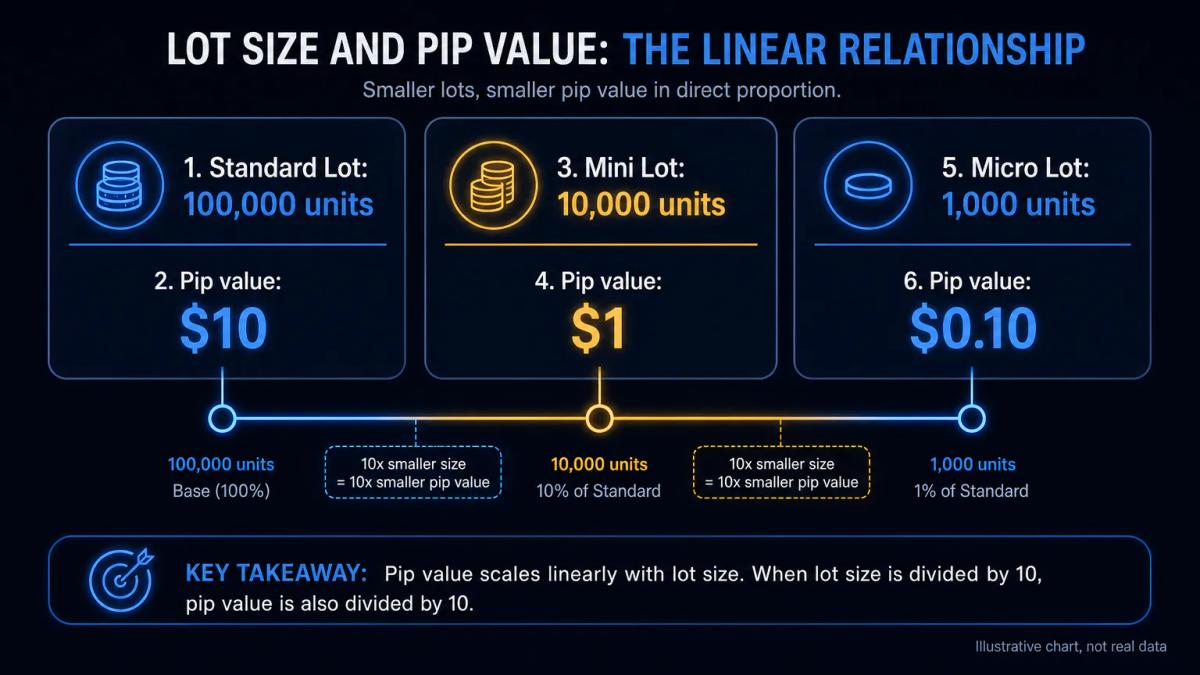
Pip value is the amount of money gained or lost when the price moves one pip. For a pair quoted against the US dollar, such as EUR/USD, one pip on a standard lot is worth approximately $10, one pip on a mini lot is worth $1, and one pip on a micro lot is worth $0.10. The relationship is linear: multiply or divide units of the base currency by ten and pip value moves by the same factor.
The calculation shifts when the quote currency (the second currency in the pair) is not the US dollar. Consider GBP/JPY: pip value would first be expressed in Japanese yen and then converted to your account currency at the current rate, so the dollar or pound value of a pip would change as the exchange rate moves. For cross pairs, your platform's trade ticket usually shows the live pip value in your deposit currency, which is the number to rely on.
How lot sizes affect your position sizing and risk management strategy?
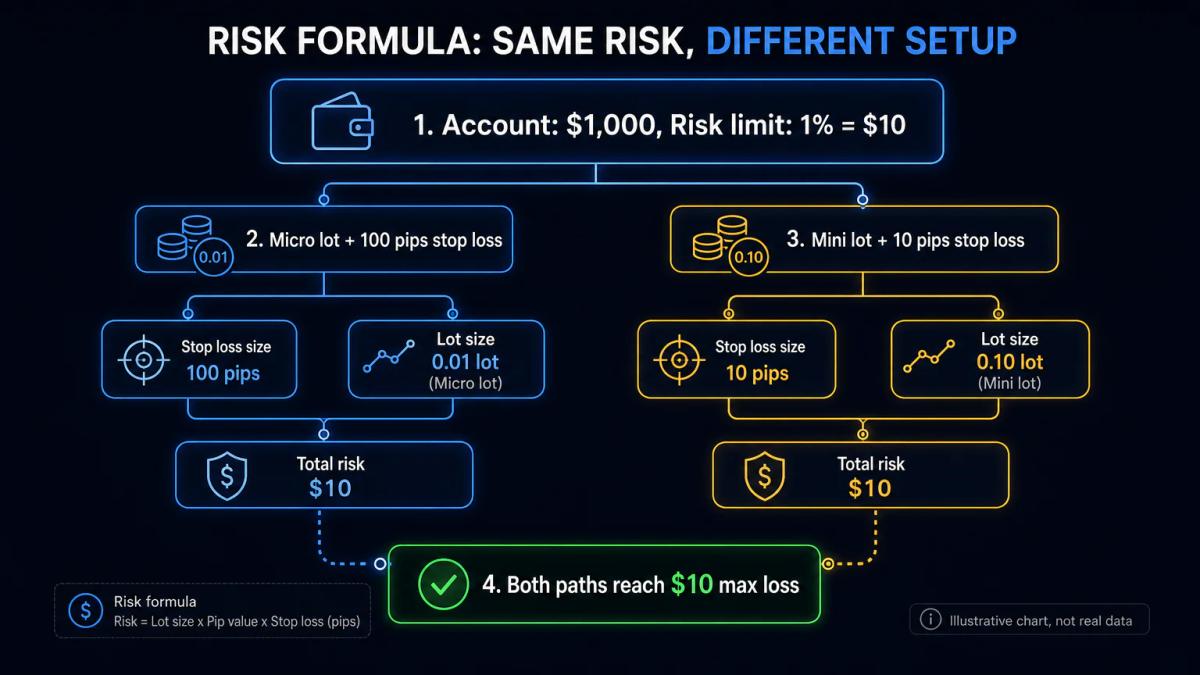
Lot size is the foundation of position sizing, the decision of how much capital is at stake on each trade. A widely used rule is to risk no more than 1 to 2 percent of your account on any single position. If your account is $1,000, risking 1 percent means capping your loss at $10 per trade; that budget could support a micro lot with a 100-pip stop loss, or a mini lot with a 10-pip stop loss.
The formula is: risk in money divided by (stop-loss in pips times pip value per lot) equals the number of lots. Working through it before every trade keeps the decision mechanical.
Suppose you hold a £5,000 account and are willing to risk 1% per trade, which is £50. You plan a GBP/USD trade with a 25-pip stop. On a mini lot, one pip is roughly $1, so a 25-pip loss costs about $25, around £20 at a 1.25 exchange rate. You could trade up to two mini lots and still stay inside the £50 budget.
Smaller lots give you finer control over the budget. On a $500 account with a 1% rule, you have $5 to spend per trade; only micro or nano lots give you a stop wide enough to let the trade breathe without blowing the risk cap. The psychological effect is just as real: a position that threatens a painful loss tends to be closed early, which turns a sound strategy into a stream of premature exits.
Matching lot size to your account and experience level
Small accounts and newer traders usually start with micro lots to keep losses contained while they learn how a strategy behaves under live conditions. As the account grows and the strategy produces a consistent track record, scaling up to mini and then standard lots becomes possible without breaking the 1 to 2 percent risk rule.
Your broker's rules add a second layer of constraint. Check the following before you commit:
- Minimum and maximum volume per trade on your account type.
- Minimum step (0.01, 0.1 or 1.00 lot).
- Maximum leverage for the instrument; FCA-authorised brokers cap retail leverage at 1:30 for major forex pairs, 1:20 for major indices and 1:5 for individual equities. CFDs on cryptoassets are prohibited for UK retail clients.
- Margin requirement in your deposit currency.
- Whether the entity onboarding you is the FCA-authorised group company or an offshore sister entity under a lighter regulator.
The UK gold tier is an FCA-authorised entity; offshore entities should be noted and treated with more caution, especially on segregation of client money and dispute resolution.
How lot sizes impact your profit and loss calculations in forex?
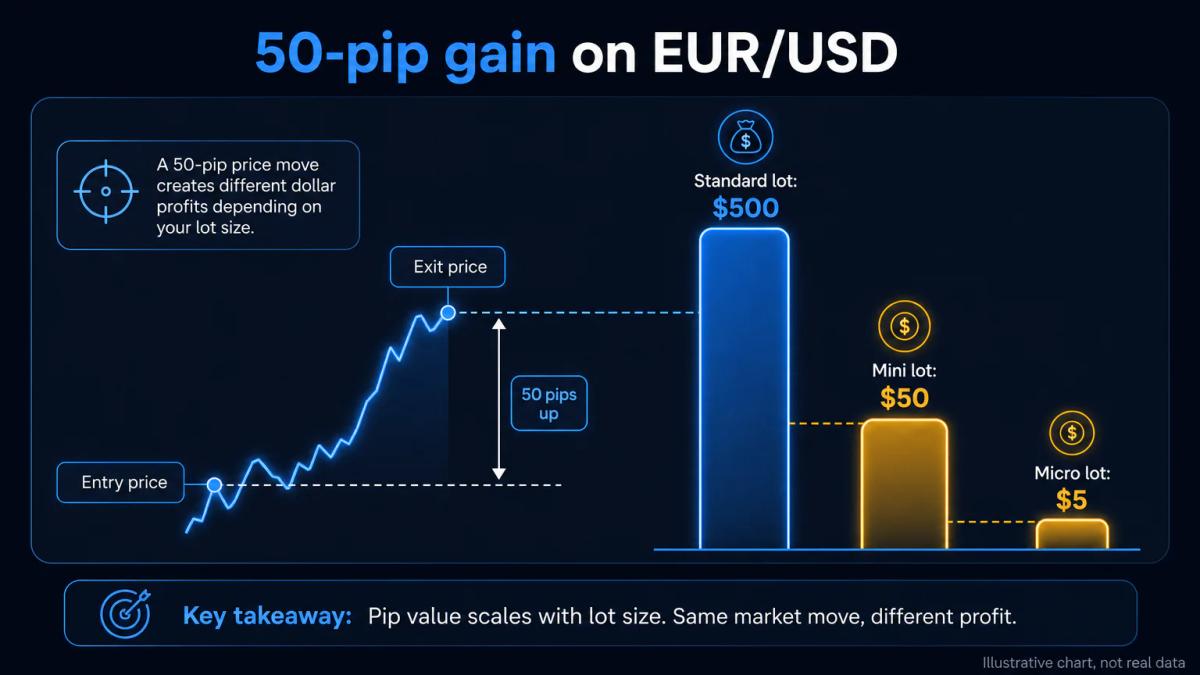
Profit and loss scale directly with lot size. A 50-pip win on a standard EUR/USD position returns about $500; the same 50-pip win on a mini lot returns $50, and on a micro lot, $5. The pip count is the same, the lot size changes the cash outcome.
Imagine a swing trader with a $10,000 account who takes a long EUR/USD position of two mini lots at 1.0850 and closes it at 1.0920, a gain of 70 pips. Pip value is about $2 for two mini lots, so the trade produces roughly $140, or 1.4% on the account. If the same trader had sized the position at two standard lots, the gain would have been around $1,400, but a 70-pip loss would have cost the same.
Transaction costs scale with lot size too. The spread (the gap between the bid and ask price) and any commission apply per lot, so larger positions pay a larger absolute cost even when the quoted spread in pips does not change.
Lot size, leverage, and margin: how they interact
Leverage amplifies your buying power, while lot size sets the actual notional exposure of the trade. A standard EUR/USD lot represents €100,000 of notional value regardless of the leverage ratio; what the ratio changes is the margin, the deposit the broker locks against the position. At 1:30, one standard lot requires roughly 3.33% of the notional in margin; at 1:10, it requires 10%.
Smaller lots reduce the margin blocked per trade, which leaves room to run several open positions in parallel without hitting a margin call. On an FCA-regulated account trading major forex pairs at a 1:30 cap, two mini lots on EUR/USD tie up roughly €666 of margin, around $720 depending on the rate.
Choosing lot size for your trading style and goals
Your trading style sets the sensible range of lot sizes before any other consideration. The table pairs common styles with the lot sizes that typically fit them:
| Style | Typical holding time | Common stop size | Lot size that usually fits |
|---|---|---|---|
| Scalping | Seconds to minutes | 3 to 10 pips | Mini or micro, kept small to survive many trades |
| Day trading | Minutes to hours | 10 to 30 pips | Micro to mini on small accounts, mini to standard on larger ones |
| Swing trading | Days to weeks | 50 to 200 pips | Micro or mini on retail accounts, to absorb wider stops |
| Position trading | Weeks to months | 200+ pips | Micro, with multiple partial entries |
Scalpers trade high frequency, so a single oversized loss can wipe out many winning trades; keeping lots small protects the equity curve. Swing and position traders hold through wider price swings, and the lot size has to be small enough that the stop can sit beyond normal volatility without breaching the risk rule.
Test the chosen size on a demo account first, and then on a very small live account. A size that looks acceptable on a spreadsheet can feel very different when real money is moving in real time, and the discipline to hold the plan is the part no simulator fully trains.
For a concrete example of costs and platform, the Pepperstone review goes through them line by line.
Frequently Asked Questions
What is the difference between standard, mini, and micro lots in forex trading?
A standard lot is 100,000 units of the base currency, a mini lot is 10,000 units, and a micro lot is 1,000 units. Each step down the ladder divides your market exposure, and the pip value, by ten. On a USD-quoted pair, that works out at roughly $10, $1 and $0.10 per pip, which is why micro lots are the usual starting point for small accounts.
How do I calculate the pip value for different lot sizes?
For pairs quoted against the US dollar, pip value equals one pip (0.0001) multiplied by the number of units: $10 on a 100,000 standard lot, $1 on a 10,000 mini, $0.10 on a 1,000 micro. For pairs where the quote currency is not the US dollar, the pip value is first expressed in the quote currency and then converted to your account currency at the live rate, so the amount shifts with the exchange rate. Most trading platforms display the live pip value on the trade ticket.
Which lot size should I use if I have a $1,000 trading account?
On a $1,000 account, micro lots are the practical choice. Using the 1% risk rule, your budget is $10 per trade. One micro lot of EUR/USD moves about $0.10 per pip, so a 100-pip stop fits inside the budget. Mini lots, at roughly $1 per pip, only make sense with very tight stops of ten pips or less, which many strategies cannot support without being stopped out by noise.
How does lot size affect my margin requirement and buying power?
Margin is a percentage of the notional value of the position, and the notional value scales directly with lot size. At 1:30 leverage, a standard EUR/USD lot ties up around 3.33% of €100,000 as margin; a mini lot ties up a tenth of that, a micro lot a hundredth. Smaller lots free up margin to run several positions at once without approaching a margin call.
Can I trade fractional lot sizes, or must I stick to whole lots?
Most retail brokers support fractional lots. On MT4 and MT5, volumes are usually entered in increments of 0.01 lots, which equals one micro lot, and some brokers go down to 0.001 (nano lots). cTrader often expresses volume in raw units of the base currency. Check your broker's account specification for the minimum step and the maximum size per trade before placing orders.
About the authors


Put this into practice
Brokers we have reviewed
Scored on the same five dimensions. Here are three of them — the full list is on the brokers page.



Related articles
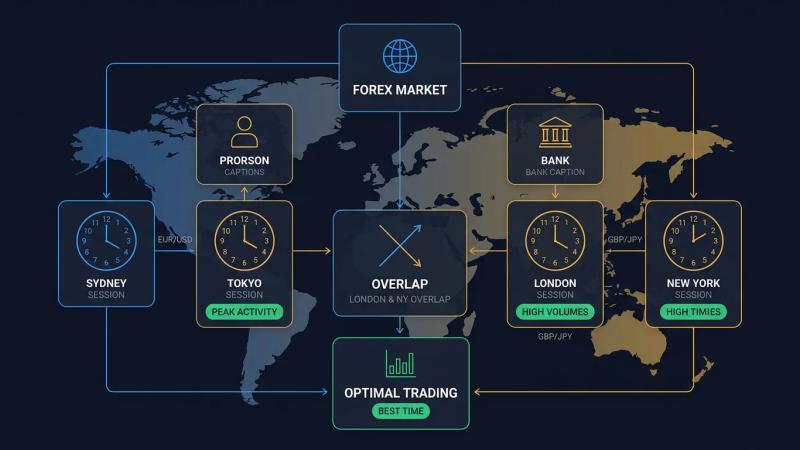
Forex Trading Sessions: Times, Overlaps and How to Trade Them
A plain-English guide to the four forex trading sessions, when they overlap, and how liquidity and spreads change across the 24-hour cycle.

How to Calculate the Real Cost of a Forex Trade Across Different Brokers
Learn how to calculate the true cost of a forex trade, including spread, commission, and swap, to compare brokers accurately and trade smarter.

How to Use the MonkeyTrade Broker Comparison Tool to Find Your Ideal Broker
The MonkeyTrade broker comparison tool lets you filter, compare, and shortlist forex brokers based on your specific trading profile, all in one place. This guide walks you through exactly how to use it, what each data point means, and how to turn a screen full of broker information into a shortlist you can actually act
0 comments