



Confirmation Bias in Trading: How It Hurts You and How to Fix It
Confirmation bias is one of the most common reasons traders keep bleeding money on the same kinds of mistakes. It feels like conviction, like clarity. And that’s precisely what makes it so dangerous.
This guide breaks down how confirmation bias operates in a trading context, how to catch it in your own decision-making, and what you can do to build a more objective process. This is educational content, not financial advice, but the concepts here can sharpen your understanding of why your brain sometimes works against your trading goals.

What Is Confirmation Bias?
Your brain is wired to protect its own beliefs. That’s a feature of human cognition that happens to be terrible for trading.
The Psychology Behind Confirmation Bias
Confirmation bias is the tendency to search for, interpret, and remember information in a way that supports what you already believe, while downplaying or outright ignoring evidence that contradicts it. It’s selective information processing, and it happens automatically, often without you noticing a thing.
Think of it this way: your brain acts as a filter. Once you form a hypothesis (say, “this stock is about to break out”), that filter starts letting through data that agrees with you and quietly blocking data that doesn’t. You’re not lying to yourself on purpose. Your brain is simply doing what brains do: conserving energy by reinforcing existing mental models instead of constantly rebuilding them from scratch.
In everyday life, this shortcut works well enough. In trading, where objective analysis separates profit from loss, it becomes a real problem.
Why Traders Are Especially Vulnerable
Trading creates near-perfect conditions for confirmation bias to thrive. You’re making decisions under uncertainty, with real money at stake, often under time pressure. You’ve invested effort in your analysis, which creates emotional attachment to the outcome. Nobody wants to feel like they spent an hour studying a chart only to conclude “actually, there’s no trade here.”
Then there’s the identity factor. If you think of yourself as a skilled trader, admitting your analysis might be wrong can feel like a threat to that self-image. So your brain steps in, helpfully filtering out the inconvenient signals that would force you to reconsider.
And here’s what catches people off guard: the more experience you gain, the more confident you become in your read of the market, which can actually make the bias stronger, not weaker. So how does this play out when real money is on the line?
How Confirmation Bias Shows Up in Your Trading
The tricky part about confirmation bias is that it looks like thorough analysis. Here are the most common ways it sneaks into your process.
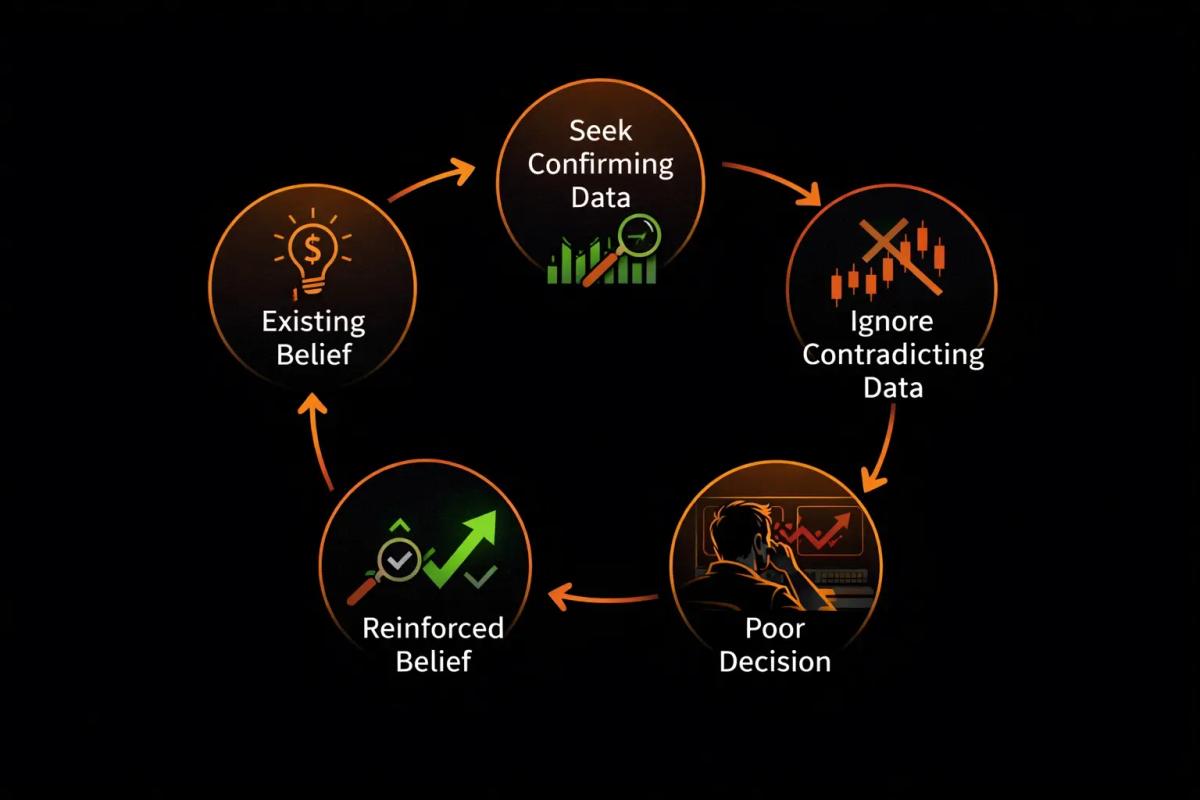
Cherry-Picking Technical Signals
You’re bullish on a setup. You spot a moving average crossover that supports your thesis, a support level that holds, a volume spike that looks promising. What you don’t notice, or choose not to weight heavily, is the bearish divergence on the RSI, the resistance zone overhead, or the fact that the broader sector is weakening.
You haven’t fabricated any data. Every signal you found is real. But you’ve unconsciously curated a highlight reel that supports a conclusion you already reached. If someone showed you the same chart cold, with no prior opinion, you might read it very differently.
Ignoring Contradictory News or Data
Say you’re long on a stock and an earnings report comes in below expectations. Instead of reassessing, you find yourself scanning for reasons the report “doesn’t matter.” Maybe you latch onto a single forward guidance comment that was mildly positive, or you decide the market “already priced it in.”
This is your brain doing damage control for your existing position. You’re not evaluating the news on its merits. You’re evaluating it through the lens of what you need it to mean. Over time, that compounds into a pattern of consistently misreading the information environment around you.
Holding Losing Trades Too Long
This is where confirmation bias gets expensive. You entered a trade with a thesis. Price moves against you. Instead of honoring your stop or re-evaluating, you go hunting for reasons to hold. You find a forum post agreeing with your direction. You notice a minor support level nearby. You tell yourself it’s just a pullback.
Every piece of “evidence” you find to justify staying in the trade is confirmation bias at work. The original thesis may have already been invalidated, but your brain is working overtime to avoid the discomfort of being wrong.
Overconfidence After Winning Streaks
A few wins in a row feel great, but they can prime you to believe your analysis is sharper than it actually is. After a streak, you might start sizing up, skipping parts of your checklist, or waving off warning signs you’d normally respect. Why? Because your recent results “confirm” that you know what you’re doing.
This is confirmation bias feeding off recency. Your wins reinforce the skill narrative, and suddenly you’re making decisions based on how you feel about your abilities rather than what the chart or data is actually telling you.
Recognizing these patterns matters. But what does it actually cost you when bias goes unchecked?
The Real Cost of Biased Analysis
Confirmation bias carries measurable consequences that can quietly erode both your trading account and your confidence.
Financial Damage
The math is straightforward. Biased analysis leads to poorly timed entries, late exits, oversized positions, and ignored stop losses. Each of these alone can produce a losing trade. Combined, they create a pattern of losses that feels random but is actually systematic.
The worst part? Biased traders often can’t diagnose what’s going wrong. Because the bias is invisible to the person experiencing it, you might blame the market, blame your broker, or chalk it up to bad luck, when the real issue is a built-in blind spot in your analytical process. Over weeks and months, the cumulative damage from even slightly biased decisions adds up in ways that are genuinely hard to recover from.
Erosion of Trading Discipline
Beyond direct financial impact, unchecked confirmation bias slowly dismantles your discipline. If you’re consistently ignoring your own rules to justify trades that “feel right,” those rules stop meaning anything. Your trading discipline degrades not because you abandoned it, but because bias gave you a convenient reason to bend it, one trade at a time.
Eventually, you’re not following a process at all. You’re following a feeling and telling yourself it’s analysis.
If confirmation bias is this pervasive and this damaging, how do you actually catch yourself doing it?
How to Recognize Confirmation Bias in Yourself
Self-awareness is the first real defense. You can’t fix what you can’t see, and confirmation bias is specifically designed, by your own brain, to stay hidden.
Warning Signs in Your Decision Process
Pay attention to these patterns in how you research and execute trades:
- You only consult sources or analysts who agree with your existing position.
- You feel irritated or dismissive when someone presents a bearish case on your bullish trade (or vice versa).
- You catch yourself rationalizing why negative data “doesn’t apply” to your specific situation.
- You spend more time looking for reasons to enter a trade than reasons not to.
- After a loss, your first instinct is to find external explanations rather than reviewing your own analysis with fresh eyes.
- You frequently add to losing positions based on new “evidence” found after the original entry.
None of these individually prove bias is at play. But if several sound familiar, your decision-making process likely has a filtering problem worth addressing.
A Self-Assessment Checklist
Before your next trade, try answering these questions with real honesty:
- Did I look for reasons this trade could fail with the same effort I used to find reasons it could work?
- If I had no position and saw this chart fresh, would I still make the same call?
- Am I holding or entering this trade because of the data, or because I don’t want to be wrong?
- Have I changed my thesis in the last week to accommodate new information, or have I been defending the same view regardless of what happened?
If those questions make you uncomfortable, pay attention to that discomfort. It’s useful information. Now, what do you actually do about it?
Practical Strategies to Overcome Confirmation Bias
Knowing about bias isn’t enough on its own. You need structural changes to your process that make it harder for bias to operate unchecked. Here are concrete techniques worth building into your routine.
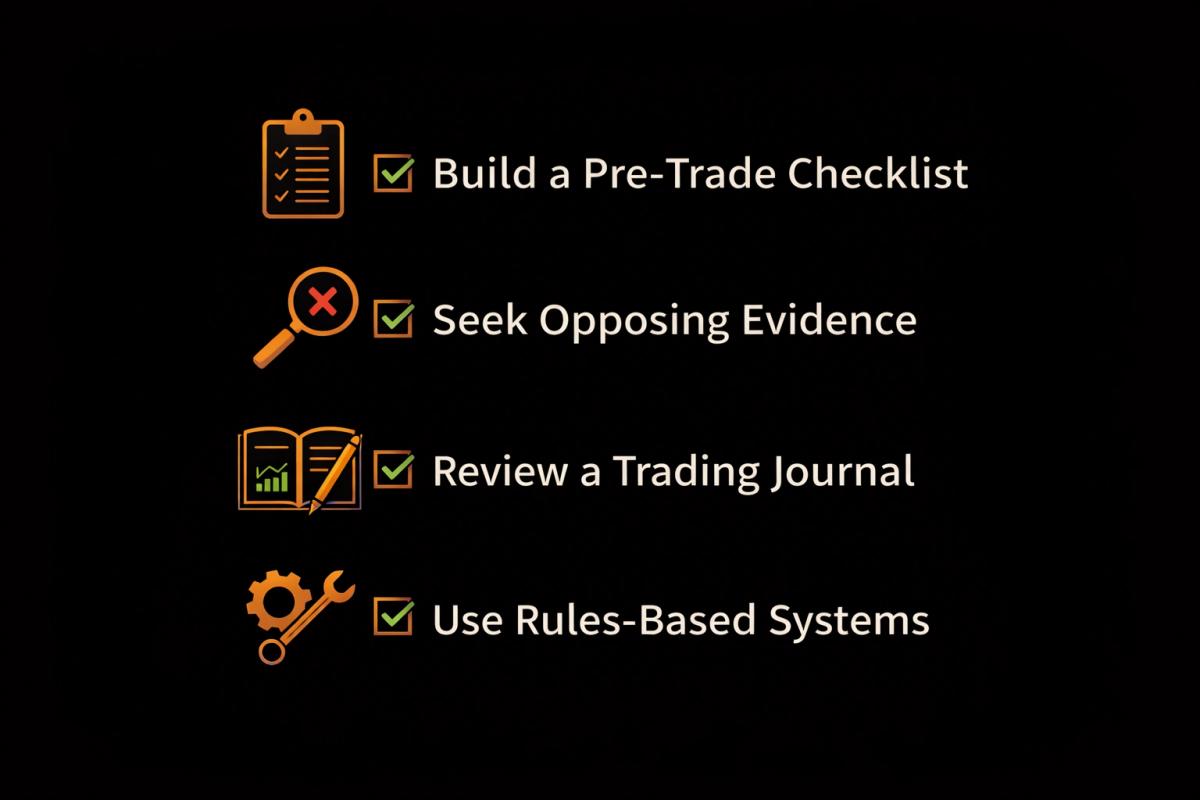
Build a Pre-Trade Checklist
A checklist forces you to evaluate specific criteria before entering a trade, not after you’ve already decided you want in. Your checklist should include both confirming and disconfirming factors. For example:
- What is my specific entry trigger?
- What would invalidate this setup?
- What is the risk-to-reward ratio?
- Are there conflicting signals on higher timeframes?
- Does the broader market context support or contradict this trade?
The key is completing the checklist before you commit emotionally to the trade. Once you’ve decided you “like” a setup, the checklist becomes a rubber stamp. Used correctly and early, it acts as a structured decision filter that your bias can’t easily bypass.
Actively Seek the Opposing Case
This is uncomfortable, and that’s the point. Before entering any trade, deliberately spend time building the case against it. If you’re bullish, look for every bearish signal you can find. Read analysis from people who disagree with you. Try to steelman the opposing view as if your account depended on it.
You’re not doing this to ensure that when you do pull the trigger, you’ve weighed both sides rather than just the one your brain handed you first. If your thesis survives honest scrutiny, you can trade it with more confidence, not less.
Use a Trading Journal for Honest Review
A trading journal is one of the most effective tools for surfacing bias patterns you can’t see in real time. But it only works if you’re ruthlessly honest with it. Record not just what you traded and the result, but why you entered, what you expected, what you chose to ignore, and how you felt at the time.
Over weeks and months, patterns emerge. You might notice that you consistently ignore bearish divergences on your long trades, or that you hold losers an average of three days longer than your rules allow. These patterns are confirmation bias leaving fingerprints, and a journal makes them visible in a way that memory alone never will.
Rely on Rules-Based Systems Over Gut Feelings
The more discretion you allow in your trading, the more room bias has to operate. Rules-based systems, whether fully automated or simply a strict personal framework, reduce the number of subjective decisions you make in the heat of the moment.
This means defining clear, pre-committed rules for entries, exits, position sizing, and risk management, then actually following them. When your rules say “exit,” you exit. When the setup doesn’t meet your criteria, you pass on it, no matter how much your gut says otherwise.
Will you still feel the pull of bias? Absolutely. But a rules-based framework gives you something external to anchor to, something that doesn’t shift based on how your last trade went.
How Objective Trading Changes Your Results
None of this eliminates confirmation bias entirely. That’s not a realistic goal, and anyone claiming otherwise is overselling. What these strategies do is reduce the frequency and severity of biased decisions in your process.
Over time, the compounding effect of slightly better, slightly more objective decisions is significant. You hold losers for less time. You size positions based on data, not emotion. You enter trades because they meet your criteria, not because you talked yourself into them.
The psychological shift matters just as much as the financial one. When you trust your process because it’s built on objectivity rather than rationalization, you trade with less stress, less second-guessing, and more clarity. You stop asking “why does the market keep doing this to me?” and start asking a better question: “what is the market actually telling me right now?”
That’s a foundation that makes consistent, clear-headed decision-making possible, and in trading, that’s where long-term results tend to come from.
Frequently Asked Questions
Can confirmation bias be completely eliminated from trading?
No, and be wary of anyone who claims it can. Confirmation bias is a deeply embedded cognitive pattern, not a bad habit you can simply drop. The realistic goal is to build awareness and process structures that reduce its influence on your decisions. Think of it as ongoing management, not a one-time fix.
How is confirmation bias different from other trading biases?
Confirmation bias specifically relates to how you filter and interpret information to support existing beliefs. It often works alongside other biases, like anchoring (fixating on a specific price level) or recency bias (overweighting recent events). The key distinction is that confirmation bias shapes what information you even allow yourself to see, which makes it foundational. Addressing it tends to reduce the impact of other biases as well.
How does a trading journal actually help with confirmation bias?
A trading journal creates a written record of your reasoning at the time of each trade, including what you expected and what you chose to ignore. When you review it later, without the emotional pressure of a live position, patterns of selective analysis become visible. You might discover that you consistently downplay specific types of contrary evidence, something that's almost impossible to notice in real time.
What are the signs that confirmation bias is affecting my trades right now?
The most common signs include feeling defensive when someone challenges your trade thesis, spending more time justifying losing positions than evaluating them objectively, and noticing that your "research" consistently agrees with your pre-existing view. If your analysis always seems to confirm what you wanted to do before you started analyzing, that's a strong signal worth paying attention to.
Does using automated or algorithmic trading remove confirmation bias?
Automated systems can reduce bias in trade execution by following pre-set rules without emotional interference. However, confirmation bias can still influence the design and backtesting of those systems. Traders may unconsciously optimize for results that confirm their beliefs about what "should" work, or selectively interpret backtest data to fit a preferred narrative. Automation helps, but it doesn't make you immune. This article is for educational and informational purposes only. It does not constitute financial advice. Trading involves risk, and past performance does not guarantee future results.
About the authors


Put this into practice
Related articles
Drawdown Psychology: How to Protect Your Mind When Your Account Is Bleeding
Practical techniques to manage drawdown psychology: circuit breakers, real-time journaling, staying positive, and position sizing strategies.

Emotional Intelligence for Traders: A Practical Guide to Trading with EQ
Learn how emotional intelligence shapes your trading results. A practical framework with daily EQ exercises, journaling techniques, and the Pause Protocol.
Fear of Losing Money Trading: Why It Happens and How to Manage It
Learn why fear of losing money trading affects your decisions and discover practical methods to manage loss aversion without eliminating healthy caution.
0 comments