



Drawdown Psychology: How to Protect Your Mind When Your Account Is Bleeding
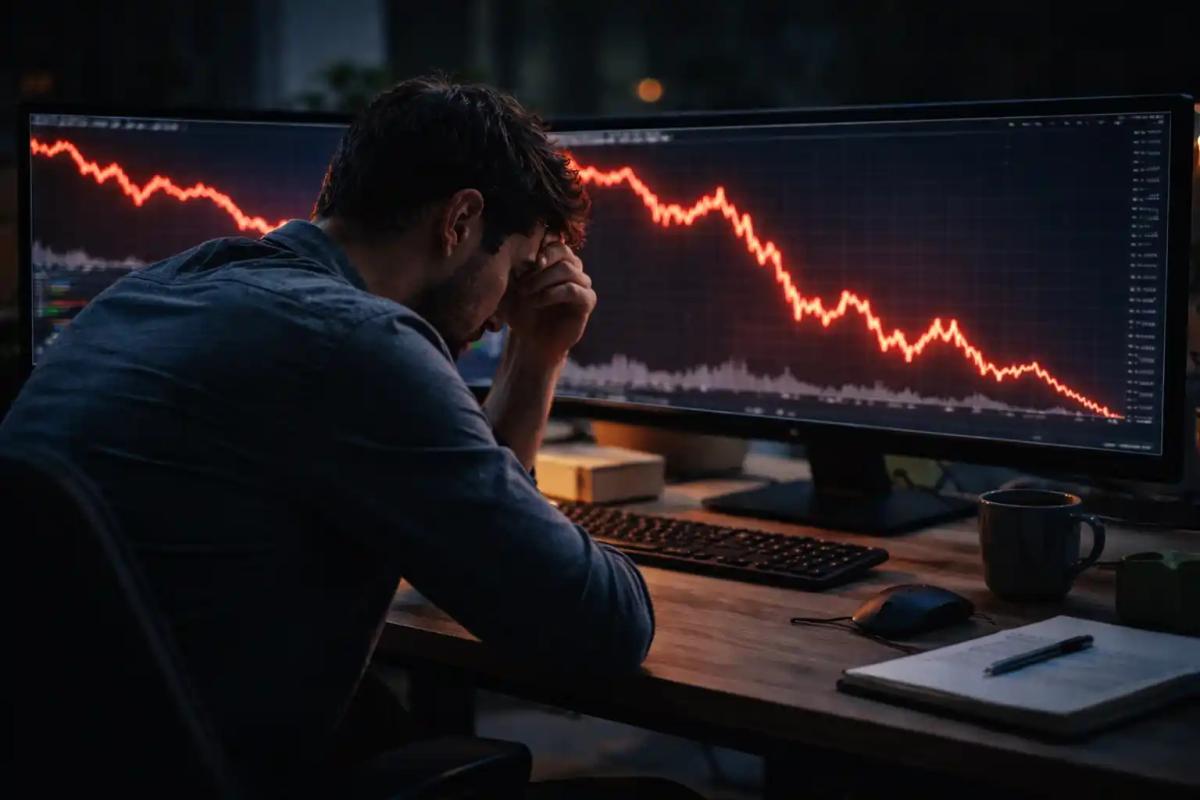
Drawdown psychology is the gap between knowing what a drawdown is and actually surviving one with your account and your confidence still intact. It’s the reason two traders running identical strategies can eat the same 15% drawdown and land on opposite sides: one recovers methodically, the other blows up trying to claw it all back in a single afternoon.
This article is a practical playbook for what to do when you’re in the thick of a drawdown right now, or when you keep falling into the same destructive patterns every time your equity curve rolls over. You’ll walk away with a structured framework, named techniques, and a personal protocol you can reach for the next time your account starts bleeding.
This content is educational and is not financial advice. It is also not a substitute for professional mental health support. If you’re experiencing significant distress, please reach out to a qualified professional.
What Drawdown Psychology Actually Means for Active Traders
Every trader talks about managing emotions. Very few can tell you exactly what that looks like at 2:47 PM on a Thursday when you’ve just taken your fourth consecutive loss and the fifth setup is forming on your chart right now.
Drawdown psychology is the specific set of cognitive and emotional responses your brain produces when it perceives ongoing financial loss, along with the behavioral patterns those responses create. It’s a real, predictable, mappable process. And once you understand its mechanics, you can build defenses against it.
The Difference Between Knowing About Drawdowns and Living Through One
Here’s a scenario you’ll probably recognize. You backtest a strategy. It shows a max historical drawdown of 18%. You tell yourself, “I can handle that.” You’ve seen the equity curve. You know recovery follows the dip. Intellectually, you’re prepared.
Then it happens live. Not in a backtest, but in your real account, with real money. And at 10% down, something shifts. The rational part of your brain that calmly accepted an 18% drawdown in theory is now completely overridden by a much louder voice insisting: this time is different, the strategy is broken, you need to act now.
That gap between intellectual acceptance and emotional experience is exactly where drawdown psychology lives. Backtests don’t simulate the feeling of watching money vanish in real time. They don’t replicate the tightness in your chest, the compulsive phone-checking, or the way a drawdown starts colonizing your thoughts well outside market hours. Understanding this gap is the first step toward managing it, because you can’t fix a problem you believe you’ve already solved.
So what is it about losses specifically that hijacks your decision-making so completely?
Why Drawdowns Break Traders Psychologically
A drawdown is a sustained assault on the parts of your brain responsible for calm, rational thought. Understanding why it hits so hard isn’t an academic exercise; it’s the foundation for every technique that follows.
Loss Aversion and the Brain’s Threat Response
Your brain is not wired to weigh gains and losses equally. Decades of behavioral research confirm that the pain of losing a dollar lands roughly twice as hard as the pleasure of gaining one. This isn’t a character flaw. It’s how your nervous system evolved to keep you alive.
During a drawdown, this asymmetry shifts into overdrive. Each losing trade doesn’t just shrink your account; it triggers a genuine threat response. Cortisol rises. Your thinking narrows. Your brain shifts from analytical mode to survival mode, which is brilliant if you’re dodging a predator but disastrous if you’re deciding whether to hold a position through a pullback.
Think of it like driving in dense fog. Under normal conditions, you process the full road ahead, scanning peripherals, planning moves. Under threat, your vision collapses to whatever’s directly in front of you. That’s what loss aversion does to your trading: it shrinks your time horizon, locks you onto the very next trade, and strips away the broader context of your strategy’s edge.
Identity Attachment to P&L
Here’s a trap that rarely gets the attention it deserves: many traders unconsciously fuse their self-worth with their trading performance. When the account is growing, you feel competent, sharp, validated. When it’s shrinking, you don’t just feel like you’re losing money. You feel like you’re losing proof that you’re good at this.
This identity fusion transforms a drawdown from a statistical event into a personal crisis. Instead of thinking “my strategy is experiencing expected variance,” you start thinking “I’m failing.” And once the drawdown becomes about who you are rather than what’s happening on your chart, every decision gets filtered through ego rather than analysis.
If you’ve ever doubled your position size during a drawdown specifically to “prove” you could recover, you’ve felt this pull firsthand. Sunk cost bias operates on similar wiring. You hold a losing position not because the analysis still supports it, but because you’ve already absorbed so much pain that closing the trade feels like making that pain permanent. The logic whispers: “I’ve already lost $3,000 on this position; if I close now, that loss is locked in for nothing.” So you hold, waiting for a reversal that justifies the suffering you’ve already endured. The money already lost shouldn’t factor into the decision at all, but during a drawdown, it can dominate every call you make.
The Compounding Loop: How One Bad Decision Creates the Next
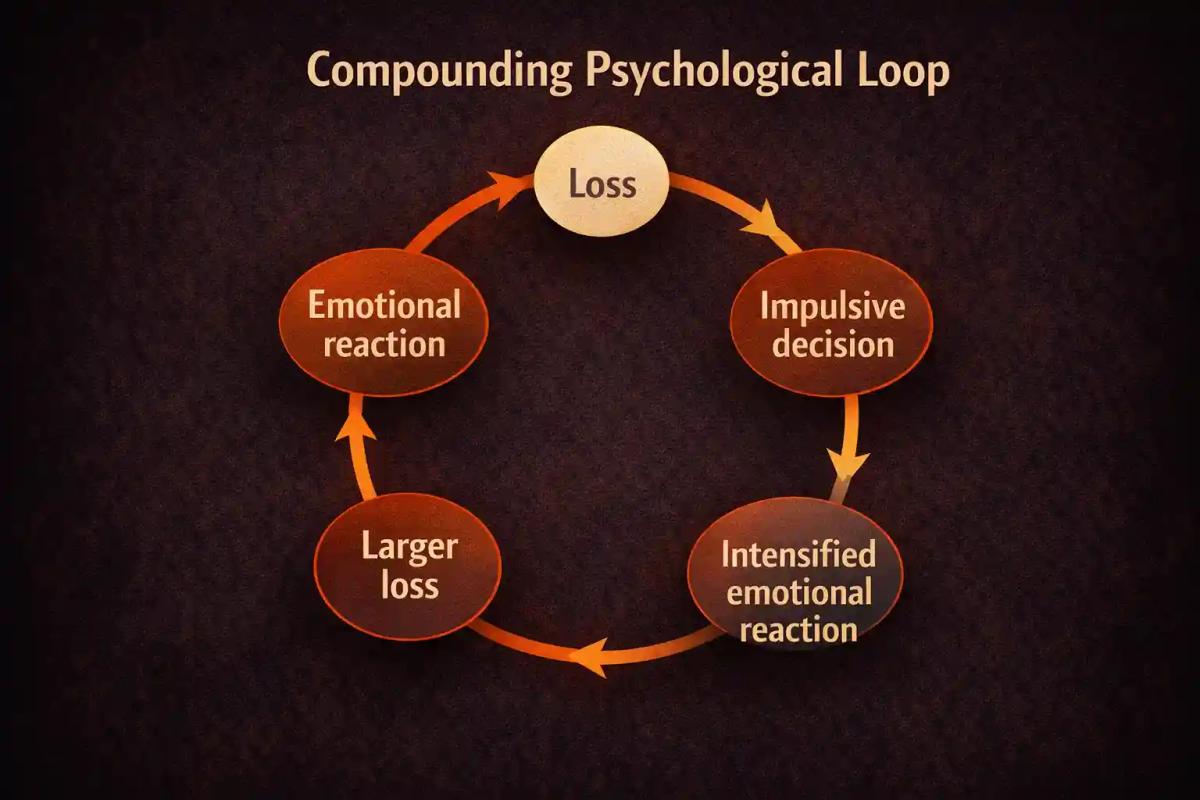
This is where drawdowns turn from painful to genuinely destructive. A loss triggers an emotional response. That emotional response drives an impulsive decision (revenge trade, oversized position, abandoned stop). The impulsive decision produces a larger loss. The larger loss intensifies the emotional response. And the cycle picks up speed.
What makes this loop so dangerous is that it feels like problem-solving. You’re not sitting passively. You’re trading. You’re fighting back. But each “action” is actually deepening the hole, and the emotional urgency makes it nearly impossible to see that in real time.
Recognizing this loop is critical, but recognition alone won’t break it. You need structured interventions, which brings us to the phases.
The Three Phases of Drawdown Psychology
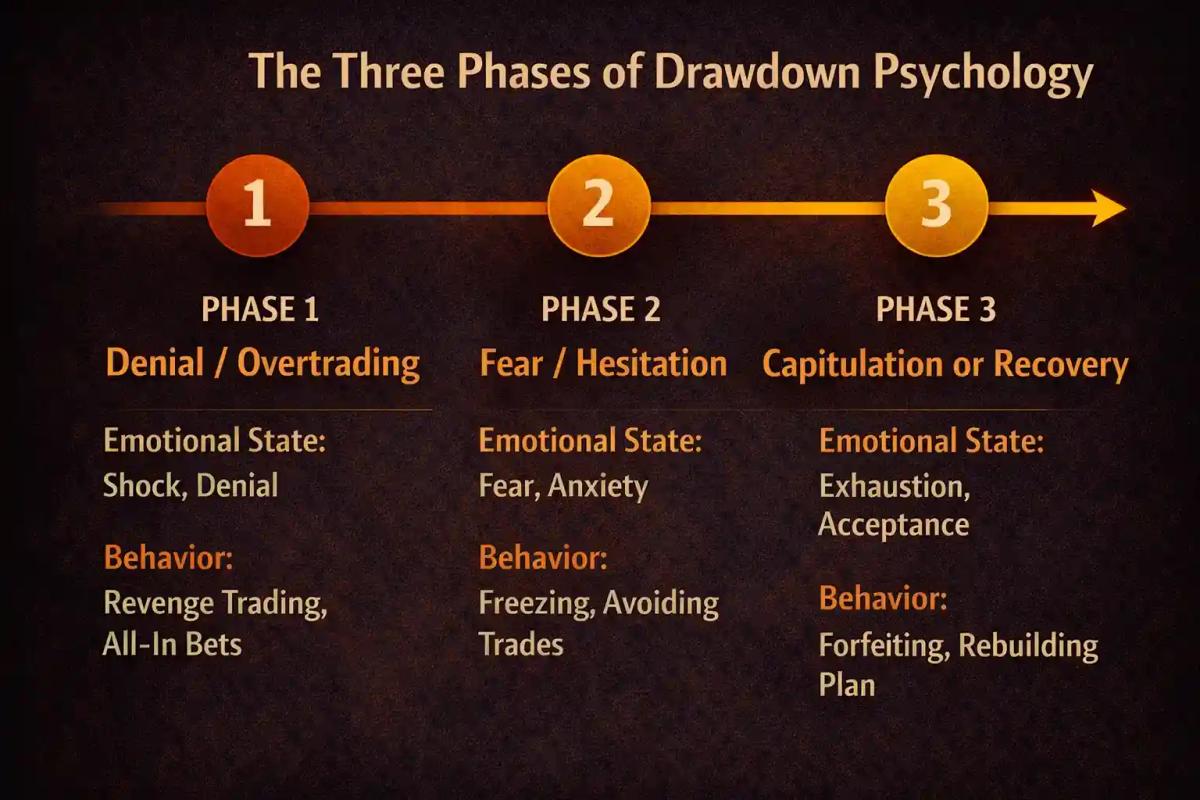
Drawdowns unfold in a predictable emotional sequence, and the mistakes you’re most vulnerable to shift at each phase. Knowing where you sit in this cycle changes what you need to do next.
Phase 1 – Denial and Overtrading
The drawdown begins, but you haven’t fully accepted it. Your internal narrative sounds something like: “This is just a rough patch. I’ll make it back this week.” You might even feel a surge of determination, an eagerness to recover quickly.
The behavioral fingerprint of Phase 1 is overtrading. You take setups you’d normally skip. You increase frequency. You might widen your criteria to “find more opportunities.” The logic feels sound in the moment, but what you’re really doing is refusing to accept the drawdown as real and trying to outrun it with volume.
Key warning signs of Phase 1:
- Trading outside your plan’s defined setups
- Taking trades in additional markets or timeframes you don’t normally touch
- Feeling urgency to “make back” a specific dollar amount
- Rationalizing larger position sizes as “conviction trades”
Phase 2 – Fear, Hesitation, and Missed Setups
If Phase 1 doesn’t resolve the drawdown (and it rarely does, since overtrading usually deepens it), Phase 2 settles in. The denial burns off, and what replaces it is fear.
Now you’ve swung to the other extreme. Every setup looks like a potential loss. You hesitate. You wait for “extra confirmation” that never arrives. You watch valid trades play out without you, then feel even worse because the drawdown would be recovering if only you’d taken them.
Recency bias is the engine behind this paralysis. Your brain overweights your most recent results and treats them as predictive, so after five consecutive losses, the sixth setup doesn’t get evaluated on its own merits. It gets filtered through the memory of the last five failures. Statistically, if your setups are valid, the odds on trade number six haven’t changed. Emotionally, it feels like a guaranteed loss. That distortion is what keeps you frozen, watching perfectly good entries come and go while the drawdown grinds on.
Phase 2 is where many traders experience the deepest psychological suffering. You’re paralyzed. And the paralysis creates its own kind of loss: not from bad trades, but from good ones you never took.
Phase 3 – Capitulation or Recovery
Phase 3 is the fork in the road. One path is capitulation: you blow through your risk limits, abandon your strategy entirely, or quit trading for a stretch driven by emotional exhaustion rather than a deliberate plan. The other path is structured recovery: you acknowledge where you are, activate your pre-set protocols, and trade your way back with reduced risk and renewed process focus.
What separates capitulation from recovery is almost never talent or market knowledge. It’s whether you have a plan for this exact moment, built before you needed it.
Which raises the obvious question: what does that plan actually look like?
Practical Techniques for Handling Drawdowns
Theory is useful but insufficient. What follows are concrete, named techniques you can put in place before and during your next drawdown. None of them are magic. All of them work by inserting structure between your emotional impulse and your trading action.
Pre-Drawdown Rules You Set When Calm
The single most important thing you can do for your trading psychology during drawdowns happens before the drawdown ever starts. When you’re trading well, feeling clear-headed, and your account is near highs, that is the moment to write your drawdown protocol.
Your pre-drawdown rules should be specific and non-negotiable. Here’s a framework to build from:
- Define your drawdown thresholds. Decide in advance what actions you’ll take at specific levels (for example, 5%, 10%, 15% from peak equity).
- Assign behaviors to each threshold. At 5%, you might reduce position size by half. At 10%, you take a mandatory 48-hour break. At 15%, you stop live trading and move to simulation until your process review is complete.
- Write them down physically. Put them somewhere you’ll see them during your trading session, not buried in a document you’ll never open under stress.
- Commit to them with an accountability partner. Tell another trader, a mentor, or a trading community what your rules are. External commitment makes them far harder to override.
The key insight here is simple: these decisions are made by the calm, rational version of you and are simply executed by the stressed version of you. You’re removing real-time decision-making from the equation entirely.
The Drawdown Circuit Breaker Method
Think of this like the circuit breakers that halt stock exchanges during extreme moves. The market doesn’t “decide” to pause. It hits a predetermined level and the halt is automatic. You need the same mechanism for your trading.
The Drawdown Circuit Breaker is a formalized pause protocol with three components:
- Trigger: A specific, measurable condition (e.g., three consecutive losses, daily loss exceeding 2%, weekly drawdown exceeding 5%)
- Action: An immediate, predefined response (close all positions, close the platform, leave the desk)
- Re-entry criteria: A specific set of conditions that must be met before you trade again (e.g., next trading day, after completing a written review, after a conversation with your accountability partner)
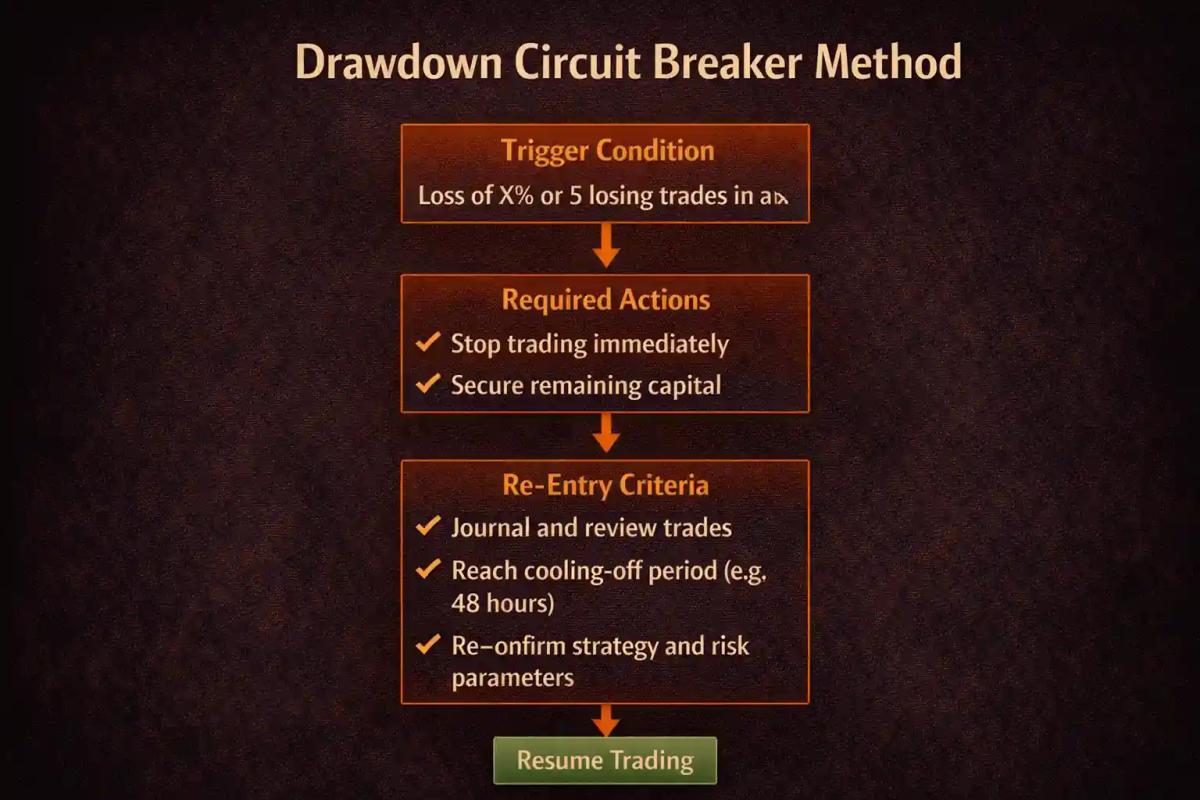
The circuit breaker works because it targets the most dangerous window in any drawdown: the minutes between the emotional impulse and the next trade. When you stretch that gap from seconds to hours or even days, recovery has room to begin.
Journaling Through the Drawdown, Not After It
Most traders who journal do it once the session is over. That’s useful for long-term pattern recognition, but it misses the most valuable data: what you were actually thinking and feeling in real time while the drawdown was unfolding.
Journaling during a drawdown means capturing your state as it happens. Not polished reflections, but raw, honest entries:
- What did you feel when the last trade hit your stop?
- What is your impulse right now? What trade are you considering, and why?
- What would your pre-drawdown rules tell you to do?
- If you take this trade, is it coming from your plan or from your emotions?
This kind of real-time journaling serves two purposes. First, the act of writing physically slows you down. It inserts a tangible buffer between impulse and action. Second, it creates an honest record you can mine later to identify your specific emotional patterns.
Position Sizing as a Psychological Tool
Most traders think of position sizing and risk management as purely mathematical. You calculate your risk per trade, determine your stop distance, and size accordingly. But during a drawdown, position sizing becomes one of the most powerful psychological levers you have.
Here’s why: when you reduce your position size during a drawdown, you’re not just cutting financial risk. You’re dialing down emotional intensity. A trade risking 0.25% of your account produces a fundamentally different psychological experience than one risking 2%, even if the chart setup is identical.
Reducing size during drawdowns allows you to:
- Continue trading and executing your strategy (preserving rhythm and routine)
- Lower the emotional weight of each individual trade
- Rebuild confidence through clean process execution rather than P&L recovery
- Prevent the drawdown from deepening at the same rate
Think of it as turning down the volume. The music is still playing, you’re still in the game, but the intensity drops to a level where your rational brain can stay engaged.
But techniques only work when they’re embedded in a broader mindset shift. So how do you build a mental framework that holds up not just for one drawdown, but across an entire trading career?
Building a Drawdown Mindset That Lasts
Techniques get you through a single drawdown. A drawdown mindset gets you through a career. The difference lies in how you frame what drawdowns are, what they mean, and what they demand from you.
Reframing Drawdowns as Cost of Business
Every business carries operating costs. A restaurant pays for ingredients that spoil. A retailer absorbs returns and shrinkage. A trader pays drawdowns.
This is an accurate description of how probabilistic strategies function. If your strategy has a documented edge, drawdowns are the price you pay to access that edge over time. They are not evidence that something is broken. They are the expected cost of the approach working as designed.
The reframe matters because it changes the question you ask yourself. Instead of “why is this happening to me?” you ask “is this drawdown within the expected parameters of my strategy?” One question spirals toward panic. The other leads to a plan review.
Perseverance vs. Stubbornness: Knowing the Difference
This might be the most important distinction in all of trading psychology, and it’s one that very few discussions address head-on.
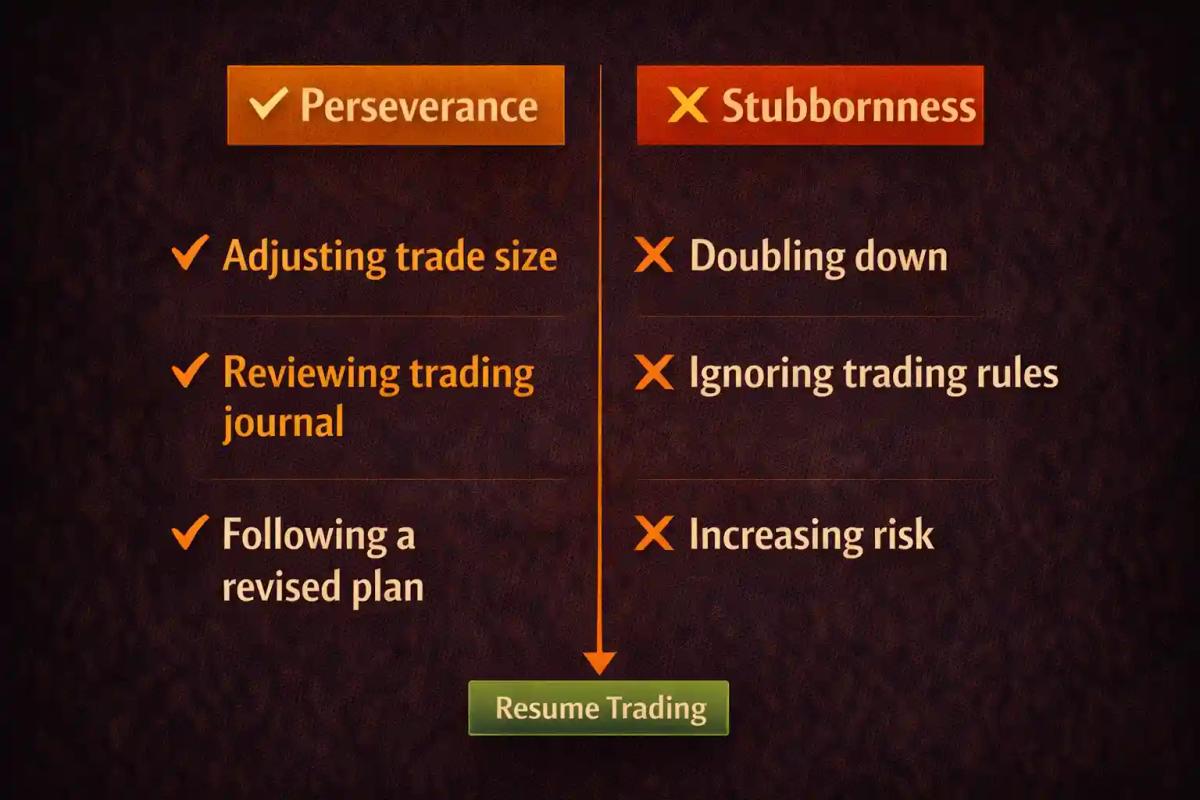
Perseverance looks like this:
- Continuing to trade a validated strategy with reduced size
- Reviewing your journal and adjusting process based on evidence
- Following your pre-drawdown rules even when it’s uncomfortable
- Accepting the drawdown while maintaining discipline
Stubbornness looks like this:
- Refusing to reduce size because “the edge will show up”
- Ignoring your rules because “this is a special situation”
- Increasing risk to accelerate recovery
- Continuing without any review or adaptation
The difference isn’t always visible from the outside. Both the persevering trader and the stubborn trader are “staying in the game.” But the persevering trader is adapting within a framework, while the stubborn trader is white-knuckling through denial.
Ask yourself honestly: am I following my plan, or am I following my ego?
Creating Accountability Structures
Drawdown psychology is hardest to manage alone. When you’re the only person tracking your performance and your behavior, it becomes remarkably easy to rationalize breaking your own rules. “I’ll start the protocol tomorrow.” “This one trade doesn’t count.” “I’ll journal later.”
Accountability structures work against this tendency. They can take several forms:
- A trading partner or peer. Someone at a similar level who you share your drawdown rules with and check in with regularly.
- A mentor or coach. Someone with more experience who can offer perspective when yours is compromised.
- A trading community. A group where you post your journal entries or drawdown updates, creating social commitment to your process.
- Automated rules. If you trade through a platform or prop firm with drawdown rules, external limits can enforce discipline when your own discipline wavers.
The point is to create friction between your emotional impulse and your ability to act on it. The harder it is to break your rules without someone noticing, the less likely you are to break them.
When to Step Away and When to Push Through
Not every drawdown demands the same response, and one of the most dangerous pieces of generic advice in trading is “just keep going.” Sometimes the right call is to keep trading. Sometimes it’s to stop entirely. The real skill is knowing which situation you’re in.
Consider pushing through when:
- Your drawdown falls within the historical parameters of your backtested strategy
- You can trace the losses to valid setups that simply didn’t work out
- Your journaling shows clean process execution
- You’re following your pre-drawdown rules and your position sizing adjustments are active
Consider stepping away when:
- You can’t honestly say your recent trades followed your plan
- Your journal entries (if you’re still writing them) reveal increasing emotional reactivity
- You’re thinking about the market constantly outside of trading hours
- Your drawdown has crossed the thresholds where your rules say to stop
- Trading is spilling into your sleep, relationships, or daily functioning
Stepping away is one of the most sophisticated risk management decisions available to you. Professional athletes sit out games when injured to protect the rest of the season. You can sit out a week of trading to protect the rest of your career.
The distinction that matters is this: stepping away should be a deliberate, rule-based decision, not an emotional collapse. “I’m stopping because my rules say I stop at this threshold” is recovery. “I’m stopping because I can’t take it anymore” is capitulation, and it often leads to a chaotic return when the emotional pressure temporarily lifts.
Frequently Asked Questions
How long does a typical trading drawdown last psychologically?
There's no universal timeline because it depends on the depth of the drawdown, your experience level, and whether you have a structured response protocol in place. Psychologically, most traders find that the sharpest emotional intensity peaks within the first few days to two weeks and gradually eases as you either implement your framework or adapt to the new equity level. The crucial point is that having a plan significantly shortens the psychological recovery, even when the account recovery takes longer.
Should I keep trading through a drawdown or stop entirely?
It depends on whether your drawdown stems from expected variance within a valid strategy or signals that something in your process has broken down. If your trade journal shows clean execution and the losses come from valid setups, continuing at reduced size is often the better path. If your journal reveals emotional decision-making, broken rules, or trades outside your plan, stopping until you've completed a thorough review tends to be the wiser choice.
How do I tell the difference between a normal drawdown and a strategy that's no longer working?
This is one of the hardest questions in trading, and no perfect answer exists. A solid starting point is comparing your current drawdown to your strategy's historical performance data. If you're within the expected maximum drawdown and the losing trades still qualify as valid setups by your criteria, the strategy is likely intact. If you're noticing a fundamental shift in how the market responds to your setups, or if the drawdown has pushed well beyond historical norms, a deeper strategy review is warranted.
Does drawdown psychology differ for prop firm traders versus personal account traders?
The core emotional mechanics are the same, but prop firm traders often carry an additional layer of pressure because external drawdown limits create hard deadlines for recovery. This can sharpen the urgency and fuel the temptation to over-leverage. On the flip side, prop firm drawdown rules can also function as enforced circuit breakers, preventing you from compounding losses past a set point. Some traders find that external structure genuinely helpful for maintaining discipline.
How does journaling during a drawdown help more than journaling after it?
Journaling after a session gives you hindsight analysis, which is valuable but inevitably filtered through memory and rationalization. Journaling during the drawdown captures your raw emotional state, your impulses, and the real-time distance between what your plan says and what you want to do. This live data is far more revealing and helps you pinpoint the specific emotional triggers that precede your worst decisions.
At what drawdown percentage should I seriously consider pausing?
This is personal and should be defined before you're in a drawdown. A common starting framework is to reduce size at 5-7% drawdown, take a mandatory short break at 10%, and pause live trading entirely at 15-20% for a full strategy and process review. Your specific thresholds should be calibrated to your strategy's historical drawdown profile and an honest assessment of your own emotional tolerance.
Do experienced traders still struggle psychologically with drawdowns?
Yes. Experience doesn't eliminate the emotional difficulty of drawdowns. What it changes is the speed of recognition and the quality of the response. Experienced traders tend to identify which phase they're in more quickly, activate their protocols sooner, and carry deeper trust in their process. But the discomfort, the self-doubt, the impulse to overtrade or freeze: those don't vanish with experience. They simply get managed more effectively.
About the authors


Put this into practice
Related articles

Emotional Intelligence for Traders: A Practical Guide to Trading with EQ
Learn how emotional intelligence shapes your trading results. A practical framework with daily EQ exercises, journaling techniques, and the Pause Protocol.
Fear of Losing Money Trading: Why It Happens and How to Manage It
Learn why fear of losing money trading affects your decisions and discover practical methods to manage loss aversion without eliminating healthy caution.

Fear of Missing Out in Trading: How FOMO Destroys Accounts and How to Stop It
Learn what causes fear of missing out "FOMO" in trading, how to recognize it in your decisions, and practical steps to stop chasing trades for good.
0 comments