



Fear of Missing Out in Trading: How FOMO Destroys Accounts and How to Stop It
FOMO in trading is a deeply wired psychological response that hijacks your decision-making at exactly the moments when discipline matters most. Once you understand how it actually works, though, you can learn to see it coming, interrupt it, and eventually trade right past it without flinching.
This guide breaks down what FOMO really is in a trading context, why your brain keeps falling for it, how to catch yourself in the act, and what concrete steps you can take to stop letting urgency replace strategy.
This content is for educational and informational purposes only. It does not constitute financial advice or professional psychological guidance.
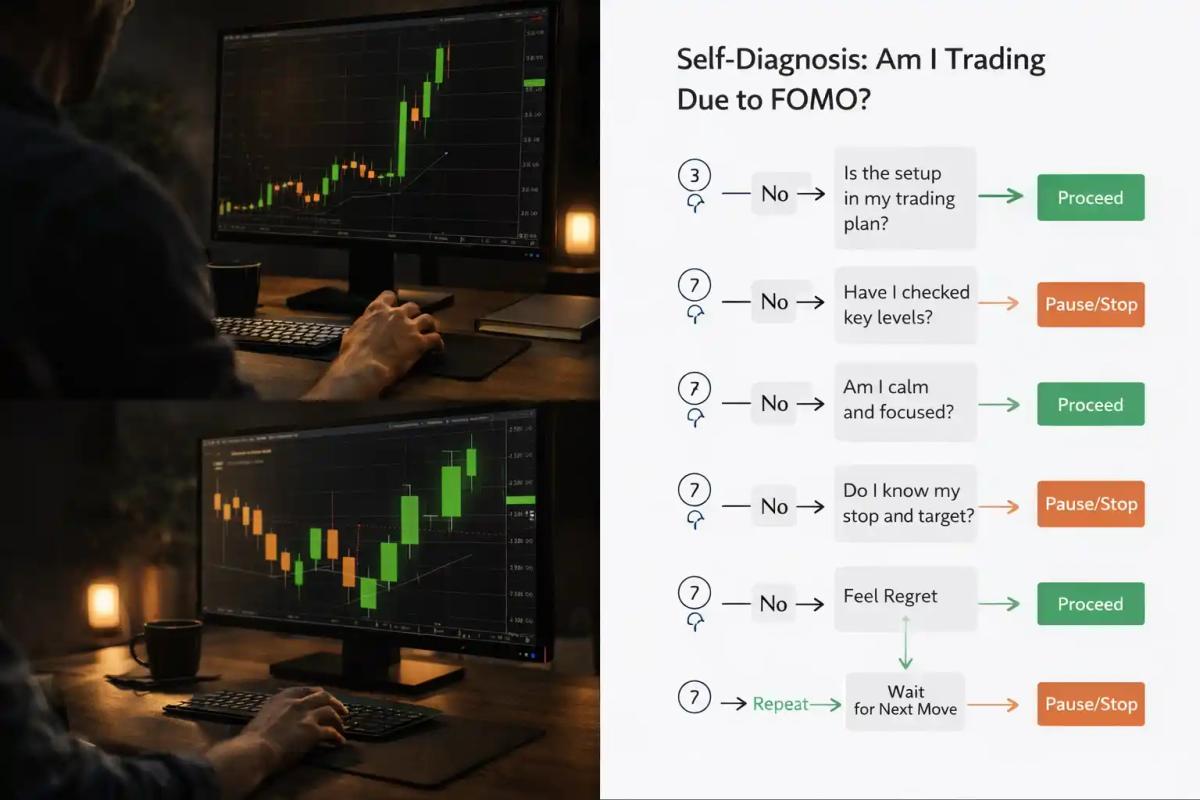
What Is FOMO in Trading
The moment your chest tightens because a pair just broke out and you are flat, that is FOMO doing its work. In trading, FOMO is the anxiety-driven compulsion to enter a position not because your analysis supports it, but because you are afraid the market will leave without you.
It is not the same as spotting an opportunity and acting on it. FOMO specifically refers to the emotional override, the point where fear of missing a profitable move replaces your actual trading criteria as the reason for entering.
How FOMO Differs From Normal Market Excitement
There is nothing wrong with feeling excited when a setup forms or when the market starts moving in a direction you anticipated. That kind of engagement is healthy. It means you are paying attention.
FOMO feels different. Normal excitement comes with a plan already in place. You see the move developing, recognize the setup, and execute according to rules you defined before the candle ever printed. FOMO hits hardest when you had no plan at all, or when the plan said “stay out” and your emotions overruled it.
If you can articulate exactly why you are entering a trade before you click the button, and that reason existed before the move started, it is probably not FOMO. If the only honest answer is “because it is going up and I am not in it,” that is FOMO talking.
The Psychology Behind Opportunity Anxiety
Your brain is not built for trading. It is built for survival in environments where missing an opportunity (a meal, a safe shelter, a mating chance) could mean real danger. When your brain perceives a scarce, time-limited opportunity, it triggers a stress response designed to push you into action before the window closes.
In trading, this maps almost perfectly. A rapidly moving price feels like a closing window. Your brain releases dopamine in anticipation of the reward, the profit you imagine, and simultaneously triggers loss aversion. This is the deeply researched psychological finding that losing something, or missing out on it, feels roughly twice as painful as gaining the equivalent feels good.
So when you watch a currency pair rally 80 pips without you, your brain is not calmly calculating probabilities. It is screaming that you are losing something, even though you never had it. That is why FOMO feels so urgent, and why willpower alone rarely stops it.
Understanding the mechanism matters. But what makes certain traders more vulnerable to this than others?
Why Traders Experience FOMO
FOMO does not appear in a vacuum. Specific conditions in your environment and your habits feed it, and recognizing those conditions is the first step toward cutting off the supply.
Social Media and Real-Time Market Noise
Every time you open trading Twitter, a Discord server, or a Telegram group and see someone posting a screenshot of a 200-pip winner, your brain registers a signal: other people are profiting, and you are not. It does not matter that you have no idea whether that screenshot is real, cherry-picked, or the one winner among fifteen losers. The emotional hit lands instantly.
Real-time market commentary amplifies this further. When multiple voices are saying “this is breaking out” or “you do not want to miss this,” the herd instinct kicks in. You start to feel that if everyone else sees the opportunity, you must be wrong for staying out. Social proof, the psychological tendency to follow what others are doing, stacks on top of your existing fear and pushes you toward impulsive entries.
Loss Aversion and the Pain of Watching Profits You Did Not Take
Loss aversion does not only apply to open positions. It applies to hypothetical ones. When you watch a trade you considered taking run 100 points in profit, your brain processes that as a loss, even though you never risked a cent. The pain of “I could have been in that” is psychologically real, and it primes you to jump into the next opportunity without proper evaluation.
This is particularly toxic because it creates a feedback loop. You miss a move, feel the sting, then overtrade on the next signal to compensate. The compensation trade is poorly planned, so it loses. Now you have an actual loss stacked on top of the perceived one, and the pressure to “make it back” builds even further.
Lack of a Defined Trading Plan
This is the structural root of most FOMO. If you do not have a written, specific trading plan that defines exactly what setups you trade, under what conditions, and with what position size, then every market move looks like a potential opportunity. Without a filter, your brain has no basis for saying “this is not my trade.” Everything feels relevant, everything feels urgent, and the fear of missing out has nothing to push against.
A plan does not just tell you when to trade. It gives you permission to not trade. And that permission is what FOMO-prone traders are missing most.
So how do you know if FOMO is already shaping your decisions?
How to Recognize FOMO in Your Own Trading
The trickiest thing about FOMO is that it disguises itself as conviction. You do not think “I am acting on fear right now.” You think “this is a great setup” or “I just know this one is going to work.” Learning to distinguish between genuine analysis and emotional rationalization is a skill, and it starts with honest self-observation.
Behavioral Warning Signs
FOMO leaves fingerprints on your trading behavior. Once you know what to look for, the pattern becomes hard to ignore. Watch for these signals:
- Entering trades without checking your plan first. If you clicked before consulting your rules, emotion drove the decision.
- Increasing position size because you “need to make up” for a missed move. Sizing up out of frustration is a classic FOMO escalation.
- Trading setups you would normally skip. If the pair, the timeframe, or the pattern is outside your usual scope, ask yourself what changed today.
- Feeling physical urgency. Rapid heartbeat, restlessness, a sense that you need to act right now. These are stress responses, not analytical signals.
- Rationalizing after entry. If you entered the trade and then started looking for reasons it was a good idea, the order of operations was backwards.
The FOMO Trade Checklist (Self-Diagnosis Framework)
Before you enter your next trade, run through these questions honestly. They are designed to separate planned trades from impulsive ones:
- Did this setup exist in my plan before I saw the price move? (Yes = proceed / No = pause)
- Am I entering because of my own analysis, or because I saw someone else’s trade? (Own analysis = proceed / Someone else’s = pause)
- If this trade loses, will I be comfortable with the reasoning behind it? (Yes = proceed / No = pause)
- Have I defined my stop-loss and position size before clicking? (Yes = proceed / No = stop)
- Am I feeling calm, or do I feel rushed? (Calm = proceed / Rushed = step away)
If you paused or stopped on even one question, close the order window. The trade will either come back on your terms, or it was never yours to take.
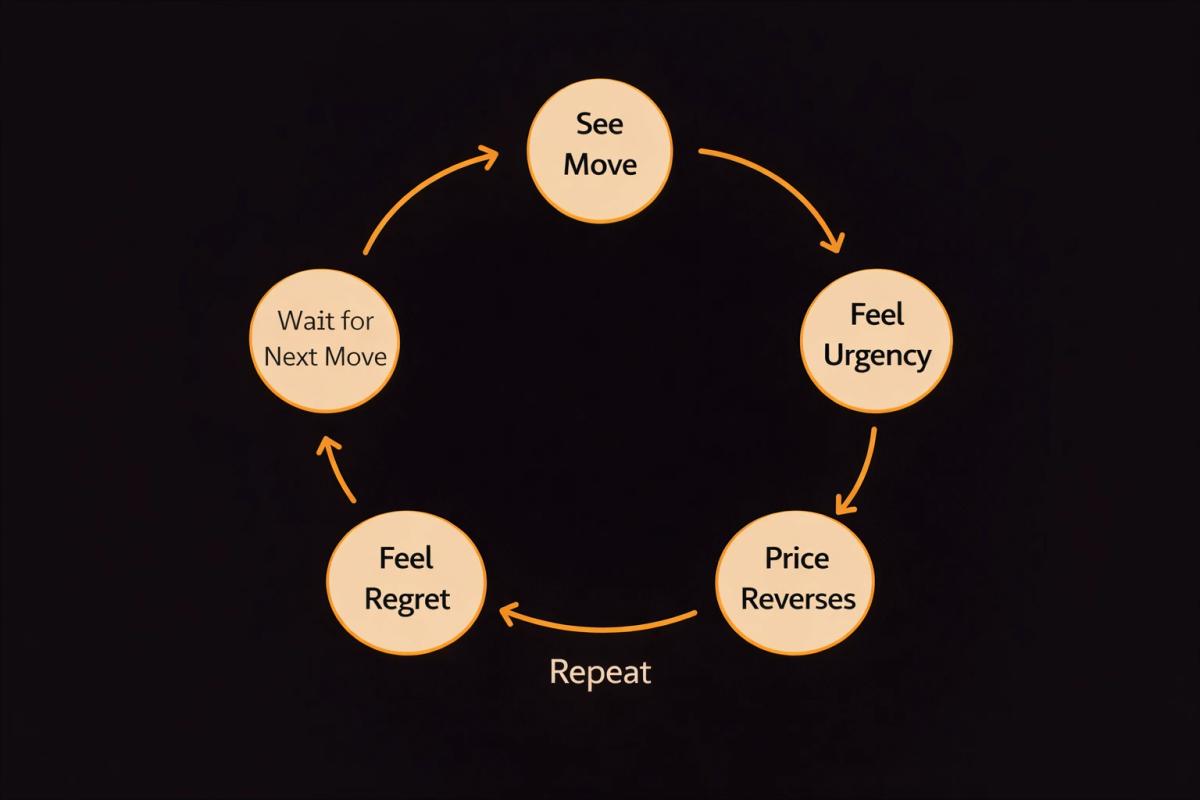
What happens if you ignore these signals and trade on impulse anyway? The consequences follow a painfully predictable pattern.
What Happens When You Trade on FOMO
FOMO trades do not just lose money randomly. They lose money in specific, recognizable ways that compound the emotional damage and make the next FOMO episode even more likely.
Chasing Trades After the Move Has Happened
The most common FOMO behavior is chasing: entering a trade after a significant portion of the move has already occurred. You see a candle that has already traveled 70% of its typical daily range, and you buy at the top hoping for another 30%. What usually follows is a pullback, and you are now holding a position that was underwater from the first tick.
Chasing is structurally disadvantageous. Your entry price is poor, your risk-to-reward ratio is compressed, and you are competing against traders who got in earlier and are now looking to take profit, often right at the level where you just entered.
Overleveraging and Abandoning Risk Rules
FOMO distorts risk management because the emotional urgency makes normal rules feel like obstacles. You might increase your lot size because you “know” this trade is going to work, or skip setting a stop-loss because you do not want to get stopped out of what feels like a guaranteed winner.
This is where FOMO transitions from an annoyance to a genuine account threat. A single overleveraged, unprotected FOMO trade can erase weeks of disciplined work.
The Emotional Spiral After a FOMO Loss
This is where the cycle becomes self-reinforcing. You take a FOMO trade. It loses. Now you feel two things at once: the regret of the loss itself, and the added frustration of knowing you broke your own rules to take it. This double-layered emotional hit often triggers what traders call revenge trading, the impulse to immediately re-enter the market to “get it back.”
Revenge trading is FOMO’s close relative, and together they create a spiral: impulsive entry, loss, emotional reaction, another impulsive entry, another loss. Each loop drains capital and confidence in equal measure.
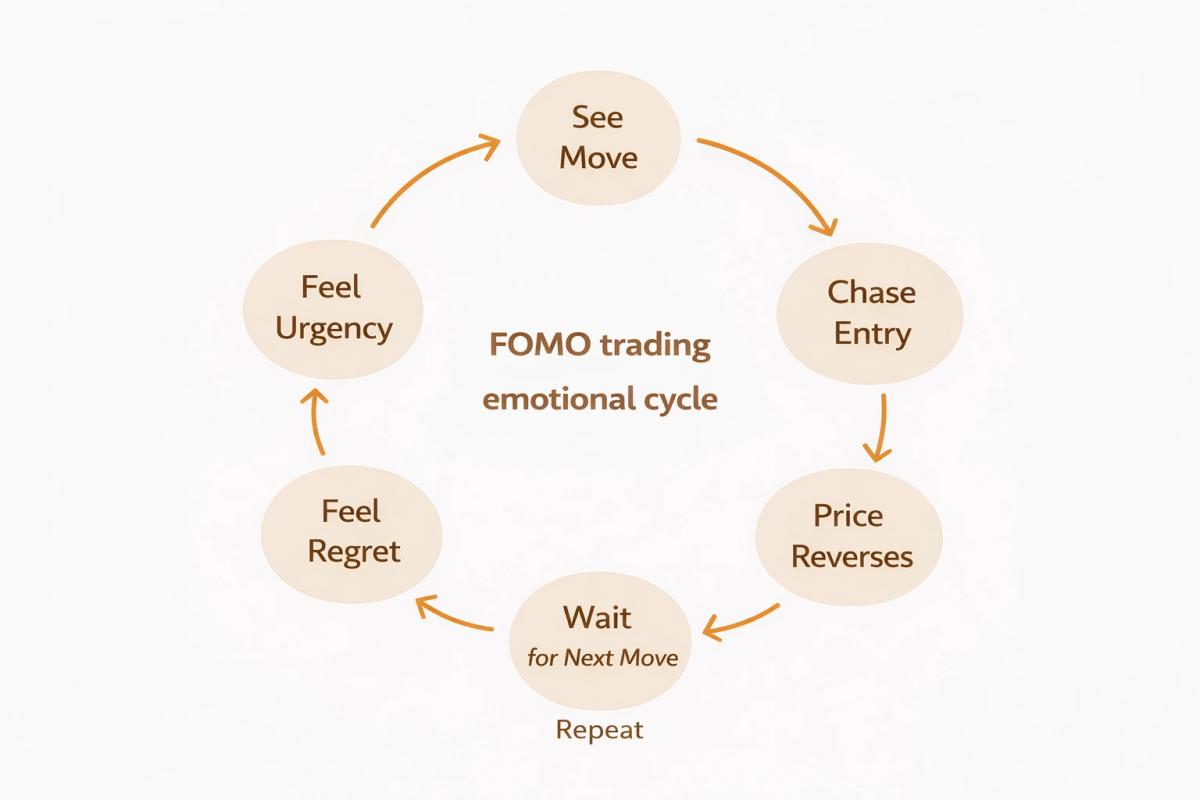
The pattern is circular, but it is not unbreakable. Once you see the loop for what it is, you can start interrupting it at specific points.
How to Overcome FOMO in Trading
There is no switch that turns FOMO off permanently. But there are concrete practices that, over time, weaken its grip and build the kind of discipline that makes impulsive entries feel obviously wrong instead of irresistibly tempting.
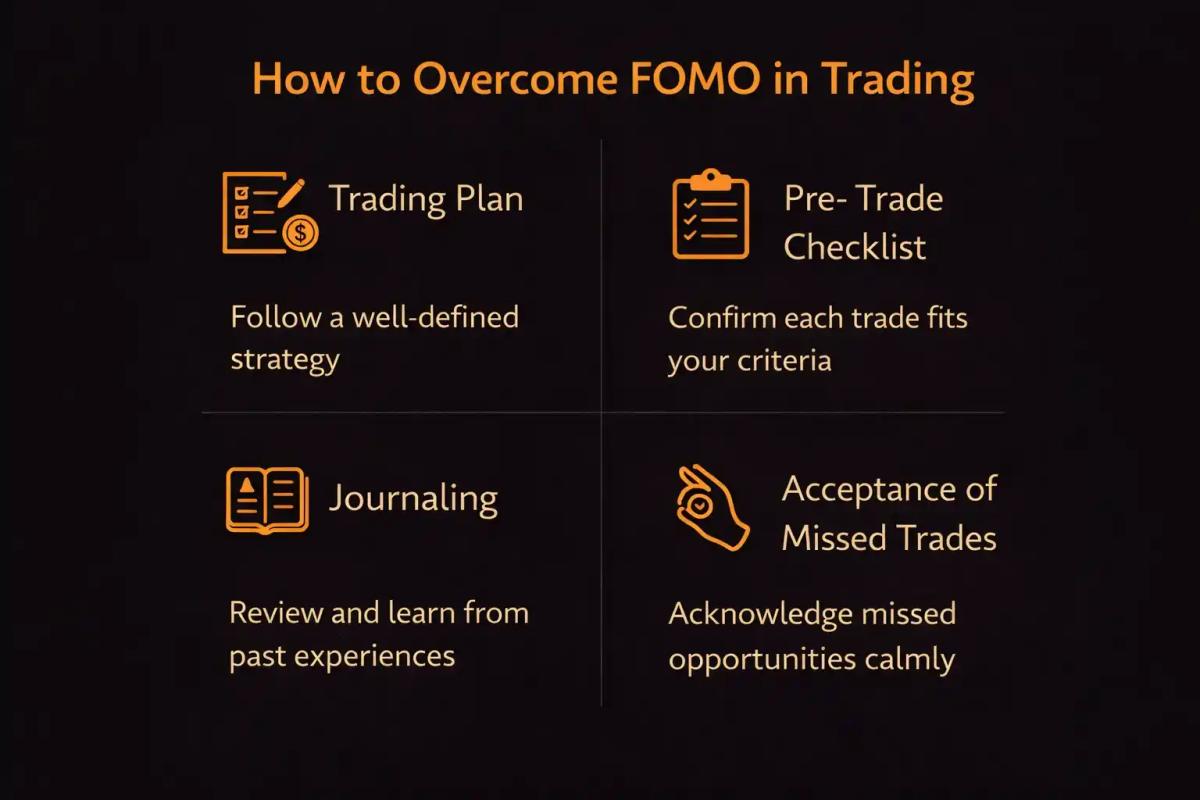
Building and Trusting a Trading Plan
A trading plan is your primary defense against FOMO because it redefines what counts as an opportunity. Without one, every price movement is a potential trade. With one, only movements that match your predefined criteria qualify.
Your plan should specify, at minimum:
- Which instruments you trade
- Which setups you act on (with clear, visual examples)
- Your entry criteria, stop-loss placement, and take-profit logic
- Your maximum risk per trade and per day
- The times of day you trade
The critical word here is “trust.” Writing a plan is easy. Following it when the market is moving and you are flat requires trust that the plan works over a series of trades, not just one. Building that trust often comes from backtesting your strategy across historical data. When you have seen your plan generate consistent results over hundreds of past scenarios, the fear of missing a random, unplanned trade loses much of its power.
Using a Pre-Trade Checklist
The FOMO checklist from earlier is not just a diagnostic tool. It becomes a procedural barrier between impulse and execution. Make it a physical (or digital) routine: before every single trade, you run the checklist. No exceptions.
This introduces a deliberate pause into your workflow. FOMO thrives on speed. It needs you to act before you think. A mandatory checklist forces a gap between feeling and action, and in that gap, rationality has room to reassert itself.
Journaling to Expose Patterns
A trading journal is not a diary. It is a data collection tool. After every trade, record not just the technical details (entry, exit, P&L) but the emotional context: how you felt before entering, what triggered the trade idea, and whether the trade followed your plan.
Over weeks and months, patterns surface. You might discover that your FOMO trades cluster on Mondays after a weekend of reading market commentary. Or that they spike after a winning streak when overconfidence lowers your guard. These patterns are invisible in real time but obvious in retrospect, and once you see them, you can build specific countermeasures.
Accepting Missed Trades as Part of the Process
This is the hardest technique because it requires a fundamental shift in how you evaluate yourself. Most FOMO-prone traders measure their performance partly by how many winning moves they captured. Every missed winner feels like a failure.
The reframe is straightforward but takes practice: your job is not to catch every move. Your job is to execute your plan. A trade that would have been profitable but did not match your criteria is not a missed opportunity. It is an irrelevant event, like a goal scored in a game you are not playing.
When you internalize this, missed trades stop generating pain. And without the pain, FOMO loses its fuel.
What if your own discipline is not enough, though? Sometimes, external structure can provide the guardrails you need while you build internal ones.
How Prop Trading Rules Can Help Manage FOMO
Structured trading environments, like prop trading firms, impose rules that you cannot bend in the heat of the moment. Maximum daily loss limits, drawdown thresholds, and position size caps exist independent of your emotional state.
Why External Accountability Reduces Impulsive Entries
When you know that a single overleveraged FOMO trade could breach your daily loss limit and restrict your account, the cost of impulsivity becomes concrete and immediate. It is no longer an abstract “I should not do this.” It is “if I do this and it goes wrong, I lose access to my funded account.”
This external accountability acts as a circuit breaker. It does not eliminate the feeling of FOMO, but it raises the stakes of acting on it high enough that the pause before entering becomes automatic. Over time, many traders find that discipline enforced by external rules gradually becomes internalized. The structure trains the habit even after the external constraints are removed.
This is not to say that prop firms are a solution to FOMO on their own. No environment can fix a psychological pattern by itself. But for traders who struggle with self-imposed rules, having non-negotiable boundaries enforced from the outside can provide scaffolding while internal discipline develops.
Frequently Asked Questions
Is FOMO in trading normal, or does it signal a deeper problem?
FOMO is an extremely common experience among traders at all levels. It is rooted in normal human psychology, specifically loss aversion and social comparison, not in any clinical disorder. Experiencing FOMO does not mean something is wrong with you. However, if it is consistently overriding your decision-making and causing significant financial or emotional distress, working with a professional to address the underlying patterns may be worthwhile.
How do I tell the difference between FOMO and a legitimate trade opportunity?
The key distinction is process. A legitimate opportunity is one that matches your predefined trading plan criteria and was identifiable before the move accelerated. FOMO-driven entries typically lack any pre-existing plan justification, and the primary motivation is the fear of missing the move rather than a specific analytical reason. If you cannot explain your entry without referencing how fast the price was moving, it was likely FOMO.
How long does it take to overcome FOMO tendencies?
There is no fixed timeline, and it is more accurate to think of managing FOMO rather than eliminating it entirely. Most traders who consistently apply techniques like journaling, pre-trade checklists, and plan adherence report significant improvement within a few months. The feeling may still surface occasionally, but your response to it changes. You learn to notice it without acting on it.
Can demo trading help reduce FOMO?
Demo trading can help you practice executing a plan without financial risk, which builds mechanical discipline. However, because there is no real money at stake, demo accounts do not fully replicate the emotional intensity that triggers FOMO. They are useful for testing strategy and building checklist habits, but the real work of managing FOMO happens when actual capital is on the line.
How does social media specifically make FOMO worse for traders?
Social media creates a highlight reel of other traders' wins. You see screenshots of profits, calls that played out perfectly, and confident commentary, all without seeing the losses, the failed setups, or the full context. This curated feed triggers constant social comparison and creates the illusion that everyone is profiting from moves you are missing. Reducing exposure to trading social media during market hours is one of the simplest ways to lower your FOMO baseline.
Can automated trading or price alerts help with FOMO?
Price alerts can be helpful because they allow you to step away from the screen and only engage when your predefined conditions are met. This reduces the passive chart-watching that feeds FOMO. Automated trading systems remove emotion from execution entirely, but they require robust strategy development and testing. Neither tool addresses the root psychology, but both reduce your exposure to the real-time emotional triggers that activate it.
What is the relationship between FOMO and revenge trading?
FOMO and revenge trading are closely linked but distinct. FOMO is the impulse to enter a trade because you fear missing a move. Revenge trading is the impulse to enter a trade to recover a recent loss. In practice, they often chain together: a FOMO entry leads to a loss, which triggers revenge trading, which leads to another loss, reinforcing the cycle. Recognizing that both are emotional responses, not strategic decisions, is the first step to interrupting either one.
About the authors


Put this into practice
Related articles
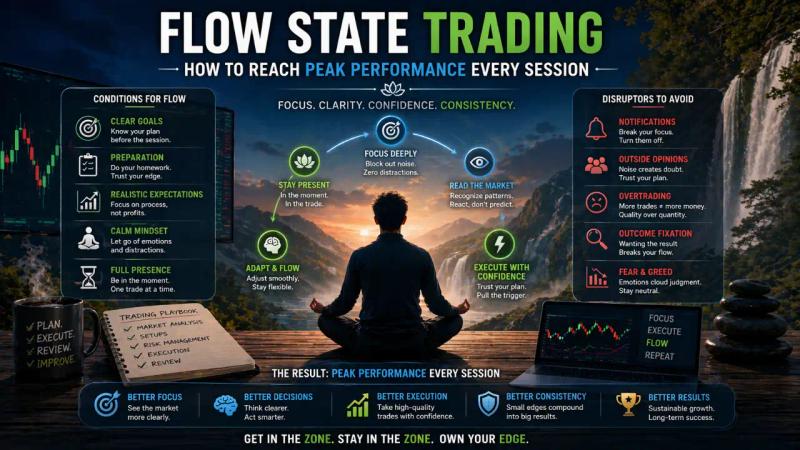
Flow State Trading: How to Reach Peak Performance Every Session
Learn what flow state is, what triggers it, and how to design your trading sessions for consistent peak focus and execution quality.

Forex Broker Fee Structure Explained: How to Read the Numbers Without Getting Misled
Learn how forex broker fees really work. Understand spreads, commissions, swap rates, and hidden costs so you can calculate the true cost of every trade before you deposit.
Gambler’s Fallacy in Trading: Why Your Next Trade Isn’t “Due”
Learn how the gambler's fallacy distorts trading decisions after losing streaks, why your brain falls for it, and how to build defenses that protect your account.
0 comments