



Flow State Trading: How to Reach Peak Performance Every Session
You know those trading sessions where every entry feels obvious, your timing is razor-sharp, and you close your charts feeling like you just played the best game of your life?
That effortless winning streak has a name, and more importantly, a science behind it. It’s called flow state, and it’s one of the most studied phenomena in performance psychology. The good news is that you don’t have to wait for it to show up at random. You can design your trading sessions to invite it in.
This guide breaks down what flow state actually is in the context of trading, what triggers it, what kills it, and how to build a repeatable framework so your best sessions stop being the exception and start becoming the baseline.
This content is for educational and informational purposes only. It does not constitute financial, psychological, or medical advice.
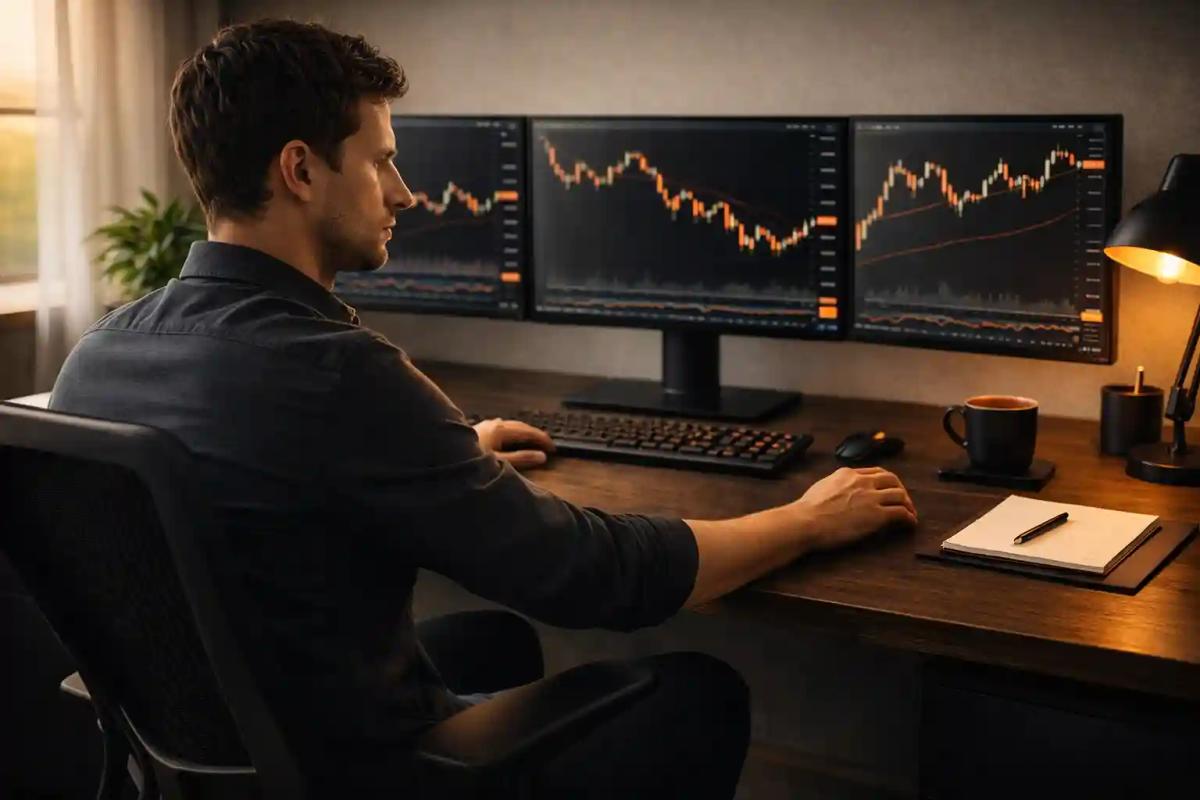
What Flow State Actually Means for Traders
Most traders have heard the phrase “being in the zone,” but few understand the mechanics underneath it. Flow is a measurable psychological state with specific entry conditions. Once you understand those conditions, you can start engineering them into your trading routine.
The Psychology Behind Flow
The concept of flow was formalized by psychologist Mihaly Csikszentmihalyi after decades of studying peak performers across disciplines: chess players, surgeons, rock climbers. What he found was remarkably consistent. When certain conditions aligned, people entered a state of total absorption where performance elevated, the sense of time distorted, and actions felt almost automatic.
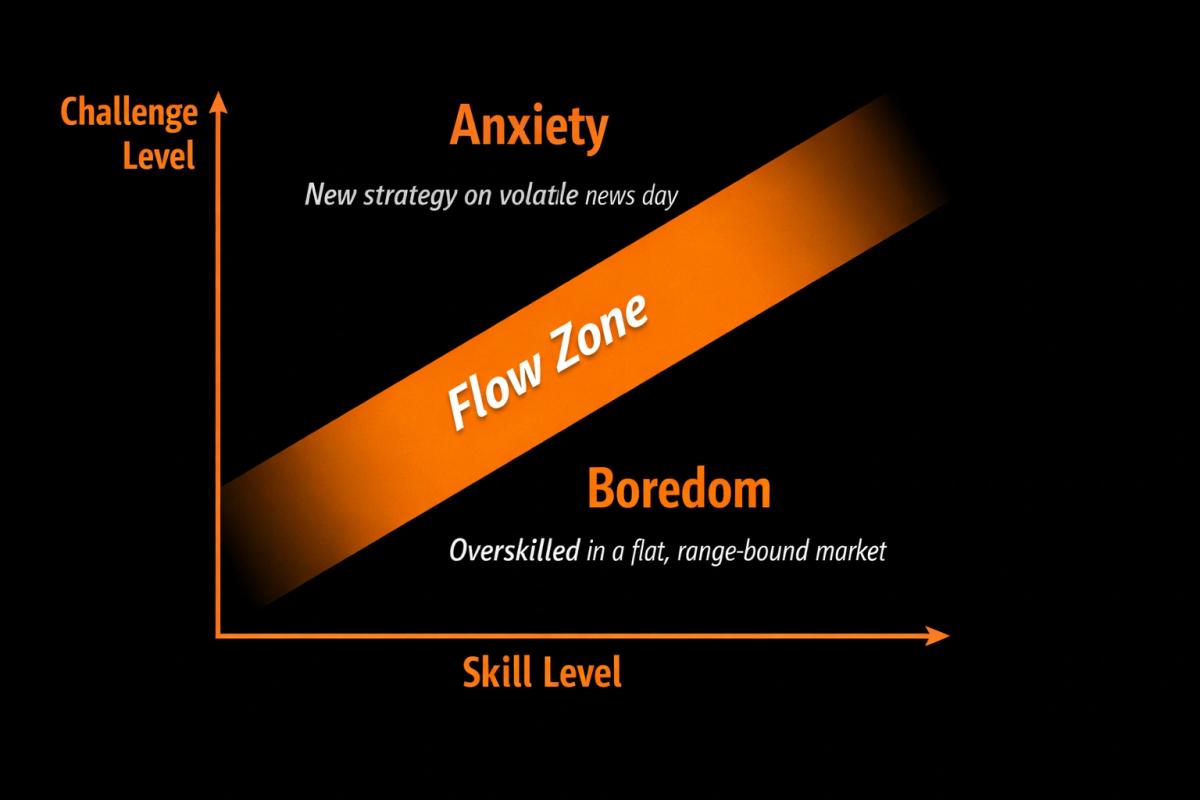
Flow happens when the challenge you’re facing closely matches your current skill level. Too much challenge relative to your skill, and you tip into anxiety. Too little, and you slide into boredom or complacency. That narrow band between the two extremes is where flow lives.
For traders, think of it this way: trading a strategy you’ve backtested and practiced for months, on a market moving with just enough volatility to hold your attention: that’s the flow channel. Trading a brand-new strategy on a news-driven session you don’t understand: that’s anxiety. Watching a dead-flat market while you wait for a setup that never materializes: that’s boredom. Neither will get you anywhere near flow.
Csikszentmihalyi also described flow as an “autotelic” experience, meaning the activity becomes rewarding in itself. When you’re in flow during a trading session, the process of reading price, managing risk, and executing your plan feels intrinsically satisfying.
What Flow Feels Like During a Live Session
If you’ve experienced flow while trading, you’ll recognize these sensations immediately. Your focus narrows to the chart and your plan. Decisions arrive without that painful internal tug-of-war where you argue with yourself for thirty seconds about whether to pull the trigger.
There’s a sense of merging with your process, where the gap between spotting a setup and acting on it collapses to almost nothing. Your self-talk quiets. You’re not thinking about your P&L or what happened yesterday. You’re simply executing, reading, adjusting, executing again.
Time bends too. An hour of active trading might feel like fifteen minutes. And afterward, even if the session wasn’t wildly profitable, there’s a distinct satisfaction because you know you traded at your best.
That last point matters more than it might seem. Flow is a process state, not an outcome state. You can be in flow and still take a losing trade. The difference is that your decision-making was clean, and you know it.
Why Most Traders Rarely Experience Flow
If flow sounds familiar but rare, you’re in good company. Most traders stumble into it occasionally and then spend weeks trying to recreate it without understanding what produced it in the first place. The reasons it stays elusive tend to fall into two categories.
The Skill-Challenge Mismatch
This is the most common barrier, and it cuts both ways. Traders who are underprepared for the conditions they’re facing will experience anxiety, not flow. If you’re trading a volatile earnings session with a strategy you’ve only practiced on calm trending days, you’re setting yourself up for cognitive overload.
On the flip side, traders who are overskilled for the conditions, sitting in a range-bound market with nothing to do, will feel restless and bored. Boredom leads to forcing trades, which spirals into frustration, which pushes flow even further out of reach.
The fix is about honestly matching your preparation and skill level to the conditions you choose to trade. If you don’t have edge in choppy markets, don’t trade choppy markets and expect to find flow there.
Environmental and Emotional Blockers
Even when the skill-challenge balance is right, flow can’t survive in a hostile environment. Constant notifications, a cluttered workspace, unresolved emotional tension from a disagreement with a partner or a bad trade from yesterday: these things hijack your attention and make sustained focus nearly impossible.
Flow demands what psychologists call “deep work” conditions. Your brain cannot split its resources between chart analysis and a text conversation. Every time your attention leaves the market and comes back, you pay a cognitive switching cost. Stack enough of those up, and flow never gets a foothold.
So what actually opens the door? The specific triggers you can control.
The Core Triggers of Flow State in Trading
Csikszentmihalyi’s research identified several universal flow triggers, and they map remarkably well onto trading. These four matter most for your sessions.
Clear Goals and Pre-Session Planning
Flow requires clarity. If you sit down at your charts without knowing what you’re looking for, what setups you’ll trade, or what your rules are for the session, your brain stays stuck in decision-making mode instead of execution mode. That constant low-level decision fatigue is a flow killer.
A pre-session plan (your watchlist, your setups, your max risk, your session goals) gives your mind a clear track to run on. That clarity frees up mental bandwidth for pattern recognition and real-time execution, exactly where flow lives.
Immediate Feedback Loops
Flow thrives on rapid feedback. In trading, this feedback arrives naturally through price action. You enter a trade, and the market immediately tells you whether your read was correct. You adjust your stop, and you see the result. This tight loop between action and outcome keeps your brain engaged at precisely the right level.
The key is to actually stay present with that feedback. Traders who enter a trade and then walk away or flip to social media are severing the feedback loop. Watching how price responds to your levels, reading its rhythm in real time: that’s what keeps the flow cycle turning.
The Right Level of Challenge
This ties directly back to Csikszentmihalyi’s core model. You need to be trading conditions that stretch you slightly beyond autopilot without overwhelming you. Think of a musician who knows a piece well enough to play it confidently but is pushing for a slightly faster tempo or richer expression. That edge of growth is where flow ignites.
For you, this might mean focusing on a market active enough to generate your setups but not so volatile you can’t read the structure. It might mean trading your usual size, not the inflated size you reach for when you’re feeling lucky. The right challenge is personal, and it shifts as your skills develop.
Eliminating Distractions
This one sounds obvious, yet most traders dramatically underestimate how much their environment undermines their focus. A single notification can yank you out of a developing flow state, and getting back in takes far longer than the two seconds you spent glancing at your phone.
Think of distractions as flow toxins. Each one actively degrades the state you were building toward. The most disciplined traders treat session time the way a surgeon treats operating time: phone off, door closed, non-essential tabs gone.
Knowing the triggers, though, is only half the equation. How do you actually structure a session to stack these conditions in your favor?
How to Design a Trading Session for Flow
Flow doesn’t happen by accident on a consistent basis. The traders who access it regularly have designed their sessions around it, even if they’ve never used the word “flow” to describe what they’re doing.
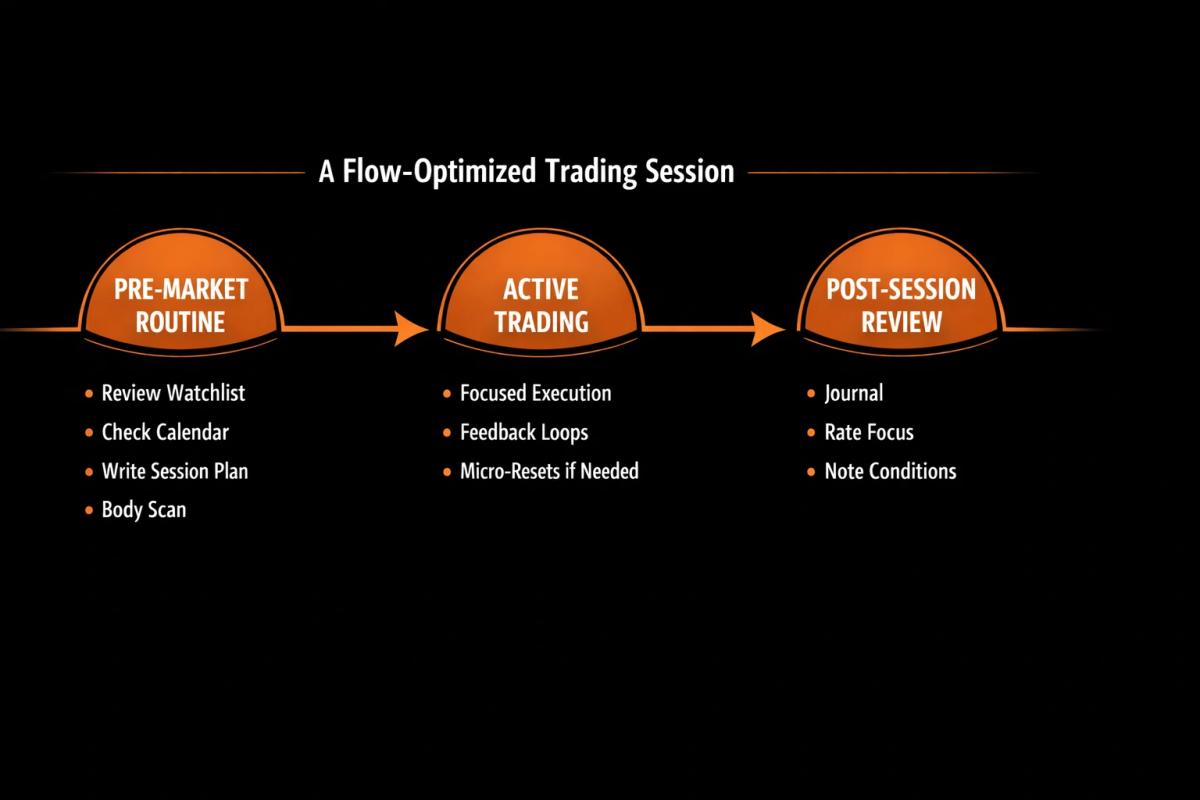
Pre-Market Routine and Mental Priming
Your mental state when you open your charts sets the trajectory for the entire session. If you roll out of bed, grab coffee, and immediately start scanning for trades, you’re skipping the most important phase of session preparation.
A pre-market routine acts as a psychological transition. It signals your brain to shift from everyday mode into performance mode. This doesn’t need to be elaborate: fifteen minutes of reviewing your watchlist, checking the economic calendar, writing down your session plan, and doing a quick body scan to check your stress level.
Some traders add a few minutes of breathwork or light stretching to lower baseline arousal and sharpen attention before the open. The specific activities matter less than the consistency. What counts is having a routine that reliably primes your mind for focused work.
Environment and Workspace Setup
Your trading workspace should be flow-friendly by default. That means a clean desk, monitors arranged for efficient scanning, and every tool you need already open and positioned. If you’re fumbling with layouts or searching for a chart template five minutes after the open, you’re burning cognitive resources that should be fueling analysis.
Consider your sensory environment, too. Some traders perform best in silence. Others work well with ambient noise or instrumental music. Whatever you choose, the point is intentionality. Choose your environment rather than letting random factors dictate it.
Managing Risk to Protect Mental Clarity
This is something most trading psychology content overlooks: your risk management directly shapes your ability to enter flow. When your position size is too large for your comfort zone, part of your brain is constantly monitoring P&L, calculating worst-case scenarios, and bracing for pain. That’s cognitive load competing directly with flow.
When you know your downside is contained, your mind is free to focus entirely on process and execution. The mental freedom that comes from well-defined position sizing and stop-losses is one of the most underrated flow enablers in trading.
This raises a practical question worth sitting with: what happens when you’ve set everything up correctly, you’ve entered flow, and then something knocks you out of it?
How to Recover Flow When You Lose It Mid-Session
Even with careful preparation, flow isn’t a permanent state. It fluctuates, and interruptions happen. A surprising news headline, an unexpected loss, or simply a lull in market activity can pull you out. The ability to recognize these drops and recover from them is what separates traders who occasionally find flow from those who sustain it.
Recognizing the Drop
The first step is noticing it. Flow loss usually shows up as a sudden return of self-conscious thinking. You start second-guessing. Your inner dialogue gets louder. There’s a palpable shift from acting to over-analyzing. You might notice physical tension creeping in, shallow breathing, or the urge to grab your phone.
Another reliable signal is frustration with the market itself. If you catch yourself thinking “this market is stupid” or “nothing is working,” that’s rarely a market problem. It’s a sign you’ve exited flow and your emotional brain is running the show.
Reset Techniques That Work in Real Time
When you notice the drop, the worst response is to force your way back in by immediately taking another trade. Pressure is the opposite of flow.
Instead, try a micro-reset. Step away from your screens for sixty to ninety seconds. Take a few slow breaths. Reread your session plan to reconnect with your pre-session clarity. Some traders find it useful to write a single sentence in their journal about what just happened: a quick acknowledgment that creates distance between the disruption and your next decision.
That small gap gives your nervous system time to downshift and your analytical mind time to re-engage. Think of it like a musician who hits a wrong note mid-performance. The professionals take a breath, reconnect with the piece, and continue.
If you can’t recover flow after two or three attempts, that’s valuable information on its own. Sometimes the smartest call is to end the session early rather than grinding through a mentally compromised state. Protecting your psychological capital is just as important as protecting your financial capital.
Flow State vs. Overconfidence: Knowing the Difference
This might be the most important section in this guide, because flow and overconfidence can feel dangerously similar on the surface.
Both involve reduced hesitation, quick decision-making, and a feeling that things are “clicking.” But the internal mechanics are entirely different, and confusing one for the other is how traders blow up accounts on their “best” days.
In genuine flow, you’re process-focused. Your attention is on execution quality, risk parameters, and reading the market. There’s calm underneath your confidence. You’re still following your plan, still honoring your stops, still sizing appropriately. Flow is disciplined energy.
Overconfidence, by contrast, is outcome-focused. You’re thinking about how much you’ve made, how great you are at this, and whether you should bump up your size because “you’re on fire today.” There’s euphoria underneath that confidence, and euphoria is a warning sign.
A practical test: if you’re in a state where you’d comfortably ignore your risk rules because “today is different,” you’re not in flow. You’re in the danger zone.
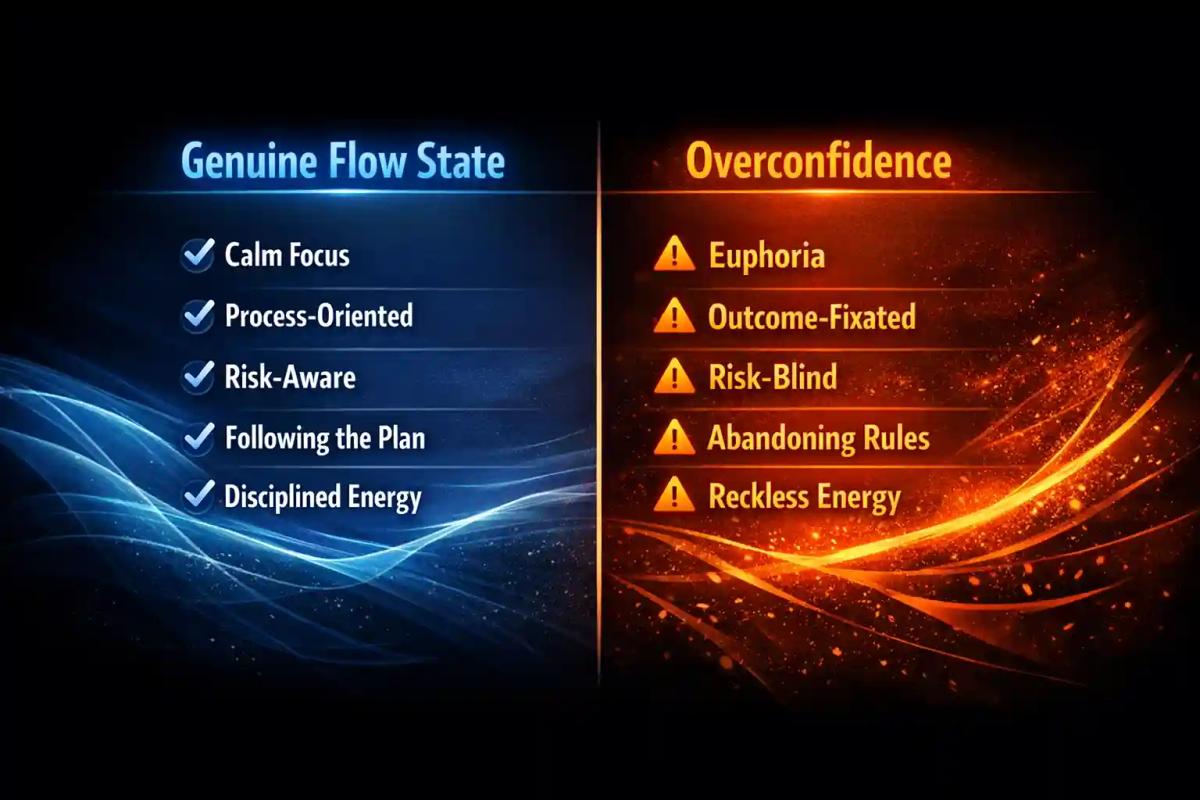
Learning to distinguish between these two states gives you one of the most valuable self-awareness skills a trader can develop. And that kind of self-awareness is built through consistent practice and honest reflection over time.
Building a Long-Term Flow Practice
Reaching flow once is interesting. Reaching it consistently is transformative for your trading. But consistency demands systems, not just good intentions.
Journaling for Pattern Recognition
A trading journal is the single most powerful tool for building a repeatable flow practice. Yet most traders journal the wrong things. They track entries, exits, and P&L, then stop there.
To build flow awareness, add a simple mental state rating to each session. After you close your charts, rate your focus on a 1-to-10 scale. Note what conditions were present: sleep quality, pre-market prep, market conditions, emotional state going in. Over weeks, patterns will surface that reveal exactly what your personal flow triggers look like.
You might discover that you consistently enter flow on days when you exercised in the morning, or that certain market conditions reliably produce your sharpest focus. You might also uncover hidden blockers, like the fact that trading after a difficult phone call almost always leads to poor sessions. This data is uniquely yours, no article or course can hand it to you. Only your journal can.
Physical and Mental Health as Flow Foundations
This is the part nobody wants to hear, but it’s non-negotiable. Flow is a peak cognitive state, and peak cognitive states demand a well-maintained foundation. Chronic sleep deprivation, poor nutrition, lack of physical activity, and unmanaged stress all raise your baseline cognitive load. That means you need even more ideal conditions just to reach the threshold where flow becomes possible.
Treating your body and mind as core components of your trading psychology toolkit, rather than afterthoughts, will meaningfully increase how often and how deeply you access flow. Even modest improvements in sleep consistency and daily movement can tip the balance.
If you’re serious about achieving flow, it’s not enough to be skilled at reading charts. You have to be skilled at managing yourself.
Frequently Asked Questions
Can beginner traders achieve flow state, or does it require experience?
Flow is technically accessible at any skill level, but beginners face a practical hurdle. You need enough competence that your basic actions (placing orders, reading charts, managing risk) are somewhat automatic. If you're still thinking about mechanics, your cognitive load is too high for flow. Most traders find it becomes accessible once they've traded a consistent strategy for several months and internalized their core process.
How long does it typically take to enter flow state during a session?
There's no fixed timeline, but most research suggests roughly 10 to 20 minutes of uninterrupted focused activity before flow begins to develop. For traders, this means the first few minutes of a session are warmup, not peak performance. This is one reason protecting your early session focus (no distractions, no impulsive trades) matters so much.
Is flow state the same thing as being "in the zone"?
In casual conversation, they're used interchangeably, and for practical purposes that's fine. "In the zone" is the colloquial version of what Csikszentmihalyi formally defined as flow. The psychological characteristics (deep focus, time distortion, reduced self-consciousness, intrinsic motivation) are the same regardless of which term you use.
What should I do when an external interruption breaks my flow mid-session?
First, acknowledge the break rather than pretending it didn't happen. Take sixty to ninety seconds away from your screens, reset with a few deep breaths, and revisit your session plan. If the interruption was significant (an emotional phone call, urgent news), honestly assess whether you can regain the necessary focus. Sometimes ending the session early is the best trade you'll make that day.
Can flow state lead to overtrading?
Genuine flow typically doesn't cause overtrading because it keeps you process-focused and aligned with your trading plan. However, what many traders mistake for flow (the euphoric, "I can't lose" feeling) absolutely leads to overtrading. The key differentiator is whether you're still following your rules. If you're abandoning your plan because everything feels easy, that's overconfidence, and you should pause.
How can I tell if I was in flow state after a session ends?
Look for these retrospective markers: time felt compressed (the session went faster than expected), you remember feeling absorbed rather than stressed, your decision-making felt clear rather than conflicted, and you followed your plan without constant internal arguments. Importantly, flow is independent of P&L. You can be in flow during a losing session if your process was clean and your focus was sustained.
Does flow state work differently for day traders versus swing traders?
The core psychology is identical, but the entry conditions differ. Day traders have more opportunities to enter flow during active market hours because of the rapid feedback loops and continuous engagement. Swing traders, who may only check positions a few times per day, tend to experience flow more during their analysis and planning phases than during trade management. Both styles benefit from the same triggers (clear goals, appropriate challenge, focused environment), just applied at different time scales.
About the authors


Put this into practice
Related articles

Forex Broker Fee Structure Explained: How to Read the Numbers Without Getting Misled
Learn how forex broker fees really work. Understand spreads, commissions, swap rates, and hidden costs so you can calculate the true cost of every trade before you deposit.

Gambler’s Fallacy in Trading: Why Your Next Trade Isn’t “Due”
Learn how the gambler's fallacy distorts trading decisions after losing streaks, why your brain falls for it, and how to build defenses that protect your account.
Greed in Trading: How to Recognize It and Stop It From Destroying Your Profits
Learn to spot greed-driven trading behavior, understand its true financial and psychological costs, and build a concrete framework to protect your profits.
0 comments