



Gambler’s Fallacy in Trading: Why Your Next Trade Isn’t “Due”
You’ve just closed your fifth losing trade in a row. Your stomach is tight, your jaw is clenched, and somewhere in the back of your mind, a voice whispers: “The next one has to go my way. It has to.” That feeling, that quiet certainty the universe owes you a win, is one of the most dangerous things a trader can carry into their next position.
It’s called the gambler’s fallacy, and it doesn’t care how smart you are or how long you’ve been in the markets. It exploits a flaw in how your brain processes probability, and it has drained more trading accounts than most technical indicators ever will.
This article breaks down exactly what the gambler’s fallacy is, how it sneaks into your trading decisions, why your brain is wired to fall for it, and, most importantly, how you can build defenses against it. Nothing here is a magic fix or a guarantee of profits. But understanding this bias is one of the most valuable edges you can develop as a trader.
This article is for educational purposes only and does not constitute financial advice. Always consult a qualified professional before making trading decisions.
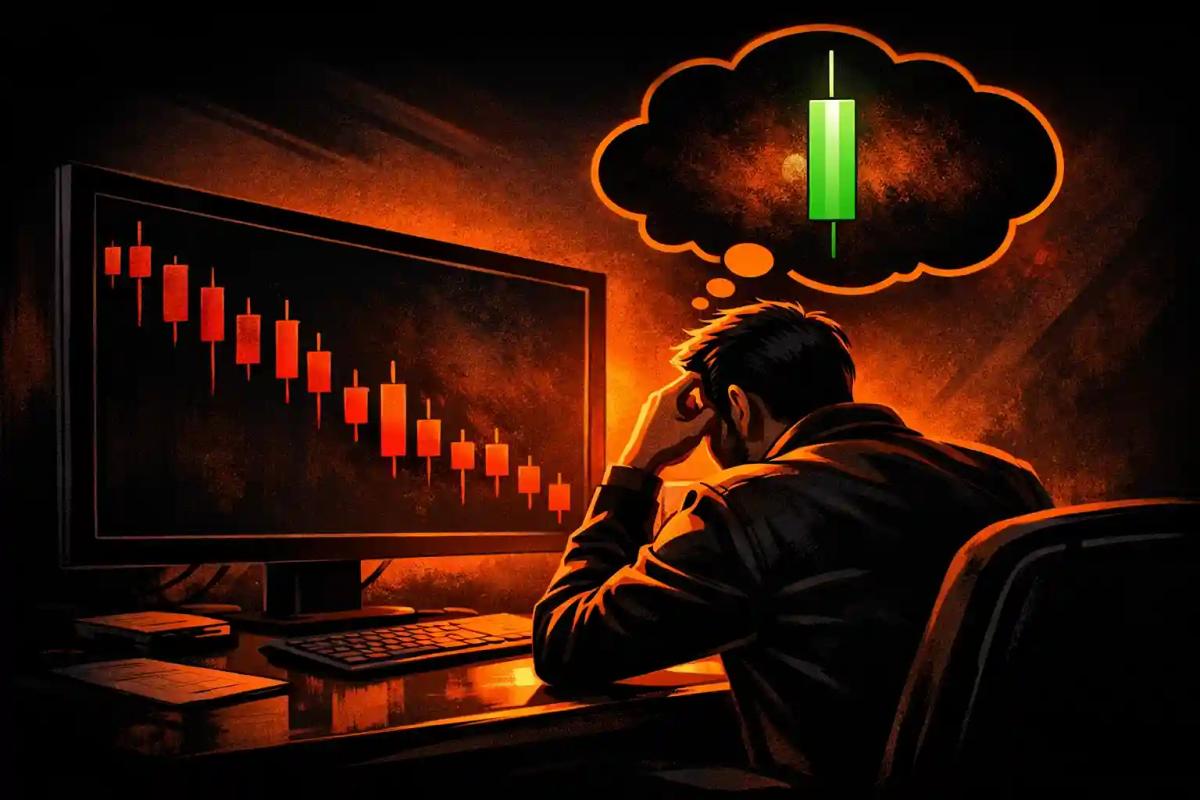
What Is the Gambler’s Fallacy?
The gambler’s fallacy is the belief that past outcomes influence the probability of future outcomes in situations where each event is statistically independent. Put simply, it’s the conviction that because something has happened several times in a row, the opposite result is now “overdue.”
The Core Misconception About Probability
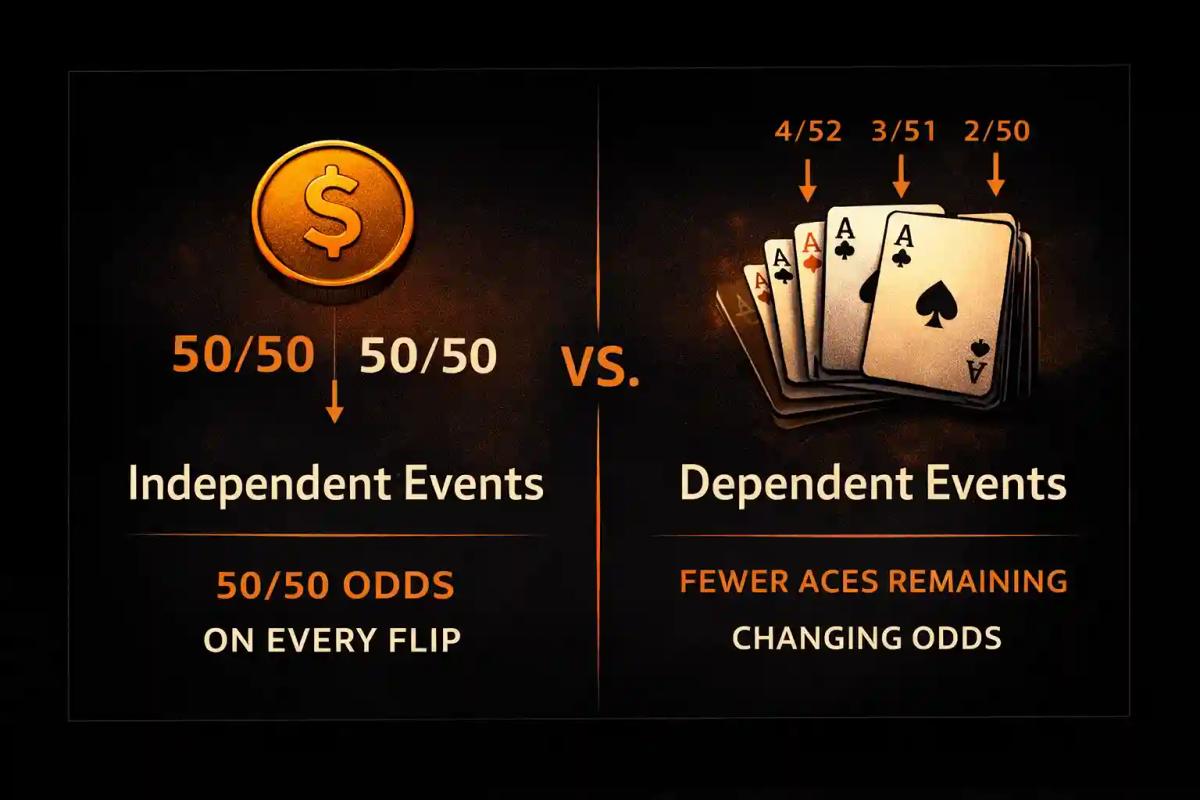
Picture a coin flip. You flip heads five times in a row. Your gut screams that tails is more likely on the sixth flip. But the coin doesn’t have a memory. It doesn’t know what happened on flips one through five. The probability of tails on that sixth flip is still exactly 50/50, identical to every flip before it.
The core misconception comes down to this: you’re confusing the probability of a specific sequence with the probability of a single event. Yes, flipping heads ten times in a row is statistically unlikely before you start. But once you’ve already flipped nine heads, the tenth flip is still a coin toss. The past results don’t reach forward and tilt the odds.
Now transplant that thinking into your trading. You’ve had four losing trades in a row using your strategy. Your brain starts telling you the fifth trade is more likely to be a winner, not because anything about the setup has changed, but simply because you’ve lost enough times that a win “should” come. That’s the gambler’s fallacy doing its work, and it’s already compromising your next decision.
Independent Events vs. Dependent Events
This distinction is where the fallacy gets its teeth, and where many traders get tripped up.
Independent events are outcomes that have no influence on each other. Each coin flip, each roll of a die, each spin of a roulette wheel starts fresh. The odds reset every single time. In trading, if your strategy generates setups based on criteria unrelated to your previous trade outcomes, each trade is functionally independent.
Dependent events are a different animal. Drawing cards from a deck without replacing them is the classic example. Pull three aces from a standard deck, and the probability of drawing a fourth ace on your next pull has genuinely changed, because the composition of the deck has changed.
The critical distinction for you as a trader? The outcome of your last trade does not change the probability profile of your next setup. Your strategy either meets its criteria or it doesn’t. The market doesn’t know you just lost four in a row, and it certainly isn’t preparing to hand you a win out of fairness.
So why does it feel like it should? That question is worth sitting with, because the answer reveals something important about how your brain is working against you.
How the Gambler’s Fallacy Shows Up in Trading
The gambler’s fallacy disguises itself as intuition, as pattern recognition, as “feel.” Three of the most common ways it infiltrates trading decisions deserve close attention.
Revenge Trading After a Losing Streak
You know the feeling. Three, four, five losses stack up and something shifts inside you. You stop trading your plan and start trading your emotions. You begin entering positions not because the setup is clean, but because you need to “get back” what the market took from you. The underlying belief driving this behavior is textbook gambler’s fallacy: you’ve lost enough, so now you’re “due.”
Revenge trading compounds losses because it replaces process-driven decisions with emotional reactions. You abandon your entry criteria, skip your checklist, and start forcing trades. Each new loss reinforces the urgency to keep going, building a destructive feedback loop that accelerates the damage.
Oversizing Positions Because You’re “Due for a Win”
This is the gambler’s fallacy wearing its most expensive disguise. After a string of losses, you don’t just enter the next trade; you load up on it. You double or triple your usual position size because you’re convinced this one is going to be the reversal.
And now, instead of a standard loss, you take a devastating one. Oversizing based on the belief that past losses make a win more probable is one of the fastest ways to blow up a trading account.
Abandoning a Strategy After a String of Losses
This is a subtler version of the fallacy, and it works in reverse. Instead of doubling down, you abandon ship. You assume that because your strategy has produced several losses in a row, it must be broken. You ditch it and start hunting for something new, often right before the original strategy would have started producing winners again.
Every trading strategy goes through drawdown periods. A string of losses might be perfectly normal within your strategy’s historical performance. But the gambler’s fallacy convinces you that the losses are a signal, not noise.
Before you overhaul your approach entirely, ask yourself: is this decision based on data, or on the feeling that your strategy has lost “too many times”?
Gambler’s Fallacy vs. Hot Hand Fallacy
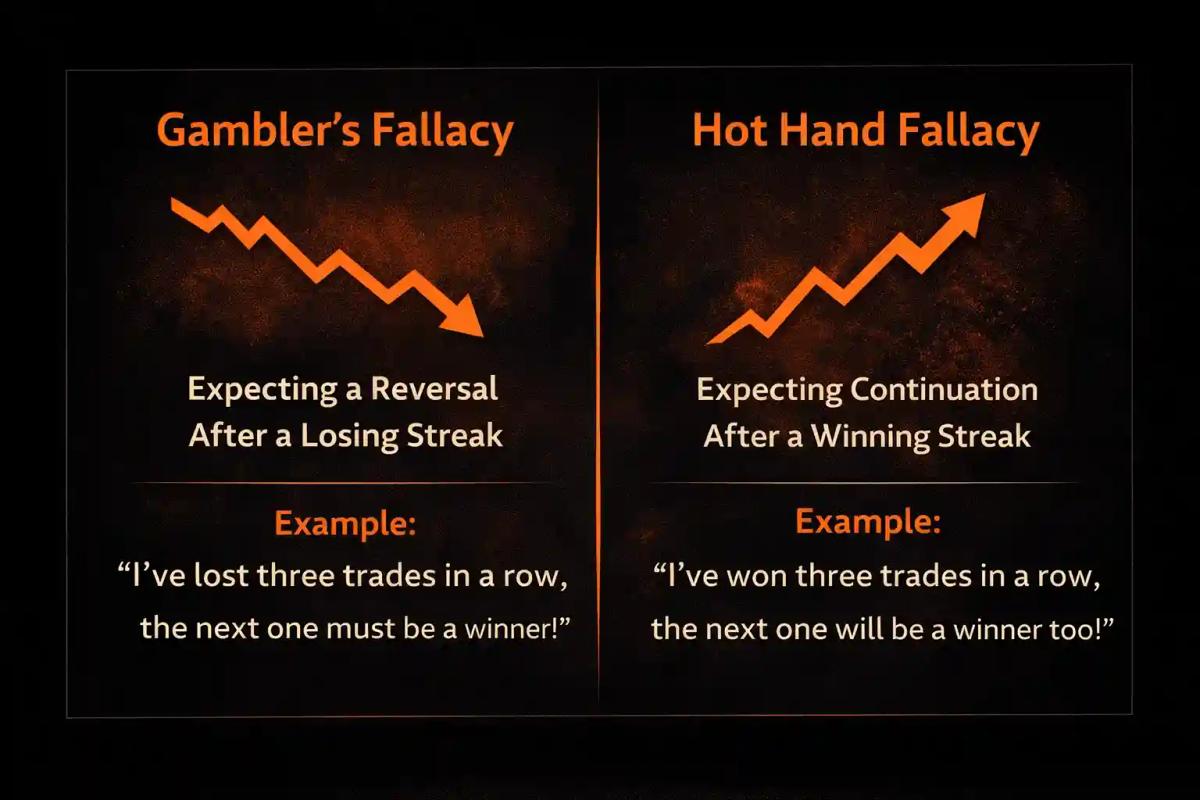
If the gambler’s fallacy is the belief that a streak must end, the hot hand fallacy is its mirror image: the belief that a streak must continue. Both are cognitive traps, and both will distort your trading if you let them.
How They Differ
The gambler’s fallacy says: “I’ve lost five in a row, so a win is coming.” The hot hand fallacy says: “I’ve won five in a row, so I can’t lose.” One expects reversal; the other expects continuation. Both rest on the same flawed foundation: the assumption that past independent outcomes shape future ones.
In trading, the gambler’s fallacy tends to surface during losing streaks and drives reckless risk-taking. The hot hand fallacy surfaces during winning streaks and fuels overconfidence, leading you to take on bigger positions or sloppier setups because you feel untouchable.
How Both Distort Trade Decisions
What makes these two biases especially dangerous as a pair is that they can alternate within the same trader, sometimes in the same session. You ride a winning streak with inflated confidence (hot hand), take an oversized loss, then immediately start chasing recovery trades because you’re “due” (gambler’s fallacy). The combination creates a whipsaw of emotional decision-making that has nothing to do with your actual trading edge.
The common thread? Both biases trick you into believing that the sequence of outcomes matters more than the quality of each individual setup.
Why Your Brain Falls for It
You’re falling for the gambler’s fallacy because your brain is doing exactly what it evolved to do, and the trading environment punishes it for that.
Pattern Recognition and Survival Instinct
Your brain is a pattern-detection machine. It’s been shaped by hundreds of thousands of years of evolution to find patterns in the environment, because spotting patterns kept your ancestors alive. Rustling in the grass three times in a row? Probably a predator. Better run.
The problem is that your brain doesn’t distinguish well between environments where pattern recognition is useful (the savanna) and environments where it’s misleading (the market). When you see a streak of losses, your brain screams “pattern!” and starts predicting what comes next. It fills in the blank with a win, because that’s what would “balance” the sequence. But the market isn’t a pattern your brain evolved to read.
Probability Misunderstanding in Real-Time Decisions
There’s a meaningful difference between understanding probability intellectually and applying it under pressure. You might know, sitting here calmly, that each trade is independent. But in the heat of a losing streak, with real money on the line, your emotional state hijacks your rational thinking.
This is where the gambler’s fallacy compounds with emotional trading. The bias hands you a false logical framework (“I’m due”), and your emotions supply the urgency to act on it. Together, they create a kind of certainty that feels rational but isn’t.
Recognizing this dynamic is the first step toward breaking it. But recognition alone isn’t enough. You need systems.
Real Trading Scenarios That Expose the Fallacy
Theory only goes so far. Seeing the gambler’s fallacy play out in concrete situations makes the pattern harder to ignore when it shows up in your own trading.
Scenario 1: The Forex Trader on a Five-Loss Streak
A forex trader runs a swing strategy that historically wins about 55% of the time. They hit five consecutive losing trades over two weeks. Each loss was a clean setup that met their criteria, and each stop was hit. Statistically, a five-loss streak with a 55% win rate isn’t unusual. It’s uncomfortable, but it falls within expected variance.
The trader doesn’t see it that way. On trade six, instead of following their system, they double their lot size. “Five losses in a row? The sixth has to hit.” Trade six loses too, and now they’ve taken a loss twice as large as any of the previous five. The damage from the gambler’s fallacy was the behavior change on the sixth.
Scenario 2: The Crypto Trader Chasing a Bounce
A crypto trader watches a token drop 15% over three days. They didn’t have a position, but now they’re convinced a bounce is coming. “It can’t keep dropping forever,” they tell themselves. They buy in without any technical justification: no support level, no volume confirmation, just the belief that the decline has gone on “long enough.”
The token drops another 20%. The trader holds, doubling down on the fallacy. “Now it really has to bounce.” By the time they finally exit, they’ve taken a significant loss on a trade they never planned, built on nothing more than the assumption that a trend was “due” to reverse.
These scenarios happen every day, across every market. And they all start with the same quiet thought: “This has to turn around.”
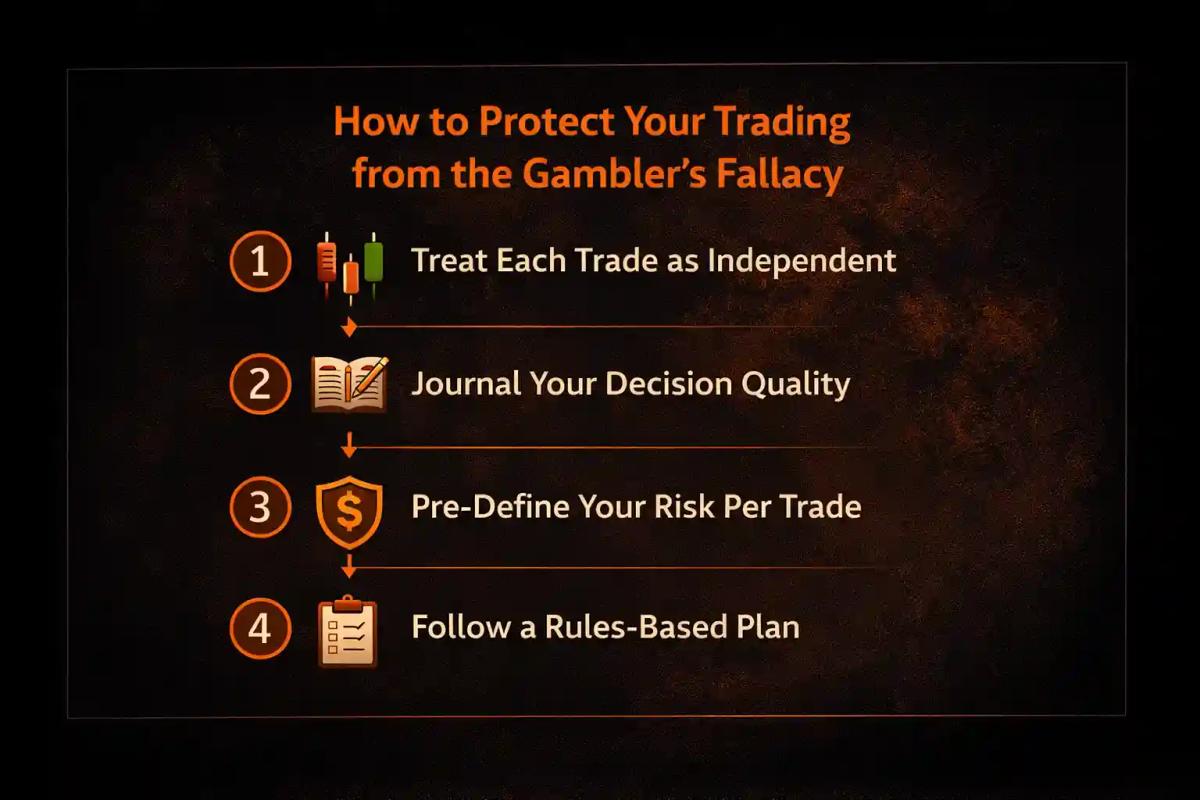
How to Protect Your Trading from the Gambler’s Fallacy
Understanding the fallacy is valuable, but it’s not a shield on its own. You need structural protections: systems that kick in before your emotions get a vote.
Treat Every Trade as Independent
This is the mental reset that everything else builds on. Before you enter any trade, remind yourself: this trade has nothing to do with the last one. Your previous outcome, win or loss, has zero bearing on what happens next. Some traders literally write “independent event” at the top of their pre-trade checklist. It sounds almost too simple, but it works because it forces your conscious mind to override your instincts.
Use a Trading Journal to Track Decision Quality
A trading journal is one of the most effective tools for catching the gambler’s fallacy in action. The key, though, is tracking decision quality, not just outcomes. For each trade, record why you entered, what your criteria were, and whether the decision was driven by your system or by a feeling.
Over time, patterns emerge. You’ll start to see entries where your stated reason was “the setup was there” but the real driver was “I needed a win.” That self-awareness is what loosens the fallacy’s grip.
Pre-Define Risk Per Trade Before Emotions Engage
Set your position size and stop-loss before you sit down at your screen. Not after you see the chart. Not after you check your P&L for the week. Before.
When risk parameters are locked in ahead of time, the gambler’s fallacy has less room to operate. You can’t double your size on a “due” trade if your risk rules won’t allow it. The goal is to remove that decision from the emotional moment and anchor it in a calm, rational one.
Build a Rules-Based Trading Plan
The most reliable defense against any cognitive bias is a system that doesn’t require judgment calls in the heat of the moment. A rules-based trading plan defines your entries, exits, position sizes, and risk limits before the market opens. When a setup meets your criteria, you take it. When it doesn’t, you pass.
This is about ensuring that the decisions most vulnerable to bias, the ones made under emotional pressure, are handled by rules rather than feelings.
Could algorithmic or systematic trading approaches take this even further? Absolutely. Automated systems don’t experience loss streaks emotionally, which means they’re immune to the gambler’s fallacy entirely. But even if you trade manually, a structured plan gets you most of the way there.
Frequently Asked Questions
Does the gambler's fallacy apply to all financial markets?
Yes, the gambler's fallacy can affect your decision-making in any financial market, including forex, stocks, crypto, and commodities. It's a cognitive bias rooted in how you process probability, not a feature of any specific market. Wherever you're making sequential decisions with uncertain outcomes, the fallacy can show up.
What's the difference between the gambler's fallacy and a legitimate mean-reversion strategy?
A mean-reversion strategy is based on statistical evidence that certain price behaviors tend to revert to an average over time, supported by historical data and defined criteria. The gambler's fallacy, by contrast, is the unfounded belief that a reversal is "due" simply because of a streak of outcomes. The difference is data versus feeling. If you can't point to a tested, data-backed reason for expecting a reversal, you're likely in fallacy territory.
How can I tell if I'm currently falling for the gambler's fallacy in my trading?
The biggest red flag is noticing that your trade decisions are influenced more by your recent results than by your system's criteria. If you're increasing position sizes after losses, entering trades without valid setups because you "need a win," or feeling certain that a reversal is imminent without data to support it, the fallacy is likely driving your behavior. Reviewing your trading journal for patterns in post-loss decision-making is one of the fastest ways to spot it.
Can keeping a trading journal actually reduce cognitive bias?
A trading journal won't eliminate cognitive bias entirely, but it is one of the most effective tools for identifying when bias is influencing your decisions. Recording your reasoning for each trade and reviewing it later with a clear head helps you create a feedback loop that builds self-awareness over time. Many experienced traders credit consistent journaling as a turning point in their ability to separate emotional impulses from process-driven decisions.
How does the gambler's fallacy relate to other common trading psychology mistakes?
The gambler's fallacy often works alongside other biases rather than in isolation. It pairs frequently with loss aversion (the tendency to feel losses more intensely than equivalent gains), which amplifies the urgency to recover. It also intersects with overconfidence bias and the hot hand fallacy during winning streaks. Understanding the gambler's fallacy is a strong starting point, but building awareness of the broader landscape of trading psychology biases will give you a much more complete defense.
About the authors


Put this into practice
Related articles
Greed in Trading: How to Recognize It and Stop It From Destroying Your Profits
Learn to spot greed-driven trading behavior, understand its true financial and psychological costs, and build a concrete framework to protect your profits.
Handling Trading Failure: How to Recover, Learn, and Trade Better
Learn a step-by-step framework for handling trading failure, managing losing streaks, and building long-term resilience. Practical strategies every trader needs.

Happiness and Pride in Trading: How to Stay Grounded After Wins
The emotional high after a winning trade can be more dangerous than a loss. Learn how dopamine, pride, and overconfidence distort your trades.
0 comments