



Herd Mentality Trading: Why Traders Follow the Crowd and How to Stop
Herd mentality is one of the most powerful and most misunderstood forces in financial markets. It exploits the instinct to follow the group when uncertainty runs high. And in markets, uncertainty never takes a day off.
This article gives you a framework for understanding why traders follow the crowd, how herd behavior builds and accelerates, and most importantly, how you can develop the mental discipline to make independent decisions. This is educational content, not financial advice. Nothing here is a recommendation to buy, sell, or adopt any specific trading strategy.
[
What Is Herd Mentality in Trading?
Every trader likes to believe they think for themselves. But the moment a ticker starts trending, your notifications light up, and the charts go vertical, something shifts inside your decision-making process. Herd mentality in trading is the tendency to mirror the actions of a larger group, replacing your own analysis with the assumption that the crowd must know something you don’t.
It’s human wiring operating in an environment it was never designed for.
The Psychology Behind Following the Crowd
At the root of herd behavior sit a few well-documented cognitive biases, all working together.
Social proof is the dominant one. When you see thousands of people buying an asset, your brain interprets that volume of agreement as a signal of correctness. If everyone is doing it, it must be the right move, right? This mental shortcut works well when choosing a restaurant. It works terribly when sizing up a volatile market position.
Then there’s the information cascade effect. This kicks in when individuals stop relying on their own data and start copying earlier decisions, assuming those earlier actors had better information. The trouble is that each person in the cascade is making the same assumption. The whole structure ends up built on borrowed confidence rather than independent analysis.
Layer on top of that the raw emotional pull of FOMO (fear of missing out), and you’ve got a psychological cocktail that can override even the most disciplined trading plan. Your logical brain says “wait.” Your emotional brain screams “everyone else is getting rich right now.”
How Herd Behavior Differs from Informed Consensus
Not every crowd move is irrational. Sometimes a large number of traders converge on the same trade because the evidence genuinely supports it. Earnings beat expectations, a sector catches a policy tailwind, or a technical breakout confirms across multiple timeframes.
The distinction comes down to why people are acting. Informed consensus is driven by independent analysis arriving at similar conclusions. Herd behavior is driven by imitation, where the primary reason for entering is simply that others are entering.
A useful litmus test: if you removed the crowd from the equation entirely, would you still take the trade based on your own research? If the answer is no, you’re likely following the herd, not the evidence.
So how does this crowd dynamic actually gather momentum in live markets?
How Herd Mentality Forms in Financial Markets
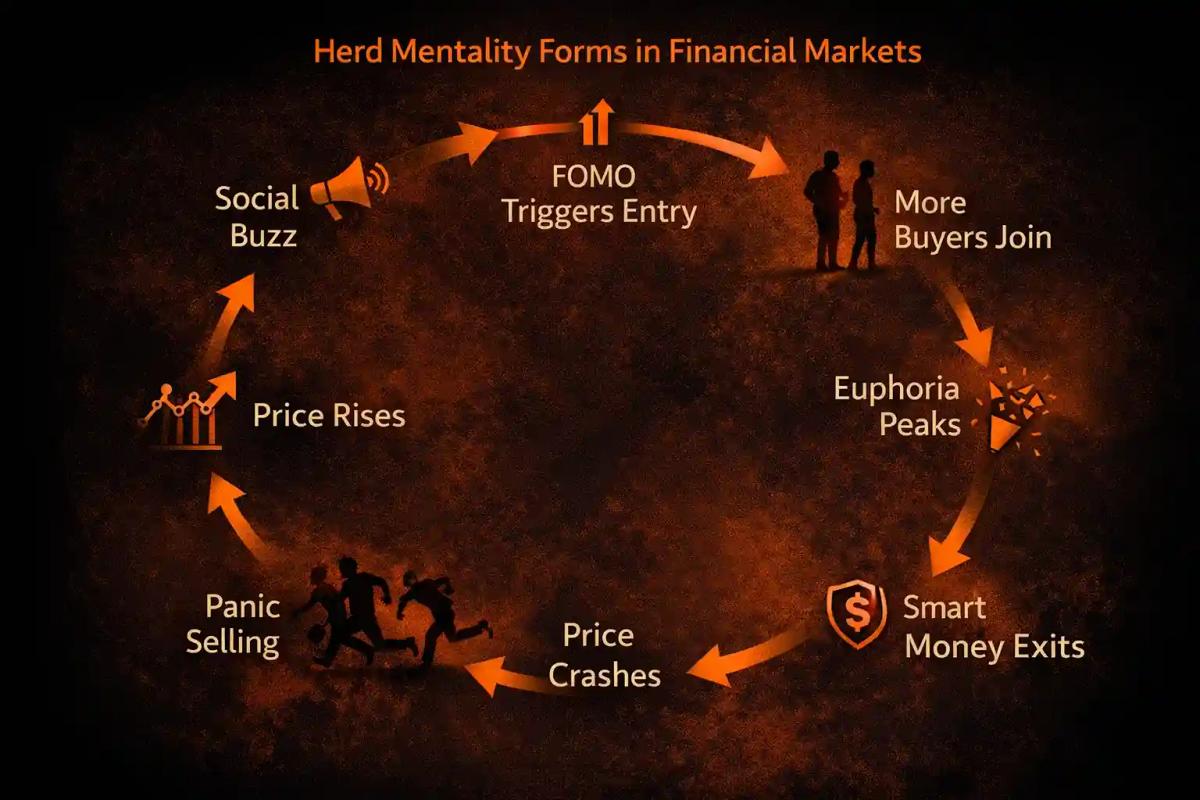
Herd mentality doesn’t materialize out of thin air. It follows a predictable escalation pattern, and understanding that pattern is your first real line of defense against getting swept up in it.
The Role of Social Media and News Cycles
A decade ago, herd behavior spread through trading floors and financial television. Today, it spreads at the speed of a viral tweet. Social media platforms have compressed the timeline of crowd formation from days to minutes. A single influential post, a trending hashtag, or a Reddit thread gaining traction can funnel thousands of traders into the same position almost simultaneously.
Financial news amplifies this further. When outlets start covering a “hot stock” or a “market rally,” they’re not just reporting. They’re creating a feedback loop where coverage drives attention, attention drives buying, and buying drives more coverage. The result is an echo chamber where every source seems to confirm the same trade.
Fear of Missing Out as a Herd Accelerator
FOMO is the emotional fuel that turns a mild crowd lean into a full stampede. You see a stock up 40% in a day. You see people posting screenshots of their gains. A voice in your head whispers, “If you don’t get in now, you’ll miss the whole move.”
That voice isn’t your analysis talking. It’s your emotional response overriding your trading discipline. FOMO compresses your decision timeline from an hour of careful review down to thirty seconds of clicking “buy” because the price is still climbing and every passing second feels like lost profit.
FOMO-driven entries tend to cluster near the top of a move, precisely when the risk-reward ratio is at its worst.
How Institutional Activity Amplifies Crowd Behavior
Institutional traders and fund managers face their own version of crowd pressure, often called “career risk”: the danger of underperforming peers by not holding the same positions everyone else holds.
When institutions pile into the same trades, the sheer volume of capital involved creates self-reinforcing price movements that pull even more participants in. Retail traders see the big moves, assume “smart money knows something,” and jump aboard. The reality is often far more circular than it appears from the outside.
Recognizing how herds form is only half the picture. What does herd-driven price action actually look like when it unfolds in real time?
Real Market Patterns Driven by Herd Mentality
If you’ve spent any time watching markets, you’ve already witnessed herd mentality in action, even if you didn’t have a name for it at the time. These patterns repeat across asset classes, timeframes, and market eras because they’re driven by human behavior.
Bubbles and Parabolic Rallies
Bubbles are herd mentality at its most dramatic. An asset’s price disconnects from any reasonable valuation and goes parabolic because a critical mass of buyers are entering on price momentum alone. Think of the dot-com era, or more recently, the explosive runs in certain meme stocks and crypto tokens.
The hallmark of a bubble is that the primary justification for buying shifts from “this asset has value” to “the price is going up.” When you hear people arguing that traditional valuation metrics no longer apply, that’s usually the herd narrative working overtime to justify positions that logic can’t support.
Panic Selling and Capitulation Events
The same crowd dynamics that drive euphoric buying also fuel panic selling. When prices start falling sharply, fear spreads just as fast as greed did on the way up. Traders rush for the exits not because their analysis changed, but because everyone else is selling and nobody wants to be the last one out.
Capitulation, that moment when the final holdouts give up and sell at any price, is pure herd behavior in reverse. And ironically, it often marks the point of maximum opportunity for those who kept their composure.
Volume Spikes and Sentiment Extremes
You don’t need a full-blown bubble or crash to spot herd behavior. Sometimes it surfaces as a sudden, dramatic spike in volume on a stock with no corresponding news catalyst. Other times it shows up in sentiment indicators hitting extreme readings, like the Fear & Greed Index pushing deep into “extreme greed” or “extreme fear” territory.
When volume and sentiment both reach extremes at the same time, it’s a strong signal that crowd psychology, not rational analysis, is steering price action. The real question is whether you can spot these signals before you get caught up in them yourself.
How to Recognize Herd Mentality in Real Time
Knowing that herds exist is one thing. Catching yourself mid-stampede is something else entirely. The real skill is the ability to pause, assess, and decide independently while the crowd is screaming at you to act now.
Warning Signs in Price Action and Sentiment
Certain patterns tend to accompany herd-driven moves. Keep an eye out for these:
- Parabolic price moves on rising volume with no clear fundamental catalyst
- Social media and forums suddenly fixating on a single ticker or asset
- Extreme readings on sentiment tools like put/call ratios or fear and greed indexes
- Narrative dominance, where the “story” behind a trade is repeated everywhere but the underlying data is thin
- Unusual options activity or volume spikes concentrated in short-dated, out-of-the-money contracts
- A shift in justification from fundamentals to price action (“it’s going up because it’s going up”)
No single signal confirms herd behavior on its own, but when several show up together, your skepticism should rise in proportion.
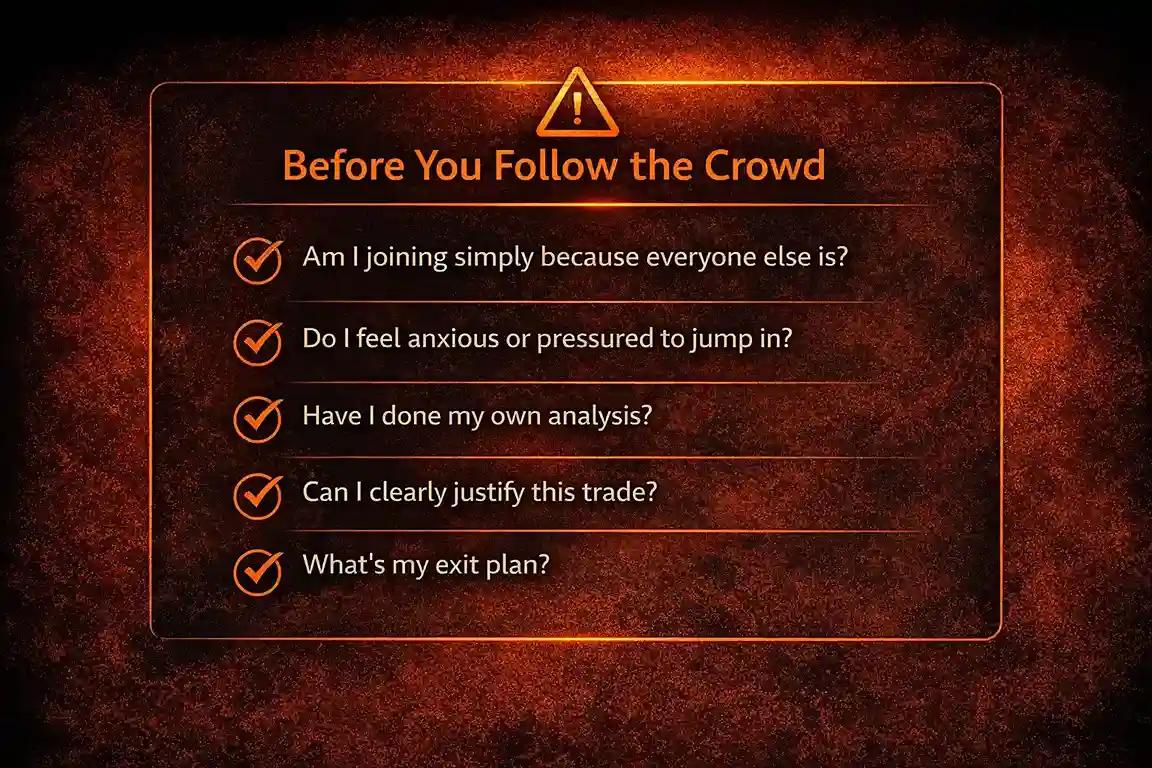
Questions to Ask Before Entering a Crowded Trade
Before you click that buy (or sell) button during a high-excitement market moment, run through this self-check:
- Did I identify this trade independently, or did I learn about it from social media, a chatroom, or a news headline?
- Would I still take this trade if nobody else was talking about it?
- Can I articulate my thesis in one or two sentences without referencing what “everyone” is doing?
- Does this fit my existing trading plan, or am I improvising because the opportunity feels urgent?
- What’s my exit plan? If I can’t define my stop-loss and target before entering, I’m not trading. I’m gambling.
- Am I feeling pressure to act quickly? Urgency is one of the strongest fingerprints of crowd-driven decision-making.
If your honest answers reveal that the crowd is your primary catalyst, that’s valuable self-awareness. It means your edge isn’t coming from your own analysis.
Once you’ve learned to spot the herd in real time, the next challenge is building habits that keep you out of it consistently.
How to Think Independently as a Trader
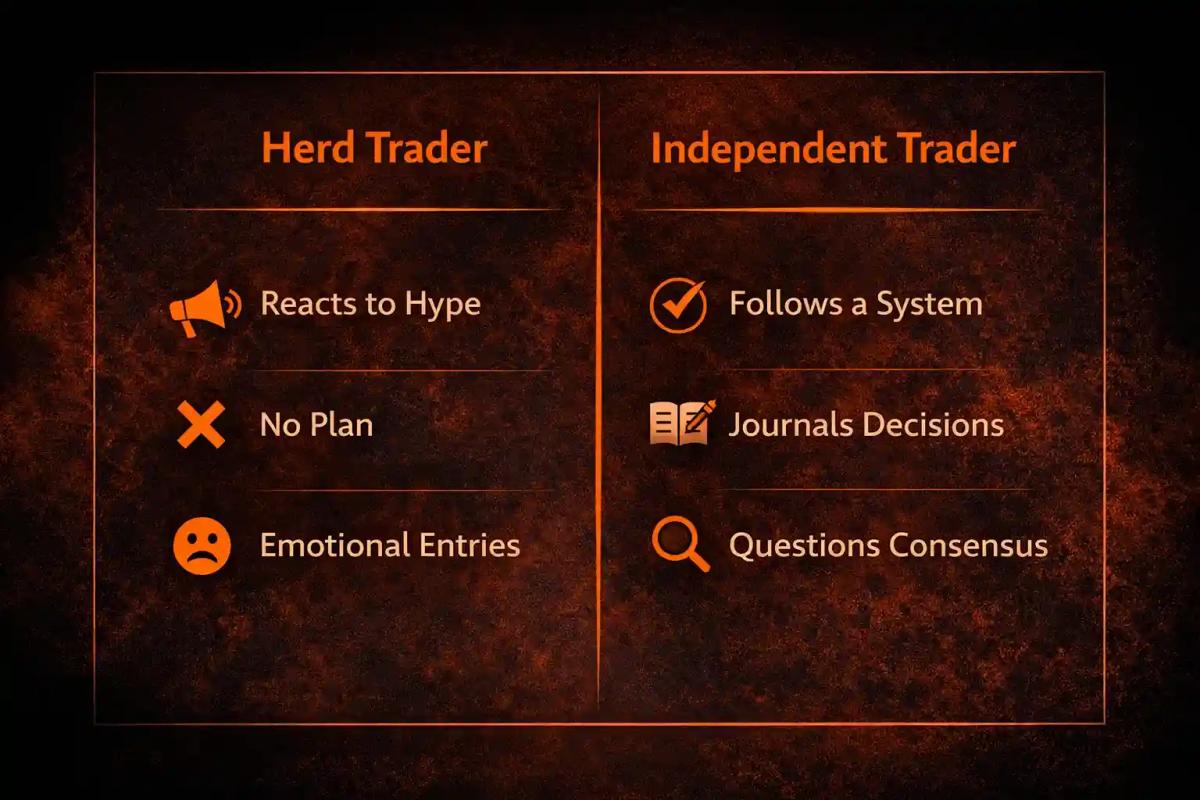
Independent thinking in markets is a skill you build through systems, habits, and deliberate practice. Nobody is immune to social influence, but you can design your trading process to reduce its grip on your actual decisions.
Building a Rule-Based Decision Framework
The simplest way to insulate your decisions from crowd noise is to make them before the noise starts. A rule-based framework means you define your entry criteria, position sizing, stop-loss levels, and profit targets before you’re exposed to market excitement.
When you have clear rules in place, every trade either fits your criteria or it doesn’t. There’s no grey area for “well, everyone else is buying, so maybe I should too.” Your rules become a filter that the crowd’s signal has to pass through before it reaches your capital.
This doesn’t require a rigid or complex system. Even a simple checklist (like the self-check above) functions as a decision filter. The point is that you’re making choices based on pre-defined logic, not real-time emotion.
The Contrarian Approach: When and How to Use It
Going against the crowd sounds appealing in theory. Buy when others are fearful, sell when others are greedy. It’s a clean narrative. But contrarian trading is far more nuanced than simply doing the opposite of everyone else.
Effective contrarian thinking means recognizing when crowd behavior has pushed prices to unsustainable extremes, and only then positioning accordingly with strict risk management in place. It does not mean reflexively fading every popular trade.
Contrarian approaches carry real risk. The crowd can stay irrational longer than your account can stay solvent. If you short a stock purely because “it’s gone up too much,” you can absorb devastating losses while waiting for the reversal that may not come on your timeline. Timing matters enormously, and the contrarian edge comes from patience and selectivity, not from blanket opposition.
The Role of a Trading Journal in Countering Groupthink
A trading journal is one of the most underrated tools for breaking herd patterns in your own behavior. When you record not just what you traded, but why you traded it and how you felt at the time, you build a personal database of your decision-making under pressure.
Over time, patterns surface. You might discover that your worst trades consistently happen on days when social media chatter peaks, or that your best entries come when you feel slightly uncomfortable going against popular sentiment. This kind of self-knowledge is impossible to develop without written records.
The journal also forces honesty. It’s easy to rationalize a herd-driven entry in the heat of the moment. It’s much harder to defend it weeks later when you’re reviewing your notes and staring at the outcome.
Of course, not every crowd-driven move turns out to be wrong. So how do you avoid swinging to the other extreme and becoming contrarian for its own sake?
When the Crowd Is Right: Avoiding Contrarian Bias
It would be convenient if the crowd was always wrong. You’d simply do the opposite and collect profits. Reality, of course, is far messier. Sometimes the crowd is right, and fighting it will cost you just as much as blindly following it would.
Trend Following vs. Herd Following
There’s a meaningful difference between following a trend and following a herd. Trend following is a systematic approach where you enter positions in the direction of established price momentum based on defined technical criteria. Herd following is entering positions because other people are entering positions.
The distinction matters because trends can persist for weeks, months, or even years for sound fundamental reasons. Dismissing every strong trend as “just herd behavior” is its own form of bias, and an expensive one at that.
A helpful mental check: are you entering because of a signal from your system, or because of a signal from the crowd? The trade might look identical on a chart, but the decision-making process behind it makes all the difference to your long-term consistency.
How to Distinguish Momentum from Mania
Separating healthy momentum from mania isn’t always straightforward, but there are telling clues:
Neither column is absolute, and markets often drift from momentum into mania gradually. The key is to keep testing your assumptions as conditions evolve rather than committing to a single interpretation early and defending it as things change around you.
Frequently Asked Questions
Does herd mentality only affect beginner traders?
Not at all. Herd mentality affects traders at every experience level, including professionals and institutional fund managers. Experienced traders may be quicker to recognize it, but the psychological pull of social proof and career risk means even seasoned market participants can get swept into crowd-driven decisions.
What's the difference between trend following and herd following?
Trend following is a systematic approach based on defined rules and technical signals that identify and ride established price momentum. Herd following means entering trades primarily because other people are entering them, without independent analysis. The positions might look the same on a chart, but the decision process behind them is fundamentally different.
How does social media amplify herd behavior in today's markets?
Social media compresses the timeline of herd formation from days to minutes. Viral posts, trending tickers, and gain screenshots create intense social proof that reaches thousands of traders simultaneously. This creates rapid feedback loops where attention drives buying, buying drives coverage, and coverage drives more attention, all at a pace that earlier generations of traders never had to contend with.
Is contrarian trading always the right response to crowd behavior?
No. Contrarian trading can work well when the crowd has pushed prices to genuinely unsustainable extremes, but going against the crowd simply for the sake of being different is its own form of bias. The crowd is sometimes right, and fighting a strong trend without solid reasoning and risk controls can be just as costly as blindly following one.
What's the first practical step I can take today to reduce herd influence on my trading?
Start a trading journal. Before every trade, write down your thesis in your own words and note whether the idea came from your own analysis or from an external source like social media, news, or a chatroom. Over time, reviewing these entries will reveal patterns in how crowd influence shapes your decisions and help you build the awareness that leads to better independence.
How can I use a trading journal to track crowd-influenced decisions?
Include a field in each journal entry that rates how much external influence affected your decision on a simple scale (for example, 1 to 5). Note your emotional state, where you first heard about the trade, and whether it aligned with your pre-existing plan. After a few weeks, filter your entries by that influence rating and compare win rates. The data tends to speak louder than intuition. This article is for educational purposes only and does not constitute financial advice. Trading involves risk, and past market patterns do not guarantee future results. Always do your own research and consider consulting a qualified financial professional before making trading decisions.
About the authors


Put this into practice
Related articles
Hindsight Bias in Trading: Why “I Knew It All Along” Is Holding You Back
Hindsight bias makes every past trade look obvious. Learn how it distorts your reviews, blocks real learning, and what to do about it.
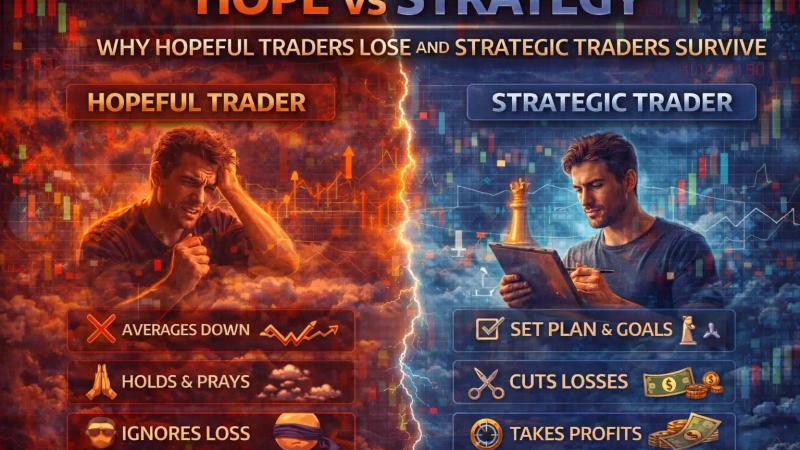
Hope vs Strategy: Why Hopeful Traders Lose and Strategic Traders Survive
Hope vs. strategy: how hope silently destroys trading accounts, why your brain defaults to it under pressure, and how to replace it with a rules-based strategy.

How to Build Real Trading Confidence
Learn how to build genuine trading confidence through preparation and process-driven habits. A practical framework for overcoming self-doubt and hesitation.
0 comments