



Loss Aversion in Trading: Why You Fear Losses More Than You Value Gains
Something about live markets turns your rational brain into a passenger while your emotions grab the wheel. That something has a name: loss aversion. And until you understand how deeply it’s wired into your decision-making, it will keep extracting money from your account in ways you barely notice until the damage is already done.
This guide breaks down what loss aversion actually is, how it distorts your trading psychology in specific and predictable ways, and, most importantly, what you can do about it before your next session.
What Is Loss Aversion
Loss aversion is a deeply embedded cognitive bias, one that shapes how you perceive risk, reward, and every decision in between.
The Core Principle Behind Asymmetric Risk Perception
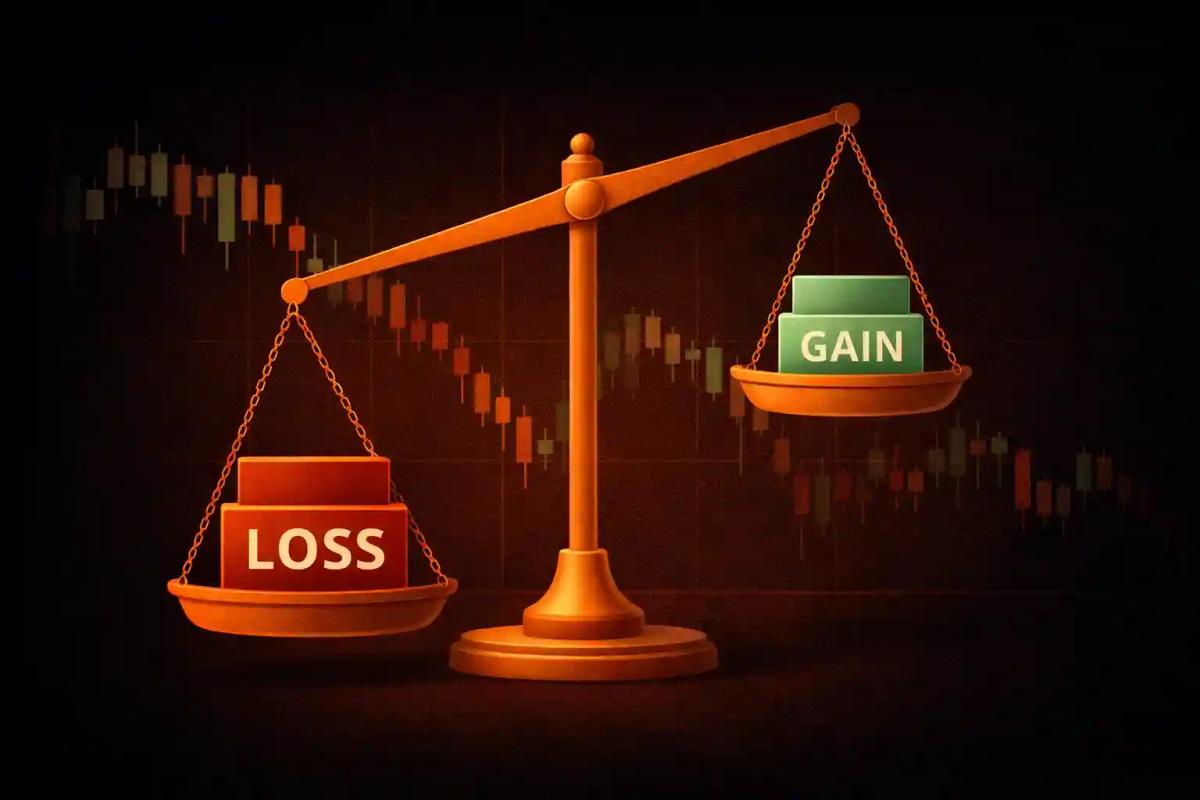
Here’s the simplest way to understand it: losing $500 feels roughly twice as painful as gaining $500 feels good. The dollar amounts are identical. The emotional weight isn’t even close.
This asymmetry means your brain doesn’t evaluate gains and losses on a level playing field. A potential loss looms larger, feels more urgent, and demands more of your attention than an equivalent potential gain. In practical terms, you’ll fight harder to avoid losing $500 than you will to earn $500, even when the math says both scenarios carry the same probability.
For traders, this creates a constant tug-of-war. Your rational mind knows the risk-reward setup is sound. Your emotional wiring screams that the downside is unbearable. And in the heat of a live session, the scream almost always wins.
So where does this wiring come from? And why is it so difficult to override?
Kahneman, Tversky, and Prospect Theory in Brief
The concept of loss aversion was formalized by psychologists Daniel Kahneman and Amos Tversky through their landmark work on prospect theory in 1979. Their research demonstrated that people don’t evaluate outcomes in absolute terms. Instead, they measure outcomes relative to a reference point, usually whatever they currently have.
Think of it this way: if someone hands you $100, you feel good. If someone hands you $200 and then takes $100 back, you feel terrible, even though you end up with the same $100 in both cases. The loss of that second $100 dominates your entire experience.
Prospect theory showed that this isn’t a personality flaw or a sign of weakness. It’s a feature of how human brains process uncertainty. The loss-gain asymmetry runs roughly 2:1 for most people, meaning losses need to be about half the size of gains to feel emotionally equivalent.
Understanding the theory is step one. But how does this actually play out when you’re sitting in front of your charts with real money on the line?
How Loss Aversion Shows Up in Your Trading
Loss aversion disguises itself as intuition, caution, or even discipline. But the patterns it creates are remarkably consistent across traders at every level.
Holding Losers Too Long
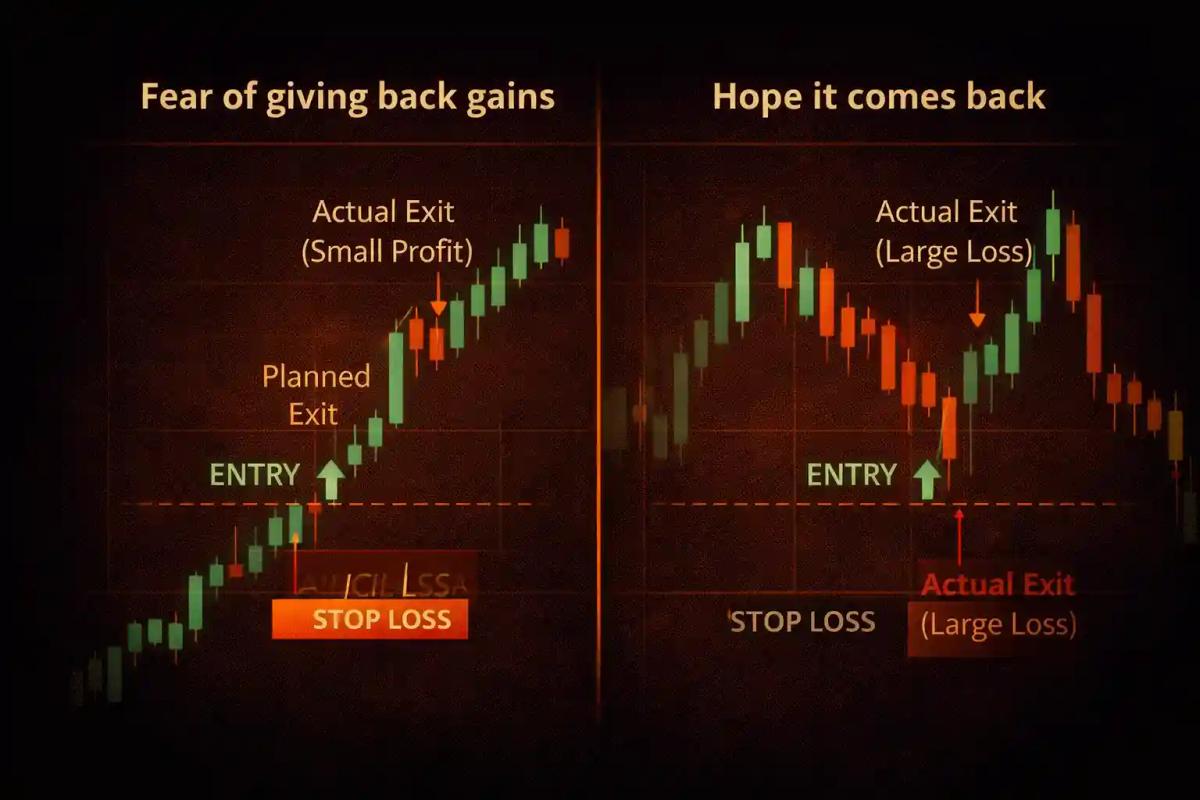
This is loss aversion’s signature move. You enter a trade, it moves against you, and instead of executing your stop, you start negotiating with the chart. “It’s just a pullback.” “Support is right below here.” “I’ll give it a little more room.”
What you’re really doing is avoiding the pain of crystallizing a loss. As long as the position stays open, the loss feels theoretical, almost negotiable. The moment you close it, it becomes permanent, and your brain treats that transition like a wound. So you hold. And hold. And what was a manageable 1R loss turns into a 3R crater that takes days to recover from.
Cutting Winners Too Early
The flip side is just as destructive, and often harder to recognize. When a trade moves in your favor, loss aversion shifts its focus. Now you’re not afraid of losing capital from your account. You’re afraid of losing the unrealized gains sitting right there on your screen.
That profit, even though you haven’t booked it yet, already feels like it belongs to you. Every tick against your position feels like something being taken away. So you grab the small win and run, even when your original plan called for a target twice as far.
Over dozens of trades, this pattern quietly destroys your risk-reward ratio from the inside out.
Avoiding Trades Entirely After a Loss
After a losing trade, or especially a losing streak, loss aversion can paralyze you completely. Valid setups appear on your screen. They meet every criterion in your plan. And you watch them play out without entering. The pain of the recent loss has temporarily rewired your risk tolerance to near zero.
This isn’t the same as healthy caution. Healthy caution means reducing size or stepping away to clear your head. Loss aversion-driven avoidance means you’re making non-decisions rooted in fear, not analysis. One protects your capital and the other silently bleeds opportunity.
Revenge Trading and Overcompensation
Paradoxically, loss aversion can also shove you in the opposite direction. After absorbing a loss, some traders feel an overwhelming urge to win it back immediately. The psychological ledger feels unbalanced, and the brain wants to settle the score.
This is where revenge trading takes over. You increase size, take lower-quality setups, or force entries that don’t match your system. The goal isn’t to follow your process. The goal is to erase the pain of the last loss as fast as possible, and that urgency clouds everything.
But if these patterns are so predictable, and now you can name them, shouldn’t that be enough to stop them?
The Real Cost of Fear-Driven Decisions
One bad trade driven by loss aversion stings. But the real danger is what happens when fear-driven decisions compound across weeks, months, and hundreds of trades.
Portfolio Damage Over Time
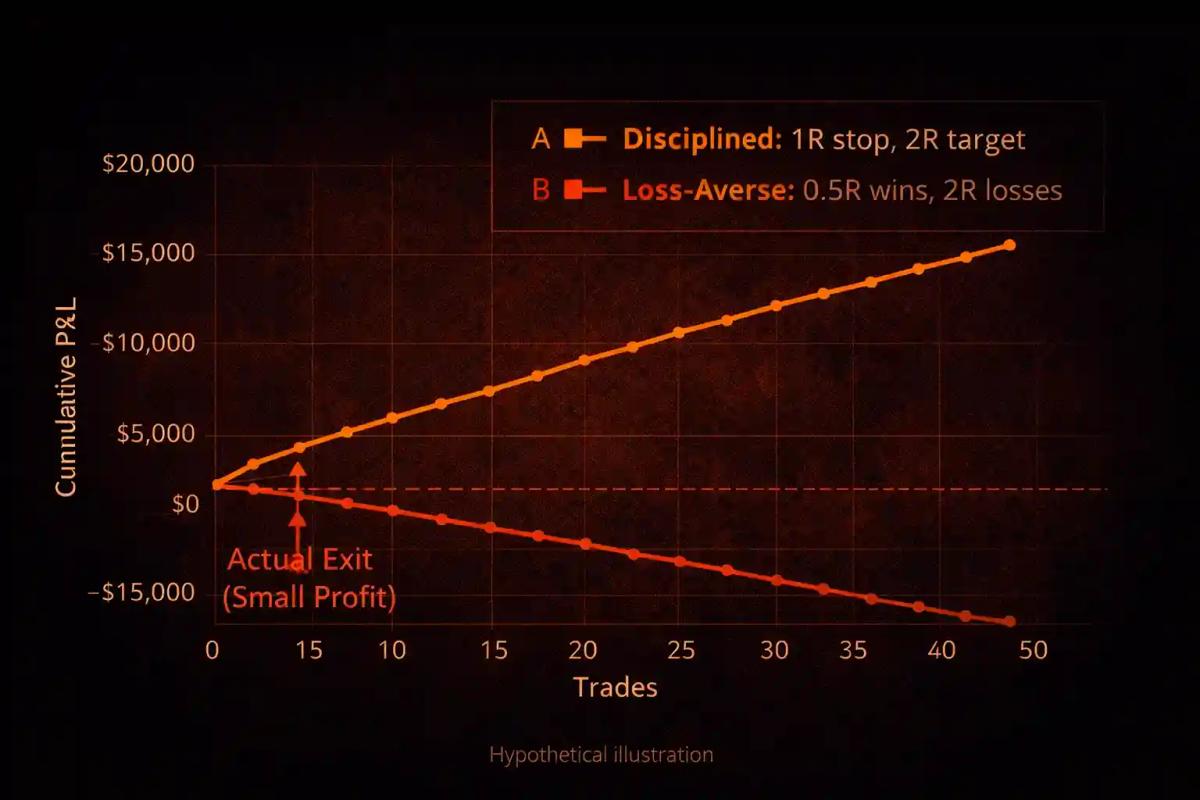
Imagine two versions of you trading the same system over 50 trades. Version A follows the plan: takes every stop at 1R, lets winners run to 2R. Version B, influenced by loss aversion, holds losers until they hit 2R and cuts winners at 0.5R.
Even with the same win rate, the gap in equity curves is staggering. Version B doesn’t just underperform. Over a long enough series, Version B bleeds out entirely. Each individual decision feels small in the moment, but the cumulative effect turns a viable edge into a losing system.
Erosion of Trading Discipline and Rule Adherence
Beyond the financial damage, loss aversion erodes something harder to rebuild: your trust in your own rules. Every time you override your stop or close a winner early, you’re training yourself to ignore your system. Over time, the plan stops feeling like a plan and starts feeling like a suggestion you’re free to discard.
This is how disciplined traders slowly drift into discretionary chaos. Not because they lack knowledge, but because loss aversion chips away at their ability to execute what they already know works. The erosion is gradual, which makes it dangerous.
If the damage is this clear, then why doesn’t simply knowing about loss aversion fix the problem?
Why Knowing About Loss Aversion Is Not Enough to Fix It
You’ve read this far. You can define loss aversion. You can spot the patterns. So why will you probably still move your stop-loss next week?
The Gap Between Rational Knowledge and Emotional Execution
This is the part most articles on psychological biases in trading gloss over. Understanding a bias intellectually and overcoming it during live execution are two completely different cognitive processes.
When you’re calm, reviewing your journal on a Sunday afternoon, the logic is obvious. “I should have held that winner. I should have taken that stop.” But during a live session, with real money fluctuating tick by tick, your prefrontal cortex (the rational, planning part of your brain) gets overridden by the amygdala (the threat-detection center). Your body enters a mild stress response. And the rational framework you built in calm conditions becomes unreachable.
This is why awareness alone doesn’t produce behavior change. You need systems, structures, and habits that operate even when your emotional state is compromised. Think of it like a seatbelt: you don’t decide whether to wear it based on how safe you feel in the moment. You click it every time because the habit has been externalized beyond the reach of in-the-moment judgment.
So what does that look like in practice?
Practical Strategies to Counteract Loss Aversion
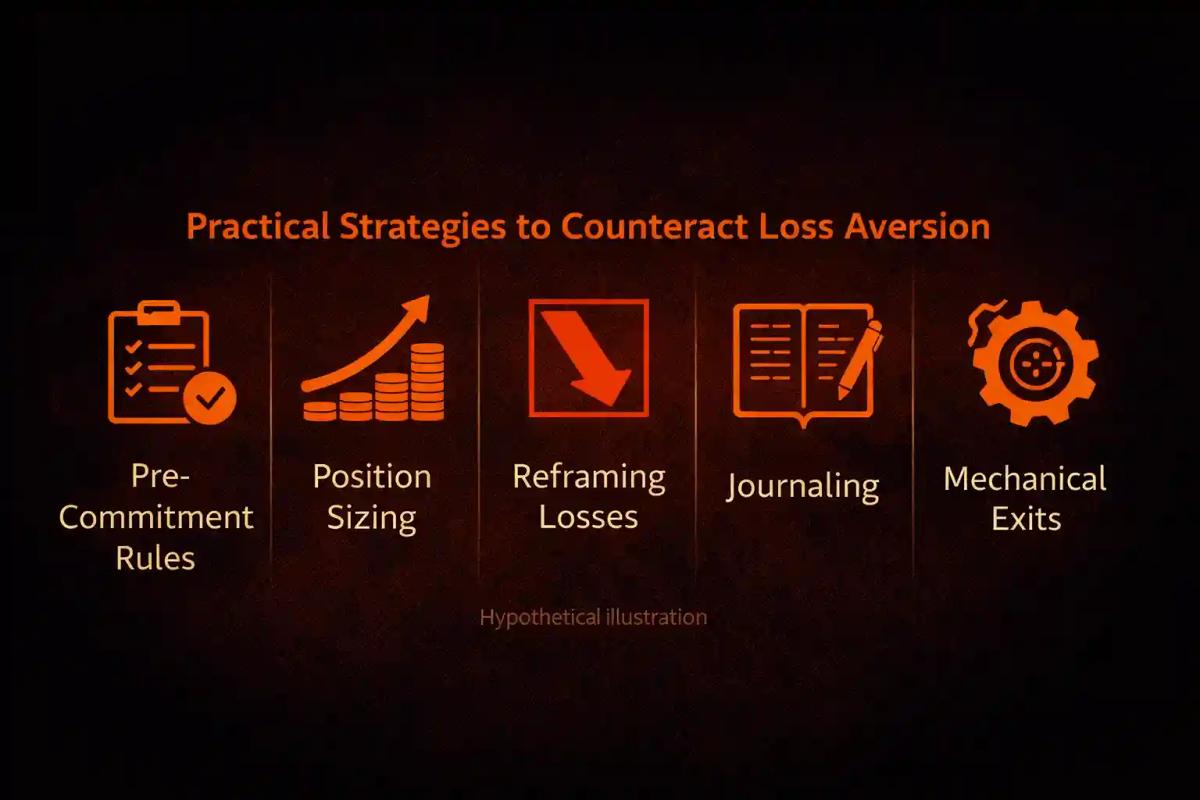
Each strategy below is designed to shrink the gap between your emotional impulse and your planned action, making it harder for loss aversion to hijack your execution.
Pre-Commitment Rules and Trade Plans
Before you enter any trade, your plan should already dictate exactly where you exit, both for a loss and for a win. Put it on a sticky note next to your screen. Enter it into your platform before you place the trade.
Pre-commitment works because it shifts the decision point from the emotionally charged present to the calm, rational past.
Key elements of an effective pre-commitment plan:
- Entry price and rationale
- Stop-loss level with no ambiguity
- Target level (or trailing criteria)
- Maximum position size
- Conditions under which you will NOT enter, even if the setup appears
Position Sizing as a Psychological Buffer
If every trade feels like it could ruin your week, your position size is too large. Loss aversion intensifies dramatically when the dollar amount at risk crosses a personal threshold. Below that threshold, you can follow your rules. Above it, survival instincts kick in and rational thinking exits.
Position sizing is psychological management. Reducing your size until losses feel uncomfortable but not threatening gives your rational brain enough room to stay online during the trade.
A useful test: if you can’t walk away from your screen for 10 minutes while a trade is open, you’re probably sized too large.
Reframing Losses as Costs of Doing Business
This is a mental shift, not a technique, but it may be the most powerful item on this list. Most traders unconsciously frame losses as failures. Each red trade feels like evidence that they did something wrong, that they are somehow deficient.
Reframing means treating losses the way a casino treats payouts: an expected, budgeted cost of running the operation. You need your edge to play out over a large enough sample, and that sample includes losses by definition.
Try replacing “I lost $300” with “I spent $300 to find out that setup didn’t work this time.” The information is the same. The emotional charge is completely different.
Journaling and Post-Session Review
A trading journal does something your memory can’t: it tells you the truth. Left to its own devices, your brain will selectively remember the trades that confirm whatever narrative you’re currently running. A journal captures what actually happened.
Effective journal entries for combating loss aversion should include:
- What you planned to do (entry, stop, target)
- What you actually did
- Why you deviated (if you did)
- Your emotional state at the time of the decision
- The outcome, and whether the deviation helped or hurt
Over weeks, patterns surface that you simply can’t see in real time. You’ll notice that your deviations almost always cost you, and that recognition builds the evidence base your rational brain needs to overrule your emotional impulses in future sessions.
Mechanical Exits and Automation
If you consistently struggle to execute your stops manually, stop trying. Use hard stop-losses placed at entry. Use take-profit orders. Use trailing stops if your platform supports them.
Plenty of experienced traders automate their exits specifically because they’ve learned that their judgment deteriorates under the pressure of an open position. The less your loss-averse brain has to participate in exit decisions, the more consistently your system performs.
But strategies are only as durable as the mindset behind them. What does it take to build the kind of long-term thinking that absorbs losses without spiraling?
Building a Long-Term Mindset That Absorbs Losses
Individual techniques help. But lasting change requires a deeper shift in how you relate to your trading results.
Thinking in Probabilities, Not Individual Outcomes
Loss aversion thrives on single-trade thinking. When each trade feels like a standalone event with life-or-death stakes, every loss is devastating and every win is a relief you need to protect at all costs.
Probability thinking flips this entirely. You stop asking “did this trade win?” and start asking “am I executing my edge over a statistically meaningful sample?” A loss in this framework is just one data point in a distribution. It carries no more emotional weight than a single coin flip in a series of 200.
This shift builds through experience, through journaling, and through repeatedly watching your edge play out across dozens and hundreds of trades. The patience required is real, but so are the results.
Process-Oriented vs. Outcome-Oriented Trading
Outcome-oriented traders judge themselves by P&L. Process-oriented traders judge themselves by execution quality.
When your measure of success is “did I follow my plan today,” a losing trade executed well is a win. And a winning trade taken outside your system is a failure worth examining. This is a practical approach that directly weakens loss aversion’s grip, because the source of pain (losing money) is no longer the primary metric you’re optimizing for.
Ask yourself at the end of each session: “Did I trade my process?” If the answer is yes, the P&L is secondary. Over time, the P&L tends to take care of itself when the process is sound and consistently executed.
Frequently Asked Questions
Does loss aversion only affect beginner traders?
No. Loss aversion is a fundamental feature of human cognition, not a skill gap. Experienced traders may manage it better through discipline and systems, but the underlying bias doesn't disappear with experience. Even professional fund managers show measurable loss aversion in their decision-making under certain conditions.
What's the difference between loss aversion and risk aversion?
Risk aversion means you prefer certainty over uncertainty, choosing a guaranteed $50 over a 50/50 chance at $100. Loss aversion is more specific: it means losses hurt disproportionately more than equivalent gains feel good. You can be risk-neutral or even risk-seeking in certain contexts and still be loss-averse. The two often overlap in trading, but they're distinct psychological mechanisms.
Can loss aversion be completely eliminated?
Not really, and you should be skeptical of anyone who claims otherwise. Loss aversion is rooted in neurological processes that evolved long before financial markets existed. The goal is management: building systems and habits that prevent the bias from overriding your trading plan during live execution.
How can I tell if loss aversion is affecting my trading right now?
Look for these signals: You consistently move stop-losses further away after entryYou close winning trades before they reach your targetYou feel physically anxious about open positionsYou avoid entering valid setups after a lossYour actual risk-reward ratio is significantly worse than your planned risk-reward ratio If any of these ring true, loss aversion is likely influencing your decisions.
Does algorithmic or automated trading remove loss aversion entirely?
Automated systems execute without emotion, so they remove loss aversion from individual trade decisions. However, the trader behind the algorithm still faces loss aversion when deciding whether to turn the system off during a drawdown, whether to override signals manually, or whether to abandon a strategy after a losing streak. The bias shifts from execution to oversight, which catches many algorithmic traders off guard.
How does loss aversion interact with leverage?
Leverage amplifies everything, including the psychological impact of losses. A 1% move against a 10x leveraged position produces a 10% account swing, and your brain responds to the dollar amount lost, not the percentage of the underlying move. Higher leverage means faster, larger losses, which triggers stronger loss aversion responses and makes rational execution significantly harder. This is one reason why many traders find their discipline collapses at higher leverage levels.
What's the connection between loss aversion and revenge trading?
Revenge trading is one of the most common behavioral expressions of loss aversion. After a loss, your brain registers an imbalance: something was taken from you, and it urgently seeks to restore the balance. This drives impulsive, oversized trades aimed at recovering the lost amount quickly. The irony is that revenge trading, motivated by the pain of loss, typically produces even larger losses, deepening the very wound it was trying to heal. This article is for educational purposes only and does not constitute financial or psychological advice. Trading involves significant risk of loss. The strategies discussed may help manage psychological biases but do not guarantee improved performance. Consider consulting qualified professionals for personalized guidance.
About the authors


Put this into practice
Related articles

Meditation for Traders: Practical Techniques to Sharpen Your Edge
Learn practical meditation techniques for before, during, and after trading sessions. Reduce emotional reactivity, and strengthen your trading discipline.
Mental Resilience in Trading: How to Bounce Back From Losses and Stay Sharp
Learn about mental resilience trading. Practical techniques for recovering from losses, handling drawdowns, and staying sharp under pressure.

Mindfulness in Trading: Practical Techniques to Trade With Clarity
Learn practical mindfulness techniques for trading. Build pre-session routines, manage tilt, and improve decision-making with concrete tools for your next session. |
0 comments