



Meditation for Traders: Practical Techniques to Sharpen Your Edge
Meditation for traders is about building a practical skill set that helps you stay clear-headed when the charts get choppy and your emotions start doing the trading for you. Think of it as a performance tool, like backtesting or journaling, except this one targets the most unpredictable variable in your trading system: you.
This guide gives you concrete meditation techniques you can use before, during, and after your trading sessions.
A quick note before we dive in: meditation supports mental clarity and emotional regulation, but it does not guarantee trading success. If you’re experiencing persistent stress, anxiety, or mental health challenges, please consult a qualified professional.
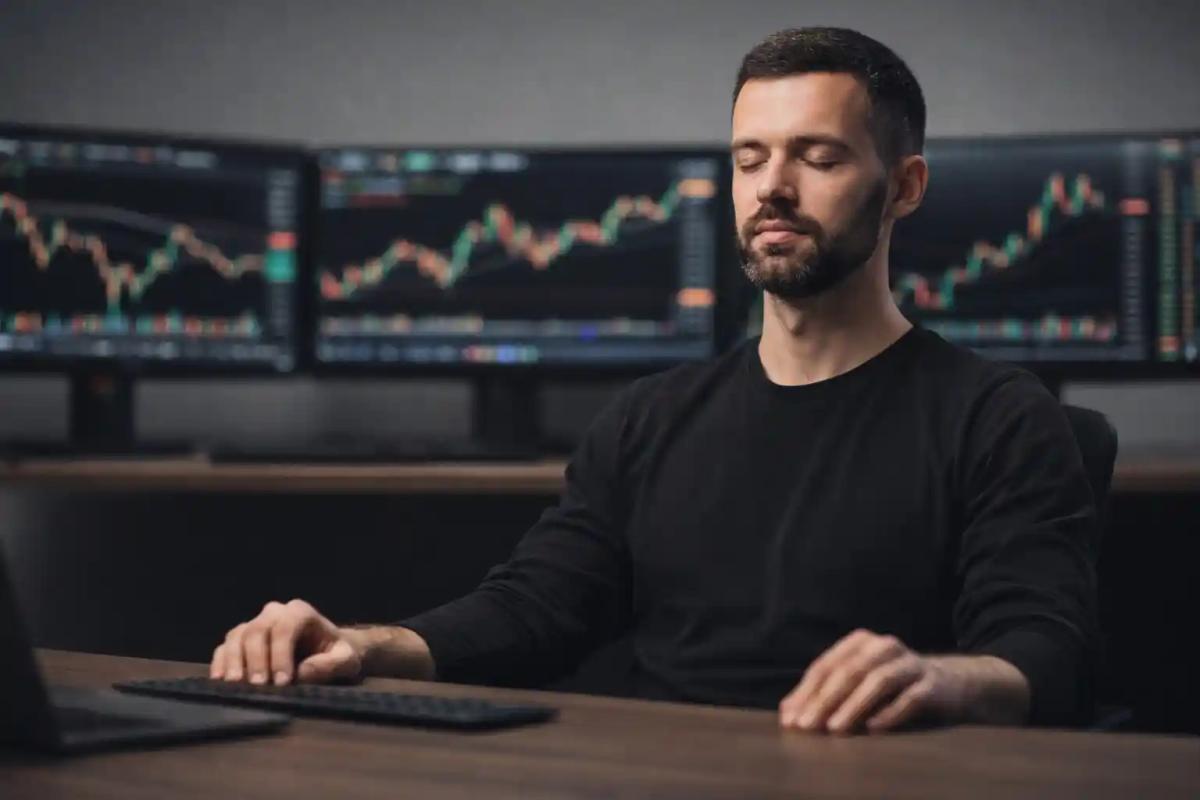
Why Traders Need Meditation (Not Just Motivation)
Motivation fades by the third red candle. What you actually need is a nervous system that doesn’t hijack your decision-making when the pressure spikes. That’s where meditation earns its place in your routine.
The Neuroscience of Stress and Trading Decisions
When your body perceives a threat, whether it’s a bear charging at you or a position moving hard against you, the stress response kicks in. Your brain’s amygdala, the region responsible for processing fear and emotional reactions, fires up. Cortisol and adrenaline flood your system, narrowing your focus and pushing you toward fight-or-flight reactions.
Here’s the problem for traders: that response was designed for physical survival, not for reading a price chart. When cortisol spikes, the prefrontal cortex, where rational analysis, planning, and impulse control live, gets essentially overruled. Imagine trying to read a complex options chain while someone blasts a horn in your ear. The information is still there, but your ability to process it calmly is compromised.
Meditation, even in short sessions, has been shown to reduce baseline cortisol levels and strengthen prefrontal cortex activity over time. In practical terms, this means your brain gets better at staying in “analysis mode” instead of defaulting to panic mode when volatility hits.
How Emotional Reactivity Costs You Money
Think about the last time you revenge traded. You took a loss, felt that hot sting of frustration, and immediately entered another position to “make it back.” Or maybe you froze during a perfect setup because your last three trades were losers and you couldn’t pull the trigger.
These aren’t strategy problems. They’re emotional reactivity problems, and they show up in predictable ways:
- Revenge trading after a loss, driven by frustration and the urge to recover immediately
- Freezing on entries because recent losses have wired a fear response
- Cutting winners short out of anxiety about giving back unrealized gains
- Overtrading on slow days because boredom and restlessness override your plan
- Widening stop-losses mid-trade because you can’t sit with the discomfort of a drawdown
Every one of these patterns has an emotional trigger at its root. Meditation builds the space between feeling an impulse and acting on it. That gap, even a few seconds of awareness, is often the difference between following your plan and blowing through your risk limits.
If you’re already working on managing emotions while trading, meditation is one of the most direct tools you can layer in. But knowing why it works is only half the equation. What does a meditation practice actually look like for someone who trades?
Pre-Market Meditation Techniques
You sit down at your desk thirty minutes before the open. Your watchlist is loaded, your levels are drawn, and your mind is already racing through ten different scenarios. What if that gap fills? What if the news drops early? What if yesterday’s loss turns into today’s loss?
This is exactly the moment where a short, structured meditation practice pays for itself. The goal is to arrive at the opening bell focused, grounded, and mentally prepared to execute your plan rather than react to noise.
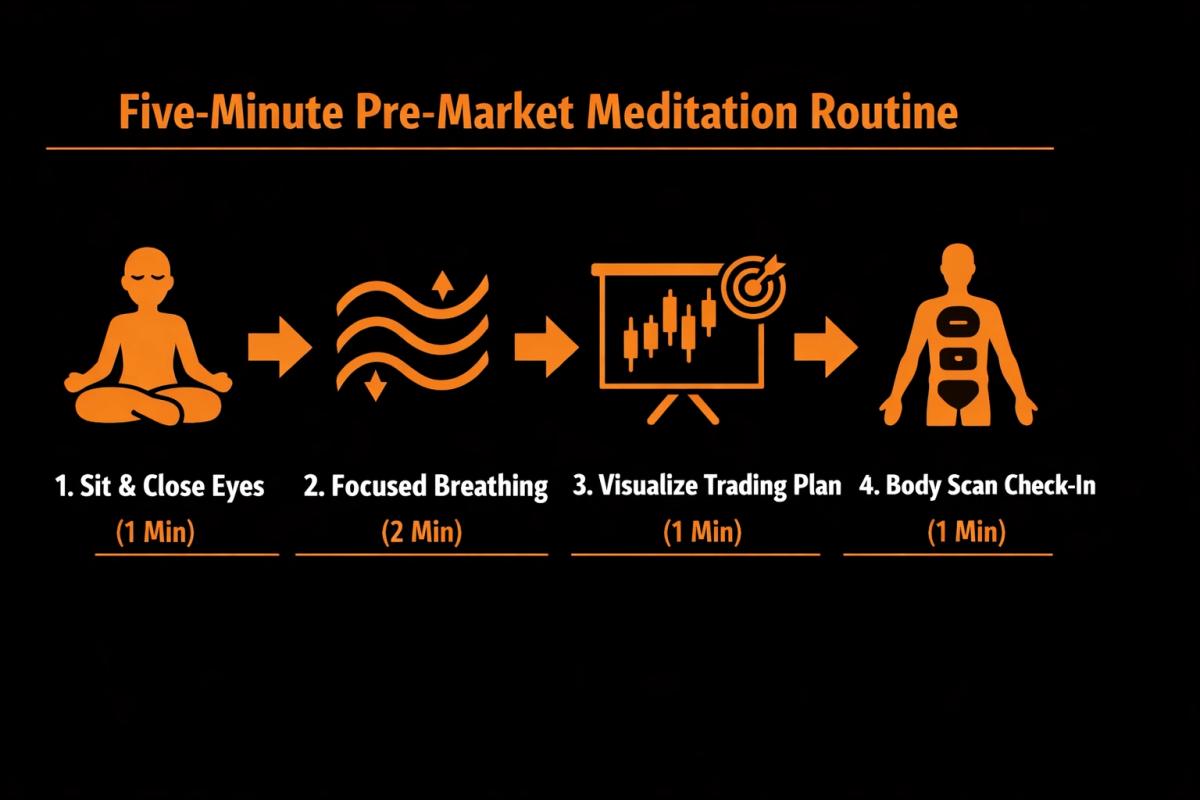
Focused Breathing for Session Preparation
This is the foundation technique, and it’s simpler than you’d expect. Focused breathing calms your nervous system by activating the parasympathetic response (your body’s “rest and process” mode), which directly counteracts the stress chemicals that cloud judgment.
Here’s how to do it:
- Sit comfortably at your desk. Feet flat on the floor, hands resting on your legs or the desk.
- Close your eyes or soften your gaze toward a neutral spot on your screen.
- Inhale slowly through your nose for 4 seconds.
- Hold for 4 seconds.
- Exhale slowly through your mouth for 6 seconds.
- Repeat for 2 minutes (roughly 8-9 full cycles).
The extended exhale is the key piece. It signals your vagus nerve to slow your heart rate and lower cortisol. Think of it as manually switching your brain from “reactive mode” to “analytical mode” before you need it most.
If your mind wanders to the charts or the news, that’s fine. Just notice it happened and bring your attention back to the count. That act of noticing and redirecting is the exercise.
Visualization of Your Trading Plan
Once you’ve settled your breathing, spend 60 seconds mentally walking through your trading plan for the session. Close your eyes and visualize:
- Your key levels and where you expect to look for entries
- The specific setup you’re waiting for (be precise about what qualifies)
- How you’ll respond if your first trade is a loss (what does “following the plan” actually look like in that moment?)
- Your predetermined stop point for the day, whether that’s a loss limit or a session time cutoff
Mental rehearsal works because it activates similar neural pathways as actual execution. Athletes have relied on this for decades. For traders, it pre-loads the “correct” response so you’re less likely to improvise under pressure. If you already have a written trading plan, this visualization step becomes even more powerful because you’re reinforcing decisions you’ve already made with a clear head.
Body Scan to Detect Pre-Session Tension
Your body often knows you’re stressed before your mind admits it. A quick body scan takes about 60 seconds and helps you identify physical tension that could signal emotional states you haven’t consciously recognized yet.
Starting from the top of your head, slowly move your attention down through your body:
- Jaw and face: Are you clenching? A tight jaw often signals anxiety or frustration carried over from the previous session.
- Shoulders and neck: Tension here usually means you’re bracing for something. That’s anticipatory stress showing up physically.
- Hands and forearms: If you’re gripping or your fingers feel tight, your body is already in “fight” mode before a single candle has printed.
- Stomach and chest: Tightness or a “knotted” feeling can point to unresolved worry about open positions or recent losses.
When you find tension, don’t try to force it away. Simply breathe into that area and consciously relax it. The point is awareness. If you notice your jaw is locked before the session even starts, that’s useful data. You can choose to acknowledge it and proceed more carefully, rather than letting it drive impulsive decisions without ever realizing it was there.
These three pre-market techniques, done together, take roughly 5 minutes. That’s a small investment for showing up to the market in a fundamentally different mental state. But what happens when you’re already in the thick of it?
Techniques for Use During Live Trading
The market is open, your position is live, and a red candle just wiped out half your unrealized gain in 30 seconds. This is not the moment for a 10-minute meditation session. You need something fast, discreet, and effective enough to keep you from clicking something you’ll regret.
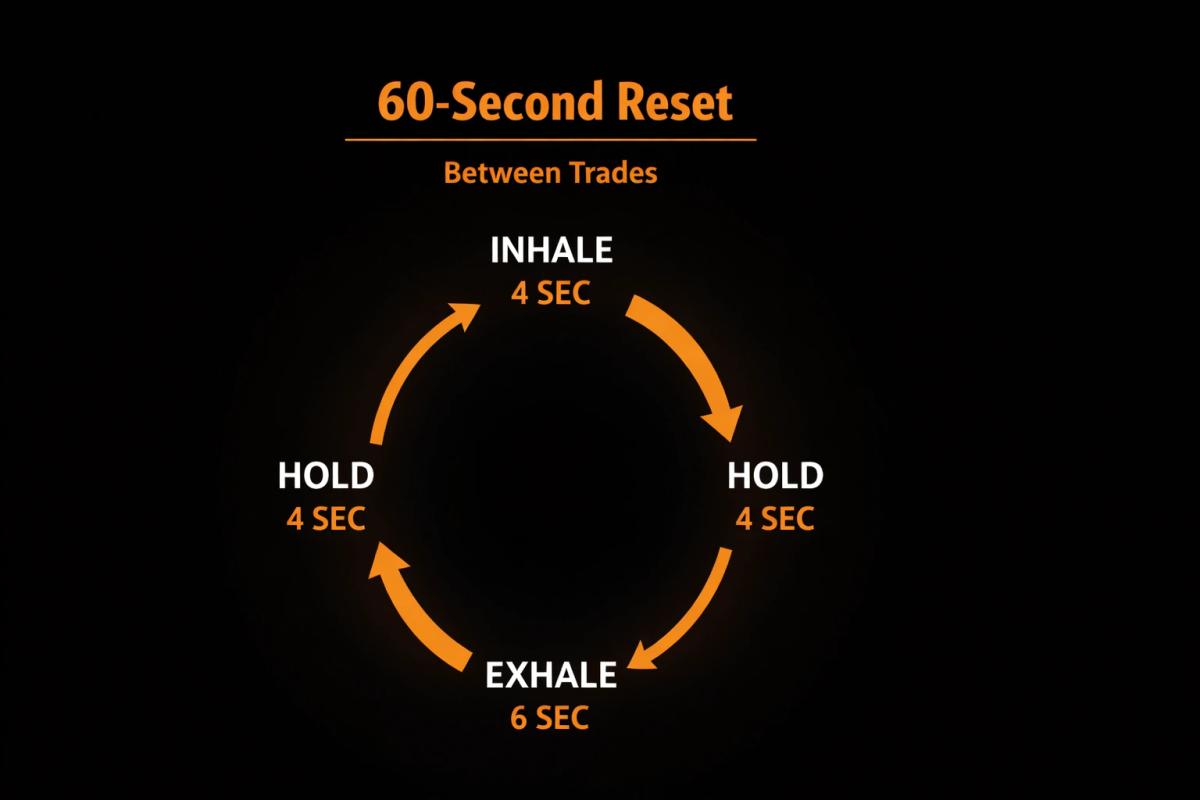
The 60-Second Reset Between Trades
After closing any trade, win or loss, take 60 seconds before doing anything else. This is your circuit breaker, and it’s non-negotiable if you want to break reactive patterns like revenge trading.
Here’s the protocol:
- Close the trade and remove your hands from the keyboard and mouse.
- Take 3 slow breaths using the 4-4-6 pattern (inhale 4 seconds, hold 4, exhale 6).
- Mentally label what you’re feeling. Don’t judge it, just name it: “Frustration.” “Relief.” “Excitement.” “Fear.”
- Ask yourself one question: “Is my next action based on my plan, or based on what just happened?”
- Only then return to your screen.
This technique interrupts the emotional momentum that causes most intra-session mistakes. The simple act of labeling an emotion (“that’s frustration”) activates your prefrontal cortex and loosens the amygdala’s grip. It’s like putting a name tag on the thing that’s trying to take over your controls.
Pair this with solid risk management strategies and you’ve built a double layer of protection: one systematic, one psychological.
Anchor Breathing for High-Volatility Moments
When the market is moving fast, a news event drops unexpectedly, or your position is deep in the red, you don’t have 60 seconds. You need something you can do while still watching the screen.
Anchor breathing is a 15-second technique:
- Place both feet flat on the floor and press down slightly (this is your physical “anchor”).
- Take one deep breath in for 4 seconds, feeling the pressure of your feet on the ground.
- Exhale for 6 seconds while consciously relaxing your hands.
- Return your focus to the chart with a single thought: “What does my plan say?”
The physical anchoring (feet pressing into the floor) gives your mind something concrete to latch onto, pulling attention away from the emotional spiral. It sounds almost too simple, but in a moment of genuine panic, having a rehearsed micro-routine is far more effective than trying to reason your way out of a stress response.
These in-session techniques are about damage control and clarity in real time. But what about the emotional residue that lingers after you close the charts for the day?
Post-Session Meditation and Recovery
Some of the worst trading decisions don’t happen during the session at all. They happen in the hours after, when you’re replaying losses, second-guessing exits, or carrying frustration into the next morning. Post-session meditation is about processing what happened so it doesn’t bleed into your next session.
Detachment Practice After Losses
After a losing session, your mind will want to loop the trades over and over. This is natural, but it’s counterproductive beyond a certain point. The detachment practice is designed to let you acknowledge the loss without fusing your identity to it.
- Sit quietly for 3 minutes after closing all charts and platforms.
- Mentally replay the session, but observe it as if you’re watching someone else trade. You’re a reviewer, not the trader in the chair.
- For each trade, note what happened without layering on judgment. Not “I was an idiot for taking that entry,” but “the entry was taken before the confirmation signal appeared.”
- After the review, take 3 breaths and mentally say: “That session is complete. It doesn’t define tomorrow.”
- Physically close your laptop or turn off your monitors as a symbolic endpoint.
The third-person perspective is the key ingredient. It creates cognitive distance between you and the outcome, which reduces the emotional charge of the experience. Over time, this trains your brain to treat losses as data points rather than personal failures. That shift alone can change how you show up the following morning.
Gratitude and Reflection Journaling Meditation
This technique bridges meditation and journaling, two practices that reinforce each other well. Spend 3-5 minutes after each session writing brief responses to these prompts:
- One thing I executed well today (even on a losing day, there’s usually something)
- One thing I noticed about my emotional state (when did I feel most reactive? Most calm?)
- One thing I’m grateful for in my trading journey (progress on discipline, a lesson learned, access to markets)
Research consistently shows that gratitude practice reduces stress hormones and improves mood regulation. For traders, it counterbalances the natural negativity bias that makes you remember every loss in vivid detail while the wins fade quickly.
Write it by hand if you can. The physical act of writing slows your thinking and forces more deliberate reflection than typing. Over time, this becomes a valuable companion to your regular trading journal, giving you both technical and psychological data to review side by side.
Building these post-session practices into your routine closes the loop. But how do you make this stick without it feeling like yet another chore on top of an already demanding schedule?
Building a Sustainable Meditation Routine as a Trader
Most traders who try meditation quit within two weeks because they start with unrealistic expectations and an unsustainable commitment. The fix is making the habit so small it’s almost impossible to skip.
Starting Small: The 5-Minute Daily Commitment
Forget 20-minute sessions or hour-long retreats. As a trader, your meditation practice should start at 5 minutes per day, and you shouldn’t increase it until those 5 minutes feel effortless.
Here’s a realistic starting framework:
The total investment is roughly 5-7 minutes spread across your trading day. That’s less time than most traders spend scrolling through Twitter looking for trade ideas.
The critical principle here is that consistency beats duration. Five minutes every trading day for a month will produce noticeably more benefit than one 30-minute session followed by two weeks of nothing. Attach the habit to something you already do, like sitting down at your desk or closing your last trade, so it becomes automatic rather than something you need to remember.
Tracking Progress Alongside Trading Performance
You track your P&L, your win rate, your average risk-to-reward. Why wouldn’t you track your mental performance with the same discipline?
Create a simple weekly tracker with these columns:
- Meditation completed (yes/no)
- Duration
- Pre-session mood rating (1-5)
- Post-session mood rating (1-5)
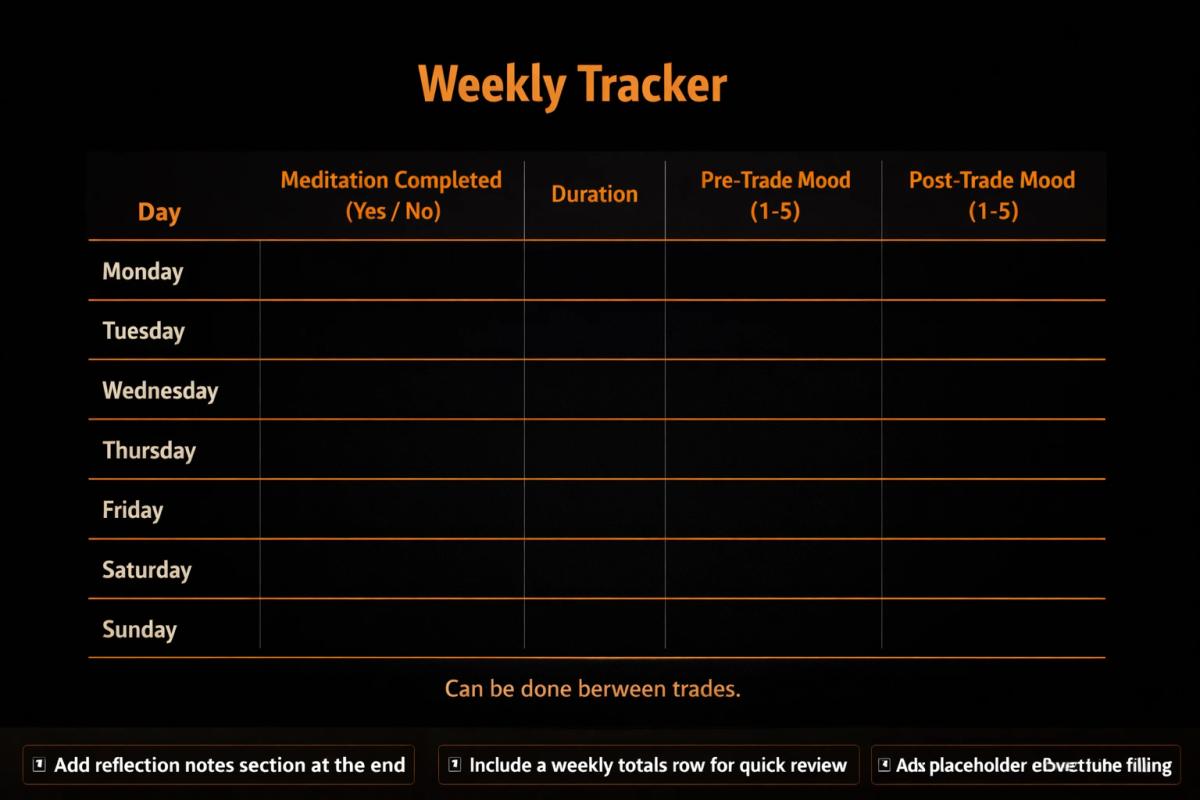
After 3-4 weeks, look for patterns:
- Do you trade better on days you meditate?
- Is your post-session mood consistently higher when you do the detachment practice?
- Are your revenge trading incidents declining?
This is about seeing whether it works for you, in your specific trading context. The data either supports continuing or tells you to adjust your approach. Either way, you’re making informed decisions about your practice, which is exactly the mindset meditation is designed to build.
Some traders find guided meditation apps helpful for maintaining consistency, especially in those first few weeks. If you’re the type who benefits from structured guidance, explore what’s available and test a few to see what fits your style.
Common Mistakes Traders Make with Meditation
Even traders who commit to a meditation practice can undermine their own progress by approaching it with the wrong expectations. Two traps come up more often than any others.
Expecting Instant Results
You wouldn’t expect a new trading strategy to be profitable after three days of paper trading. Meditation works the same way. The benefits, including reduced reactivity, improved focus, and better emotional regulation, build gradually over weeks and months of consistent practice.
The first few sessions will probably feel awkward or pointless. Your mind will race, you’ll feel restless, and you might wonder if you’re “doing it right.” That’s completely normal. The point is to practice noticing your thoughts and redirecting your attention. That practice compounds over time, much like screen time compounds your pattern recognition.
Give yourself at least 30 days of consistent practice before evaluating whether meditation is “working.” Define “working” in concrete terms before you start: fewer revenge trades, a calmer pre-market state, better adherence to your trading plan. Vague goals like “feel more zen” won’t give you anything useful to measure against.
Using Meditation to Suppress Emotions Instead of Processing Them
This is the subtler and more damaging mistake. Some traders start meditating with the goal of not feeling anything during trades. They want to become emotionless, and they use meditation as a tool to push everything down.
That’s suppression, and it backfires reliably. Suppressed emotions accumulate and eventually break through, usually at the worst possible moment (the middle of a volatile session, for example).
Proper meditation practice teaches you to notice and acknowledge emotions without being controlled by them. There’s a massive difference between “I don’t feel fear” and “I notice fear is present, and I’m choosing to follow my plan anyway.” The first is avoidance. The second is genuine emotional regulation.
If you find yourself using meditation to numb out or disconnect from what you’re feeling, take that as a signal to slow down and refocus on the labeling and observation techniques described earlier.
Frequently Asked Questions
How long do I need to meditate each day to see benefits as a trader?
Most traders see noticeable improvements in focus and emotional regulation with just 5 minutes of daily practice. The techniques in this guide are designed to fit into your existing trading routine without adding significant time. Consistency matters far more than session length, so start with 5 minutes and only increase if it feels natural.
Can meditation actually help during fast-moving markets like day trading?
Yes, but you need the right techniques. Long, seated meditation sessions aren't practical mid-session. Techniques like the 60-Second Reset and Anchor Breathing (a 15-second exercise) are specifically designed for use during live trading. They're fast enough to use between trades without missing setups.
When is the best time for a trader to meditate relative to market hours?
Pre-market meditation (15-30 minutes before the session opens) tends to deliver the most immediate impact because it sets your mental baseline before the pressure starts. That said, the most effective approach combines brief pre-market, in-session, and post-session practices to cover the full emotional arc of your trading day.
Can meditation help specifically with revenge trading?
Revenge trading is driven by emotional reactivity, typically frustration and the urge to recover a loss immediately. Meditation directly targets this by building the pause between impulse and action. The 60-Second Reset technique, combined with the practice of labeling your emotions, is particularly effective at interrupting the revenge trading cycle before you click into a bad position.
How long does it take before meditation starts improving my trading performance?
Most practitioners report subtle shifts in awareness and reactivity within 2-3 weeks of consistent daily practice. More significant behavioral changes, like reduced overtrading or better plan adherence, typically emerge after 4-8 weeks. Track your meditation alongside your trading metrics to identify your own timeline rather than relying on general estimates.
About the authors


Put this into practice
Related articles
Mental Resilience in Trading: How to Bounce Back From Losses and Stay Sharp
Learn about mental resilience trading. Practical techniques for recovering from losses, handling drawdowns, and staying sharp under pressure.

Mindfulness in Trading: Practical Techniques to Trade With Clarity
Learn practical mindfulness techniques for trading. Build pre-session routines, manage tilt, and improve decision-making with concrete tools for your next session. |

Overconfidence in Trading: How to Spot It and Stop It Before It Costs You
Overconfidence in trading disguises itself as skill. Learn to spot the warning signs, understand the psychology behind it, and build systems to protect your capital.
0 comments