



Recovering from Big Losses: A Trader’s Step-by-Step Guide
No motivational speech fixes a blown account. No secret indicator rebuilds your capital overnight. What exists is a process. A structured, honest, sometimes uncomfortable process that addresses both the damage between your ears and the damage on your balance sheet.
This guide walks you through that process phase by phase. With the kind of direct, practical framework that actually works when you’re starting from a dark place.
Disclaimer: This article is educational content, not personalized financial or psychological advice. Trading involves significant risk of loss, and past performance does not guarantee future results. If your losses are causing serious mental health distress, please seek professional help.

Why Big Losses Happen to Experienced Traders Too
If you think major drawdowns only happen to beginners, think again. Some of the largest account wipeouts in trading history came from people who knew exactly what they were doing, or thought they did. Understanding why big losses happen even to skilled traders isn’t about making excuses. It’s about recognizing the patterns so you can interrupt them before they compound.
Common Patterns Behind Major Account Drawdowns
Most catastrophic losses don’t come from a single bad trade. They come from a sequence of decisions that stack into disaster. These are the patterns that show up again and again:
- Averaging into losers. Adding to a losing position because you’re convinced the market “has to” reverse. Each add increases your exposure while the original thesis falls apart underneath you.
- Ignoring stop losses. You set them, then override them. Or you never set them at all, telling yourself you’ll “manage it manually.” The market doesn’t wait for you to decide.
- Oversizing on conviction trades. You feel so certain about a setup that you allocate 3x or 5x your normal size. When it works, you feel like a genius. When it doesn’t, the damage is wildly disproportionate.
- Correlated positions. Holding multiple trades that look different on the surface but are all exposed to the same underlying risk factor. One move wipes out everything at once.
- Trading through news events without protection. Holding full-size positions into earnings, Fed announcements, or geopolitical events without hedging or reducing exposure.
Notice that none of these require ignorance. They require overconfidence, emotional attachment, or a momentary lapse in discipline. That’s precisely what makes them so dangerous for experienced traders.
The Role of Overconfidence and Risk Drift
There’s a specific psychological trap that hits traders after a period of success. It’s called risk drift, and it works like this: you have a good month, so you size up a little. Another good stretch, and you relax your rules slightly. Your stop losses get wider. Your position sizes creep up. Your risk management, the very thing that made you profitable, slowly erodes because success made you feel invincible.
Think of it like a pilot who’s flown thousands of hours without incident. That experience is valuable, but it can also breed complacency. The moment you stop respecting the checklist is the moment you’re most exposed.
Risk drift is gradual. And by the time you notice, you’re already deep in a drawdown that your original risk parameters would never have allowed.
So if you’re reading this after a major loss, the question isn’t just “what went wrong with that trade?” It’s “what shifted in my process over the weeks or months before the blowup?”
The Psychological Impact of a Major Trading Loss
A big trading loss hits your identity. If you’ve built any part of your self-image around being a competent trader, a major drawdown can feel like a personal failure that extends far beyond money. And that psychological damage, left unaddressed, will quietly sabotage every recovery attempt you make.
Shame, Fear, and the Urge to Revenge Trade
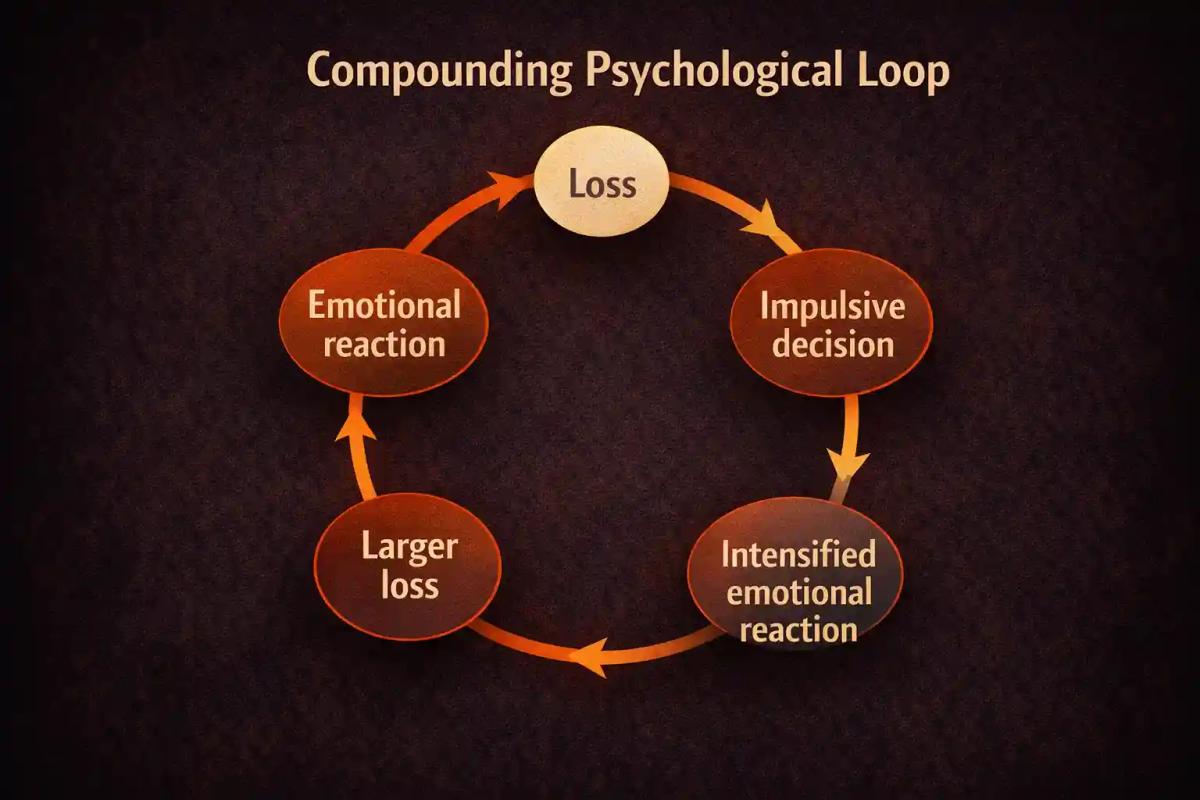
The emotional sequence after a major loss is almost universal. First comes shock, that numb, detached feeling where the number doesn’t seem real. Then shame creeps in. You don’t want to tell your partner. You don’t want to face your trading group. You replay the decisions over and over, wincing at each one.
Then comes fear. Fear of the market. Fear of placing another trade. Fear that you’re simply not good enough.
And paradoxically, sitting right next to that fear is the most dangerous impulse of all: the urge to revenge trade.
Revenge trading is the desperate attempt to “make it back” quickly. It’s driven by emotional pain, not logic. You size up, you chase setups, you overtrade, all trying to undo the damage as fast as possible. But revenge trading is how a 30% drawdown becomes a 70% drawdown. It’s the emotional equivalent of a gambler doubling down after a losing streak, and it almost always accelerates the destruction.
If you recognize this urge in yourself right now, that’s actually a good sign. Awareness is the first breakout point in the cycle. You can’t interrupt a pattern you refuse to see.
Recognizing When You Need to Step Away
Here’s a truth that trading culture doesn’t like to talk about: sometimes the best trade you can make is no trade at all. If you’re experiencing any of the following, it’s a clear signal to step away from the screens entirely:
- You’re checking your P&L more than once per hour
- You’re entering trades without a clear setup or plan
- You feel physically agitated, nauseous, or unable to sleep because of market positions
- You’re hiding the extent of your losses from people close to you
- You’re trading to “feel something” rather than to execute a strategy
Stepping away is a tactical pause, the same way an athlete sits out a game with an injury to prevent further damage. Your capital and your emotional state are both resources. Depleting either one to zero makes recovery exponentially harder.
But stepping away is only the beginning. What you do during that pause determines whether you come back stronger or simply repeat the cycle.
Phase 1: Stabilize Before You Strategize
The single biggest mistake traders make after a major loss is trying to fix everything at once. They want to adjust their strategy, recalculate their risk, study new setups, and start trading again, all in the same weekend. That impulse is understandable, but it’s counterproductive. Before you can rebuild anything, you need to stabilize.
Stopping the Bleeding: Immediate Actions
Your first priority is simple: stop the damage from getting worse. This is triage, not optimization.
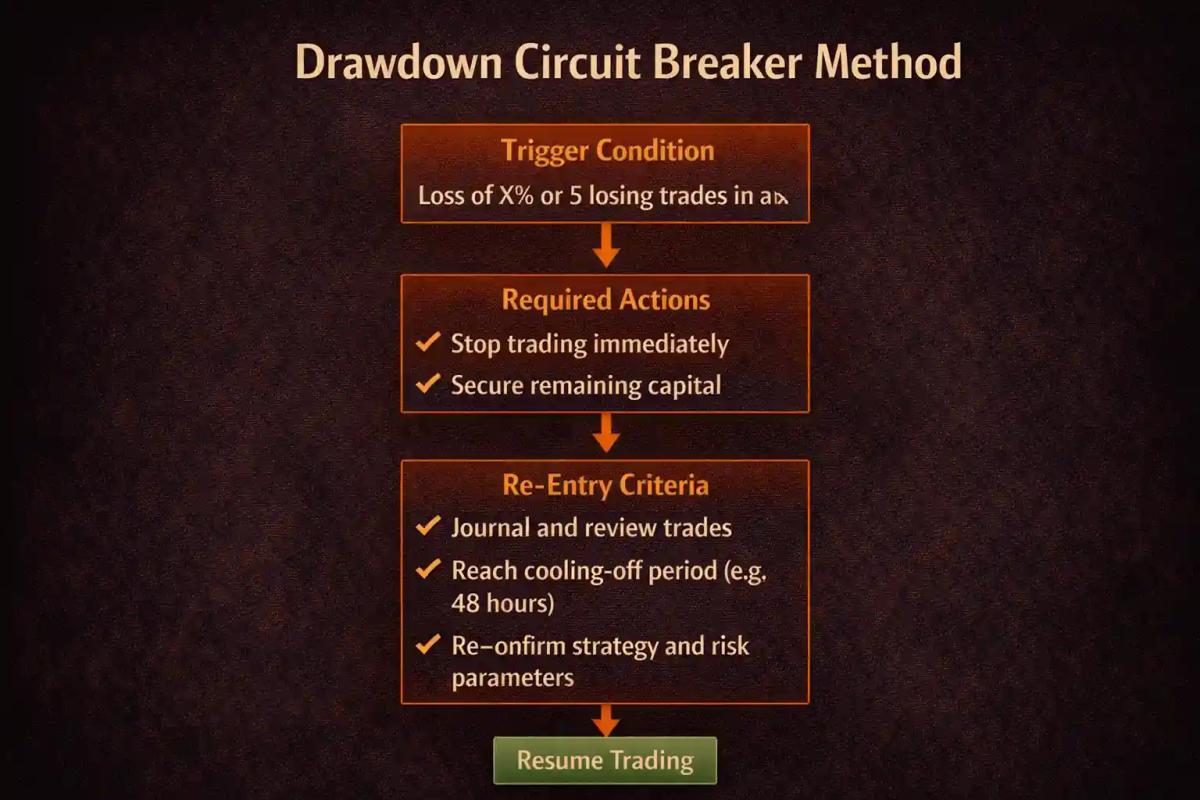
Here’s your immediate action list:
- Stop trading. Not tomorrow. Now. Close any open positions that don’t have defined risk. If you have positions with proper stops in place, you can leave those, but do not enter anything new.
- Secure your remaining capital. Whatever is left in your account is your recovery seed. Protect it. Consider withdrawing a portion to a separate bank account so you can’t impulsively deploy it.
- Step away from screens. Give yourself a minimum of 48-72 hours completely away from charts, trading feeds, and financial social media. Your brain needs to exit fight-or-flight mode before you can think clearly.
- Set a return date. Don’t leave your break open-ended. Pick a specific date, at least one week out, often two, when you’ll begin the review process. Write it down.
- Tell someone. This is the hardest one. Find one trusted person, whether that’s a trading partner, a mentor, or a friend who understands markets, and tell them what happened. Shame thrives in isolation. Speaking the loss out loud reduces its grip on you.
None of these steps involve analysis, strategy, or market research. That’s intentional. You can’t think clearly about what to fix until your nervous system calms down.
Setting a Recovery Mindset Without False Optimism
There’s a difference between hope and delusion. A recovery mindset isn’t about convincing yourself that you’ll “make it all back.” It’s about accepting three things.
The loss happened. It’s real. No amount of analysis changes the number on the screen. Acceptance is the foundation for forward movement.
Recovery takes time. If you lost 50% of your account, you need a 100% return just to break even. That’s not happening in a week or even a month with responsible position sizing. Anchoring your expectations to reality protects you from the desperation that triggers revenge trading.
The goal isn’t to get back to the old number. The goal is to become a better, more resilient trader than the one who took the loss. If you focus only on recovering dollars, you’ll cut corners. If you focus on improving your process, the dollars follow.
That shift in framing, from “recovering money” to “recovering as a trader,” is what separates people who actually come back from those who blow a second account trying.
With your emotions more stable and your expectations grounded, you’re ready for the hardest part of recovery: looking at what actually happened.
Phase 2: Conducting an Honest Loss Audit
This is where most traders skip ahead or do a superficial job. They glance at their history, mutter something about “the market being irrational,” and move on to tweaking indicators. But a real loss audit is uncomfortable by design. It forces you to sit with the specific decisions that led here and classify them with unflinching honesty.
Reviewing Your Trade Journal and Identifying Root Causes
If you kept a trade journal, now is when it earns its value. If you didn’t, this is a painful but instructive lesson in why journaling matters. Either way, here’s the process:
Pull up every trade from the period leading up to and including the major loss. For each one, document:
- Entry reason: Why did you take this trade? Was it based on your system, or was it impulsive?
- Exit reason: Did you exit according to plan, or did emotion drive the decision?
- Risk taken vs. risk planned: Did you follow your position sizing rules, or did you deviate?
- Emotional state at entry: Were you calm, frustrated, euphoric, or desperate?
Look for clusters. Were most of the damaging trades concentrated in a few sessions? Did the losses escalate after a specific trigger event? Did your sizing increase after wins (risk drift) or after losses (revenge trading)?
The patterns will surface if you’re honest with yourself. And those patterns are the real enemy, not the market.
Separating Process Errors from Market Conditions
This distinction is critical, and most traders miss it entirely. Not every losing trade is a mistake. Sometimes you execute perfectly and the market delivers a low-probability outcome. That happens. It’s called variance, and it’s built into every strategy with a win rate below 100%, which is all of them.
A process error is when you broke your own rules. You sized too large, skipped your stop, entered without a setup, held through a news event you should have avoided. These are fixable.
A market condition mismatch is when your strategy was correctly applied but the market environment shifted. A trend-following system will bleed during choppy, range-bound markets. A mean-reversion strategy will get crushed in a strong trend. This isn’t a mistake; it’s a limitation of the approach.
Your audit needs to sort each losing trade into one of these buckets. If your losses came mostly from process errors, the fix is discipline and accountability. If they came mostly from a market condition mismatch, the fix might be adding filters, reducing exposure during unfavorable regimes, or diversifying your strategy set.
Most major drawdowns involve both. But knowing the ratio tells you where to focus your rebuild.
Phase 3: Rebuilding Your Trading Plan
You’ve stabilized. You’ve audited. Now it’s time to build something designed to prevent a recurrence. This is about restructuring your risk parameters, your re-entry approach, and your confidence, all at the same time.
Resizing Positions and Recalibrating Risk Parameters
If your pre-loss position sizing allowed for the drawdown you just experienced, then your position sizing was wrong. Full stop. This is the most concrete, actionable change you can make.
Here’s a practical framework for recalibration:
- Cut your previous position size by at least 50%. If you were risking 2% per trade, drop to 1% or less. You can scale back up later once you’ve proven consistency.
- Set a hard daily loss limit. If you lose a defined amount in a single session (say, 2-3% of your current capital), you stop trading for the day. No exceptions.
- Set a weekly loss limit. Same principle, broader timeframe. If you hit your weekly cap, you sit out until the following week.
- Define your maximum open risk. How much total capital can be at risk across all open positions at any given time? This prevents correlated position blowups.
These are guardrails for the recovery phase. Think of them like the speed limit in a construction zone: once the road is clear and you’ve proven you can drive safely again, you can gradually increase.
Choosing a Reduced-Risk Re-Entry Strategy
Your first trades back should be boring. Intentionally boring. This is not the time for aggressive setups, exotic instruments, or high-conviction swing trades. Your only goal in the first phase of re-entry is to execute your process cleanly with small size.
Consider focusing on:
- Your highest-probability setups only (the ones with the best historical win rate)
- Liquid, well-understood markets where slippage and surprises are minimal
- Shorter holding periods that limit overnight or weekend risk
- Defined-risk trades where your maximum loss is known at entry
The point is to rebuild the neural pathways associated with disciplined execution. Every clean trade, even a small loser taken according to plan, is a deposit in your confidence account.
Using Demo or Small Accounts to Rebuild Confidence
There’s a stigma around demo trading among experienced traders. It can feel like a step backward. But consider this: if a professional athlete tore their ACL, nobody would criticize them for starting rehab with bodyweight exercises instead of jumping straight back into full-contact competition.
A demo account or a very small live account serves the same function. It lets you:
- Test your rebuilt strategy in real market conditions without meaningful financial risk
- Rebuild the habit of following your rules in real time
- Identify any remaining emotional triggers before they can cause real damage
- Generate a track record of consistent execution that gives you objective evidence, not just feelings, that you’re ready to scale back up
If demo trading feels too disconnected, a micro or small live account with capital you’re genuinely prepared to lose is a solid middle ground. Some traders also find that prop firm evaluations offer a useful structure here, providing defined rules, loss limits, and clear targets that enforce the discipline you’re rebuilding.
The key is this: do not rush the progression from small to full size. Your eagerness to “get back to normal” is itself a risk factor. Let your results, not your impatience, dictate when you scale up.
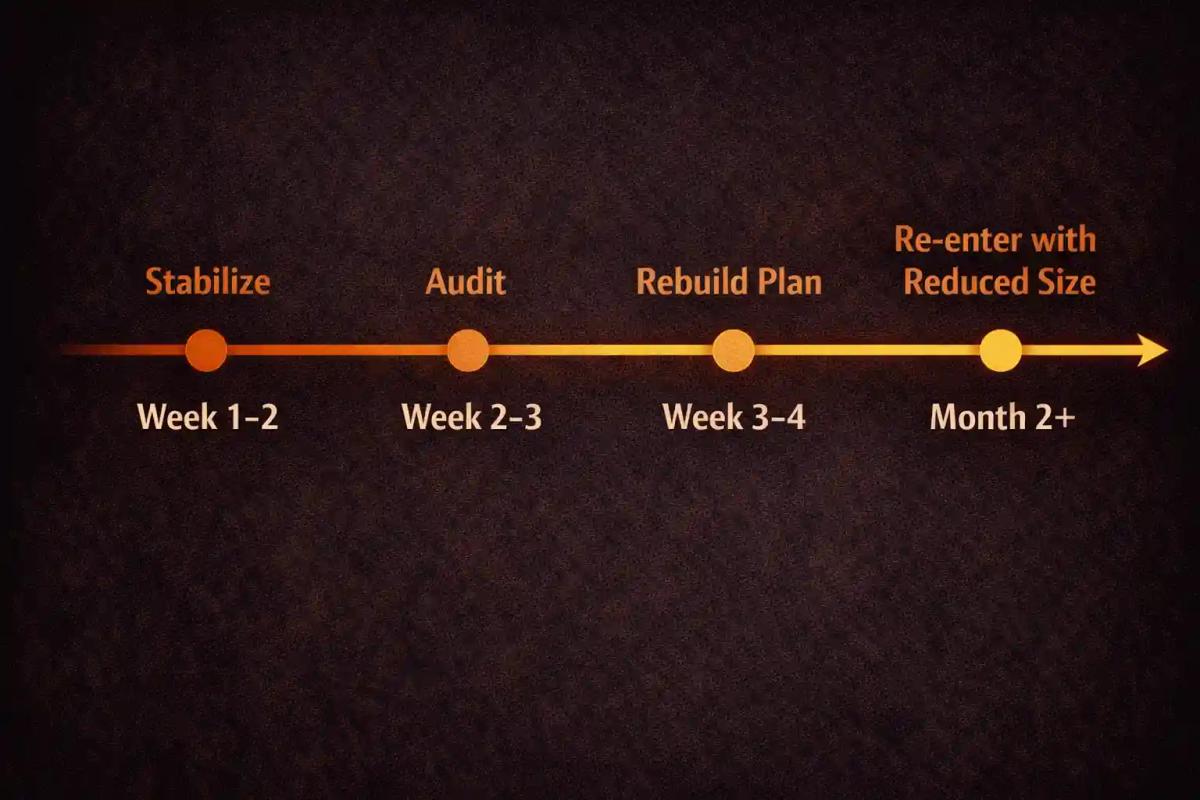
With your plan rebuilt and your confidence slowly returning on smaller size, how do you manage the long game of actually executing your comeback?
Phase 4: Executing the Comeback
Planning the recovery is one thing. Living it, day after day, trade after trade, while the gap between where you are and where you were stares at you from the screen, is something else entirely. This phase is about sustainable execution, not sprinting toward a number.
Setting Realistic Recovery Milestones
Forget about your old account balance for now. Seriously. Anchoring to that number will distort every decision you make. Instead, set process-based milestones that are entirely within your control:
- First milestone: Execute 20 consecutive trades following your rules exactly, regardless of P&L outcome.
- Second milestone: Complete one full month trading within your new risk parameters with zero rule violations.
- Third milestone: Achieve a positive expectancy (net profitable) over a 50+ trade sample at your reduced size.
- Fourth milestone: Scale position size up by 25% and repeat milestone three.
Notice what these milestones measure: discipline, consistency, and process. Not dollars. The dollars are a byproduct. If you chase the dollars directly, you’ll start cutting corners, and that’s exactly how you ended up reading this article in the first place.
Tracking Progress Without Obsessing Over P&L
Your daily P&L is noise. Your weekly P&L is still mostly noise. At reduced position sizes during recovery, the numbers will feel painfully small. That’s by design. If you let yourself get frustrated by the slow pace of dollar recovery, you’ll be tempted to size up too soon.
Instead, track metrics that reflect the quality of your trading:
- Rule adherence rate: What percentage of trades followed your plan exactly?
- Average risk per trade: Is it staying within your new parameters?
- Recovery factor: Are your winners larger than your losers, even if both are small in absolute terms?
- Emotional state log: A simple 1-5 rating of your emotional discipline each session. Are you trending calmer, or are anxiety spikes still frequent?
These metrics tell you whether your process is healing. The account balance tells you almost nothing useful during early recovery. Trust the process metrics. They don’t lie.
But what if, after all of this, the honest answer is that your old approach simply doesn’t work anymore? What if recovery means something bigger than rebuilding? What if it means reinventing?
When Recovery Means Changing Your Entire Approach
Sometimes the loss audit reveals something you don’t want to hear: the strategy that blew up was fundamentally unsuited to current conditions, your risk tolerance, or your lifestyle. In those cases, recovery isn’t about refinement. It’s about transformation.
Switching Markets, Timeframes, or Strategies
This isn’t failure. This is adaptation. Some of the most successful traders in history went through complete style overhauls after major setbacks. A day trader who can’t manage the screen time anymore might transition to swing trading. A futures trader who got wrecked by leverage might move to equities. A discretionary trader who keeps making emotional decisions might explore systematic approaches.
The key questions to ask yourself:
- Does my trading style match my actual personality and emotional capacity (not the version of myself I wish I were)?
- Am I trading a market and timeframe that fits my daily schedule and life obligations?
- Was my edge real, or was I riding a favorable market cycle that has now ended?
- Would a completely different approach give me better risk-adjusted returns with less emotional strain?
Be honest with yourself here. The market doesn’t care about your loyalty to a specific method.
Knowing When to Seek External Help or Mentorship
If you’ve worked through the phases above and you’re still stuck, paralyzed, or repeating the same patterns, it might be time to bring in outside perspective.
Options worth considering:
- A trading mentor or coach who has verifiable experience and can review your journal, your plan, and your execution objectively. A good mentor sees blind spots you can’t.
- A trading psychologist or performance coach who specializes in the emotional dimensions of high-stakes decision-making. The skills they teach (emotional regulation, cognitive reframing, performance routines) translate directly to trading.
- A peer accountability group where you share trades, review each other’s journals, and hold each other to stated rules. Isolation is one of the biggest risk factors for repeat blowups.
If your losses are causing persistent anxiety, depression, sleep disruption, or relationship problems, please consider speaking with a licensed mental health professional. Trading losses can trigger or worsen mental health conditions, and there’s no trading strategy that substitutes for proper support. Your wellbeing matters more than any account balance.
Recovery, in whatever form it takes, is a marathon. Not a sprint. Be patient with yourself, but be honest too. That combination, patience and honesty, is the real edge.
Frequently Asked Questions
How long does it realistically take to recover from a major trading loss?
There's no universal timeline, because it depends on the size of the drawdown, your remaining capital, your strategy's expectancy, and how much you reduce position sizing during recovery. A trader who lost 40% and drops to half-size might need 6-12 months of consistent, disciplined trading to approach previous levels. The psychological recovery often takes longer than the financial one. Anyone promising you a faster timeline is selling something.
Should I keep trading the same strategy after a big loss, or switch entirely?
That depends on what your loss audit reveals. If the strategy has a proven edge and your losses came from process errors (broken rules, oversizing, revenge trading), then the strategy isn't the problem. Your execution is. Fix the execution. If the losses came because market conditions shifted and your strategy no longer has an edge, then clinging to it out of familiarity will just produce more losses. Let the data from your audit guide this decision, not emotion.
How do I figure out the right position size when I start trading again?
Start with what you can afford to lose without it affecting your emotional state or decision-making. For most traders in recovery, that means cutting previous risk per trade by at least half. If you were risking 2% per trade, drop to 0.5-1%. The number should feel almost uncomfortably small. That discomfort is a feature, not a bug. It means the size is small enough that you can focus on process rather than outcome. Scale up only after demonstrating consistent rule adherence over a meaningful sample of 50 or more trades.
What are the signs that I should take a longer break or stop trading altogether?
If you're unable to follow your own rules despite knowing them, if trading is causing persistent anxiety or depression that bleeds into your non-trading life, if you're hiding losses from your partner or family, or if you find yourself constantly thinking about "getting even" with the market, these are all signals that you need more than a standard recovery pause. Consider whether trading is the right activity for your current life circumstances. There's no shame in stepping away for months or even permanently if it's damaging your mental health or relationships.
Is demo trading actually useful during recovery, or is it a waste of time?
Demo trading is genuinely useful during recovery if you use it correctly. The purpose isn't to "practice trading." It's to rebuild the habit of disciplined execution without financial pressure. Trade your demo account exactly as you would a real account: same position sizing (relative to a theoretical account size), same rules, same journaling. If you find yourself taking reckless trades on demo because "it's not real money," that reveals an emotional pattern worth examining. Some traders prefer a very small live account instead, since real money adds a layer of psychological authenticity that demo can't replicate.
How do I handle the urge to revenge trade?
First, name it. The moment you recognize the thought "I need to make this back right now," label it for what it is: a revenge trading impulse. Naming it creates a small gap between the urge and the action. Second, have a pre-committed rule: if you catch yourself in this state, you close your platform and walk away for at least 24 hours. No negotiation. Third, review the emotional cycle (loss, shame, fear, revenge trading, further loss) and remind yourself where that path leads. The urge will fade. It always does. But the damage from acting on it doesn't.
Is starting a prop firm evaluation a good recovery strategy?
It can be, for the right person. Prop firm evaluations provide built-in structure: defined loss limits, profit targets, and rules that enforce the discipline you're trying to rebuild. They also let you trade with relatively low personal capital at risk. The downside is that evaluation fees add up if you fail repeatedly, and the pressure of a timed evaluation can trigger the same emotional patterns that caused your initial loss. If you go this route, treat the evaluation as a training exercise, not a do-or-die event. The goal is to practice disciplined execution within defined rules, which is exactly what recovery demands.
About the authors


Put this into practice
Related articles
Regret in Trading: Why It Happens and How to Move Past It
Learn why regret hooks traders so effectively and discover practical strategies to stop it from distorting your decisions. Covers journaling, mind shifts, etc.
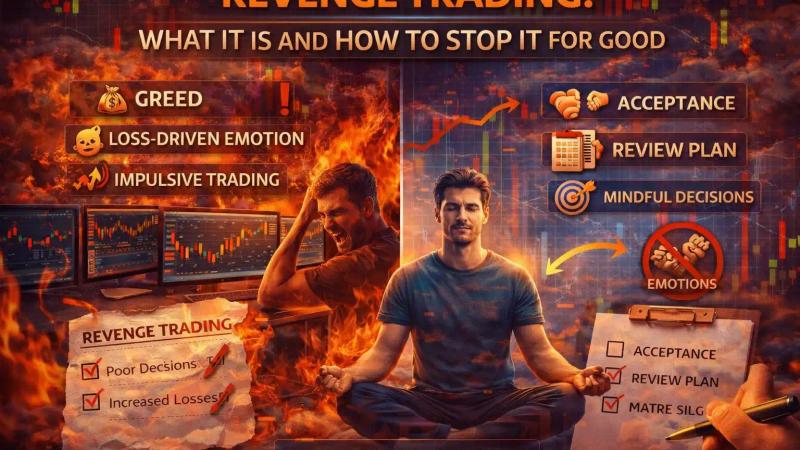
Revenge Trading: What It Is and How to Stop It for Good
Learn what revenge trading is, why it happens, and how to stop it with a proven 5-step protocol. Break the cycle of emotional trading for good.

Self-Awareness for Traders: Know Yourself to Trade Better
Learn how self-awareness helps traders perform better. Identify your trading personality, run a self-assessment, and turn self-knowledge into a real edge.
0 comments