



Revenge Trading: What It Is and How to Stop It for Good
Revenge trading is one of the most common and destructive patterns in trading, and it doesn’t discriminate. It hits beginners and experienced traders alike. The worst part is that most traders recognize the behavior after the fact but feel powerless to stop it in the moment.
This guide breaks down exactly why revenge trading happens at a psychological and emotional level, how to spot it before it spirals, and gives you a concrete, step-by-step protocol you can use in your very next session to interrupt the cycle. This is a framework built around how your brain actually works under pressure.
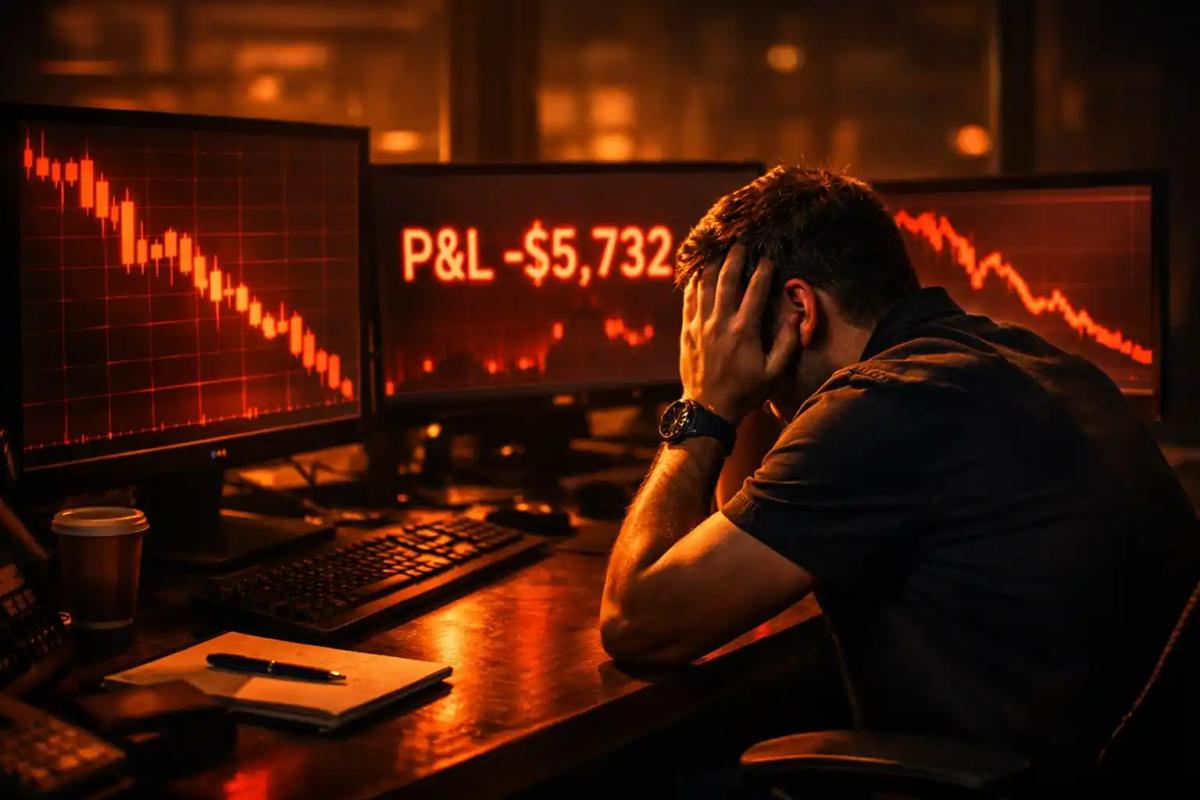
What Is Revenge Trading?
Revenge trading is the act of entering a trade primarily to recover a recent loss, rather than because the trade meets your strategy criteria. It’s driven by emotion, not analysis. The “revenge” isn’t directed at another person. It’s aimed at the market itself, as if you can somehow force it to return what it took.
The critical distinction here is motivation. Every trade you take has a reason behind it. In revenge trading, that reason is emotional recovery, not strategic opportunity. That single difference changes everything: how you size the position, how you manage risk, and how you react to what happens next.
The Anatomy of a Revenge Trade
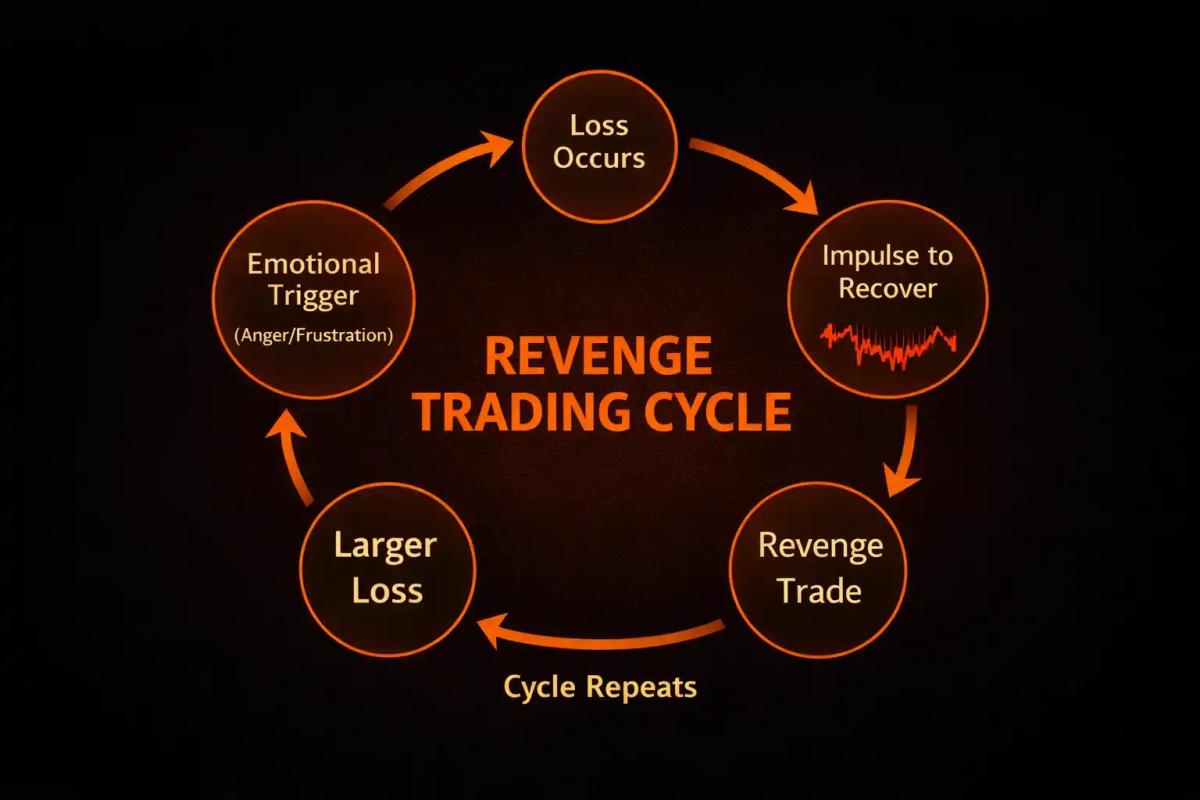
Here’s how a revenge trade typically unfolds. See if this sounds familiar:
- You take a trade based on your plan. It goes against you and hits your stop loss. A normal, expected loss.
- Instead of stepping back to reassess, you feel a surge of frustration. The loss feels personal.
- Within minutes (sometimes seconds), you re-enter the market. Often in the same instrument, often in the same direction, sometimes with a larger position size.
- You haven’t consulted your checklist. You haven’t confirmed a new setup. You’re trading to erase the feeling of losing, not to capitalize on an opportunity.
- The second trade also goes against you, or even if it wins, you’ve broken your process. Either way, you’ve lost control.
That sequence, from controlled loss to emotional re-entry, is the fingerprint of a revenge trade. It can repeat multiple times in a single session, compounding losses at a frightening pace.
Revenge Trading vs. Aggressive Recovery (Key Differences)
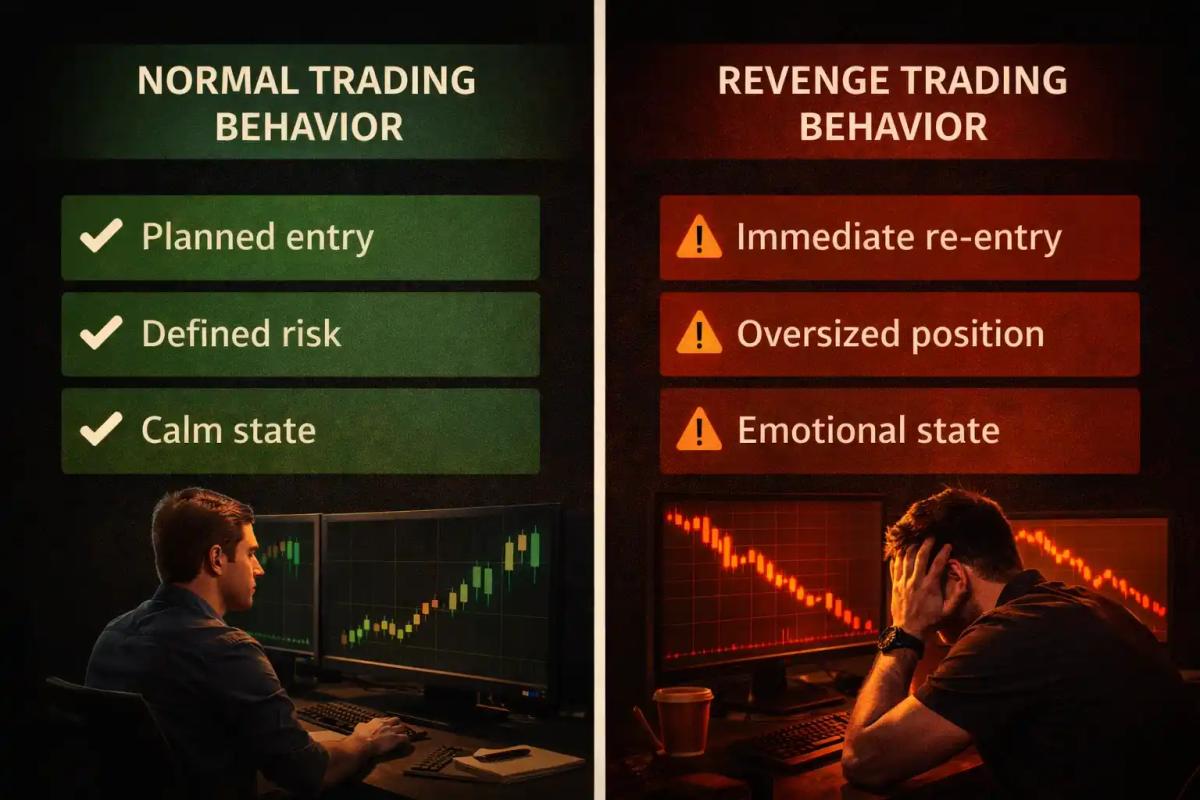
This is where many traders get confused, and understandably so. Not every trade taken after a loss is a revenge trade. Sometimes the market genuinely presents a new setup right after you’ve been stopped out. The difference comes down to a few key factors:
If you’re honest with yourself, you almost always know which category your trade falls into. The problem isn’t identification. It’s that in the moment, your brain is remarkably good at disguising revenge as opportunity.
So what makes your brain pull that trick? The answer lies in some deeply wired psychological machinery.
Why Revenge Trading Happens
Revenge trading isn’t a character flaw. It’s a predictable response rooted in how your brain processes loss, risk, and identity. Understanding the mechanism is the first step to overriding it.
The Psychology of Loss Aversion
Behavioral economists, most notably Daniel Kahneman through prospect theory, have demonstrated that humans tend to experience losses significantly more intensely than equivalent gains. Losing $500 doesn’t just feel bad. It stings far more than gaining $500 feels good.
Sit with that for a moment in a trading context. Every time you take a loss, your brain registers it as significantly more painful than the pleasure of an equal win. This asymmetry creates urgent internal pressure to eliminate the pain, and the fastest way your brain sees to do that is to trade again and win it back.
It’s the same mechanism that keeps a gambler at the blackjack table after a bad hand. The rational move is to walk away and reassess. But the emotional weight of the loss makes walking away feel like accepting defeat, and your brain is wired to fight defeat, not accept it.
There’s a neurochemical layer here, too. When you start planning your next trade to recover a loss, your brain releases dopamine largely in anticipation of winning, not only from the win itself. That dopamine hit is what makes the revenge trade feel like a good idea in the moment. Your brain is essentially rewarding you for the decision to chase the loss before you even see the outcome. It’s the same reward-anticipation loop that drives compulsive gambling, and it explains why the urge to re-enter can feel almost physically irresistible.
Emotional Triggers That Fuel Impulse Trading
Loss aversion creates the foundation, but specific emotional triggers light the fuse. The most common ones include:
- Frustration with a “correct” analysis that lost anyway. You did everything right, the market moved against you, and it feels unjust. That sense of injustice is one of the most powerful motivators in trading.
- Anger at yourself for a mistake. Maybe you moved your stop, entered too early, or ignored a signal. Self-directed anger creates an overwhelming urge to “fix” the mistake immediately.
- Fear of ending the day red. This is particularly common among traders who track daily P&L obsessively. The approaching session close creates time pressure stacked on top of emotional pressure.
- A string of small losses. Each individual loss is manageable, but the cumulative effect erodes patience and discipline until one trade becomes the breaking point.
Notice that none of these triggers are about the market. They’re all internal. The market doesn’t care about your P&L or your ego. But you do, and that’s exactly where the danger lives.
The Role of Ego and Identity in Trading Losses
This one cuts deep, and it’s the trigger most traders don’t want to examine. If your identity is wrapped up in being a “good trader” or a “profitable trader,” then every loss isn’t just a financial event. It’s a threat to who you believe you are.
When a loss challenges your self-image, your brain shifts into defensive mode. The revenge trade becomes less about recovering money and more about proving to yourself that you’re still competent, still in control, still the trader you believe yourself to be.
This is why revenge trading often involves larger position sizes. It’s not simply about recovering the dollar amount. It’s about making a statement, a dramatic win that restores your confidence. Of course, the oversized position usually just amplifies the next loss, which deepens the identity crisis further.
But how do you know when you’ve crossed the line from disciplined trading into revenge territory? The warning signs are more concrete than you might think.
Warning Signs You Are Revenge Trading
The tricky thing about revenge trading is that it feels like trading. You’re still analyzing charts, clicking buttons, managing positions. The mechanics look identical. It’s the context and the patterns that give it away.
Behavioral Red Flags
Watch for these patterns in your own behavior during a session:
- You re-enter the same instrument within minutes of being stopped out, without a clearly new and independent setup.
- You increase position size after a loss, telling yourself you need to “make it back.”
- You feel physically tense, your heart rate is elevated, or you notice clenched hands.
- You skip your pre-trade checklist or scan it so quickly it’s essentially meaningless.
- You catch yourself thinking “just one more trade” to get back to breakeven.
- You move or widen stop losses on active positions because you “can’t afford another loss.”
- You trade outside your normal hours, instruments, or strategy because “nothing is working.”
Even one of these in isolation is a warning. Two or more happening in the same session is a strong signal that you’re no longer trading your plan.
Account-Level Indicators
Beyond behavior, your account data will reveal revenge trading patterns over time. Look for:
- Clustering of losses. If your losing trades tend to cluster together in tight time windows (multiple losses within an hour or two), that’s a signature of emotional re-entry, not independent setups.
- Increasing position sizes on losing days. If your average position size on red days is meaningfully larger than on green days, you’re likely scaling up to recover.
- Win rate divergence by time of day. If your win rate drops sharply in the hours following your first loss, your post-loss trades probably aren’t meeting the same quality standard as your initial entries.
- Drawdown velocity. If your drawdowns happen in steep, sudden drops rather than gradual declines, it often points to a few concentrated revenge sessions rather than slow strategic underperformance.
Your trading journal and account statements don’t lie, even when your emotions do. That brings us to the most important section of this guide.
How to Stop Revenge Trading (Step-by-Step Protocol)
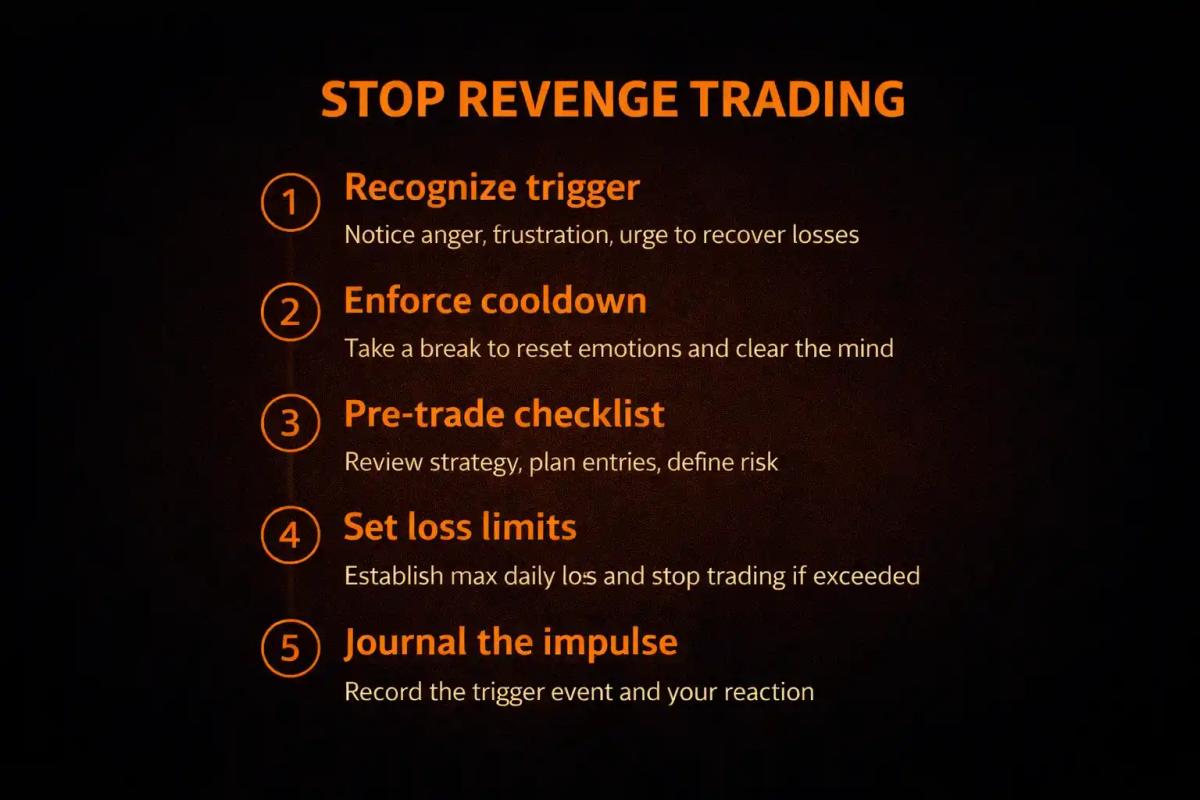
Knowing that revenge trading is destructive isn’t enough. You’ve known that all along. What you need is a systematic intervention, something you can actually execute when your brain is flooded with the urge to jump back in. Here’s a five-step protocol designed to interrupt the cycle at its weakest points.
Step 1: Recognize the Trigger in Real Time
You can’t stop what you can’t see. The first step is building the ability to notice the emotional shift as it’s happening, not after the damage is done. This sounds simple, but under pressure, self-awareness is the first thing to go.
Practice labeling your emotional state out loud or in writing immediately after a losing trade. Not an essay. Just a few words: “I’m frustrated,” “I feel the urge to re-enter,” “I want to make this back.” The act of labeling an emotion engages your prefrontal cortex (the rational, planning part of your brain) and partially disrupts the amygdala-driven fight response.
Think of it like a circuit breaker. You’re not eliminating the emotion. You’re creating a tiny gap between the impulse and the action. That gap is where your decision-making power lives.
Step 2: Enforce a Mandatory Cooldown Period
Once you’ve recognized the trigger, enforce a non-negotiable waiting period before your next trade. This isn’t optional. It’s a rule, as firm as any risk parameter in your plan.
A minimum of 15 to 30 minutes is a reasonable starting point, though some traders find they need a full hour or even to step away for the rest of the session after a significant loss. During the cooldown, physically leave your trading station. Walk around. Get water. Do something that breaks the sensory loop of screens, charts, and ticking prices.
The key word here is “mandatory.” Not “I’ll take a break if I feel like I need one.” You always feel like you don’t need one. That’s the whole problem.
Step 3: Use a Pre-Trade Checklist
After your cooldown, before you place any new trade, run through a written pre-trade checklist. Not a mental one. A physical or digital document you read line by line.
Your checklist should include:
- Does this setup exist independently of my previous trade?
- Does the entry meet my strategy’s specific criteria?
- Is my position size consistent with my standard risk rules?
- Am I emotionally neutral enough to accept a full stop-loss on this trade?
- Have I identified my exit plan (both target and stop) before entering?
If you can’t answer “yes” to every item, you don’t take the trade. No exceptions. The checklist works because it forces your rational brain back into the decision-making seat and makes it very difficult to rationalize an emotional entry.
Step 4: Set Hard Daily Loss Limits
This is your mechanical safety net. Define a maximum dollar or percentage loss you’re allowed to hit in a single session, and when you reach it, you’re done for the day. Close your platform. Walk away.
The specific number depends on your account size and risk management framework, but a common guideline falls between 1% and 3% of your account per day. The exact figure matters less than the commitment to enforcing it.
Many prop firm environments build this kind of rule directly into their platforms, with daily drawdown limits that lock you out of trading once you hit them. There’s a reason for that. External guardrails work precisely because they remove the decision from your hands during the moments when your decision-making is most compromised.
Step 5: Journal Every Revenge Impulse
This is the long game. Every time you feel the urge to revenge trade, whether you act on it or successfully resist, write it down. Record:
- What happened (the triggering loss)
- What you felt (the specific emotion)
- What you wanted to do (the impulse)
- What you actually did (the action you took)
- The outcome (what happened next)
Over weeks and months, this journal becomes a map of your personal triggers and patterns. You’ll start to see that your revenge impulses follow predictable sequences, and that predictability is exactly what makes them easier to interrupt.
This is closely tied to maintaining a trading journal more broadly. Traders who consistently track their emotional states alongside their trade data tend to develop a self-awareness that becomes almost automatic over time.
You now have a framework. But frameworks only work if they’re embedded in a broader system of discipline. Let’s talk about how to make this stick.
Building Long-Term Discipline Against Emotional Trading
Stopping a single revenge trade is a win. Building a trading practice where revenge trading rarely even tempts you is the real goal. That takes structural changes, not just willpower.
Creating a Trading Routine That Reduces Impulsivity
Decision fatigue is real. The more choices you have to make in a session, the harder each one becomes, and the more likely you are to default to impulse. The solution is to reduce the number of in-the-moment decisions by front-loading them into a pre-session routine.
Before you open your platform each day, define:
- Which instruments you’ll trade (and which you won’t)
- Your maximum number of trades for the session
- Your daily loss limit
- Your emotional “check-in” baseline (rate your current stress and focus on a 1-to-10 scale)
By making these decisions when you’re calm and clear-headed, you remove them from the high-pressure moments where impulse takes over. Your session becomes the execution of a pre-defined plan, not a series of real-time judgment calls.
How Prop Firm Rules Can Enforce Discipline Externally
If you’re struggling to enforce rules on your own, trading within a structure that enforces them for you can be a valuable stepping stone. Many prop trading firms impose daily and overall drawdown limits that automatically restrict your trading when you hit them.
Traders actively working to break the revenge trading habit, having an external backstop can prevent the worst-case scenarios while you build the psychological muscle to manage it yourself.
Think of it like training wheels. They don’t teach you balance, but they keep you from crashing while you learn.
When to Seek Professional Support
Here’s something the trading industry doesn’t say often enough: if revenge trading, or emotional trading more broadly, is a persistent pattern you can’t break despite genuine effort, talking to a professional is a legitimate and smart move. Trading psychology coaches, cognitive behavioral therapists, and performance psychologists all work with traders on exactly these kinds of behavioral patterns.
Athletes, surgeons, pilots, and other high-performance professionals routinely work with performance coaches. Trading is no different. Your mental game is a core component of your edge, and investing in it is as rational as investing in better data or faster execution.
If revenge trading has already caused significant damage to your account or is affecting your wellbeing outside of trading, seeking support sooner rather than later is worth serious consideration.
Frequently Asked Questions
Is revenge trading the same as overtrading?
They're related but not identical. Overtrading means taking more trades than your strategy calls for, which can happen for several reasons, including boredom or excitement. Revenge trading is a specific type of overtrading where the motivation is emotional recovery from a recent loss. All revenge trading is overtrading, but not all overtrading is revenge trading.
How long should a cooldown period last after a losing trade?
There's no universal answer, but 15 to 30 minutes is a reasonable minimum for most traders. Some find they need a full hour, and after particularly large or emotionally charged losses, stepping away for the rest of the session is often the best move. The right duration is the one that consistently brings you back to a calm, rational state before you trade again.
Does revenge trading mean I'm not suited to be a trader?
Not at all. Nearly every trader, including consistently profitable ones, has experienced revenge trading at some point. It's a natural byproduct of how the human brain processes loss. What separates those who overcome it is whether they develop the systems and self-awareness to manage it. Persistent difficulty controlling the behavior despite serious effort may benefit from professional support, but the impulse itself is universal.
How does a trading journal specifically help prevent revenge trading?
A trading journal creates a feedback loop between your emotions and your results. Over time, it reveals your personal trigger patterns, showing you which types of losses, times of day, or market conditions are most likely to provoke a revenge impulse. That self-knowledge lets you anticipate and prepare for high-risk moments instead of being blindsided by them. The act of writing also re-engages your analytical brain, which helps interrupt purely emotional responses.
Can demo accounts help break the revenge trading habit?
Demo accounts can be useful as a reset tool, especially if you're caught in a cycle where live losses are compounding emotional pressure. Practicing your cooldown protocol and pre-trade checklist in a demo environment lets you build the habit without financial risk. That said, demo trading doesn't fully replicate the emotional intensity of real money on the line, so the transition back to live trading should be gradual and deliberate.
What should I do if revenge trading has already caused significant damage to my account?
First, stop trading live immediately and give yourself time away from the screen, at least a few days. Assess the damage objectively by reviewing your account statements. Then, before resuming live trading, implement the full protocol outlined in this guide, especially hard daily loss limits and a mandatory pre-trade checklist. If the losses are severe or the behavior feels compulsive, consider working with a trading psychology professional. Returning to a demo account for a period can also help you rebuild confidence and discipline without further financial risk.
About the authors


Put this into practice
Related articles

Self-Awareness for Traders: Know Yourself to Trade Better
Learn how self-awareness helps traders perform better. Identify your trading personality, run a self-assessment, and turn self-knowledge into a real edge.
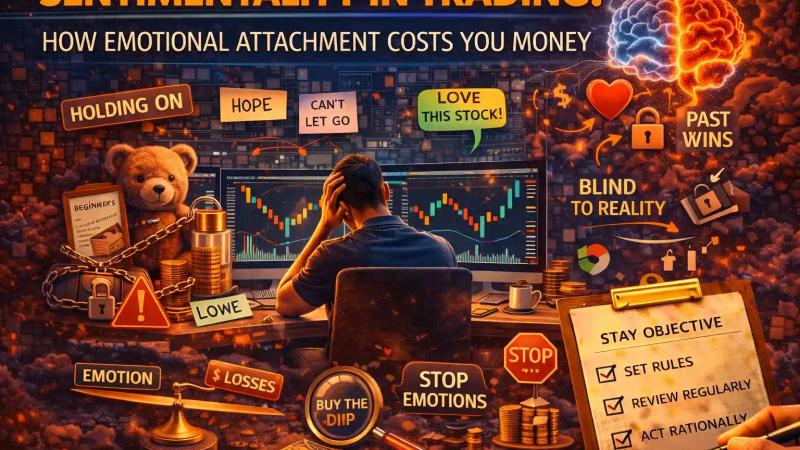
Sentimentality in Trading: How Emotional Attachment Costs You Money
Learn how sentimental attachment to trades distorts your decisions, why your brain defaults to it, and how to build a rules-based process that replaces emotion with objectivity.
Sleep for Traders: How Rest Impacts Your Trading Performance
Discover how sleep deprivation impairs trading decisions, fuels revenge trading, and erodes your edge. Practical sleep framework for active traders.
0 comments