



Copy Trading Explained: How It Works and How It Compares to Social Trading
You’ve probably seen “copy trading” and “social trading” used interchangeably, as if they’re two names for the same thing. But they’re not the same, and confusing them could steer you toward a model that doesn’t match your goals, your schedule, or your appetite for risk.
This guide breaks down copy trading explained in plain terms, walks you through how social trading actually works, and gives you a clear framework for deciding which model fits your situation.
What Is Copy Trading?
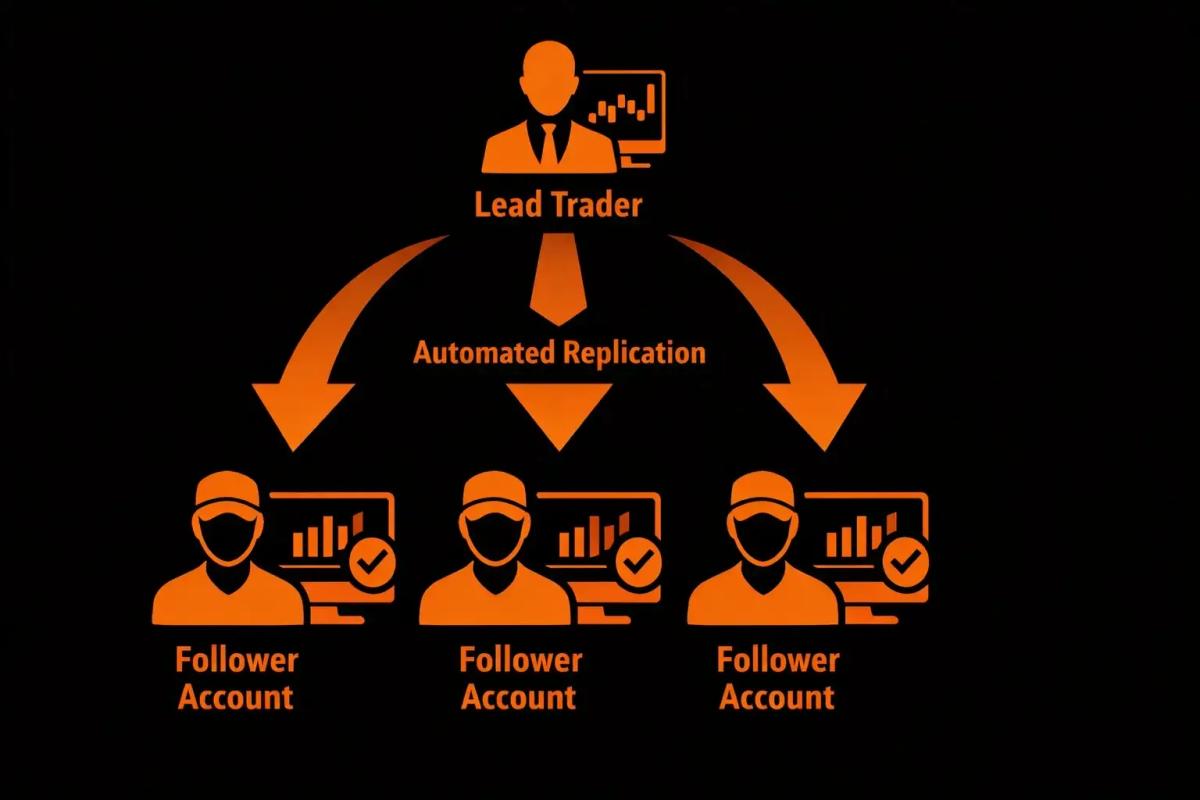
Copy trading sounds simple on the surface, and that simplicity is precisely why so many people misunderstand what they’re signing up for. It lets you automatically replicate the trades of another trader (often called a “lead trader” or “signal provider”) directly into your own account. You pick someone whose strategy and track record align with what you’re looking for, allocate a portion of your capital, and the system handles the rest.
But “the system handles the rest” is where the nuance lives. Let’s unpack that.
How Copy Trading Works Step by Step
The basic mechanics of copy trading follow a straightforward sequence:
- You open a trading account on a platform that offers copy trading functionality.
- You browse available lead traders, reviewing their historical performance, risk metrics, asset preferences, and trading style.
- You allocate capital to one or more lead traders. This is the amount of your funds that will be used to replicate their trades.
- The platform automatically executes trades in your account whenever the lead trader opens or closes a position. This happens proportionally: if the lead trader risks 2% of their portfolio on a trade, your account mirrors that same percentage of your allocated funds.
- You monitor, adjust, or disconnect at any time. Many platforms let you set stop-loss limits on the total amount you’re willing to lose on a particular copied trader.
Think of it like programming your GPS to follow someone else’s route in real time. You don’t need to know why they turned left on Oak Street. You just follow the same path, at the same time, automatically.
What Gets Copied (and What Doesn’t)
Here’s what typically gets replicated:
- Trade entries and exits (open and close positions)
- Position sizing (proportional to your allocated capital)
- Stop-loss and take-profit levels (if the platform supports it)
On the other hand, this is what usually doesn’t get copied:
- The reasoning behind the trade. You see the action, not the analysis.
- Exact execution price. Slippage can occur, meaning you might enter at a slightly different price than the lead trader, particularly in fast-moving markets.
- Portfolio-level context. A lead trader might take a risky position because it hedges another trade in their portfolio. You could end up copying the risky trade without the hedge.
This gap between what you replicate and what you actually understand is one of the most important things to keep in mind. It’s also the first major difference between copy trading and social trading. So what does social trading look like in practice?
Pick a well-regulated CFD provider among the best forex & CFD brokers.
What Is Social Trading?
If copy trading is following a GPS route, social trading is more like joining a group chat where experienced drivers share road conditions, suggest detours, and debate the best way to get across town. You still drive your own car. You still make every turn yourself. But you have access to a live stream of insights from other people navigating the same roads.
Social trading is built around community, shared analysis, and collective intelligence rather than automated replication.

How Social Trading Networks Operate
Social trading networks function as platforms where traders of all experience levels can:
- Share trade ideas and market analysis through posts, charts, and commentary
- Follow other traders’ profiles to see their positions, strategies, and performance history
- Engage in discussion through comments, forums, and live feeds
- Access sentiment indicators that aggregate what the community is doing collectively
The key distinction is that nothing happens automatically in your account. If a trader you follow posts a bullish analysis on EUR/USD, you read it, weigh it, and then decide whether to act on it yourself. You’re the one clicking the button.
The Role of Community, Signals, and Shared Analysis
The social layer is the entire point. Social trading networks thrive on the exchange of ideas. You’ll typically find:
- Trader rankings based on performance, follower count, or community reputation
- Shared charts and technical breakdowns posted in real time
- Sentiment feeds showing what percentage of the community is long or short on a given asset
- Discussion threads where traders explain their reasoning, debate setups, and challenge each other’s assumptions
This means social trading has an educational component baked into its structure. You’re seeing why they do what they do.
Be careful, though, because the quality of that “why” varies enormously. Not every voice in a social trading network is equally informed, and popularity doesn’t equal accuracy. That tension between community value and community noise is something you’ll need to learn to navigate.
So how do these two models actually stack up when you lay them side by side?
Social Trading vs Copy Trading: Key Differences
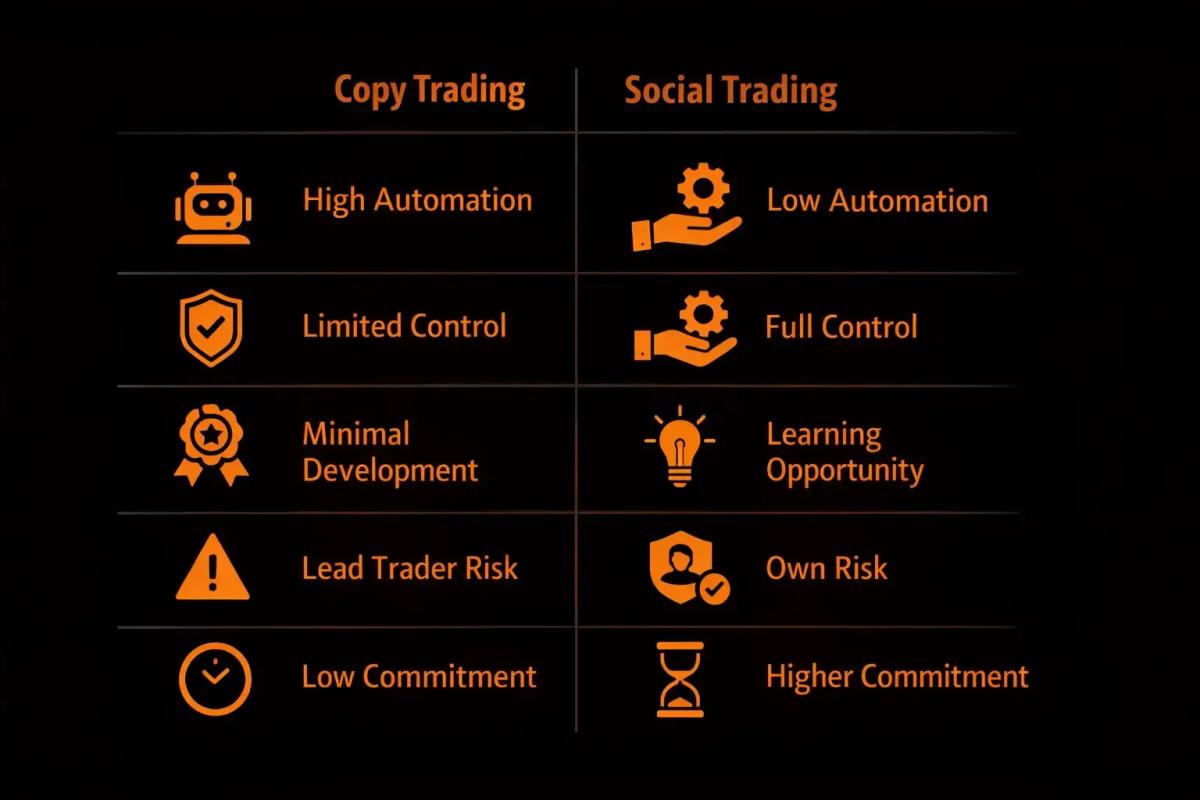
Most articles treat these two concepts as close cousins. In reality, they’re more like distant relatives who happen to live on the same street. The underlying philosophy, the level of involvement required, and the risk dynamics differ in meaningful ways.
Automation vs Decision-Making Control
This is the clearest dividing line.
With copy trading, your primary decision is who to copy and how much capital to allocate. After that, execution is hands-off. With social trading, every trade is a conscious choice you make after absorbing community insights.
Skill Development vs Passive Replication
This is where your long-term goals matter more than your short-term convenience.
Copy trading teaches you how to evaluate other traders, which is a useful skill on its own, but it’s a fundamentally different thing from understanding market dynamics, reading charts, or developing your own strategy. You can copy a profitable trader for months and still not understand why any of those trades worked.
Social trading puts you in the driver’s seat. You’re exposed to different analytical perspectives, you see how experienced traders think through setups, and you’re forced to make your own calls. That process builds competence over time, even if it’s slower and less comfortable early on.
If your goal is to eventually trade independently, social trading builds the muscles. Copy trading doesn’t.
Risk Profiles and Accountability
Both models carry real financial risk, but the nature of that risk differs.
With copy trading, your risk is directly tied to someone else’s decisions. If the trader you’re copying has a drawdown, you have the same drawdown, proportionally. You can mitigate this with stop-loss settings and capital allocation limits, but you can’t prevent the underlying trades from being placed.
With social trading, the risk is entirely yours. Every trade you take is your responsibility. The upside is full control. The downside is that you can’t blame a bad outcome on the person whose analysis you followed.
There’s also a subtler risk with copy trading worth naming: complacency. When trades are automated, it’s easy to stop paying attention. And when you stop paying attention, you might miss warning signs that a lead trader’s strategy is deteriorating, that market conditions have shifted, or that your risk allocation no longer makes sense.
What are the specific benefits and pitfalls of each approach? Let’s break them down individually.
Benefits and Limitations of Copy Trading
Copy trading has genuine appeal for the right person in the right circumstances. But the gap between what’s promised and what’s experienced can catch you off guard if you don’t go in with clear expectations.
Who Copy Trading Works Best For
Copy trading tends to suit you if:
- You have limited time to dedicate to active market analysis and trade execution
- You’re in the early stages of learning about markets and want exposure while you build knowledge
- You want diversification by allocating portions of your capital to traders with different strategies and asset focuses
- You understand it’s not passive income but rather a way to participate in markets through someone else’s skill
The best copy trading experience comes when you treat it as one component of your broader approach to markets, not as a substitute for understanding what you’re invested in.
The Real Risks Most Guides Skip
Most copy trading guides mention “past performance doesn’t guarantee future results” and move on. These are the risks that deserve more of your attention:
- Slippage and execution gaps. The lead trader might get filled at a better price than you, especially during volatile markets or with less liquid assets. Over time, these small differences compound.
- Strategy drift. A lead trader who built their track record on conservative forex scalping might suddenly start taking leveraged crypto positions. If you’re not monitoring, your account absorbs that shift without warning.
- Survivorship bias in rankings. Platforms showcase their best-performing traders. The ones who blew up their accounts generally disappear from the leaderboard.
- Proportional doesn’t mean identical. If a lead trader manages $500,000 and you’ve allocated $1,000, the proportional sizing might result in positions that don’t function well at your scale, or that can’t be opened at all due to minimum position sizes.
- Emotional detachment cuts both ways. Not watching every trade can be healthy. But it can also mean you stay connected to a failing strategy long after you should have walked away.
These risks mean your job isn’t eliminated; it’s shifted from executing trades to evaluating traders and monitoring performance.
But what if you’d rather do the learning yourself, surrounded by a community? That’s where social trading offers something genuinely different.
Benefits and Limitations of Social Trading
Social trading appeals to a fundamentally different mindset. It’s for the person who wants to participate actively but doesn’t want to figure everything out alone.
Who Social Trading Works Best For
Social trading tends to fit well if:
- You want to learn how to trade, not just profit from someone else’s skill
- You value diverse perspectives and want to see how different traders approach the same market
- You have moderate time to invest in reading analysis, following discussions, and making your own trade decisions
- You’re comfortable being wrong and treating losses as learning data rather than failures of the system
- You enjoy community interaction and find motivation in shared experience
The educational value of social trading is its strongest asset. Watching experienced traders explain their rationale in real time is a form of mentorship that simply didn’t exist at scale before these trading platforms came along.
Where Social Trading Falls Short
Social trading isn’t without its own problems:
- Noise-to-signal ratio. For every thoughtful analysis, there are dozens of low-quality posts, hype-driven predictions, and unfounded opinions. Filtering useful insight from noise is a skill in itself.
- Popularity doesn’t equal competence. The most-followed traders aren’t necessarily the best. Charisma, posting frequency, and short-term hot streaks can all inflate a trader’s social standing well beyond their actual skill level.
- Information overload. Following too many traders or spending too much time in the feed can lead to analysis paralysis, where you see so many conflicting views that you can’t commit to any trade.
- Delayed action. By the time you’ve read the analysis, processed it, and decided to act, the optimal entry point may have passed.
- False sense of validation. When a community agrees with your trade idea, it feels reassuring. But consensus in a social feed doesn’t make a trade correct. Markets don’t care how many people in a chat room think a breakout is coming.
Understanding these limitations helps you use social trading networks as a tool rather than a crutch. And speaking of tools, if you’re leaning toward copy trading, the platform you choose matters more than you might expect.
What to Look for in Copy Trading Platforms
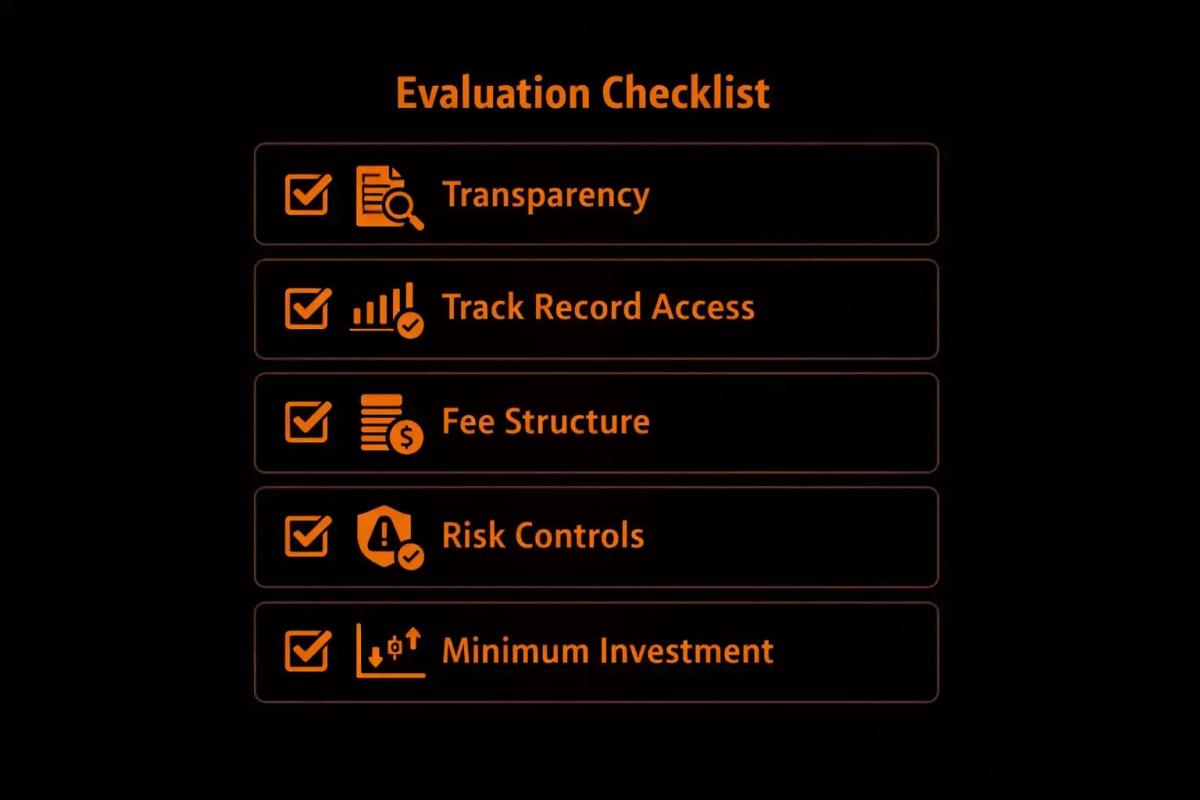
With copy trading, your money is on the line, and the platform’s infrastructure directly affects your outcomes. Here’s what to evaluate before committing capital.
Transparency and Track Record Verification
The single most important factor is whether you can verify a lead trader’s performance with real, audited data. Look for:
- Full trade history access: you want to see individual trades, including the losers.
- Verified accounts where performance data comes from actual brokerage records, not self-reported numbers.
- Drawdown metrics: A trader who made 80% in a year but experienced a 50% drawdown along the way has a very different risk management profile than one who made 40% with a 10% max drawdown.
- Time in market. A three-month track record during a trending market tells you almost nothing useful. Look for at least 12 months of data across different market conditions.
Cost Structures and Hidden Fees
Copy trading costs can erode your returns in ways that aren’t immediately obvious:
- Spread markups applied by the broker beyond normal trading spreads
- Performance fees charged by lead traders (a percentage of profits generated in your account)
- Management fees charged by the platform as a fixed percentage of allocated capital
- Swap/overnight fees on positions held across trading sessions
Add these up before evaluating any lead trader’s net returns. A trader showing 30% annual returns looks very different after you factor in 2% management fees, 20% performance fees, and widened spreads.
Risk Management Controls
A solid platform gives you tools to protect your capital independent of the lead trader’s decisions:
- Per-trader stop-loss limits that automatically disconnect you from a lead trader if losses hit a threshold
- Maximum allocation caps that prevent you from putting too much capital behind any single trader
- Position size limits that override the proportional copying if a trade would exceed your risk tolerance
- The ability to close individual copied trades without disconnecting from the lead trader entirely
Without these controls, you’re fully at the mercy of someone else’s decisions. That’s blind trust with your capital.
Now that you know what to look for, the real question remains: which model actually fits your life?
How to Decide Which Model Fits You
There’s no universally “better” option between social trading and copy trading. The right choice depends on your honest answers to a few straightforward questions.
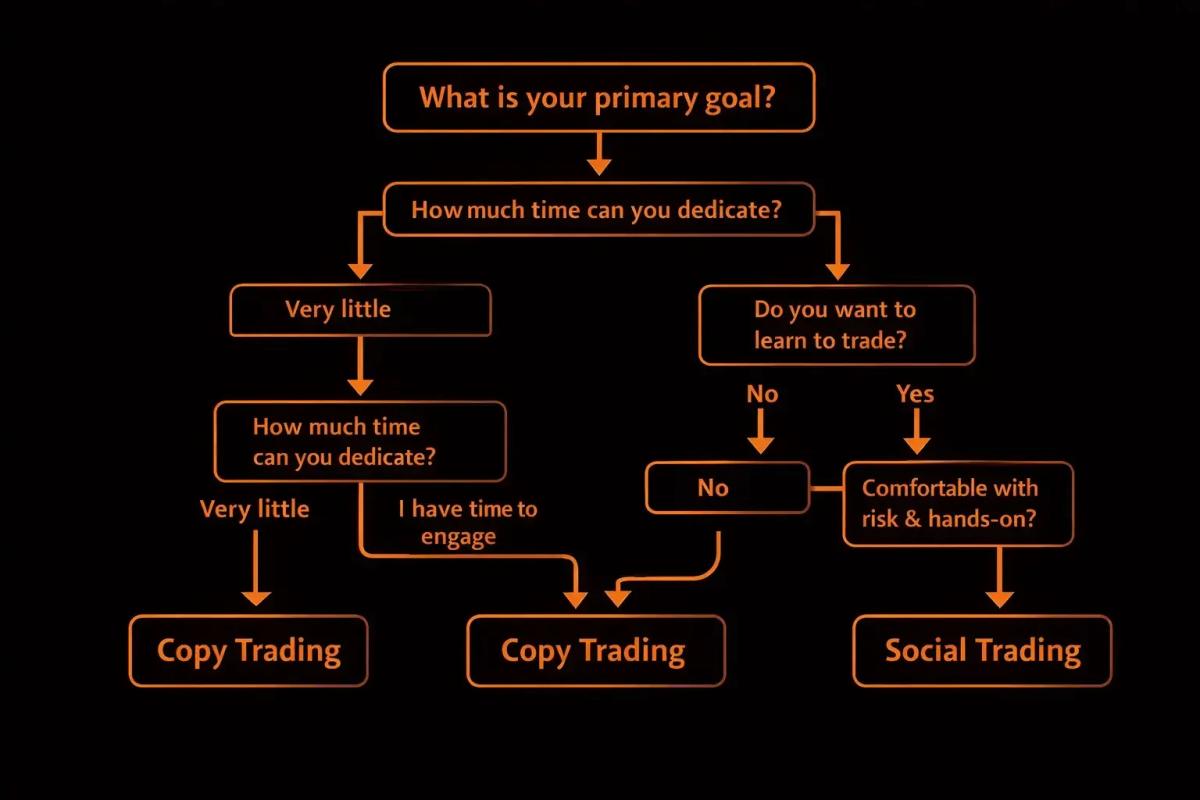
Start with your primary goal. If you want market exposure with minimal daily involvement, copy trading aligns better. If you want to build trading skill and genuine understanding, social trading serves that goal more directly.
Consider your available time. Copy trading requires upfront research to select traders and periodic monitoring. Social trading requires ongoing engagement, research, and active decision-making. Be honest about what your schedule actually allows.
Assess your learning orientation. Are you the type who learns by doing, even if it means making mistakes along the way? Social trading rewards that mindset. Do you prefer to observe outcomes and gradually absorb patterns? Copy trading can serve that approach, though it’s a slower and less direct path to building real skill.
Think about your relationship with control. Some people genuinely prefer delegating decisions. Others can’t stomach the idea of someone else directing their capital. Neither preference is wrong, but ignoring it leads to frustration down the road.
Factor in your starting capital. Some copy trading platforms have minimum allocation requirements per trader that may limit your options at smaller account sizes. Social trading networks often have lower barriers to participation since you’re trading your own account on your own terms.
And here’s something worth considering: these models aren’t mutually exclusive. You can allocate a portion of your capital to copy trading for hands-off exposure while actively participating in a social trading community to develop your skills. Many traders use both simultaneously as complementary strategies, adjusting the balance as their experience grows.
Whatever you choose, approach it with the understanding that all trading involves the risk of financial loss. Copy trading does not eliminate that risk, and social trading communities do not provide regulated financial advice. Your capital is your responsibility, regardless of the model.
Frequently Asked Questions
Is copy trading suitable for complete beginners with no trading knowledge?
Copy trading is accessible to beginners, but "accessible" doesn't mean "no knowledge required." You still need to understand basic concepts like risk allocation, drawdown, and what different asset classes involve. Going in completely blind means you won't be able to evaluate which traders are worth copying or recognize when something is going wrong.
How much money do you typically need to start copy trading?
This varies significantly by platform. Some allow you to start copying a trader with as little as $200 to $500, while others require higher minimums. Keep in mind that very small allocations can result in trades that are too small to execute proportionally, which affects how accurately your account mirrors the lead trader.
Can you lose more than your initial investment through copy trading?
On most regulated platforms, negative balance protection prevents you from losing more than your deposited funds. However, you can absolutely lose your entire allocated amount. If a lead trader experiences a severe drawdown and you don't have stop-loss protections in place, your allocated capital can be wiped out. Always check whether your platform and jurisdiction offer negative balance protection.
Can social trading and copy trading be used together?
Yes, and many traders do exactly that. A common approach is to allocate a portion of capital to copy trading for passive market exposure while actively engaging in a social trading community to learn and develop independent trading skills. This combination lets you participate in markets while building competence at your own pace.
How do you evaluate whether a lead trader's track record is trustworthy?
Look for verified performance data over at least 12 months, ideally across varying market conditions. Pay close attention to drawdown metrics rather than just total returns, check whether the trade history shows individual positions instead of just summaries, and be skeptical of extremely high returns paired with suspiciously low drawdowns. If a track record looks too good to be true, it very likely is.
Are copy trading profits taxable?
In most jurisdictions, yes. Profits generated through copy trading are generally treated the same as profits from any other form of trading and are subject to capital gains tax or income tax depending on your local regulations. Tax rules vary significantly by country, so consult a qualified tax professional for guidance specific to your situation.
What's the difference between copy trading and mirror trading?
Mirror trading is a related but distinct concept. While copy trading replicates the trades of a specific individual trader, mirror trading typically replicates an entire trading strategy or algorithm rather than a person's manual decisions. Mirror trading tends to be more institutionally oriented and strategy-based, while copy trading is more personal and trader-focused. The practical experience for you as a user is similar, but the underlying mechanism and the degree of customization differ.
About the authors


Put this into practice
Related articles

Day Trading Complete Guide: Strategies, Indicators, and Tips for Beginners
Day Trading Complete Guide: Learn how day trading works with proven strategies, key indicators, stock screening and risk management tips for beginners.

Forex Broker Comparison Metrics to Look Out For

Forex Spread Explained: What It Costs You on Every Trade
A plain-English guide to the forex spread: what it is, how to calculate the cost of one, and how it shapes the profitability of your trading strategy.
0 comments