



The True Cost of Trading: A Data-Driven Comparison Across 10 Forex Brokers
The spread your broker quotes you is not what you actually pay to trade. Between the commission structure, the pricing model, overnight financing costs, and fees you only discover when you try to move money, the real cost of a trade can be two to three times what the headline spread suggests. This article breaks down the all-in cost of trading across 10 major forex brokers so you can make a genuinely informed comparison.
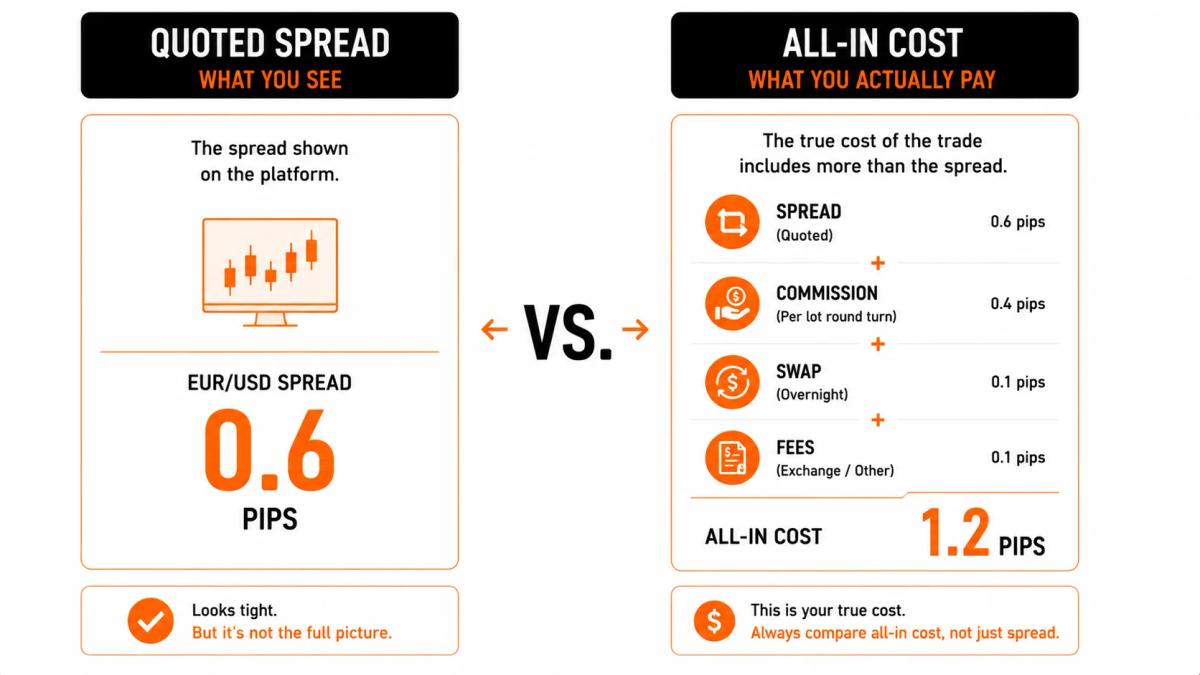
Why Quoted Spreads Do Not Tell the Whole Story
Spread-only vs commission + raw spread models
Brokers generally use one of two pricing models, and comparing them without adjusting for structure produces a meaningless result.
Spread-only (market maker / no-commission) model: The broker's revenue is embedded in the spread. You pay no separate commission, but the spread itself is wider. A typical spread-only EUR/USD quote might be 1.0–1.5 pips during liquid hours.
Commission + raw spread (ECN/STP) model: The broker charges a separate commission per lot and offers a tighter spread, sometimes as low as 0.0 pips on EUR/USD. The commission is typically quoted per round turn (opening and closing combined) or per side.
To compare these models honestly, express them in the same unit: the all-in cost per round-turn lot, which is the total you pay to open and close a standard 100,000-unit position.
For a spread-only broker with a 1.2-pip EUR/USD spread, the all-in cost per round-turn standard lot is $12. For a raw spread broker with a 0.1-pip spread and a $7 round-turn commission, it is $8. The commission model is cheaper in this example, but the gap closes or reverses in less liquid markets where raw spreads widen.
The hidden variables: swap rates, inactivity fees, deposit and withdrawal costs
Spreads and commissions are the most visible costs, but they are not the only ones.
Overnight swap rates (also called rollover rates or financing charges) apply to any position held past the daily rollover time, typically 5pm New York time. For traders holding positions overnight, swap rates can exceed spread costs significantly over the course of a week or month. Rates vary by currency pair and direction. Some positions earn a positive swap, though this is increasingly rare in lower-rate environments.
Inactivity fees are charged by some brokers when an account shows no trading activity for a defined period, typically 3 to 12 months. These can run from $5 to $25 per month and will quietly drain a dormant account.
Deposit and withdrawal fees range from zero to several percent depending on the broker and payment method. Some brokers absorb these costs; others pass them directly to clients.
Compare spreads and regulation across the best CFD brokers.
How We Measured Trading Costs (Methodology)
The 10 brokers included
This comparison covers: IC Markets, Pepperstone, XM, OANDA, IG, CMC Markets, FP Markets, Tickmill, FXCM, and Forex.com.
These brokers were selected to represent a range of pricing models, regulatory jurisdictions, and typical user profiles. All are regulated by at least one major regulator. Most hold licences from Tier-1 regulators (FCA, ASIC, or CFTC/NFA). Some hold CySEC licences (EU-based regulation) in addition to or instead of Tier-1 licences.
Instruments tested: EUR/USD, GBP/USD, Gold (XAU/USD)
Three instruments were chosen to cover different liquidity tiers:
- EUR/USD: the most liquid forex pair, where spreads are at their most competitive
- GBP/USD: mid-tier liquidity, wider spreads, useful for identifying where cost differences emerge
- Gold (XAU/USD): a commodity traded as a CFD by most of these brokers, with a significantly different cost structure
Metric used: all-in cost per round-turn lot (in USD)
All costs are expressed as USD per round-turn standard lot (100,000 units for forex; 100 oz for Gold). This normalises the comparison across spread-only and commission models.
- For commission models: All-in cost = (spread in pips x pip value) + round-turn commission
- For spread-only models: All-in cost = spread in pips x pip value
For EUR/USD and GBP/USD, pip value on a standard lot is $10. For Gold (XAU/USD), point value is calculated at $1 per $0.01 move per oz on a 100 oz contract.
Data conditions and limitations
Spread data was collected during London session hours (8am–12pm GMT) on typical trading days to reflect liquid-market conditions. Spreads widen during off-hours and around major news events, so actual trading costs will be higher during those periods.
Commission rates are based on brokers' published standard (non-VIP) account tiers. Volume-based discounts are not applied. Swap rates are directional estimates based on published rates and will vary with interest rate conditions.
Note: Broker pricing structures change regularly. Verify all figures directly with the broker before making account decisions.
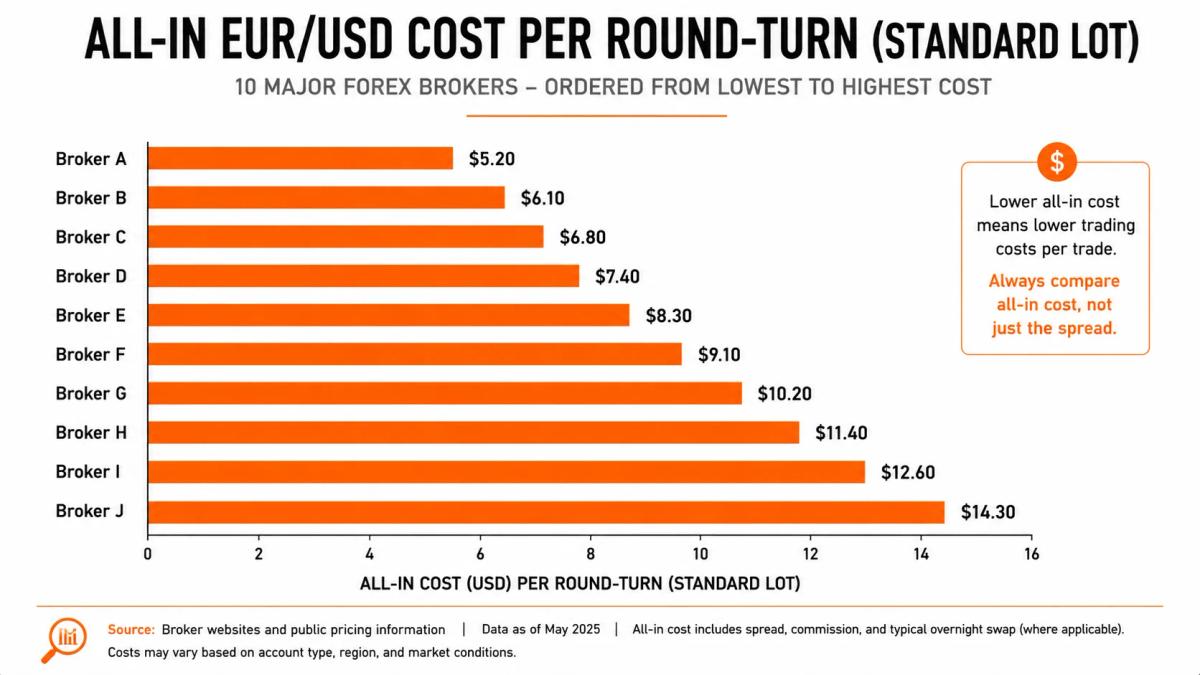
The Data: Total Trading Cost Comparison by Broker
EUR/USD — All-In Cost Per Round-Turn Lot (Standard Lot, London Session)
| Broker | Account Type | Spread (pips) | Commission (RT) | All-In Cost (USD) |
|---|---|---|---|---|
| IC Markets | Raw Trader | 0.1 | $7.00 | $8.00 |
| Tickmill | Pro | 0.1 | $4.00 | $5.00 |
| Pepperstone | Razor | 0.1 | $7.00 | $8.00 |
| FP Markets | Raw | 0.1 | $6.00 | $7.00 |
| FXCM | Active Trader | 0.2 | $4.00 | $6.00 |
| Forex.com | Commission | 0.2 | $5.00 | $7.00 |
| XM | Ultra Low | 0.6 | $0 | $6.00 |
| OANDA | Standard | 1.0 | $0 | $10.00 |
| IG | Standard | 0.9 | $0 | $9.00 |
| CMC Markets | Standard | 0.7 | $0 | $7.00 |
All figures are indicative. Data reflects typical London session conditions on standard accounts. Figures sourced from broker public disclosures and are subject to change.
GBP/USD — All-In Cost Per Round-Turn Lot (Standard Lot, London Session)
| Broker | Account Type | Spread (pips) | Commission (RT) | All-In Cost (USD) |
|---|---|---|---|---|
| IC Markets | Raw Trader | 0.3 | $7.00 | $10.00 |
| Tickmill | Pro | 0.2 | $4.00 | $6.00 |
| Pepperstone | Razor | 0.3 | $7.00 | $10.00 |
| FP Markets | Raw | 0.3 | $6.00 | $9.00 |
| FXCM | Active Trader | 0.4 | $4.00 | $8.00 |
| Forex.com | Commission | 0.4 | $5.00 | $9.00 |
| XM | Ultra Low | 1.5 | $0 | $15.00 |
| OANDA | Standard | 1.8 | $0 | $18.00 |
| IG | Standard | 2.0 | $0 | $20.00 |
| CMC Markets | Standard | 1.6 | $0 | $16.00 |
GBP/USD spreads are notably wider than EUR/USD, which amplifies the cost difference between pricing models.
Gold (XAU/USD) — All-In Cost Per Round-Turn Lot (100 oz contract, London Session)
| Broker | Account Type | Spread (USD) | Commission (RT) | All-In Cost (USD) |
|---|---|---|---|---|
| IC Markets | Raw Trader | $0.20 | $14.00 | $34.00 |
| Tickmill | Pro | $0.20 | $8.00 | $28.00 |
| Pepperstone | Razor | $0.14 | $14.00 | $28.00 |
| FP Markets | Raw | $0.20 | $12.00 | $32.00 |
| FXCM | Active Trader | $0.30 | $8.00 | $38.00 |
| Forex.com | Commission | $0.25 | $10.00 | $35.00 |
| XM | Standard | $0.30 | $0 | $30.00 |
| OANDA | Standard | $0.40 | $0 | $40.00 |
| IG | Standard | $0.35 | $0 | $35.00 |
| CMC Markets | Standard | $0.30 | $0 | $30.00 |
Gold spread expressed as USD per oz. All-in cost = (spread x 100 oz contract) + commission.
Broker-by-Broker Cost Breakdown
IC Markets
IC Markets operates a true ECN model on its Raw accounts, aggregating liquidity from multiple providers. EUR/USD all-in cost on Raw comes to around $8 per round-turn lot, GBP/USD around $10, and Gold around $34. The standard account is available for traders who prefer a no-commission structure, but the all-in costs rise noticeably. IC Markets is ASIC-regulated with additional licences in other jurisdictions.
Pepperstone
Pepperstone's Razor account is structurally similar to IC Markets' Raw account: tight raw spreads plus commission. All-in EUR/USD cost is approximately $8 per round turn, making it one of the lower-cost options for major pairs. Where Pepperstone distinguishes itself is Gold, where its Razor spreads are among the tightest in this comparison at around $0.14 per oz. Regulated by both FCA and ASIC.
XM
XM uses a spread-only model on most retail accounts. The Ultra Low account brings EUR/USD spreads down to around 0.6 pips, giving an all-in cost of $6 per round turn: competitive without requiring commission arithmetic. GBP/USD costs rise more sharply, at $15 per lot. XM is CySEC-regulated with a broad global presence.
OANDA
OANDA's pricing is mid-tier on standard accounts. EUR/USD at 1.0 pip puts the all-in cost at $10 per lot. OANDA's reputation rests on platform quality, fractional lot trading, and data access rather than pricing. For high-frequency traders, better cost structures are available elsewhere. For traders who value research tools and flexible position sizing, the cost premium may be a reasonable trade-off.
IG
IG's standard account EUR/USD spread of around 0.9 pips gives a $9 all-in cost, above the ECN leaders but below the highest spread-only options. IG's premium is breadth: they offer more instruments than almost any other broker in this comparison. For traders who move across asset classes, the cost differential may be an acceptable trade-off. GBP/USD at $20 per lot sits among the higher figures in this group.
CMC Markets
CMC competes primarily on platform quality and instrument range rather than raw pricing. EUR/USD at around 0.7 pips translates to $7 all-in, which is respectable for a spread-only model. Pricing becomes less competitive on minor and exotic pairs. CMC is FCA-regulated and operates a spread-bet model for UK clients, which carries different tax implications worth understanding.
FP Markets
FP Markets' Raw account is one of the more competitive ECN options in this comparison, with EUR/USD all-in around $7 per lot. Gold costs sit mid-range at approximately $32 per lot. FP Markets is ASIC-regulated and has grown its ECN offering significantly in recent years. For traders comfortable with Australian-regulated brokers, it represents solid value.
Tickmill
Tickmill's Pro account produces the lowest EUR/USD all-in cost in this comparison at approximately $5 per round-turn lot, driven by a $4 round-turn commission combined with tight raw spreads. GBP/USD all-in comes to about $6, also among the lowest here. Those cost advantages compound meaningfully for high-volume traders and scalpers. Regulated by FCA and CySEC.
FXCM
FXCM is permanently barred from NFA membership and withdrew its CFTC registration in 2017, meaning it cannot legally offer retail forex accounts to US residents. For traders outside the US in jurisdictions where FXCM operates, it holds FCA regulation. Note: ASIC issued an interim stop order against FXCM's Australian entity (Stratos Trading Pty Ltd) in December 2025 related to its CFD Target Market Determination. The order was revoked on 16 December 2025 following remediation. This represents a recent regulatory event worth monitoring. The Active Trader account offers commission-based pricing with competitive EUR/USD all-in costs around $6 per lot. Verify FXCM's current regulatory standing in your specific jurisdiction before opening an account.
Forex.com
Forex.com (a StoneX Group brand) sits mid-range on most pairs. EUR/USD all-in on the commission account runs around $7 per lot, GBP/USD around $9. The broker's strength is its US regulatory standing (CFTC/NFA registered) and platform range, making it a practical default for US-based traders with a limited universe of regulated options. Pricing is reasonable rather than market-leading.
Which Broker Is Cheapest for Each Trading Style?
Scalpers and high-frequency traders
For scalpers, all-in cost per trade is everything. You might be in and out of a position in two minutes, so swap rates do not matter, but every pip of cost comes directly off your edge.
Best options by all-in cost on EUR/USD:
- Tickmill Pro: approximately $5 per round-turn lot
- FP Markets Raw and FXCM Active Trader: approximately $6–7
- IC Markets Raw and Pepperstone Razor: approximately $8
For scalping Gold, Pepperstone Razor stands out on spread cost, though commission raises the total. Verify your broker explicitly permits scalping, as some brokers have account terms that restrict it.
Day traders (10–30 trades per month)
At this volume, all-in spread and commission cost matters significantly, while non-trading costs like withdrawal fees or inactivity charges are less relevant.
ECN/commission accounts are almost universally better value for day traders. Among this group, Tickmill, FP Markets, and IC Markets provide strong value. XM's Ultra Low account is a reasonable spread-only alternative if you prefer no-commission simplicity and your volume sits in the lower part of this range.
Swing traders and low-volume accounts
Swing traders hold positions overnight, so swap rates become a meaningful part of total cost. A broker with tight spreads but high swap rates may cost more than a spread-only broker with wider spreads if you are routinely holding for several days.
At lower trade frequencies, inactivity fees also become relevant. Confirm whether your broker charges them and over what timeframe.
For swing traders holding long EUR/USD or GBP/USD, compare swap rates alongside spread costs. OANDA and IG both publish competitive swap rates on major pairs, which can offset their wider spreads for multi-day positions.
Beyond the Spread: Non-Trading Costs to Factor In
Overnight swap rates
Swap rates are the financing cost of holding a leveraged position overnight. They are based on the interest rate differential between the two currencies in a pair, adjusted for the broker's markup.
On EUR/USD with rates close to parity, swaps are relatively small. On pairs with a large rate differential (such as USD/TRY or AUD/JPY) they can be significant. Gold typically carries a negative swap in both directions, meaning you pay to hold it overnight regardless of direction.
For a trade held five nights, the swap cost on a standard lot can range from under $5 to over $50 depending on the pair and direction. At that level, swap costs can compete with and exceed the one-way spread cost.
Inactivity and account maintenance fees
Brokers that charge inactivity fees include OANDA (after 12 months of inactivity; the fee amount varies by jurisdiction and entity, so verify the specific figure with your regional OANDA entity before opening an account) and Forex.com ($15 per month after 12 months). IC Markets, Pepperstone, FP Markets, and Tickmill do not currently charge inactivity fees on standard accounts.
This matters particularly if you intend to trade occasionally rather than consistently, or if you hold funded accounts at multiple brokers.
Deposit and withdrawal fees
Most brokers covered here absorb credit and debit card processing fees on deposits. Bank transfers can attract fees, particularly for international transfers. Withdrawal fees vary more:
- Several brokers, including IC Markets and Pepperstone, offer free withdrawals via most methods
- Some brokers pass bank wire fees directly to clients (typically $20–30 per wire)
- E-wallet options (Skrill, Neteller) may carry different fee structures
Always check the broker's specific fee schedule for your intended payment method before depositing.
Verdict: Best Value Broker by Use Case
| Use Case | Recommended Broker(s) | Reason |
|---|---|---|
| EUR/USD scalping, cost minimisation | Tickmill Pro | Lowest all-in cost in this comparison |
| GBP/USD and major pairs, high volume | Tickmill / FP Markets Raw | Lowest combined cost on both pairs |
| Gold trading, tight spreads | Pepperstone Razor | Tightest Gold spread among ECN options |
| Low volume, no-commission simplicity | XM Ultra Low | Competitive spread-only pricing, no commissions |
| US-regulated account, competitive pricing | Forex.com | Best pricing among US-regulated options in this set |
| Broad instrument access, platform quality | IG / CMC Markets | Not the lowest cost, but widest product range |
| Overnight holders, swap management | Compare broker swap schedules directly | Swap rates vary too much to generalise |
The cheapest broker depends entirely on how you trade. A scalper optimising for EUR/USD cost and a swing trader holding Gold positions for a week are not looking for the same thing. This data gives you the framework to run the numbers for your own trading pattern.
This article is for informational purposes only. Broker pricing changes regularly. Always verify current costs directly with the broker before making account decisions. Past trading costs do not guarantee future costs.
Frequently Asked Questions
What is the all-in cost per round-turn lot and why does it matter?
It is the total cost of opening and closing a standard 100,000-unit position, expressed in USD, including both spread and any commission. It matters because comparing spreads alone ignores commissions on ECN accounts, which can make a 0.1-pip spread account more or less expensive than a 1.0-pip no-commission account depending on the commission rate.
Which broker has the lowest cost for EUR/USD trading?
Based on the data in this comparison, Tickmill's Pro account has the lowest all-in EUR/USD cost at approximately $5 per round-turn standard lot, followed by FP Markets Raw and FXCM Active Trader. All ECN/commission accounts significantly outperform spread-only models for high-volume EUR/USD trading.
Are spread-only accounts ever better value than commission accounts?
Yes, in specific situations. At very low trading volumes, simplicity may outweigh the slightly higher spread cost. Spread-only models are also less sensitive to wider raw spreads during volatile periods, so you always know your all-in cost upfront. For occasional traders, the XM Ultra Low account produces competitive all-in costs without commission arithmetic.
How much do swap rates actually add to trading costs?
For a standard lot held one night on EUR/USD, swaps typically range from $1–5 in either direction. For Gold or exotic pairs, this can be considerably higher. For swing traders holding positions five to ten nights regularly, annual swap costs on a moderate-sized account can rival or exceed annual commission costs.
Do all 10 brokers allow scalping?
Most do, but terms vary. IC Markets, Pepperstone, FP Markets, and Tickmill explicitly permit scalping. Some other brokers in this list have terms that may restrict very high-frequency strategies or require specific account types. Always check the broker's terms of service before running a scalping strategy.
How often should I check whether my broker's pricing is still competitive?
At minimum annually, and any time a broker communicates a fee schedule change. Pricing is genuinely dynamic, as broker competition, interest rate environments, and liquidity conditions all affect costs. Rechecking cost structures every 6–12 months is worthwhile if trading is your primary financial activity.
Does account size affect the costs in this comparison?
The figures shown are for standard non-VIP accounts. Most brokers offer volume-based commission reductions for clients trading above certain monthly lot thresholds. If you are trading significant volume (above 50–100 lots per month), contact brokers directly about volume pricing, as the rankings can shift substantially at those levels.
Are there costs beyond spreads, commissions, and swaps that traders often miss?
Yes. Currency conversion fees (if your account base currency differs from the instrument currency), platform fees on some DMA or professional platforms, and data or research subscription fees are all worth investigating. These are generally smaller than the core trading costs but can add up, particularly for traders using multiple tools across multiple brokers.
About the authors


Put this into practice
Related articles

7 Moments to Be Bullish on Gold: When to Buy and Why the Setup Works
Discover 7 key moments that signal when to buy gold, from real rate shifts to dollar weakness and central bank demand.

Best Day Trading Platforms: Features, Fees, and Execution Speed Compared
A structured comparison of the best day trading platforms: execution latency, spreads, FCA leverage caps, tax reporting, and the psychological tooling that separates disciplined traders from
Copy Trading Explained: How It Works and How It Compares to Social Trading
Copy trading explained: learn how copy trading works, how it compares to social trading, and which model fits your goals. Real risks and honest trade-offs.
0 comments