



How to Choose the Best CFD Brokers
Picking a CFD broker feels a lot like choosing a bank for the first time, except the stakes are higher, the options are overwhelming, and every broker’s website swears they’re the one you need.
How to choose the right CFDs broker comes down to a handful of criteria that genuinely matter, and a whole lot of noise you need to learn to tune out.
This guide gives you a repeatable, step-by-step framework to evaluate any CFD broker on your own terms. It’s the decision-making toolkit you need to shortlist brokers with confidence and stop second-guessing yourself.
Risk Disclaimer: CFDs are complex instruments and come with a high risk of losing money rapidly due to leverage. A significant percentage of retail investor accounts lose money when trading CFDs. You should consider whether you understand how CFDs work and whether you can afford to take the high risk of losing your money.

Why Your Choice of CFD Broker Matters More Than You Think
Your broker is the foundation your entire trading experience sits on. Choose well, and you get reliable execution, transparent fees, and a platform that works with you. Choose poorly, and you’re fighting your own broker before the market even moves against you.
Think about it this way: if you were opening a restaurant, you wouldn’t pick your ingredient supplier based on who had the flashiest website. You’d want quality, reliability, fair pricing, and the ability to actually reach someone when things go sideways. Your CFD broker works the same way. It’s the infrastructure underneath every trade you place.
The difference between a solid broker and a questionable one often shows up in ways you won’t notice until it’s too late: slippage during volatile sessions, mysteriously slow withdrawals, spreads that balloon right when you need them tight, or customer support that goes silent the moment you actually need help.
So before you compare flashy bonus offers or get pulled in by aggressive marketing, let’s build the framework that helps you see through the noise. And that framework starts with the single most important factor most beginners overlook.
Compare spreads and regulation across the best CFD brokers.
Step 1 – Verify Regulatory Status and Licensing
If there’s one non-negotiable step in choosing a CFD broker, this is it. Regulation is your first and most important filter, because a broker’s regulatory status tells you whether an independent authority is holding them accountable for how they handle your money.
An unregulated broker can, in theory, do whatever they want with your funds. A regulated one has to follow strict rules about how client money is segregated, how disputes are handled, and what disclosures they’re required to make. That is the closest thing to a safety net you’ll find in this space.
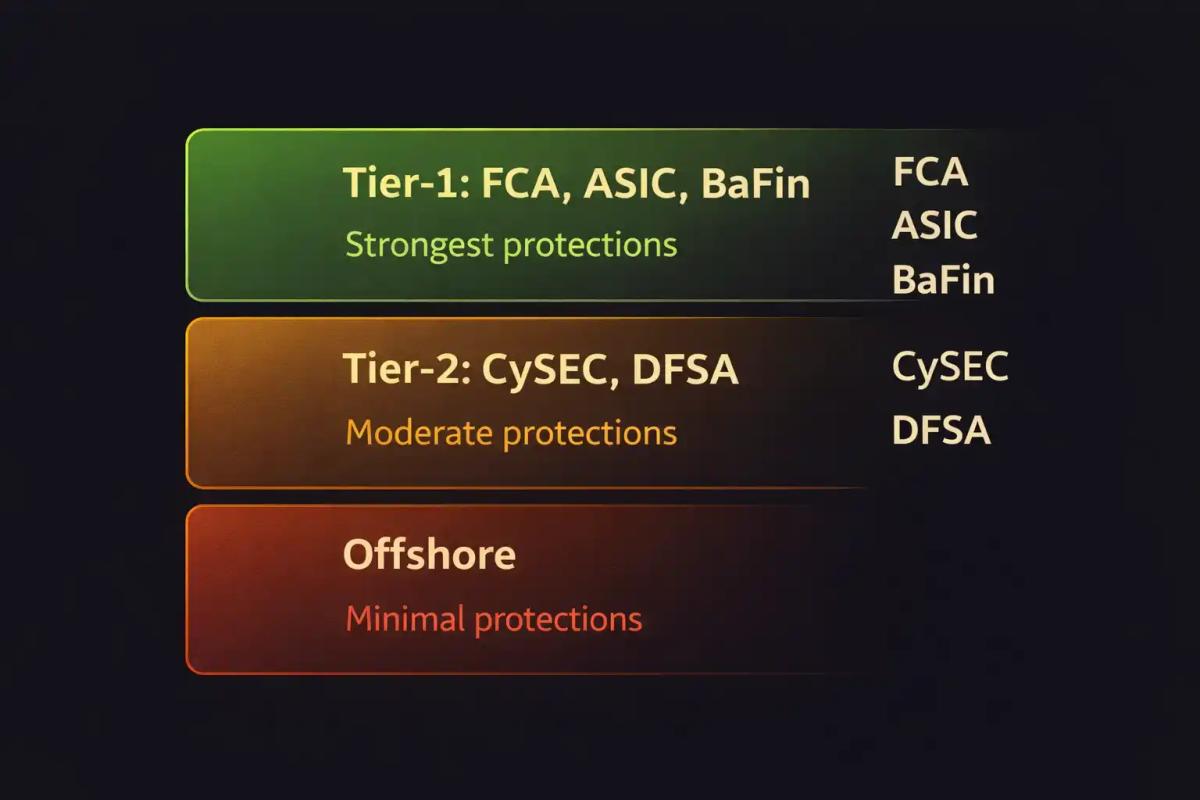
Tier-1 vs. Tier-2 vs. Offshore Regulators
Not all regulators carry the same weight. Here’s a practical way to think about the differences:
- Tier-1 regulators (FCA in the UK, ASIC in Australia, BaFin in Germany) impose the strictest requirements on brokers, including mandatory fund segregation, compensation schemes, and leverage caps. If a broker holds a Tier-1 license, they’ve cleared a high bar.
- Tier-2 regulators (CySEC in Cyprus, DFSA in Dubai) still enforce meaningful oversight, though the requirements may be somewhat less stringent. Many legitimate brokers operate under Tier-2 licenses, especially those serving international clients.
- Offshore regulators (registered in jurisdictions like Vanuatu, the Marshall Islands, or Saint Vincent) typically impose minimal requirements. This means there’s far less recourse if something goes wrong.
One important clarification: regulation reduces risk, but it does not eliminate it. Regulated brokers can still face financial difficulties, and the markets themselves remain inherently risky. Think of regulation as a seatbelt. It improves your odds, but it can’t guarantee you won’t get hurt.
How to Check a Broker’s Regulatory Status
Every reputable regulator maintains a public register you can search online:
- Go to the regulator’s official website (for example, the FCA Register at register.fca.org.uk)
- Search for the broker by name or license number
- Confirm the license is active and matches the entity you’d actually be trading with
- Check for any disciplinary actions or warnings
This takes five minutes and can save you from months of headaches. If a broker makes it difficult to locate their license number, or if their claimed license doesn’t check out, that’s your signal to move on.
With regulation confirmed, the next question becomes: what’s this broker actually going to cost you?
Step 2 – Understand the Cost Structure
Every dollar you pay in broker fees is a dollar that has to be earned back before you see any profit. Cost structure is where many beginners get caught off guard, because the headline numbers brokers advertise rarely tell the full story.
Spreads, Commissions, and Overnight Fees
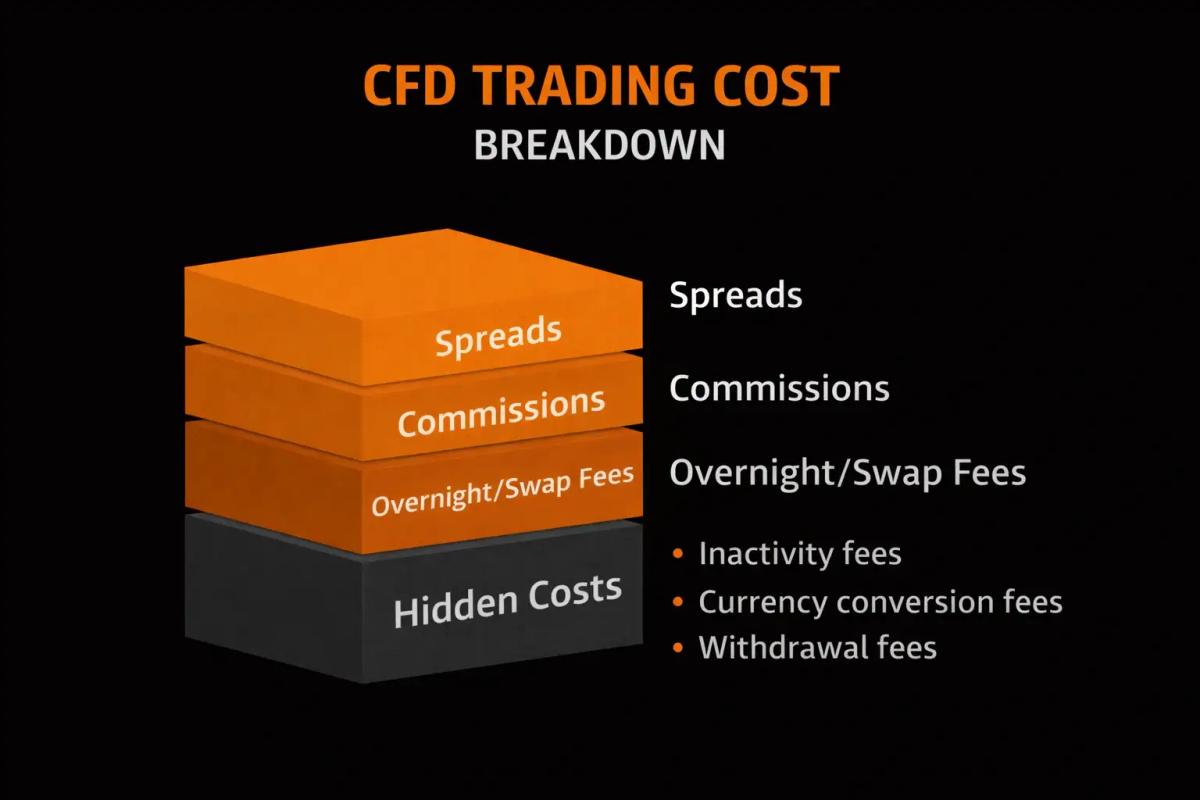
Three core costs come with almost every CFD broker:
- Spreads: The difference between the buy and sell price of an instrument. Think of it like the markup a currency exchange booth charges at the airport. Tighter spreads mean lower cost per trade. Spreads can be fixed or variable (widening during high volatility or low liquidity).
- Commissions: Some brokers charge a flat fee per trade on top of (or instead of) the spread. Commission-based accounts often come with tighter raw spreads, so you’ll need to compare the total cost, not just one component in isolation.
- Overnight (swap) fees: If you hold a CFD position overnight, you’ll typically pay a financing fee. This exists because CFDs are leveraged products and you’re essentially borrowing capital. These fees compound quickly for longer-term positions.
Hidden Costs Most Beginners Miss
Beyond the big three, watch for costs that don’t always make the marketing material:
- Inactivity fees: Some brokers charge monthly fees if you don’t trade for a set period. If you’re a casual or part-time trader, this can quietly chip away at your balance.
- Currency conversion fees: If your account is denominated in one currency but you’re trading instruments priced in another, the broker may charge a conversion fee on every trade.
- Deposit and withdrawal fees: While many brokers advertise free deposits, withdrawal fees (or minimum withdrawal amounts) can still apply depending on the method you use.
- Guaranteed stop-loss premiums: Some brokers offer guaranteed stop-losses for an extra fee. Useful in volatile conditions, but it’s an added cost you should factor in.
The smartest approach is to calculate the total round-trip cost for a typical trade you’d place, including spread, commission, and any overnight fees.
Now that you know what you’ll be paying, where exactly will you be placing those trades?
Step 3 – Evaluate the Trading Platform and Tools
Your trading platform is the cockpit you’ll sit in every time you open the markets. If it’s clunky, slow, or missing key features, it doesn’t matter how competitive the broker’s pricing is. You’ll be wrestling the interface instead of focusing on your trades.
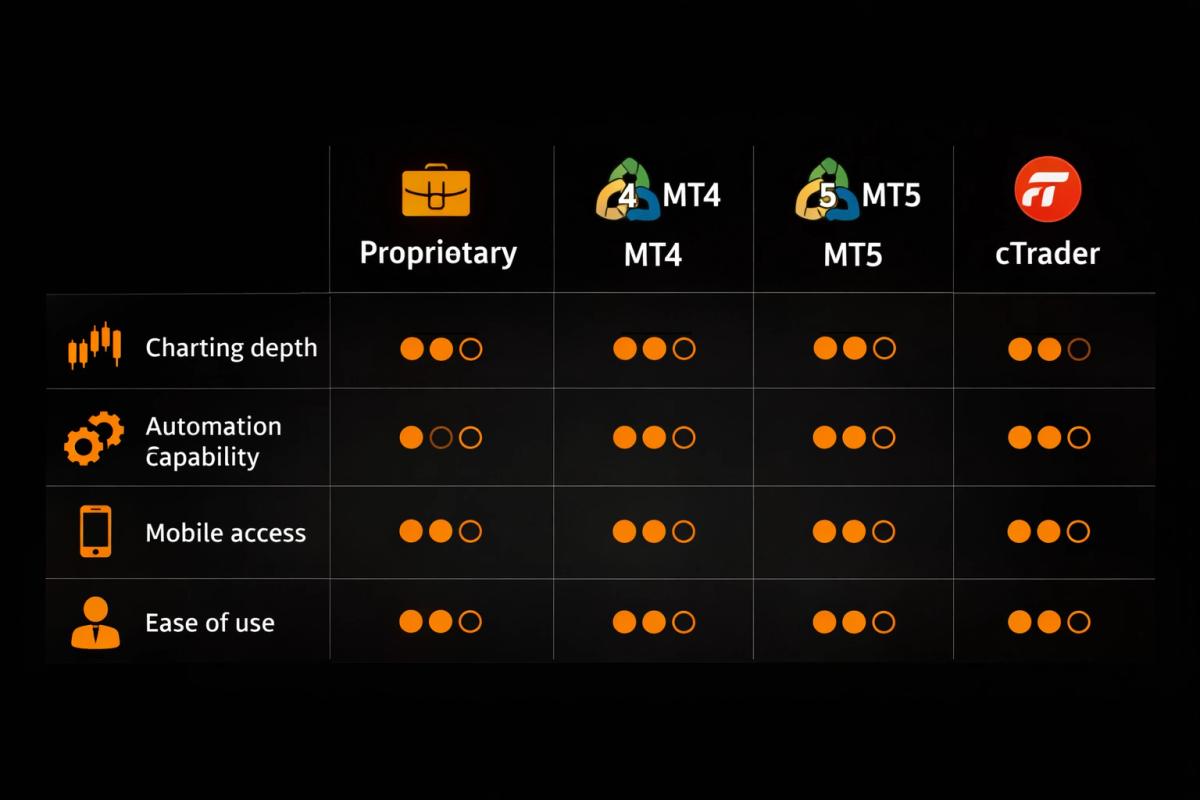
Platform Types (Proprietary vs. MT4/MT5/cTrader)
Most CFD brokers offer one or more of these platform options:
What matters is whether it fits the way you trade. If you’re just starting out, ease of use and learning resources might matter more than advanced algorithmic trading capabilities.
Charting, Order Execution, and Mobile Access
Beyond the platform name, dig into the practical details:
- Charting tools: Can you access the technical indicators and timeframes you need? Is the charting smooth and responsive, or does it lag when you add multiple indicators?
- Order execution: Does the broker offer instant execution or market execution? What’s their published average execution speed? Slow execution during fast-moving markets can cost you real money.
- Mobile access: If you need to manage positions on the go, test the mobile app thoroughly. Some mobile versions are fully featured; others feel like afterthoughts.
A platform that looks polished in a promotional video might feel completely different when you’re trying to place a trade under pressure. That’s why testing it yourself (more on that later) is essential.
Even the best platform won’t help, though, if your broker doesn’t offer the markets you actually want to trade.
Step 4 – Check Available Markets and Instruments
Not all CFD brokers cover the same range of markets. Some specialize in forex pairs, others provide thousands of instruments spanning indices, commodities, individual stocks, bonds, and more.
Before you commit, make sure the broker covers:
- The specific markets and instruments you’re interested in right now
- A broad enough selection that you won’t outgrow the broker as your interests evolve
- Any niche instruments you might want access to (sector-specific stocks, exotic forex pairs, particular commodities)
It’s like joining a gym. You might only want the treadmill today, but if you think you’ll eventually want the weight room, the pool, and the yoga studio, it makes sense to pick a gym that has it all rather than having to switch later.
Also check whether the broker offers the same range of instruments across all account types, or if some markets are restricted to higher-tier accounts. You don’t want to discover that the instruments you need are locked behind a premium account you weren’t planning to open.
Understanding what’s available is important, but equally critical is knowing how much firepower (and risk) you’re working with on each trade.
Step 5 – Assess Leverage Options and Margin Requirements
Leverage is one of the defining features of CFD trading, and also one of its biggest risks. It allows you to control a larger position with a smaller amount of capital. A leverage ratio of 30:1, for example, means you can open a position worth 30 times your margin deposit.
Here’s the part many newcomers overlook: leverage amplifies both gains and losses equally. If a 30:1 leveraged position moves 1% in your favor, you make 30% on your margin. If it moves 1% against you, you lose 30%.
When evaluating leverage options, consider:
- Regulatory leverage caps: In many jurisdictions, regulators like ESMA (in the EU) or the FCA cap leverage for retail clients, typically at 30:1 for major forex pairs and lower for other instruments. These caps exist specifically to protect less experienced traders.
- Margin call and stop-out levels: Understand at what point the broker will notify you that your margin is running low (margin call) and at what point they’ll automatically close your positions (stop-out). These thresholds vary between brokers and directly affect how much room your trades have to breathe.
- Negative balance protection: Does the broker guarantee you won’t lose more than your deposit? Many regulated brokers offer this, but it’s worth confirming explicitly.
Higher leverage isn’t better. In fact, if you’re newer to CFD trading, lower leverage can act as a built-in guardrail that prevents a single bad trade from doing serious damage to your account.
With the trading mechanics covered, let’s look at the practical side of moving money in and out of your account.
Step 6 – Review Deposit, Withdrawal, and Account Options
It might seem mundane compared to leverage ratios and charting tools, but how smoothly you can fund your account and access your profits matters more than most traders expect. This is especially true when something goes wrong.
Minimum Deposits and Account Tiers
Brokers typically offer multiple account types with different features:
- Standard accounts often have low minimum deposits (sometimes as little as $50-$200) and are designed for beginners.
- Premium or professional accounts may require higher minimums but offer tighter spreads, dedicated account managers, or additional tools.
- Islamic (swap-free) accounts are available at many brokers for traders who require them.
Match the minimum deposit to what you’re genuinely comfortable risking. A broker that requires a $10,000 minimum deposit might not be the right fit if you’re just starting out and want to test the waters with a smaller amount.
Funding Methods and Withdrawal Speed
Pay close attention to:
- Available funding methods: Bank transfer, credit/debit card, e-wallets (like Skrill, Neteller, or PayPal), and sometimes local payment options. More methods generally mean more flexibility.
- Withdrawal processing times: How long does it actually take to get your money out? Some brokers process withdrawals within 24 hours; others may take several business days.
- Withdrawal conditions: Are there minimum withdrawal amounts? Does the broker require you to withdraw via the same method you used to deposit? Are there any fees?
A broker that makes it effortless to deposit but creates friction around withdrawals is a serious warning sign, one we’ll revisit in the red flags section.
Speaking of things that matter when you actually need them, let’s talk about what happens when something goes wrong.
Step 7 – Test Customer Support and Educational Resources
You won’t think much about customer support until you need it. And when you need it, nothing else matters. A delayed response when you’re locked out of your account or confused about a margin call can cost you real money.
Before committing to a broker, test their support proactively:
- Response speed: Send a question via live chat or email before you open an account. How long do they take to reply? Is the response genuinely helpful, or a copy-pasted script?
- Availability: Is support available 24/5 (matching market hours) or more limited? What languages are supported?
- Channels: Do they offer live chat, phone support, email, or all three? Some brokers also provide support through messaging apps.
On the educational side, if you’re still building your knowledge, check whether the broker offers:
- Video tutorials and webinars
- Written guides and market analysis
- Trading glossaries and structured learning paths for beginners
For beginners, a broker with strong learning materials can meaningfully accelerate your development.
All this research is valuable, but there’s one step that replaces hours of reading with real, hands-on experience.
Step 8 – Use a Demo Account Before Committing Real Capital
This is the step that separates thoughtful traders from impulsive ones. A demo account lets you trade with virtual money on the broker’s actual platform, giving you a risk-free way to pressure-test everything you’ve evaluated so far.
Here’s what to focus on during your demo period:
- Platform usability: Is the interface intuitive? Can you find the tools you need quickly under real conditions?
- Order execution: Do orders fill at or near the expected price? Is there noticeable delay?
- Charting and analysis tools: Are they functional and responsive, or noticeably limited compared to the live account?
- Mobile experience: Test the mobile app alongside the desktop version.
- Spreads and pricing: Note that demo spreads may differ slightly from live conditions, but they’ll give you a general feel for cost structure.
Treat the demo as an audition where the broker is trying out for a role in your trading life, not just a sandbox to click around in. Take notes on what you like and what frustrates you. Compare at least two or three brokers side by side before making your decision.
But what if something feels off during your research or testing? Here’s how to recognize the warning signs.
Red Flags That Should Make You Walk Away
Not every broker deserves your trust or your capital. If you encounter any of the following, consider it a serious warning sign:
- No verifiable regulation: The broker claims to be regulated but you can’t confirm it on the regulator’s official register.
- Guaranteed profit promises: Any broker suggesting you’ll make money, or that their system is “risk-free,” is either misleading you or breaking regulatory rules.
- Withdrawal complaints: Consistent reports from users about delayed, blocked, or refused withdrawals. Check independent review sites and forums, not just the broker’s own testimonials.
- Pressure to deposit more: Aggressive sales calls pushing you to fund your account with more money, especially after losses.
- Unrealistic bonus offers: Massive deposit bonuses that come with trading volume requirements designed to be nearly impossible to meet.
- Lack of transparency: If the broker won’t clearly disclose their fee structure, regulatory status, or company ownership, that tells you something.
- Customer support vanishes: Support is responsive before you deposit but becomes unreachable after.
Trust your instincts here. If something feels off during the research process, it’s almost certainly going to feel worse once your real money is on the line.
With all eight steps covered and the red flags identified, let’s pull everything into a quick-reference checklist you can use right now.
Your CFD Broker Selection Checklist (Summary)
Use this checklist when you’re actively comparing brokers. Each item maps back to the steps covered above:
Regulation:
- [ ] Broker holds a license from a recognized regulator (Tier-1 or Tier-2 preferred)
- [ ] License verified directly on the regulator’s public register
- [ ] No unresolved regulatory warnings or sanctions
Costs:
- [ ] Spreads compared across your most-traded instruments
- [ ] Commission structure clearly understood
- [ ] Overnight/swap fees checked for typical holding periods
- [ ] Hidden fees identified (inactivity, conversion, withdrawal)
Platform:
- [ ] Platform tested via demo account
- [ ] Charting tools and indicators meet your needs
- [ ] Order execution speed is acceptable
- [ ] Mobile app tested and functional
Markets and Leverage:
- [ ] Broker offers the instruments you want to trade
- [ ] Leverage options appropriate for your experience level
- [ ] Margin call and stop-out levels clearly stated
- [ ] Negative balance protection confirmed
Account and Support:
- [ ] Minimum deposit matches your budget
- [ ] Preferred funding and withdrawal methods available
- [ ] Withdrawal speed and conditions reviewed
- [ ] Customer support tested and responsive
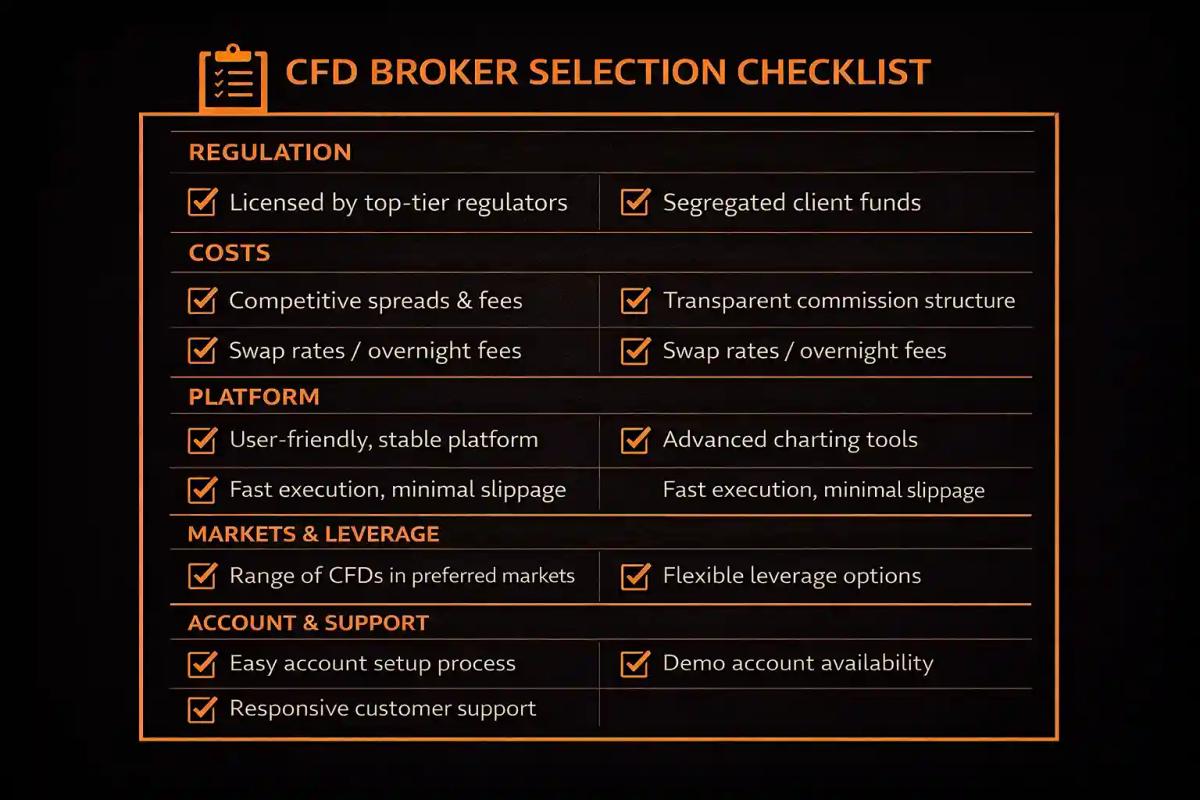
If you want to put this framework into practice and compare top CFD brokers side by side, you can use these criteria as your scoring system.
Frequently Asked Questions
Can a regulated broker still be risky or go out of business?
Yes. Regulation significantly reduces risk by imposing rules around fund segregation, transparency, and conduct, but it doesn't make a broker invincible. Regulated brokers can still face financial difficulties. However, top-tier regulators often provide compensation schemes (like the UK's FSCS) that offer a layer of protection for client funds in worst-case scenarios.
How much do spreads actually matter if I'm trading with a small account?
More than you might expect. When you're working with limited capital, every fraction of a pip in spread cost represents a proportionally larger chunk of your potential profit. Even a half-pip difference in typical spreads can add up significantly over dozens or hundreds of trades. Comparing total trade costs (spread plus any commission) across brokers is especially important for smaller accounts.
Is MT4, MT5, or cTrader the best platform for beginners?
There's no single "best" answer, and anyone who tells you otherwise is oversimplifying. MT4 has the largest community and the most third-party resources, which can be helpful when you're learning. MT5 offers a more modern experience with additional features. cTrader is praised for its clean interface and intuitive design. The best approach is to try each on a demo account and see which one clicks for you.
How do I verify a broker's regulation on my own?
Go directly to the relevant regulator's website and search their public register. For example, search the FCA Register for UK-regulated brokers, or the ASIC Connect register for Australian-regulated brokers. You'll need the broker's name or license number, which should be displayed on their website. If you can't find them in the register, or the details don't match, treat it as a red flag.
Is it safe to choose a broker that offers very high leverage (like 500:1)?
High leverage isn't inherently unsafe, but it dramatically increases the speed at which you can lose money. Brokers offering leverage far beyond what major regulators allow (30:1 for retail forex in the EU, for example) are often operating under offshore regulation with fewer protections. If you're still building your experience, sticking with regulated leverage limits is a sensible approach until you're more confident managing risk.
What should I do if a broker delays or refuses my withdrawal?
First, contact the broker's support team in writing (email, not just chat) and document everything. If the issue isn't resolved within a reasonable timeframe, file a formal complaint with the broker's regulator. Regulated brokers are required to have complaint-handling procedures. If the broker is unregulated, your options are unfortunately much more limited, which is yet another reason why regulatory status should be your very first filter.
How many brokers should I test before committing?
Aim to shortlist and demo-test at least two or three brokers. This gives you enough comparison points to notice real differences in platform quality, execution speed, and overall experience without falling into analysis paralysis. Use the checklist from this guide to score each one, and let the data guide your decision rather than gut feeling alone. Risk Disclaimer: CFDs are complex financial instruments. Trading CFDs carries a high level of risk and may not be suitable for all investors. You should carefully consider your objectives, financial situation, level of experience, and risk appetite before trading CFDs. Never trade with money you cannot afford to lose.
About the authors


Put this into practice
Related articles
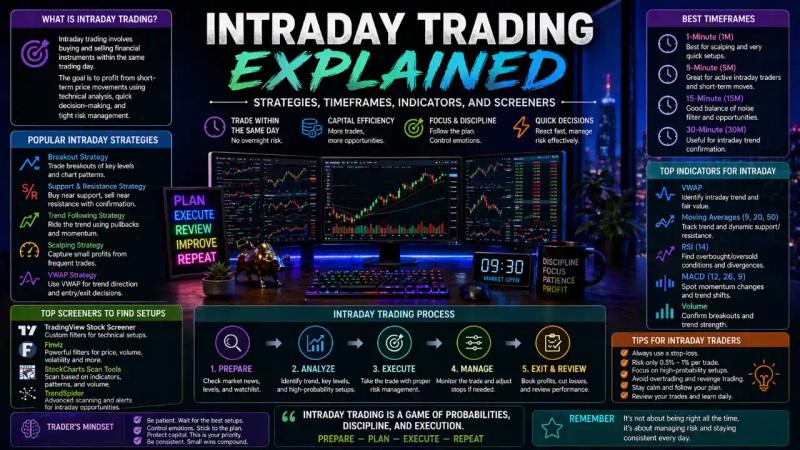
Intraday Trading Guide: Strategies, Timeframes, Indicators, and Screeners
Intraday trading guide: Learn how intraday trading works with proven strategies, the best timeframes and indicators, and top screeners to find setups.
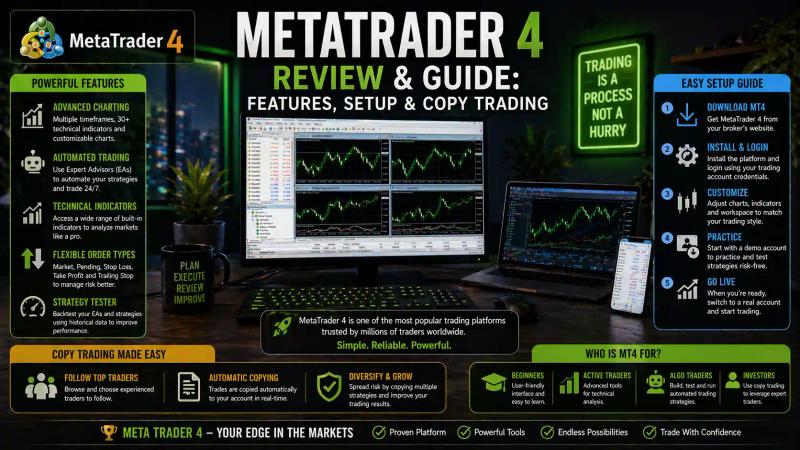
MetaTrader 4 Review and Guide: Features, Setup & Copy Trading
MetaTrader 4 review and guide covering features, setup, copy trading, and EAs. Learn how to download, configure, and use MT4 for forex and CFD trading.
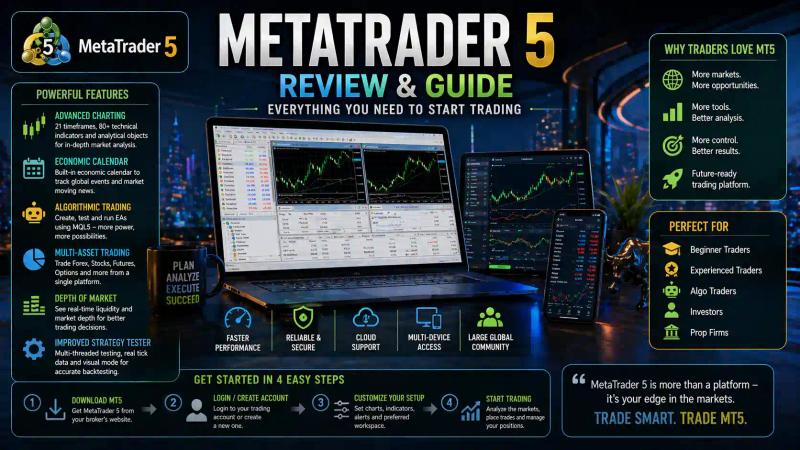
MetaTrader 5 Review and Guide: Everything You Need to Start Trading
Complete MetaTrader 5 review and guide. Explore MT5 features, setup steps, first trade walkthrough, pros and cons, and MT4 comparison
0 comments