



Trading Styles Explained: Find the Approach That Fits You
Your trading style shapes everything, from how much time you spend staring at charts to how well you sleep at night. Pick one that clashes with your personality or schedule, and even a solid strategy will feel like pushing a boulder uphill.
This guide breaks down the core trading styles, not as textbook definitions, but as real lifestyle choices. By the end, you’ll have a practical framework for narrowing down which style deserves your attention first.
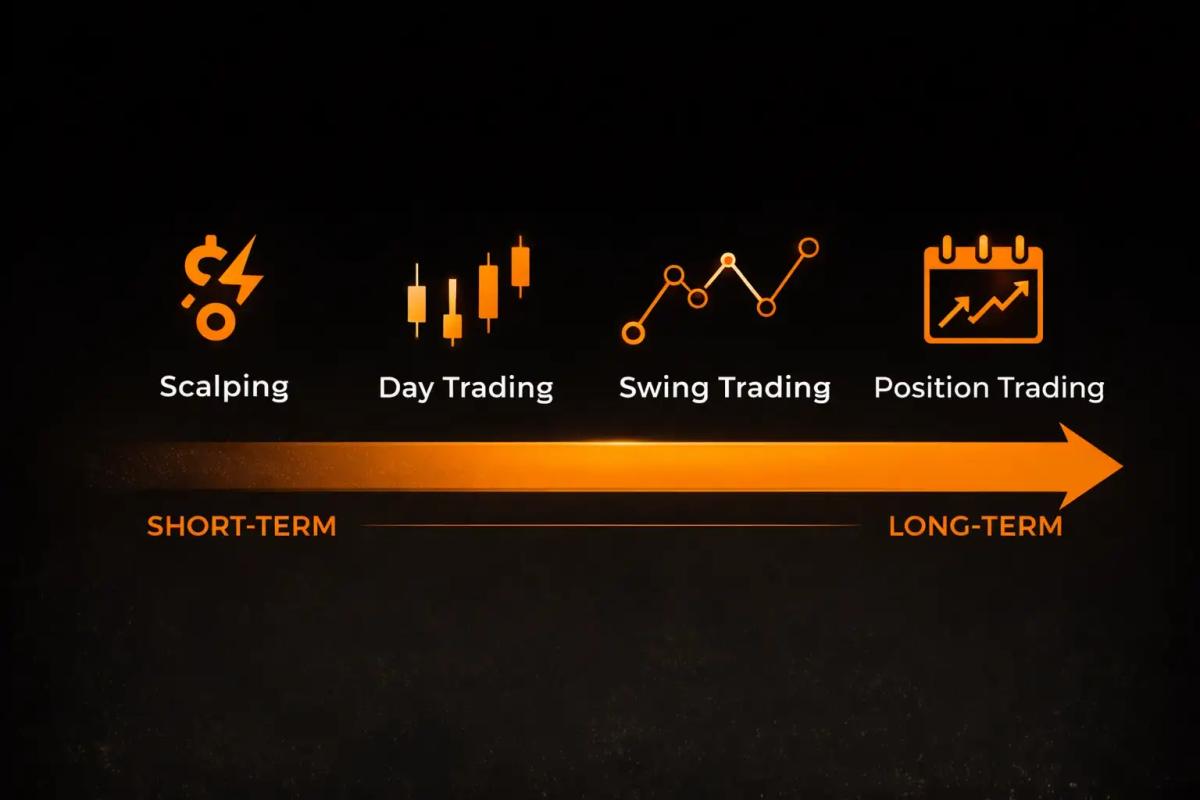
What Is a Trading Style and Why Does It Matter?
Think of a trading style as the rhythm you trade to. It’s the broader framework that governs how often you trade, how long you hold positions, and how much of your daily life the markets actually consume.
Two traders can use the exact same technical tool and walk away with completely different results, simply because one is chasing a five-minute move while the other is riding a trend for two weeks. The problem is the mismatch between the tool and the trader’s rhythm.
Getting this choice right is foundational. Nail it, and everything else (strategy, risk management, consistency) becomes far easier to build on top of.
How Your Lifestyle Shapes Your Trading
Here’s something that doesn’t get said enough: your trading style should fit around your life, not the other way around.
If you work a nine-to-five, a style that demands six hours of screen time during market hours simply isn’t realistic. If you get anxious holding positions overnight, a style that requires multi-week holds will grind you down emotionally long before it ever pays off.
The best traders are the ones who picked a style they could actually sustain, day after day, without burning out or breaking their own rules.
So before diving into each style, keep a mental checklist running: How much time do I genuinely have? How do I handle uncertainty? What’s my capital situation? Those three questions will do more for your trading than any indicator ever will.
Pick a well-regulated CFD provider among the best forex & CFD brokers.
Day Trading
If trading had a headline act, day trading would be it. It’s the style most people picture when they think about trading, and it’s also the one buried under the most misconceptions.
How Day Trading Works in Practice
Day trading means opening and closing all your positions within a single trading session. Nothing carries overnight. When the market closes, your slate is clean.
A typical day might look like this: you sit down 15 to 30 minutes before the open, review your watchlist, and identify setups based on your strategy. During the session, you might take anywhere from one to ten trades depending on your approach. Each trade could last minutes or hours. By the close, you’re flat, and your workday is done.
The reality, though, is that day trading demands consistent screen time during market hours. You do need to be available and focused during your chosen trading window. Most day traders dedicate at least two to four hours of active engagement per session.
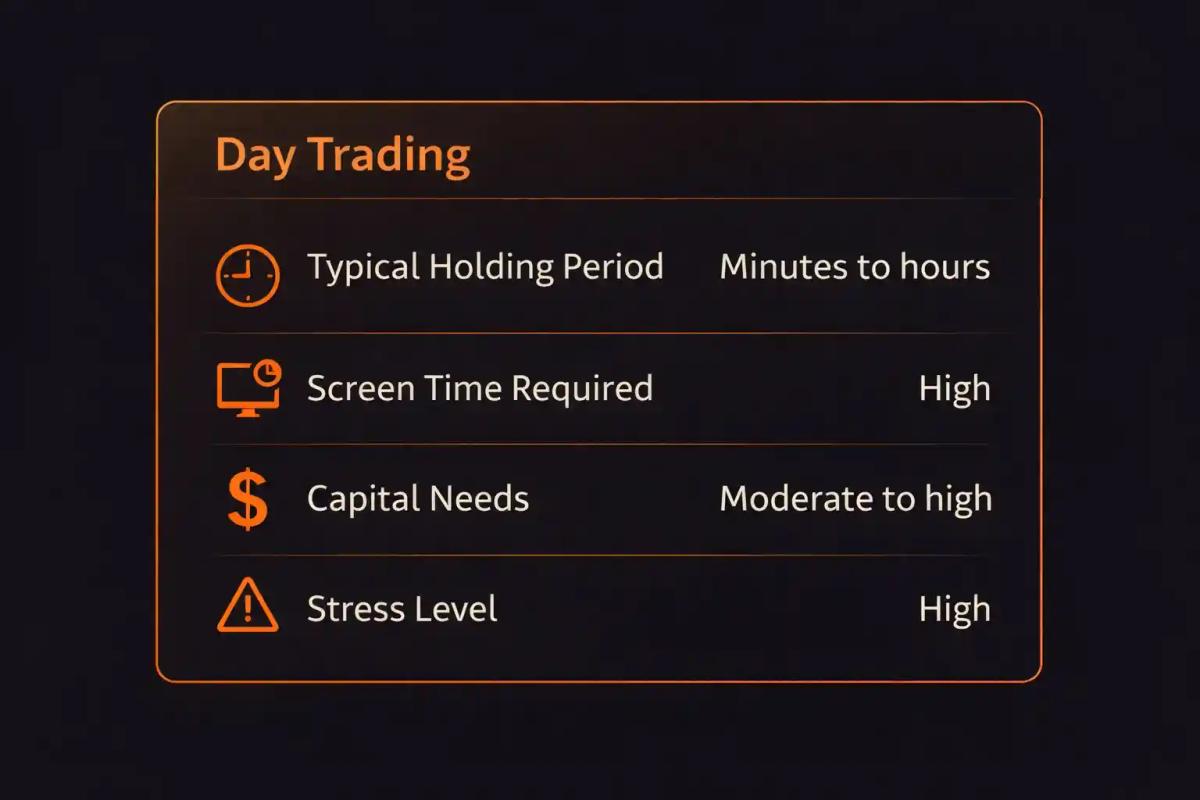
Capital requirements vary by market and region, but day trading generally calls for a moderate to high starting balance, particularly in equities where regulatory minimums may apply. The pace of trading also means transaction costs add up quickly, so your edge needs to account for those fees.
Who Day Trading Suits Best
Day trading tends to fit people who:
- Have dedicated blocks of time during market hours (at least 2 to 4 hours daily)
- Prefer the psychological comfort of zero overnight exposure
- Can make decisions quickly under pressure without spiraling into second-guessing
- Enjoy active, hands-on engagement with markets
- Have enough capital to absorb the friction of frequent trading
If you’re someone who likes clean endings, with no open positions keeping you up at night, the day trading rhythm might appeal to you. But be honest about the time commitment. Squeezing trades between meetings is a recipe for frustration, not profit.
What if your schedule doesn’t allow for that kind of daily focus, but you still want active involvement? That’s where the next style enters the picture.
Swing Trading
Swing trading lives in the middle ground, and for a surprising number of people, that middle ground turns out to be the sweet spot.
How Swing Trading Works in Practice
Swing traders hold positions for days to weeks, aiming to capture medium-term price moves. Instead of tracking every tick, you’re looking at the bigger picture: trends forming on daily or four-hour charts, key levels being tested, momentum building or fading.
A typical week might look like this: you spend 30 to 60 minutes each evening scanning charts and reviewing open positions. Maybe you place one or two new trades during the week. You set your stop losses and targets, then step away. Between check-ins, your involvement is minimal.
This is the style that often clicks for people with full-time jobs or other commitments. You don’t need to be glued to a screen during market hours. You need a consistent routine, perhaps 30 minutes in the morning and 30 minutes in the evening, along with the patience to let trades develop on their own timeline.
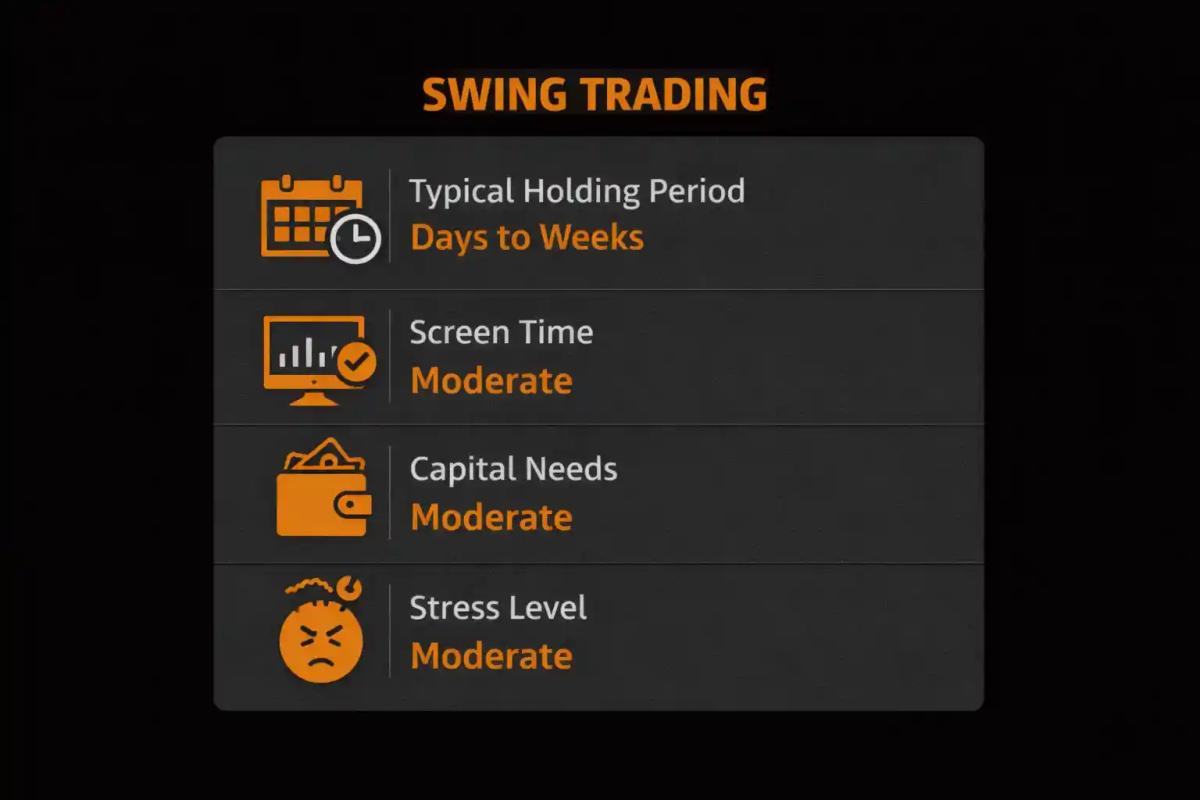
Capital requirements are generally more flexible than day trading since you’re taking fewer positions and can work with wider stop losses relative to your account size. Transaction costs matter less, too, because you’re simply not trading as often.
Who Swing Trading Suits Best
Swing trading tends to fit people who:
- Have limited time during market hours but can carve out 30 to 60 minutes daily for analysis
- Are comfortable holding positions overnight and sitting through minor fluctuations
- Prefer a more measured pace of decision-making
- Want active involvement without it becoming a second full-time job
- Have moderate capital and the patience for trades that take days to play out
The trade-off si that you need to be comfortable with overnight risk and the occasional gap that moves against your position. If waking up to check whether a trade turned against you while you slept sounds stressful, swing trading may test your nerves more than you expect.
But what if even the pace of swing trading feels too slow for your temperament, and you genuinely thrive on rapid-fire decisions? There’s a style built for exactly that kind of energy.
Scalping
Scalping is trading at its most intense. It’s the sprint in a world where most styles are closer to a jog or a marathon.
How Scalping Works in Practice
Scalpers aim to profit from very small price movements, often holding positions for just seconds to minutes. The idea is to take a tiny edge, repeat it many times, and let volume do the heavy lifting.
In practice, a scalper’s session looks frantic to an outsider. You’re watching order flow, reacting to momentum shifts in real time, and executing dozens (sometimes hundreds) of trades in a single session. Every fraction of a point matters, and your focus simply cannot waver.
This style demands the lowest latency you can get: fast execution, reliable technology, and tight spreads. Transaction costs become a critical factor because when your average profit per trade is razor-thin, even a slight increase in fees can erase your edge entirely.
Who Scalping Suits Best
Scalping tends to fit people who:
- Thrive under pressure and can maintain intense focus for extended stretches
- Have fast reflexes and can make split-second decisions without hesitation
- Have access to low-cost execution and reliable, fast technology
- Prefer very short exposure to the market (no overnight risk, minimal intra-day risk per trade)
- Can handle a high volume of small wins and losses without emotional whiplash
Scalping is not a forgiving style for anyone still developing discipline. The speed means mistakes compound fast, and the mental fatigue is very real. If you’ve ever felt drained after an hour of intense focus, imagine sustaining that level for an entire trading session.
You might be reading this and thinking, “That sounds exhausting.” Fair enough. On the complete opposite end of the spectrum sits a style built for patience.
Position Trading
Position trading is the slow burn. It’s the style that most closely resembles investing, yet it remains distinctly active.
How Position Trading Works in Practice
Position traders hold trades for weeks, months, or occasionally even longer. They’re riding major trends or macro-level moves, relying more heavily on higher timeframe charts and often weaving fundamental analysis into their technical toolkit.
A typical month might involve reviewing positions once or twice a week, adjusting stops as a trend matures, and spending a few hours on the weekend doing deeper research. You might only open a handful of new positions per month.
The screen-time commitment is the lowest of any active trading style. But don’t confuse low screen time with low skill. Position trading demands strong conviction, the ability to sit through significant pullbacks without flinching, and a solid understanding of broader market dynamics.
Capital requirements can run higher in absolute terms because your stop losses are typically wider to accommodate larger timeframe moves. That said, position sizing can offset this, and the low frequency of trades keeps transaction costs minimal.
Who Position Trading Suits Best
Position trading tends to fit people who:
- Have very limited time for active trading (a few hours per week at most)
- Are emotionally comfortable watching positions fluctuate significantly before reaching their target
- Think in terms of bigger-picture narratives and trends rather than short-term noise
- Have sufficient capital to handle wider stops
- Possess patience as a genuine personality trait, not just a theoretical preference
The biggest challenge here is psychological. Watching a position swing against you by several percent and holding firm requires a very different kind of mental fortitude than closing a quick scalp. If you need frequent feedback and quick results to stay motivated, position trading will test your resolve.
So now you’ve seen the full range, from seconds to months. But where exactly does each style fall on the broader spectrum of active versus passive?
Active vs Passive Trading: Understanding the Spectrum
Not every trader wants the same level of involvement, and that’s perfectly fine. Understanding where each style sits on the activity spectrum helps you calibrate expectations before you commit.
Where Each Style Falls on the Spectrum
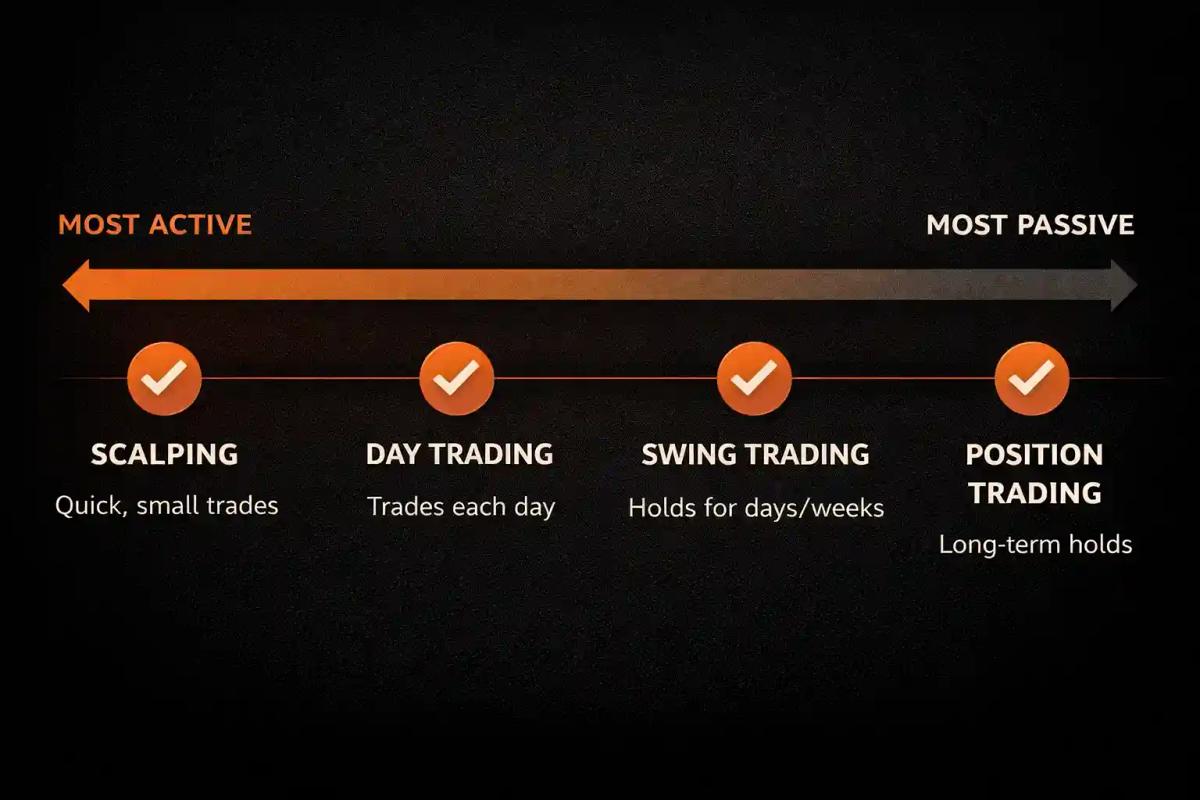
Trading styles aren’t binary, “active” or “passive.” They exist on a gradient:
- Scalping sits at the far active end. Maximum screen time, maximum trade frequency, maximum mental engagement per session.
- Day trading is highly active but slightly less intense than scalping, with fewer trades and more deliberate decision-making.
- Swing trading occupies the middle ground. Active enough to require regular attention, relaxed enough to fit around other commitments.
- Position trading leans toward the passive end of active trading. You’re still making deliberate trade decisions, but your daily involvement is minimal.
No position on this spectrum is inherently better. The real question is where you can realistically sustain yourself, week after week.
How to Choose the Right Trading Style for You
This is the section that matters most. Everything above is useful context, but it only becomes valuable when you hold it up against your own situation.
Key Factors: Time, Capital, Risk Tolerance, and Personality
Choosing a trading style comes down to four honest self-assessments:
- Time availability. How many hours per day or week can you genuinely dedicate to trading? Not how many you wish you had, but how many you actually have. Scalping and day trading need daily blocks during market hours. Swing trading needs consistent daily check-ins. Position trading needs a few hours per week.
- Capital. What’s your realistic starting balance, and what can you afford to risk? Styles with tighter timeframes often need more capital to remain viable after accounting for transaction costs and potential regulatory requirements. Longer-term styles can sometimes work with less, though wider stops mean each position carries more dollar risk.
- Risk tolerance. This isn’t about what you think you can handle in theory. It’s about what you’ve actually experienced. Do you panic when a trade moves against you by 2%? Do you check your phone every five minutes when you have an open position? Your real risk tolerance, the one you feel in your chest, should guide your choice.
- Personality and temperament. Are you patient or impulsive? Do you need quick feedback, or are you comfortable with delayed gratification? Do you thrive under pressure or crumble? Be ruthlessly honest here. Trading psychology plays a larger role in long-term success than most people expect.
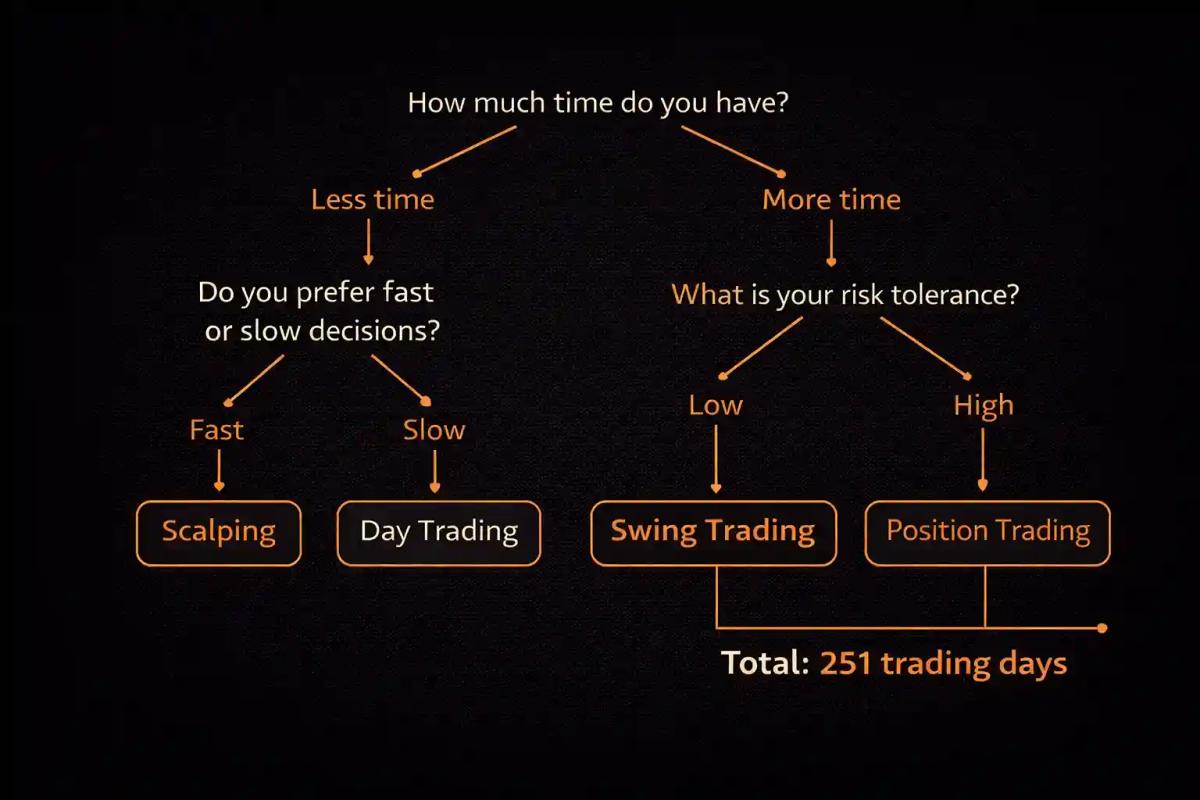
A practical exercise: write down your answers to those four factors. Then revisit the style descriptions above and see which one aligns most closely. If two styles overlap with your answers, that’s fine. You don’t need to decide permanently today.
Can You Combine or Switch Styles?
Absolutely. Many experienced traders settle into a primary style and occasionally dip into another. A swing trader might take a day trade when a particularly clean setup appears during a day off. A position trader might shorten their timeframe during high-volatility periods.
The key is having one primary style that serves as your anchor. Trying to scalp in the morning, swing trade in the afternoon, and hold position trades on the side usually leads to confusion and inconsistency, especially while you’re still building your skills.
As you gain experience, your preferences will naturally evolve. A style that felt overwhelming as a beginner might feel entirely natural after a year of screen time. Give yourself permission to reassess periodically without treating every adjustment as a failure.
Common Mistakes When Choosing a Trading Style
Knowing what to do matters. But knowing what to avoid can save you months of frustration.
Choosing based on profit potential alone. The style with the highest theoretical returns is meaningless if you can’t execute it consistently. A scalping strategy that could earn 5% monthly is worthless if your lifestyle only supports swing trading. Consistency beats potential every single time.
Ignoring emotional fit. You can intellectually understand that position trading suits your schedule, but if you emotionally cannot handle watching a position drift against you for days, you’ll override your plan.
Copying someone else’s style. Just because a trader you admire is a scalper doesn’t mean scalping fits you. Their capital, experience, technology, and temperament are likely very different from yours. Learn from others, but choose for yourself.
Refusing to adapt. Some traders pick a style and treat it like an identity. If after several months a style clearly isn’t working, despite following a sound strategy, consider that the style itself might be the mismatch.
Skipping risk management. No trading style protects you from poor risk management. Whether you’re scalping or position trading, position sizing, stop losses, and capital preservation rules are non-negotiable. The style is the frame. Risk management is the foundation underneath it.
Frequently Asked Questions
Can a beginner start with any trading style?
Technically, yes, but some styles have steeper learning curves. Scalping, for example, demands rapid decision-making and significant experience reading price action in real time, which can overwhelm newcomers quickly. Many beginners find swing trading or position trading more approachable because the slower pace allows time to think, analyze, and learn from mistakes without the pressure of split-second execution.
Is it possible to practice multiple trading styles at the same time?
You can, but it's generally more effective to focus on one style until you develop consistency before branching out. Jumping between styles too early often leads to conflicting rules, muddled analysis, and real difficulty identifying what's actually working. Once you've built a solid foundation in one style, experimenting with a secondary approach becomes much more manageable.
How much capital do I typically need for each trading style?
There's no universal number because it depends on your market, broker, and region. As a general framework, scalping and day trading often require more capital due to higher trade frequency and, in some markets, regulatory minimums. Swing and position trading can work with smaller accounts since you're taking fewer, more deliberate positions. What matters most is that your capital allows you to size positions properly without risking too much on any single trade.
How long does it take to know if a trading style is the right fit?
Give yourself at least two to three months of consistent practice before making a judgment. A few bad days, or even a few bad weeks, don't necessarily mean the style is wrong for you. It might mean your strategy needs refinement. But if after several months you consistently feel stressed, frustrated, or unable to follow your own rules, the style itself may be the issue worth reconsidering.
Should I change my trading style based on market conditions?
Experienced traders sometimes adjust their approach during unusual market conditions, such as increasing hold times during strong trending markets or pulling back during choppy, directionless periods. However, this kind of adaptation comes with experience. As a beginner, it's better to master one style across varying conditions before attempting to shift between approaches dynamically.
What's the difference between a trading style and a trading strategy?
A trading style is your broad approach, defined by your timeframe, trade frequency, and how you interact with markets day to day. A trading strategy is the specific set of rules you follow within that style: which setups you trade, where you enter, and how you manage risk. Think of the style as the genre and the strategy as the specific playbook within it.
Are there personality tests or tools that help identify a suitable trading style?
Some trading education platforms and brokers offer quizzes or self-assessment tools designed to match your personality traits with a suggested style. These can be useful starting points, but treat them as rough guides rather than definitive answers. The most reliable "test" is honest self-reflection on your time availability, emotional responses to risk, and patience level, combined with actually trying a style in a practice or demo environment. Trading involves risk of capital loss. The content in this article is educational and should not be considered financial advice. Always assess your own financial situation and consider consulting a qualified professional before making trading decisions.
About the authors


Put this into practice
Related articles
TradingView Review and Guide: Features, Setup & Best Indicators for Day Trading
Honest TradingView review and guide covering features, plan pricing, setup, and the best indicators for day trading. Practical guide for new and active traders.

What Are CFDs and How Do They Work?
Learn what CFDs are, how profit and loss works, the types you can trade, and the risks involved. A plain-language beginner's guide to Contracts for Difference.

Who Is Considered an Insider: Legal Definition and Trading Rules
A plain-English guide to who counts as an insider under US and UK securities law, what they must disclose, when they may trade, and the penalties for breaches.
0 comments