



CFD Trading · Advanced · 7 min read
Wash Sale Rule Day Trading: How the 61-Day Window Deletes Your Loss Deductions
How the wash sale rule blocks your tax deductions
The content below is general information for active traders, not personalised tax advice. Rules, elections and reporting duties depend on your residency, your broker's jurisdiction and the instruments you trade: review your situation with a licensed tax professional in the country where you file.
Active traders who scalp the same names often discover that the loss they see on the P&L is not what reaches Schedule D. The culprit is IRC §1091, which denies a capital loss whenever the taxpayer acquires the same security, or one that is substantially identical, inside a defined window around the loss sale. That window runs for a total of 61 days and covers three stretches:
- the 30 days before the sale,
- the sale date itself,
- the 30 days after the sale.
For a day trader cycling in and out of the same tickers, that window captures almost every re-entry, which means the loss booked on screen often shrinks or disappears by the time the April filing deadline arrives.
Choosing where to trade carries almost as much weight as the strategy itself; see the best forex brokers and their conditions.
The 30-day window: before, during, and after your sale
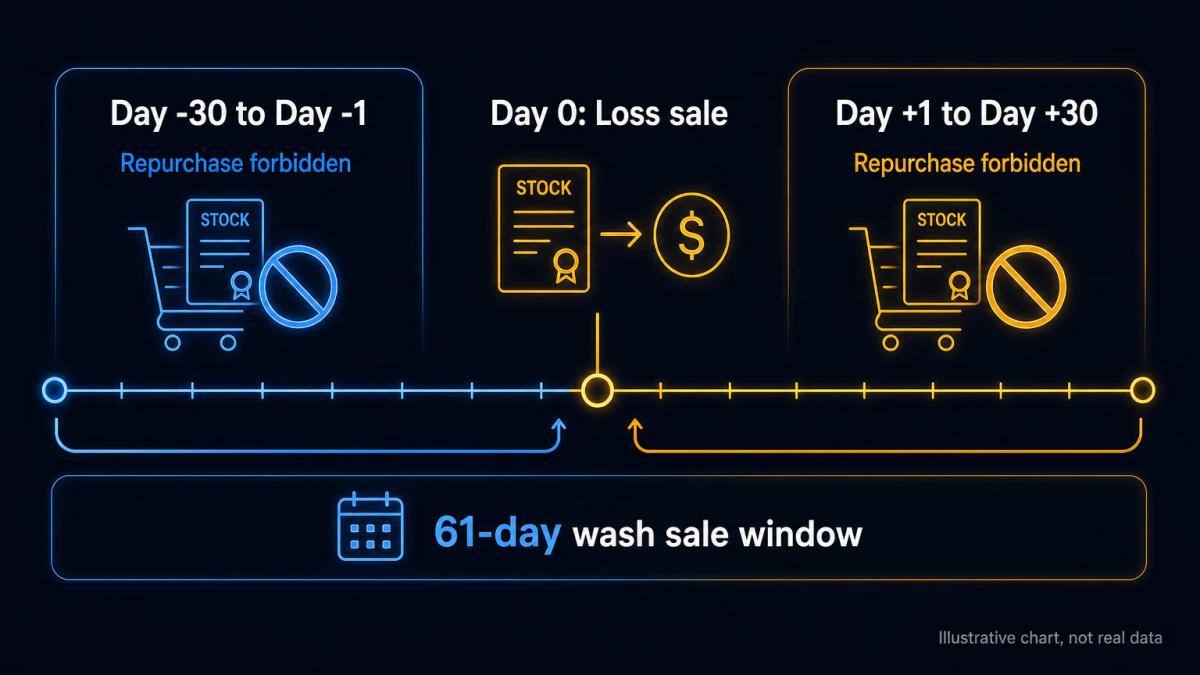
| Timing | What happens | Example |
|---|---|---|
| Day minus-30 to day minus-1 (before sale) | Any acquisition of the same security disallows the loss | If shares were bought three weeks before the original lot was dumped, the loss on the sold shares is still disallowed |
| Day zero (sale date) | The loss-triggering transaction | A position is closed at a loss |
| Day plus-1 to day plus-30 (after sale) | Any acquisition of the same security disallows the loss | Should the same ticker be re-entered at 14:00 on the sale day, the loss is disallowed |
The rule attaches to the shares themselves and reaches across account boundaries. A purchase made in a spouse's account, in a joint account, or inside an IRA within the window will still trigger disallowance. An IRA replacement carries the harshest consequence of all, because the disallowed loss is permanently lost: the IRA has no taxable basis for the deferred amount to roll into.
Settlement date plays no role in the wash sale test, since trade date governs the timing. Partial replacement produces partial disallowance in direct proportion. Imagine selling 1,000 shares at a loss and buying back 300 within the window: 30% of the loss is disallowed and 70% remains deductible.
What counts as substantially identical in day trading
For equities, substantially identical is a tighter concept than most traders assume; for derivatives, it stretches further than the name suggests. Shares of the same issuer under a different ticker, such as ADRs set against ordinary shares or share classes with identical economic rights, are generally caught by the rule. Shares of a competitor in the same sector tend to fall outside its scope. Two index ETFs that track the S&P 500 from different issuers occupy a grey area the IRS has never fully settled, and traders who swap SPY for IVV to sidestep the rule carry real audit risk.
Options add a further layer, because selling stock at a loss and then buying a call on the same name inside the window creates a wash sale: the call grants a right to the identical shares. Deep-in-the-money calls present the clearest case under the rule, while far out-of-the-money calls have been argued in both directions; the conservative reading still treats them as identical.
How wash sales adjust your cost basis and delay your loss
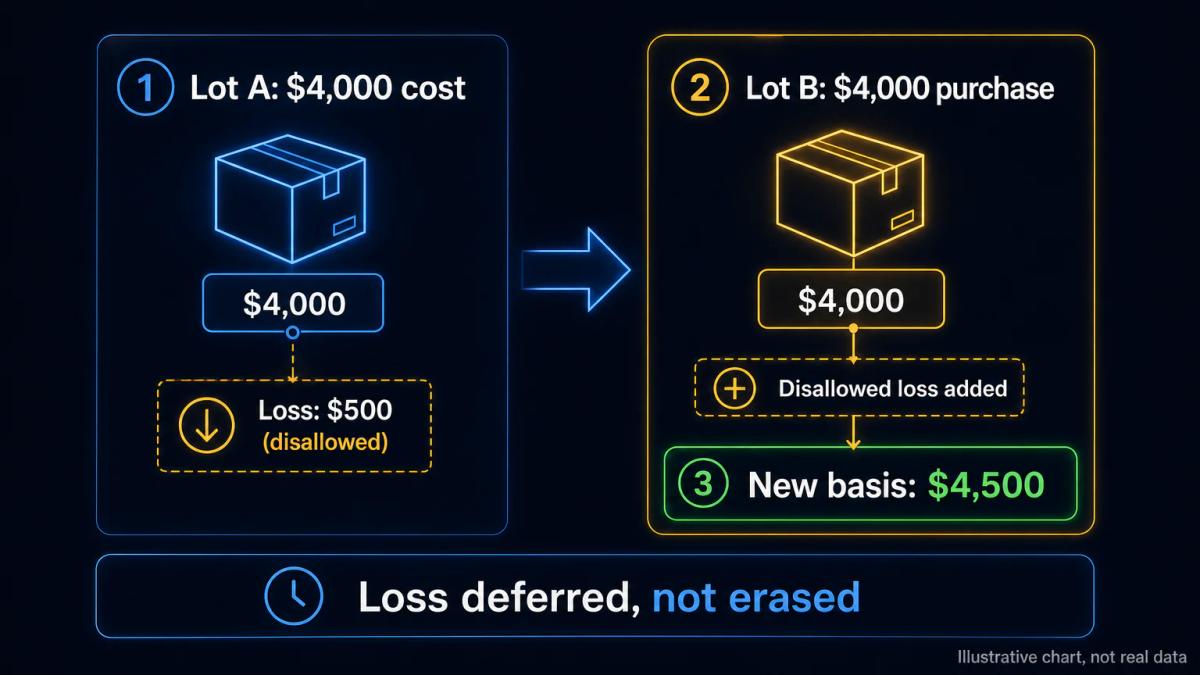
A disallowed loss is deferred rather than erased altogether. The amount is added to the cost basis of the replacement shares, and the holding period of the sold shares tacks on to the replacements. Picture a $500 loss on lot A followed by a purchase of lot B inside the window at $4,000: lot B's basis becomes $4,500 for tax purposes.
The deferral mechanics turn uncomfortable when the replacement is itself sold at a loss and triggers another wash sale, chaining the disallowed amount forward. Traders who scalp the same ticker daily can finish the year with a basis stack that only unwinds when they exit the ticker entirely for more than 30 days. Until that clean break arrives, every realised loss keeps rolling into the next replacement's basis, and the deduction stays locked away from the current tax year.
Wash sales and day trading: why the rule hits intraday traders hardest
Intraday rotation is precisely the activity §1091 was never written for, and yet it falls squarely within its scope. Consider a trader who exits a losing scalp at 10:00 and re-enters the same ticker at 14:00: that round trip, lasting only hours, still produces a textbook wash sale. Across a full year of 200 trading days, a single ticker can accumulate dozens of chained disallowances.
The cash-flow consequence can be substantial on a profitable gross year with heavy churn, because the Form 1099-B realised loss total understates deductible losses whenever disallowed amounts are sitting in replacement basis. Imagine a trader whose screen shows $200,000 in gains and $180,000 in raw losses: the filing might end up reporting $200,000 of gains against only $120,000 of recognised losses, with $60,000 parked in basis that will not be realised until the position is fully closed and left alone for 31 days.
This pattern reaches its worst form among traders who concentrate on a short watchlist of five to ten tickers. Practical mitigation usually comes from one of two approaches:
- diversifying across unrelated instruments so no single name dominates the loss ledger;
- taking a hard 31-day break from a losing name before the year-end cutoff.
Reporting wash sales on your tax return
US brokers report wash sales on Form 1099-B with code W, feeding into Form 8949 and Schedule D. The disallowed amount appears in column (g) as a positive adjustment that offsets the loss in column (h). The IRS matches 1099-B totals to the return, so omitted or reclassified wash sales surface quickly.
Broker tracking of wash sales is confined to activity within a single account at the same firm, which leaves meaningful gaps. Cross-account and cross-broker wash sales fall to the taxpayer to reconcile, and the IRS still expects them to appear on Form 8949.
Trader Tax Status election: a potential workaround
Taxpayers who qualify as traders in securities under the IRS facts-and-circumstances test can elect mark-to-market accounting under §475(f), which converts positions to ordinary gain/loss and removes them from the reach of §1091 altogether. The election is filed by the prior year's tax deadline, well before the return it first affects, and once in place it binds the taxpayer going forward unless the IRS consents to revoke it.
The trade-offs run in both directions. Ordinary loss treatment improves on the capital loss cap, which otherwise limits deductions to $3,000 against ordinary income each year, while ordinary gain treatment gives up long-term capital gain rates on any position the trader would have held longer. The qualification bar itself is high and heavily litigated, with the IRS and courts weighing factors such as:
- frequency of trading,
- holding periods,
- intent,
- hours devoted to the activity.
Making the election without a specialist tax adviser who has handled §475(f) filings before is a step few traders should take on their own.
Tracking wash sales: broker tools and manual records
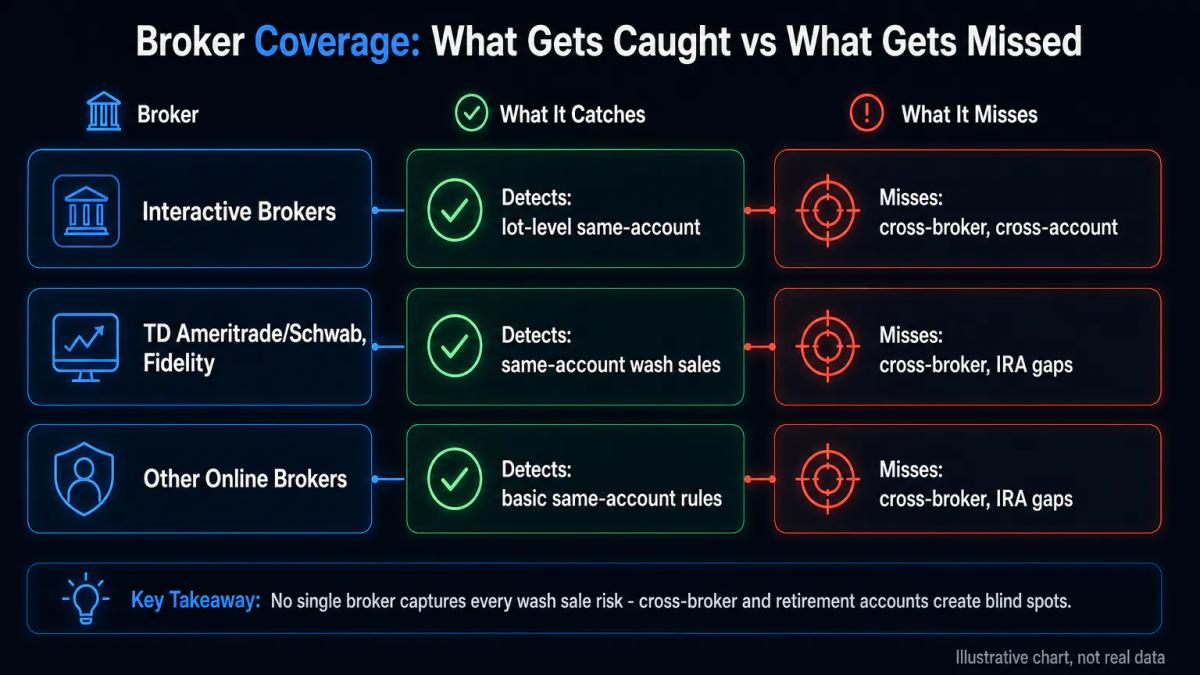
Broker handling of wash sales varies in granularity across the main US retail venues:
- Interactive Brokers flags lot-level wash sales in the activity statement and on the 1099-B;
- TD Ameritrade and Schwab provide a Gain/Loss tool with wash sale filters;
- Fidelity shows disallowed amounts on its realised gains reports.
| Platform area | What it covers | What it misses |
|---|---|---|
| 1099-B code W | Same-account wash sales within one broker | Cross-broker, cross-account, IRA interaction |
| Real-time trade ticket warnings | A minority of platforms; rare for equities | Options legs, partial replacements |
| Year-end Gain/Loss reports | Lot-level disallowance totals | Chains that cross tax years |
A personal spreadsheet keyed by ticker, carrying every entry and exit date alongside a running 61-day flag, provides the only reliable defence once trading spans more than one account or more than one broker.
Frequently Asked Questions
Does the wash sale rule apply to CFDs and futures, or only stocks?
IRC §1091 applies to stocks and securities, including options on them. Section 1256 contracts (regulated futures, broad-based index options, certain forex contracts) use mark-to-market treatment and sit outside §1091. CFDs are not sold to US retail traders and are not a US tax category; non-US residents trading CFDs follow their home jurisdiction's rules, which rarely replicate the US wash sale mechanic. Spot forex and crypto are also outside §1091 under current IRS guidance, though legislative proposals to extend the rule to digital assets have appeared repeatedly.
Can you avoid a wash sale by trading options on the same stock?
No. Buying a call option on the same underlying within the 61-day window is explicitly treated as acquiring a substantially identical security. Selling a put is also captured when the put is deep enough in-the-money that assignment is near-certain. Switching between different strikes or expirations of the same name does not break the chain reliably; the IRS looks at economic equivalence. The only clean reset is a full exit from the name, in both stock and all option legs, for the entire 31-day post-sale period.
What happens if your broker does not report a wash sale to the IRS?
Broker 1099-B reporting is limited to wash sales within a single account at that broker. If a wash sale occurs across your accounts at different brokers, between taxable and IRA accounts, or across a spouse's account, no 1099-B will flag it, but the obligation to report on Form 8949 remains yours. Omission is not a shield: the IRS can assess the disallowed amount, interest and penalties on audit, and the statute of limitations runs from the return filed, not from when the omission is discovered.
Does the wash sale rule apply to international traders outside the US?
The §1091 wash sale rule is a US Internal Revenue Code provision and applies to US taxpayers (citizens, residents, and certain non-residents with US-source income). The UK has no identical rule but applies share-matching (same-day and 30-day bed-and-breakfast rules) under TCGA 1992 that produce similar deferral of losses. Canada's superficial loss rule mirrors the 30-day concept. Germany, Spain and other EU jurisdictions have their own loss-recognition timing rules. Check the specific regime where you file.
How do you calculate the adjusted cost basis after a wash sale?
Take the purchase price of the replacement shares and add the disallowed loss from the triggering sale. If you sold 100 shares at a $5 per-share loss ($500 disallowed) and bought 100 replacement shares at $40, the adjusted basis of the replacement lot is $4,500, or $45 per share. The holding period of the sold shares tacks on to the replacement, which can convert a short-term holding into a long-term one. Partial replacements prorate the disallowance by the ratio of replacement to sold shares.
About the authors


Put this into practice
Brokers we have reviewed
Scored on the same five dimensions. Here are three of them — the full list is on the brokers page.



Related articles

What Are CFDs and How Do They Work?
Learn what CFDs are, how profit and loss works, the types you can trade, and the risks involved. A plain-language beginner's guide to Contracts for Difference.

Who Is Considered an Insider: Legal Definition and Trading Rules
A plain-English guide to who counts as an insider under US and UK securities law, what they must disclose, when they may trade, and the penalties for breaches.

Why Most Broker Review Sites Can't Be Trusted (And How to Spot the Ones That Can)
Broker review sites often claim to be independent while earning revenue from the brokers they recommend. This guide explains how affiliate commissions influence rankings, the warning signs of biased reviews, and the transparency standards traders should look for when evaluating any broker review platform.
0 comments