



Financial Markets · Intermediate
10 Economic Indicators Every Forex Trader Should Track
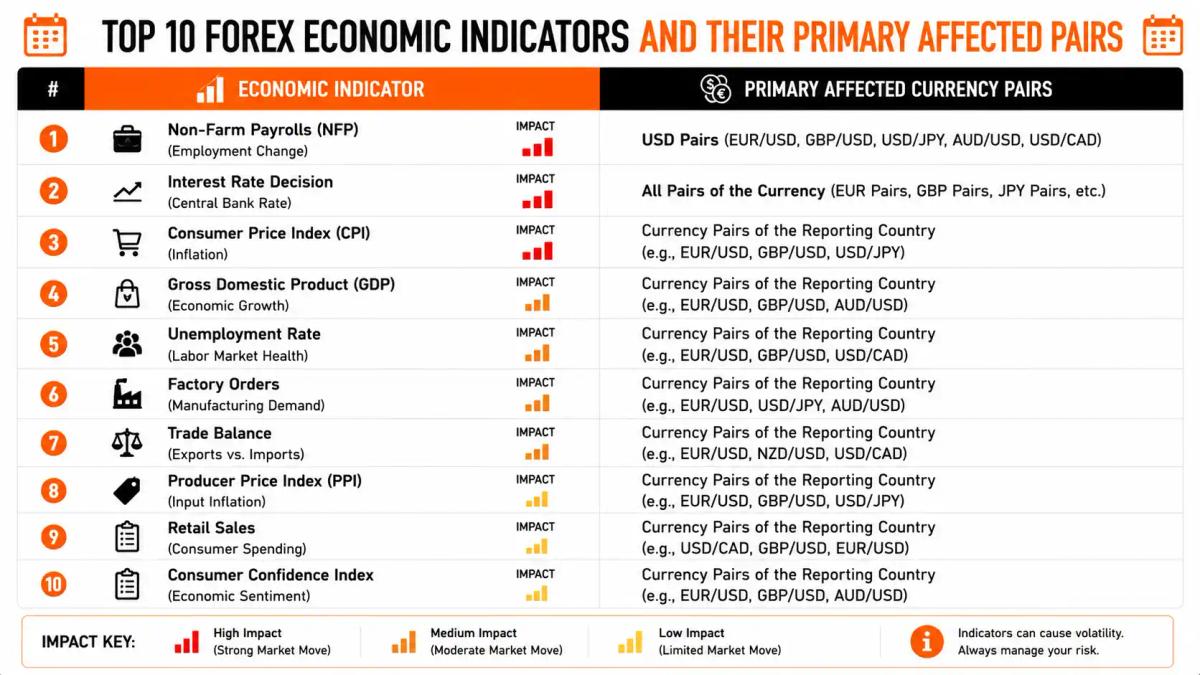
Economic indicators move currency markets more reliably than almost anything else a forex trader can monitor. Understanding which indicators matter, why they move prices, and what to watch for in each report turns economic data from background noise into actionable context.
This is a practical reference guide. Each indicator is explained with enough depth to be useful, without so much complexity that it becomes unusable.
Why Economic Indicators Move Currency Markets
Currency values are ultimately driven by flows of capital between countries. Those flows follow interest rates, inflation, growth expectations, and trade dynamics, all of which are directly measured by economic indicators. When a major indicator prints differently from what markets expected, traders reassess the outlook for the relevant currency and price adjusts accordingly.
Markets are forward-looking. Prices often begin moving before a release as positions are built around forecasts. The actual release then confirms, surprises, or disappoints those expectations, producing the price move you see on the chart. Trading economic releases is therefore less about knowing what the number is and more about understanding whether it's better or worse than consensus expected.
A single strong employment report can move a major currency pair more than weeks of technical setups. That's the scale of impact you're working with.
The 10 Forex Economic Indicators You Need to Know
1. Non-Farm Payrolls (NFP)
What it measures: Monthly US employment change, excluding agricultural workers. Released the first Friday of each month by the Bureau of Labor Statistics.
Why it moves forex markets: Employment data directly signals the health of the US economy and influences Federal Reserve interest rate expectations. A strong NFP raises the probability of rate rises or holds. A weak NFP raises the probability of cuts.
Which pairs are affected: All USD pairs: EUR/USD, GBP/USD, USD/JPY, USD/CHF, USD/CAD, AUD/USD, NZD/USD.
What traders watch for: The headline number versus consensus forecast, the revision to the prior month (often more significant than the headline), and the accompanying unemployment rate and average hourly earnings figures. The earnings component is critical for inflation assessment.
2. Consumer Price Index (CPI)
What it measures: The monthly change in the average price of a basket of consumer goods and services. The primary measure of inflation for most major economies.
Why it moves forex markets: CPI directly drives central bank interest rate decisions. Higher inflation raises rate hike expectations, which strengthens the currency. Lower inflation raises cut expectations, which weakens it.
Which pairs are affected: The pair corresponding to whichever country releases CPI. US CPI moves USD pairs. UK CPI moves GBP pairs. Eurozone HICP moves EUR pairs.
What traders watch for: Core CPI (excluding food and energy) is often weighted more heavily than headline CPI because it strips out volatile components. The year-on-year figure versus the central bank's target rate is the key comparison.
3. Interest Rate Decisions
What it measures: Central bank policy rate decisions from the Fed, ECB, Bank of England, Bank of Japan, RBA, and others.
Why it moves forex markets: Interest rate differentials between countries drive capital flows. Higher rates attract foreign capital seeking better returns, increasing demand for that currency. Rate decisions also carry forward guidance that shapes long-term positioning.
Which pairs are affected: Whichever currency's central bank is meeting. Fed decisions affect all USD pairs. ECB decisions affect EUR pairs. A single meeting can reprice a currency pair significantly if guidance is unexpected.
What traders watch for: Whether the decision matches expectations (often already priced in) or surprises. The statement language and press conference are frequently more market-moving than the decision itself: traders parse every word for signals about future policy direction.
4. Gross Domestic Product (GDP)
What it measures: The total economic output of a country over a quarter or year. The broadest measure of economic health.
Why it moves forex markets: GDP growth directly influences rate expectations and investor appetite for a currency. Strong growth suggests a healthy economy capable of sustaining higher rates. Contraction raises recession concerns and rate cut expectations.
Which pairs are affected: All pairs linked to the reporting economy. US GDP affects USD broadly. EU GDP affects EUR.
What traders watch for: The advance estimate (first release) is most market-moving because it's the first data point. Quarterly change versus forecast and year-on-year growth rate. Two consecutive quarters of contraction are the standard definition of recession.
5. Producer Price Index (PPI)
What it measures: The average change in selling prices received by domestic producers for their output. A leading indicator of consumer inflation.
Why it moves forex markets: Because producers pass costs down the supply chain, PPI changes tend to show up in CPI one to three months later. A rising PPI signals coming inflationary pressure, shaping rate expectations before CPI confirms it.
Which pairs are affected: Primarily USD pairs for US PPI, though equivalent measures in other economies affect their respective currencies.
What traders watch for: Core PPI (excluding food and energy) versus consensus. When PPI diverges significantly from CPI trends, it suggests consumer prices are about to move.
6. Retail Sales
What it measures: Monthly change in consumer spending on goods at the retail level. A direct measure of consumer demand.
Why it moves forex markets: Consumer spending drives a significant portion of GDP in developed economies. Strong retail sales signal consumer confidence and economic health, supporting the currency. Weak retail sales raise growth concerns.
Which pairs are affected: USD pairs for US retail sales. GBP pairs for UK retail sales. The US report has the broadest market impact.
What traders watch for: The core figure (excluding auto sales, which are volatile) versus forecast. A surprise in either direction frequently drives short-term momentum in the affected currency.
7. Purchasing Managers' Index (PMI)
What it measures: A monthly survey of purchasing managers indicating whether business conditions are expanding or contracting. Above 50 signals expansion. Below 50 signals contraction.
Why it moves forex markets: PMI is a leading indicator: it reflects current business conditions rather than historical data. Markets treat it as an early warning system for GDP direction. Manufacturing and services PMIs are both tracked.
Which pairs are affected: All major currency pairs have PMI equivalents. ISM in the US, S&P Global PMI for the UK and Eurozone, Caixin PMI for China (affects AUD as a proxy).
What traders watch for: The boundary between expansion and contraction (50) is the headline marker. The direction of trend, improving or worsening from the prior month, is often more significant than the absolute level.
8. Unemployment Rate
What it measures: The percentage of the labour force that is actively seeking work but not employed. Released monthly for most major economies.
Why it moves forex markets: Unemployment feeds directly into wage growth and consumer spending expectations, which influence inflation and therefore rate decisions. A falling unemployment rate is generally currency-positive.
Which pairs are affected: Primarily the currency of the reporting country. USD pairs for US unemployment, GBP pairs for UK, EUR pairs for Eurozone.
What traders watch for: Change versus forecast and versus prior month. In the US, unemployment is released alongside NFP and takes a secondary role to the employment change figure. In other economies, it's a more standalone release.
9. Trade Balance
What it measures: The difference between a country's exports and imports. A trade surplus means more exports than imports; a trade deficit means the reverse.
Why it moves forex markets: Trade flows directly affect currency demand. Countries with large trade surpluses see consistent demand for their currency from foreign buyers. Deficits can put downward pressure over time. Sudden changes in trade balance signal shifts in economic competitiveness.
Which pairs are affected: USD pairs for US trade balance. AUD and NZD pairs are particularly sensitive to trade balance given Australia and New Zealand's commodity-heavy export profiles.
What traders watch for: Widening or narrowing of the deficit or surplus versus prior period and versus expectations. The China trade balance is closely watched for its implications on AUD, given Australia's position as a major trading partner.
10. Consumer Confidence Index
What it measures: A survey-based measure of how optimistic consumers feel about current and future economic conditions. The Conference Board (US) and GfK (UK) are the primary publishers.
Why it moves forex markets: Consumer sentiment is a leading indicator of future spending. Rising confidence suggests consumers are more likely to spend, supporting GDP. Falling confidence signals potential economic weakness ahead.
Which pairs are affected: USD pairs for US consumer confidence. GBP pairs for UK GfK data.
What traders watch for: The headline number versus consensus and prior month. Large drops in consumer confidence, particularly when other economic signals look neutral, can be an early warning of a slowdown that hasn't yet shown up in hard data.
How to Use an Economic Calendar
An economic calendar lists upcoming data releases with their expected release time, the consensus forecast, and the previous result. Once a release occurs, the actual figure is added. It's the single most useful tool for planning around economic data.
Here's how to use it effectively:
- Filter by impact. Most calendars rate events by expected market impact: high, medium, or low. Focus primarily on high-impact events for your traded pairs.
- Check before every session. Before opening a trade, know what high-impact releases are scheduled for that session and the following one. This prevents being caught off guard.
- Note the consensus forecast. The direction of the market reaction depends less on the actual number than on how it compares to expectations. A good number that misses consensus can still weaken a currency.
- Track revisions. Prior period revisions often move markets as much as the new data. A strong headline masked by a major downward revision to the prior month is not as bullish as it appears.
- Use it for timing. The calendar tells you when volatility is likely. It doesn't tell you which direction the market will move. Treat it as a risk management tool.
Should You Trade Economic Releases or Avoid Them?
This is a genuine decision point, and there's a reasonable case for both approaches.
Arguments for trading releases:
- The largest and cleanest directional moves in forex often occur immediately after high-impact releases
- A significant surprise versus consensus can produce a substantial, fast move
- For traders already positioned with a macro view, releases can confirm and extend that view
Arguments for avoiding releases:
- Spreads typically widen significantly in the minutes before and after a release
- Price can move sharply in both directions before settling; a spike-and-reverse pattern is common
- Stop-losses may be triggered at significantly worse prices than intended due to price gapping
- The direction of the initial move is genuinely uncertain even with a strong number, because existing market positioning matters
The most practical approach for most traders: if you have no open positions, wait until after the initial spike settles before looking for an entry. If you have an open position in profit that's aligned with the likely release direction, consider taking partial profit before the release. If you have an open position against the likely direction, assess whether your stop is wide enough to survive a spike.
Experienced news traders use specific execution tools and typically have much faster execution than standard retail platforms allow. Trying to replicate their approach without those tools generally produces worse results.
Frequently Asked Questions
Do I need to follow all 10 indicators to trade forex successfully?
No. Most traders focus on the three to five indicators most relevant to the currency pairs they trade. If you trade primarily USD pairs, NFP, CPI, and interest rate decisions are your priority. If you trade commodity currencies (AUD, NZD, CAD), trade balance and broader global growth indicators become more relevant. Depth of understanding on a few key indicators beats surface-level awareness of all ten.
How far in advance are economic data releases scheduled?
Most major economic releases are scheduled weeks or months in advance, and exact dates and times are listed on economic calendars immediately. Central bank meeting schedules are published at the start of each year. Only surprise emergency decisions fall outside the calendar, and those are rare.
Can I trade NFP as a beginner?
NFP is one of the highest-impact and most unpredictable releases in the forex calendar. The move can be large, fast, and sometimes reverses immediately. Most experienced traders advise beginners to observe NFP releases and paper-trade them before risking real money. Understanding how the market reacts to the full picture, headline, revisions, and earnings, takes time to develop.
What does it mean when actual data beats expectations but the currency still falls?
This is the "buy the rumour, sell the news" dynamic. If the market was heavily positioned for a strong result, a good number that was already priced in doesn't produce new buying. Traders who bought in anticipation take profits at the release, causing price to drop. It's disorienting at first, but it reflects the forward-looking nature of markets.
Which currency pairs are most sensitive to economic data releases?
USD pairs are generally the most reactive to US economic data, given the dollar's reserve currency status. EUR/USD and GBP/USD have the highest retail trading volume and tend to react strongly to major releases. Commodity-linked pairs (AUD/USD, USD/CAD) are particularly sensitive to trade balance and Chinese economic data, given the trade relationships involved.
How do I know what the market consensus forecast is?
Economic calendars display consensus forecasts alongside each release. Forex Factory, Investing.com, and Bloomberg all show median analyst forecasts, compiled before the release date.
About the authors


Put this into practice
Related articles
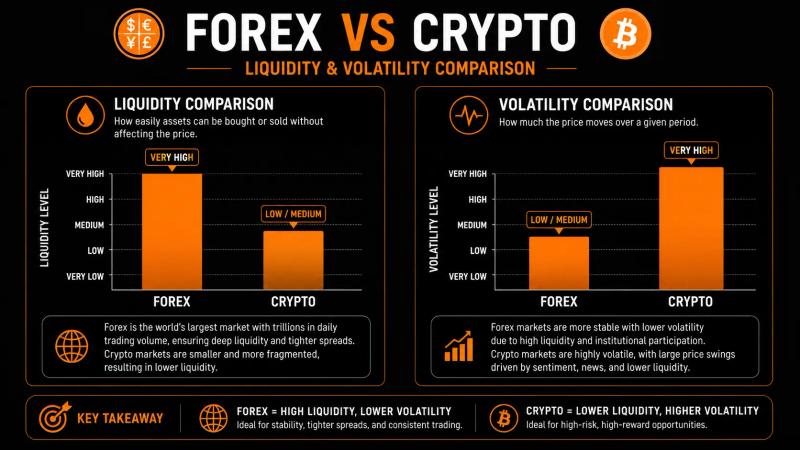
Forex vs Crypto: Which Market Has Better Risk-Adjusted Opportunities for Retail Traders?
Compare forex vs crypto on volatility, liquidity, regulation, and cost to find which market offers better risk-adjusted opportunities for you.

10 Forex Broker Red Flags to Watch Before Choosing a Forex Broker
Learn the 10 forex broker red flags that signal fraud or malpractice. Includes a step-by-step verification checklist and regulatory database links.

8 Signs That Indicate Currency Debasement (And What They Mean for Your Money)
Learn the key signs of currency debasement, from money supply expansion to purchasing power erosion, and what they mean for traders.
0 comments