



What Is Forex Trading and How Does It Work?
While you slept last night, the forex market moved trillions of dollars across continents: a 24-hour financial battlefield where currencies rise and fall with every headline.
The foreign exchange market is the largest financial market in the world. Unlike stock exchanges that operate from specific locations, forex trading runs around the clock across a global network of banks, institutions, and individual traders. If you are curious about how currencies are traded and what participation actually involves, understanding the fundamentals comes first.
This guide explains what forex trading is, how the market operates, and what you need to know before placing your first trade. By the end, you’ll have a clear picture of how currency trading works and the practical steps involved in getting started.
Warning: Forex trading involves significant risk of loss and is not suitable for all investors. The content in this article is educational and should not be considered financial advice.
What Is Forex Trading?
The Forex Market Explained
Forex, short for foreign exchange, refers to the global marketplace where currencies are bought and sold. When you exchange money at an airport or bank before traveling abroad, you’re participating in a simplified version of what happens in the forex market.
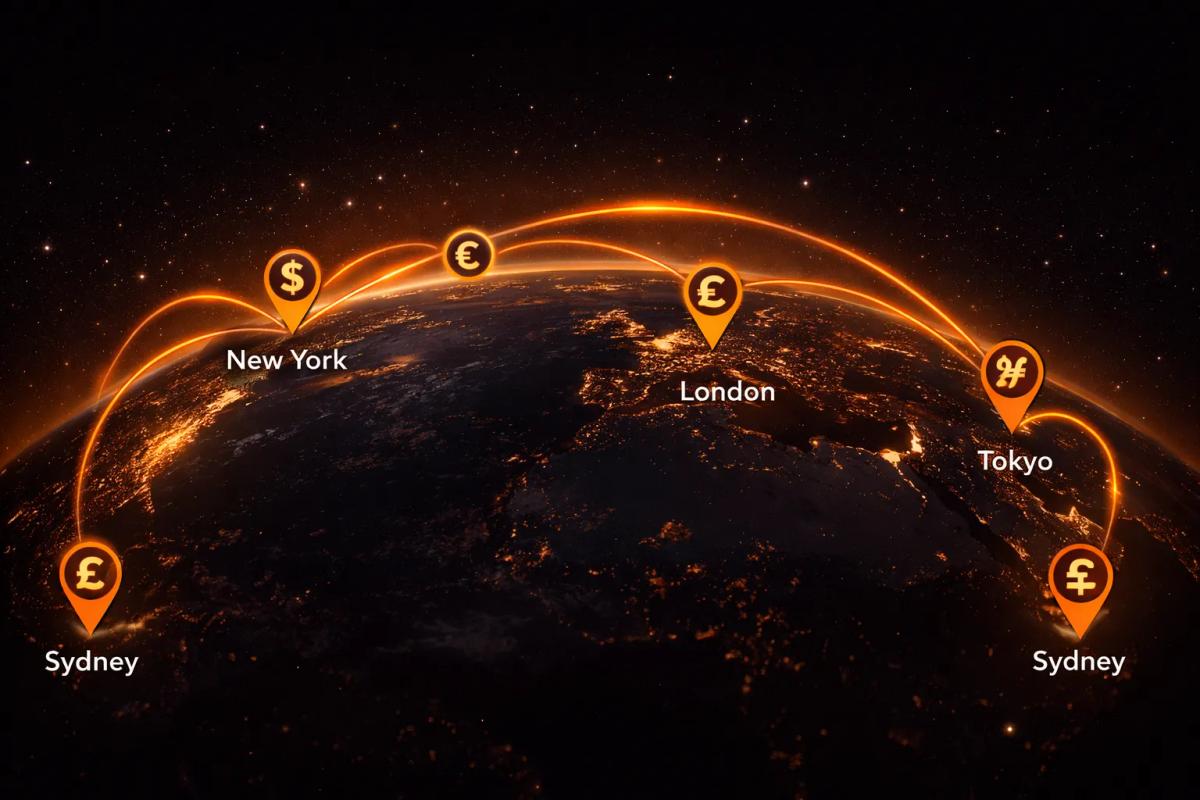
The forex market operates as a decentralized network rather than a single physical exchange. Trading takes place electronically between participants worldwide, including central banks, commercial banks, hedge funds, corporations, and individual retail traders. This decentralized structure means the market runs continuously from Sunday evening through Friday evening, following the sun across major financial centers: Sydney, Tokyo, London, and New York.
Daily trading volume in forex dwarfs that of stock markets. This high volume creates substantial liquidity, meaning large amounts of currency can typically be exchanged without dramatically affecting prices.
How Forex Differs from Stock Trading
While both forex and stock trading involve buying and selling assets to profit from price movements, several key differences set them apart.
In stock trading, you purchase shares representing ownership in a company. In forex, you’re exchanging one currency for another, speculating on whether one of them will strengthen or weaken against the other.
Stock markets operate during specific hours tied to their geographic location. The New York Stock Exchange, for instance, is open roughly six and a half hours per weekday. Forex, by contrast, operates 24 hours a day during the trading week, allowing participants to respond to news and events as they happen regardless of time zone.
Forex trading also typically involves higher leverage than stock trading, which amplifies both potential gains and potential losses. Additionally, the forex market has no central exchange and no standardized contract sizes in the way stock exchanges have standardized share units.
How the Forex Market Works
The forex market operates according to its own set of dynamics and mechanisms, much like other financial markets. Let’s go over them.
Currency Pairs and How They Are Quoted
Currencies in forex are always traded in pairs. When you trade forex, you’re simultaneously buying one currency and selling another. The price you see represents how much of the second currency is needed to purchase one unit of the first.
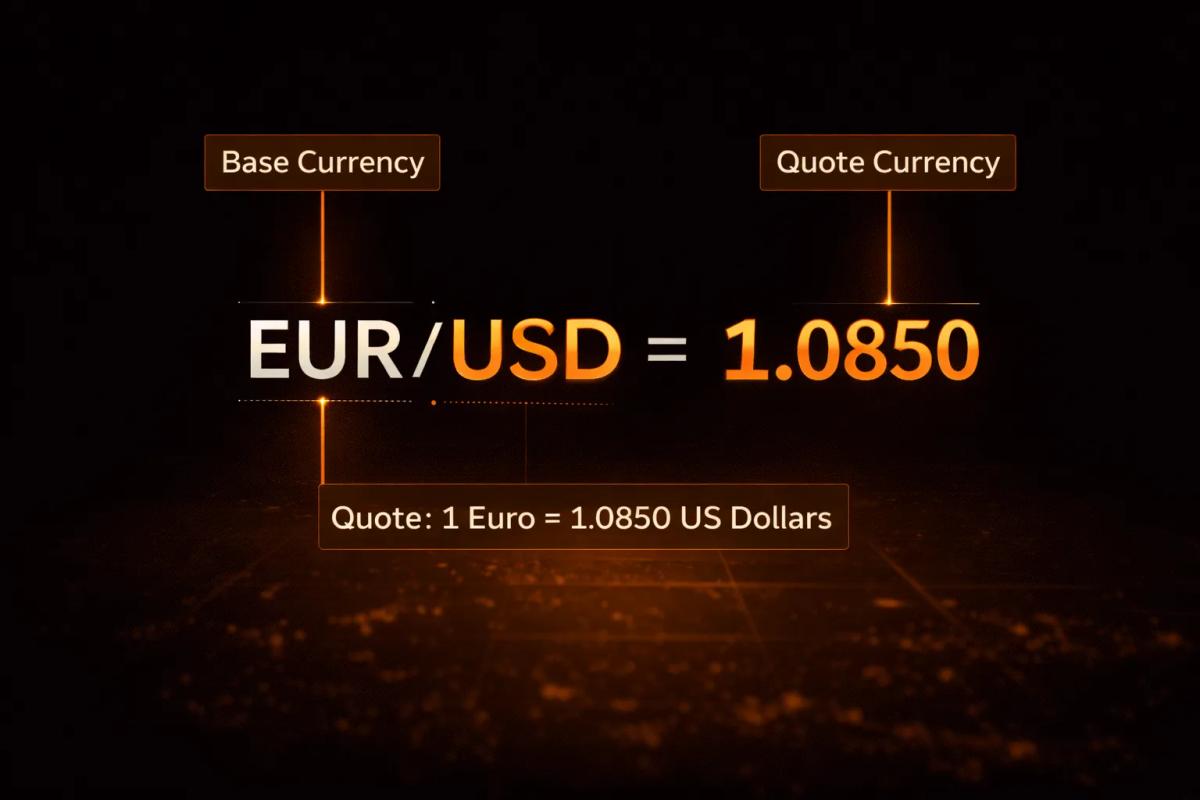
A currency pair consists of a base currency and a quote currency. The base currency appears first; the quote currency appears second. In EUR/USD, the euro is the base currency and the US dollar is the quote currency. If EUR/USD is quoted at 1.0850, one euro can be exchanged for 1.0850 US dollars.
When you believe the base currency will strengthen against the quote currency, you buy the pair. When you believe the base currency will weaken, you sell it.
Major, Minor, and Exotic Pairs
Currency pairs fall into three categories based on trading volume and the economies they represent.
Major pairs all include the US dollar and represent the most heavily traded and used currencies globally. Examples include EUR/USD, USD/JPY, GBP/USD, and USD/CHF. These pairs typically have the tightest spreads and highest liquidity because of the trading volume they attract.
Minor pairs, also called cross pairs, involve major currencies but exclude the US dollar. EUR/GBP, EUR/JPY, and GBP/JPY are examples. These pairs have somewhat less liquidity than majors but remain actively traded.
Exotic pairs combine a major currency with the currency of a developing or smaller economy, such as USD/TRY (US dollar/Turkish lira) or EUR/ZAR (euro/South African rand). Exotic pairs tend to have wider spreads and lower liquidity, making them more volatile and potentially more costly to trade.
What Moves Currency Prices
Currency values fluctuate based on supply and demand, influenced by economic, political, and market factors.
Interest rate decisions by central banks rank among the most significant drivers. When a country raises interest rates, its currency often strengthens because higher rates attract foreign investment seeking better returns. Rate cuts, conversely, can weaken a currency.
Economic indicators (such as employment data, inflation figures, gross domestic product growth) also impact currency prices. Strong economic performance tends to support a currency, while weak data can lead to depreciation.
Political stability and geopolitical events play a role as well. Elections, policy changes, trade disputes, and unexpected developments can create uncertainty that moves currency markets. Market sentiment and speculation contribute to short-term price movements as traders react to news and position themselves based on expectations.
Key Forex Trading Concepts
Interested in forex trading? Before you begin, there are some vital concepts you need to understand to fully grasp how currency trading works.
Pips, Lots, and Leverage
Understanding pips, lots, and leverage is essential for grasping how forex trades are measured and how positions are sized.
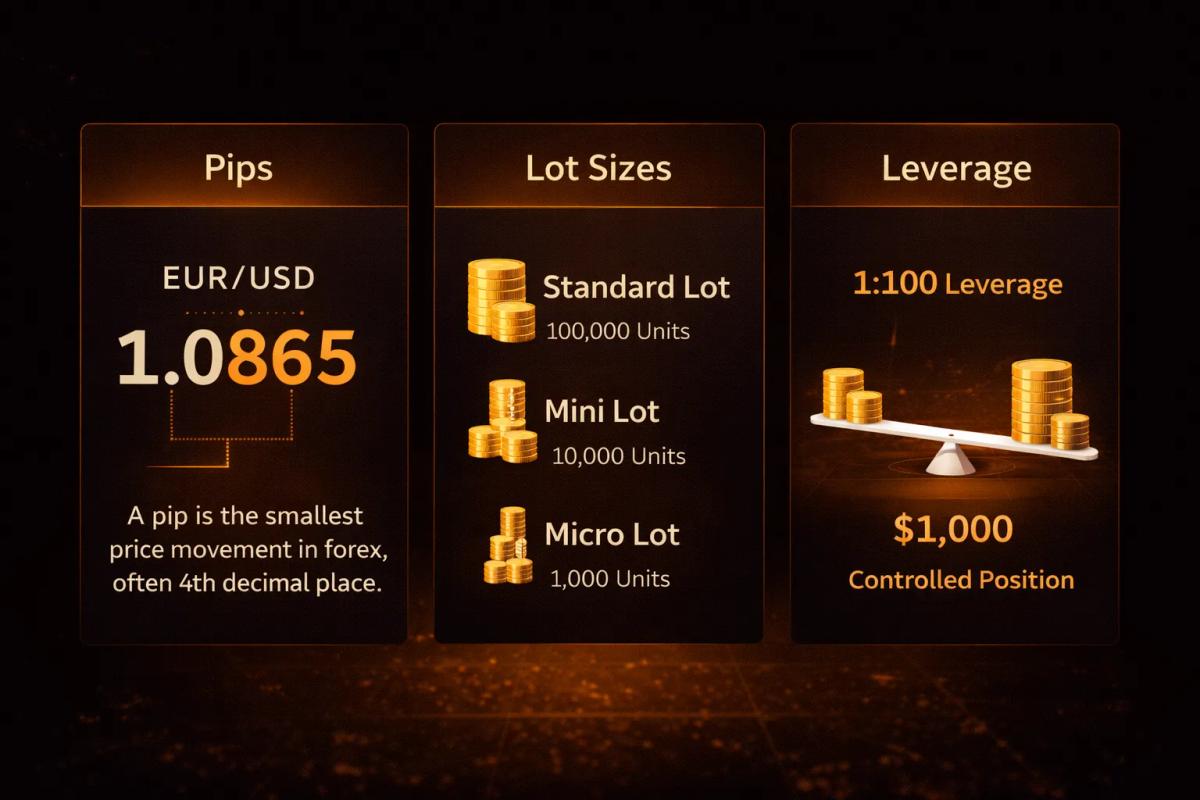
A pip (standing for “percentage in point” or “price interest point”) is the smallest standard price movement in a currency pair. For most pairs, a pip is the fourth decimal place (0.0001). If EUR/USD moves from 1.0850 to 1.0851, it has moved one pip. For pairs involving the Japanese yen, a pip is the second decimal place because yen-based pairs are quoted differently.
Lot size refers to the quantity of currency you can trade. A standard lot is 100,000 units of the base currency, a mini lot is 10,000 units, and a micro lot is 1,000 units. Smaller lot sizes allow traders to control position sizes and risk exposure more precisely.
Leverage allows you to control a larger position than your account balance would otherwise permit. If a broker offers 100:1 leverage, a trader with $1,000 could control a position worth $100,000 by borrowing directly from the broker.
Leverage is a double edge sword: while it can magnify profits, it equally magnifies losses. A small adverse price movement can result in losses exceeding the initial investment. Leverage is one of the primary reasons forex trading carries substantial risk, so make sure you understand its implications thoroughly before using it.
Bid, Ask, and Spread
Every currency pair has two prices: the bid and the ask. The bid is the price at which you can sell the base currency; the ask is the price at which you can buy it. The ask is always slightly higher than the bid.
The difference between these two prices is called the spread. If EUR/USD has a bid of 1.0848 and an ask of 1.0850, the spread is 2 pips. The spread represents a transaction cost built into every trade. Tighter spreads are generally preferable because they reduce the cost of entering and exiting positions.
Spreads vary based on market conditions, the currency pair, and the broker. Major pairs typically have the tightest spreads due to high liquidity, while exotic pairs often have wider spreads.
Long and Short Positions
A long position means you’ve bought a currency pair, expecting the base currency to rise in value relative to the quote currency. If you go long on EUR/USD and the price increases, you profit when you close the position.
A short position means you’reve sold a currency pair, expecting the base currency to fall. If you go short on EUR/USD and the price decreases, you profit when you close the position.
The ability to profit from both rising and falling prices distinguishes forex from some other markets. This flexibility doesn’t reduce risk, however: incorrect predictions result in losses regardless of whether the position is long or short.
How to Start Forex Trading
Choosing a Forex Broker
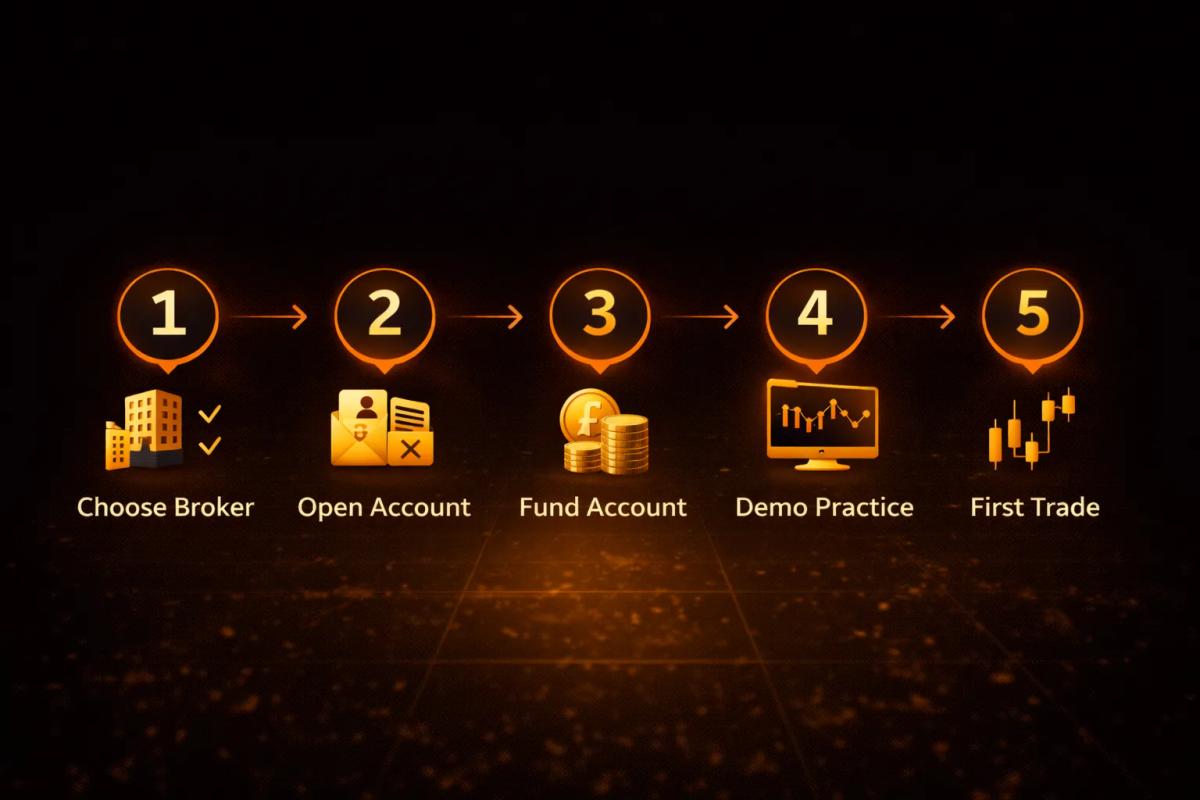
A forex broker provides the platform and access necessary for individual traders to participate in the currency market. Selecting a broker is an important decision that affects your trading experience, costs, and the safety of your funds, as different brokers have both unique advantages and limitations.
Regulation is a primary consideration. Reputable brokers operate under the oversight of financial regulatory authorities in their jurisdictions. Regulated brokers must meet certain standards for capital requirements, client fund segregation, and business practices. Checking whether a broker is properly licensed provides a baseline level of protection.
Other factors you might want to evaluate before making a decision include the trading platform offered, available currency pairs, spread and commission structures, deposit and withdrawal options, and quality of customer support. Many brokers offer demo accounts that let you practice trading with virtual money before committing real funds.
For a more detailed comparison of broker features and considerations, see our broker comparison tool.
Opening and Funding a Trading Account
Once you’ve selected a broker, opening an account typically involves completing an online application. You’ll need to provide personal information and identification documents to verify your identity. Don’t worry, this is a standard requirement for regulated financial services.
Brokers often offer different account types with varying minimum deposit requirements, leverage options, and fee structures. Beginners may want to start with an account type that allows smaller position sizes and lower minimum deposits while learning.
Funding your account can usually be done through bank transfer, debit card, credit card, or electronic payment services, depending on what the broker accepts. Be aware of any fees associated with deposits or withdrawals and how long funds take to become available.
Before trading with real money, it’s a good idea to use a demo account to familiarize yourself with the trading platform and practice executing trades without financial risk.
Placing Your First Trade
When you’re ready to start trading, you have to follow certain steps to make sure you don’t make any mistakes.
First, select the currency pair you want to trade. Then decide whether you expect the base currency to strengthen (buy/long) or weaken (sell/short) against the quote currency.
Next, determine your position size based on your account balance and how much you’re willing to risk. Many traders use stop-loss orders to automatically close a position if the price moves against them by a specified amount, helping limit potential losses.
After setting your parameters, you execute the trade through your broker’s platform. The position remains open until you manually close it, it hits a stop-loss or take-profit level you’ve set, or other conditions you’ve specified are met.
New traders should start with small position sizes and focus on understanding how the mechanics work before increasing exposure. Developing a clear plan for when and why you enter and exit trades matters more than the size of any individual trade.
Risks of Forex Trading
As any other investment, Forex trading carries significant risk. Understanding these is essential before committing real capital.
Like we said, leverage amplifies both gains and losses. While it allows you to control larger positions, it also means relatively small price movements can result in substantial losses relative to your account balance. Many retail traders lose money when trading leveraged forex products.
On another note, market volatility can lead to rapid price changes, particularly during major economic announcements, unexpected news, or periods of low liquidity. Prices can move against your position faster than you can react, and stop-loss orders may not always execute at the exact price specified during volatile conditions.
The 24-hour nature of the market means prices can move significantly while you’re not actively monitoring positions. Currency markets also react to a wide range of global factors, many of which are difficult to predict. With that in mind, it’s a good idea to implement risk management mechanisms (like stop loss orders) and tactics to always be prepared for unforeseeable factors.
Emotional decision-making poses another risk, especially for beginners. Trading losses can lead to frustration; winning trades can lead to overconfidence. Both states can result in poor decisions and increased losses over time.
Before trading with real money, consider whether you can afford to lose the funds you plan to invest. Developing an understanding of risk management principles and approaching trading with discipline can help mitigate some risks but cannot eliminate them entirely.
Frequently Asked Questions
How much money do I need to start forex trading?
The minimum varies by broker and account type. Some brokers allow accounts with as little as $50 or $100, while others require larger minimums. Micro and mini lot sizes make trading with smaller amounts possible. That said, starting with a small account means individual trades must also be small to manage risk appropriately.
Is forex trading risky?
Yes. Forex trading involves substantial risk of loss, particularly when using leverage. A significant percentage of retail traders lose money. You should only trade with funds you can afford to lose and take time to learn about the market before risking real capital.
Can I practice forex trading without risking real money?
Yes. Most brokers offer demo accounts that simulate real trading conditions using virtual funds. Demo accounts let you learn how the platform works and practice trading strategies without financial risk. They're valuable for beginners before transitioning to live trading.
What are the best times to trade forex?
The forex market operates 24 hours a day during the week, but activity and liquidity vary. The highest trading volumes typically occur when major financial centers are open, particularly during the overlap between London and New York sessions. The best time to trade depends on which currency pairs you're trading and your personal schedule.
Do I need a lot of experience to trade forex?
While you can technically open an account and begin trading with minimal experience, doing so without adequate knowledge increases the likelihood of losses. Taking time to understand how the market works, practicing with a demo account, and learning fundamental concepts before risking real money is strongly recommended.
About the authors


Put this into practice
Related articles
What Is ROI and How to Calculate It
Learn what ROI means, how to calculate return on investment step by step, and what your results reveal about trading and portfolio performance.

What is Trading in Finance? A Complete Beginner’s Guide
Learn what trading means in finance, how markets work, different types of trading, and what you need to start. A clear guide for beginners to get started.

When Does the Market Open? Hours by Exchange, Asset Class, and Time Zone
A plain-English guide to US and global market opening times, extended hours, holiday closures, and the best windows to trade across asset classes.
0 comments