



Financial Markets · Intermediate
Forex vs Crypto: Which Market Has Better Risk-Adjusted Opportunities for Retail Traders?
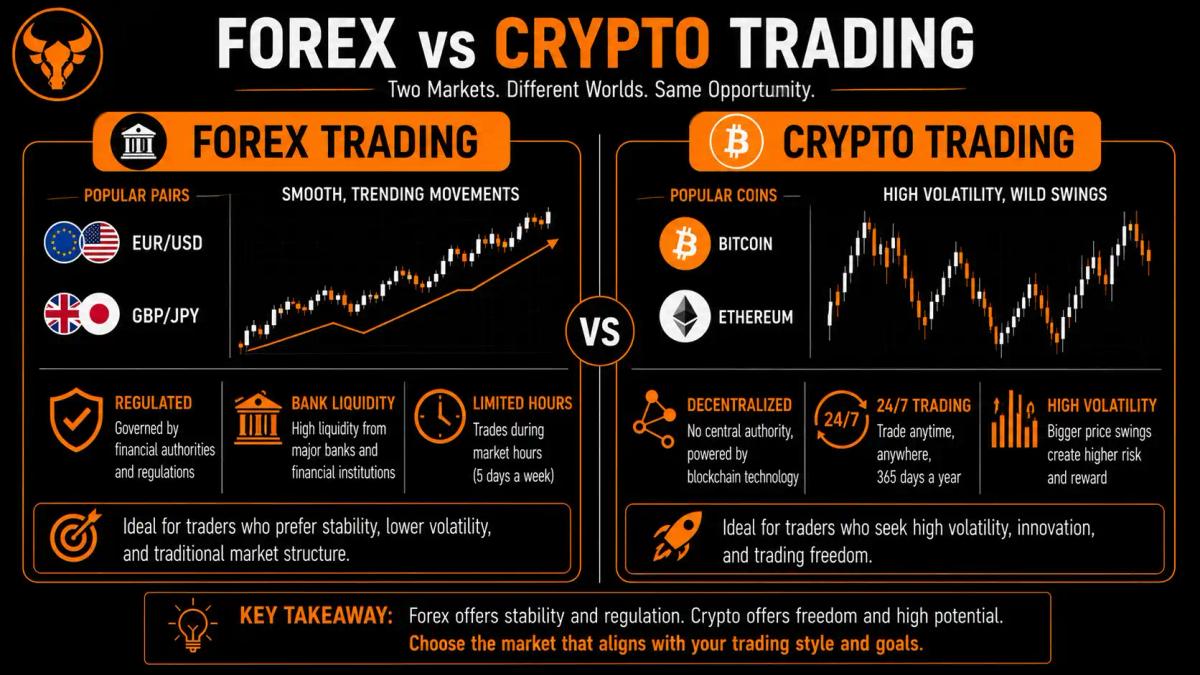
Forex and crypto attract retail traders for the same reason, the chance to grow capital, but they reward and punish very differently once you account for risk. If you are also deciding between forex and stocks, the same risk-adjusted framework applies.
This guide compares the two markets on volatility, liquidity, regulation, and cost so you can match the right one to your own risk tolerance and trading style. Neither market is safer or guaranteed to be profitable, your capital is at risk in both, and regulatory status varies by region, so the aim here is fit rather than a verdict.
What "Risk-Adjusted" Really Means for Retail Traders
A market that doubles your account in a week can halve it just as fast, and headline returns hide that reality. Risk-adjusted thinking asks a sharper question: how much return are you getting for the amount of risk you are taking on?
Two traders can earn the same percentage gain, but the one who endured wild account swings to get there took far more risk for the same reward. For retail traders, risk-adjusted opportunity comes down to a few practical factors:
- How violently the market moves against you
- How easily you can enter and exit at the price you expect
- How well your funds and counterparty are protected
- How much each trade costs you to hold and to close
These tilt differently between forex and crypto, so let us take them one at a time, beginning with the one most traders feel first.
Volatility: How Each Market Moves
Volatility is where the two markets feel most different, and it is usually the first thing that catches a new trader off guard. Crypto routinely posts daily swings that major forex pairs might take weeks to produce.
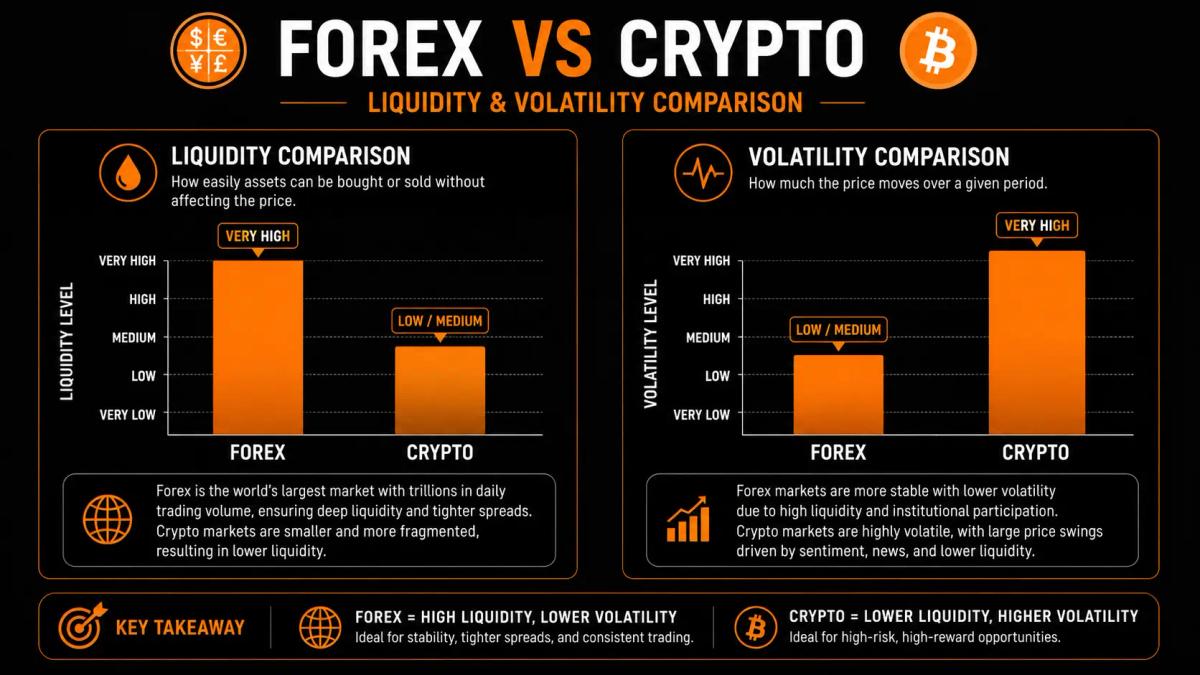
Major forex pairs like EUR/USD tend to move in fractions of a percent on an ordinary day. That relative calm makes position sizing more predictable and lets you hold positions without your stomach lurching every hour. Crypto assets can move several percent in a single session, and far more during major events, which creates larger opportunities and larger drawdowns in equal measure.
Higher volatility is neither good nor bad on its own. It rewards traders who size positions correctly and stay disciplined, and it quietly drains those who cannot. The more a market moves, the more carefully you have to control how much you put on each trade, and position sizing is how you exercise that control.
Liquidity and Market Depth
Liquidity decides whether you actually get the price you see on your screen, and it is easy to ignore until a fast market reminds you it exists. Forex is the most liquid market in the world, with enormous daily turnover concentrated in the major pairs.
Deep liquidity means tight spreads and minimal slippage on major forex pairs, so your entries and exits land close to where you intend, even in size. Crypto liquidity varies enormously. The largest assets like Bitcoin and Ethereum are reasonably deep, but smaller tokens can be thin, and during sharp moves spreads widen and orders can fill far from your expected price. The thinner the market, the more the price can move against you simply because you tried to trade it. Liquidity also feeds directly into how safe your money is once it is in the market.
Regulation and Counterparty Safety
This is where the two markets diverge most sharply, and it deserves your full attention because it concerns the safety of your funds. Forex brokers in major jurisdictions operate under established regulatory frameworks, while crypto regulation remains uneven and still developing across regions.
Regulated forex brokers are typically required to follow rules on client fund segregation, capital adequacy, and conduct, and many regions offer some form of compensation scheme. A broker comparison guide can help you evaluate which regulated brokers are worth shortlisting.
Crypto exchanges operate under a patchwork of rules that differs widely by country, and protections that forex traders take for granted may be weaker or absent. Counterparty risk, the danger that the platform holding your funds fails or freezes withdrawals, has been a real and costly issue in crypto. Before you commit capital, confirm the regulatory status that applies in your region, because it varies and it directly affects how exposed you are.
Costs: Spreads, Fees, and Funding
Costs quietly erode returns, and the two markets charge you in different ways. Comparing them properly means looking past the headline spread to everything you pay across the life of a trade.
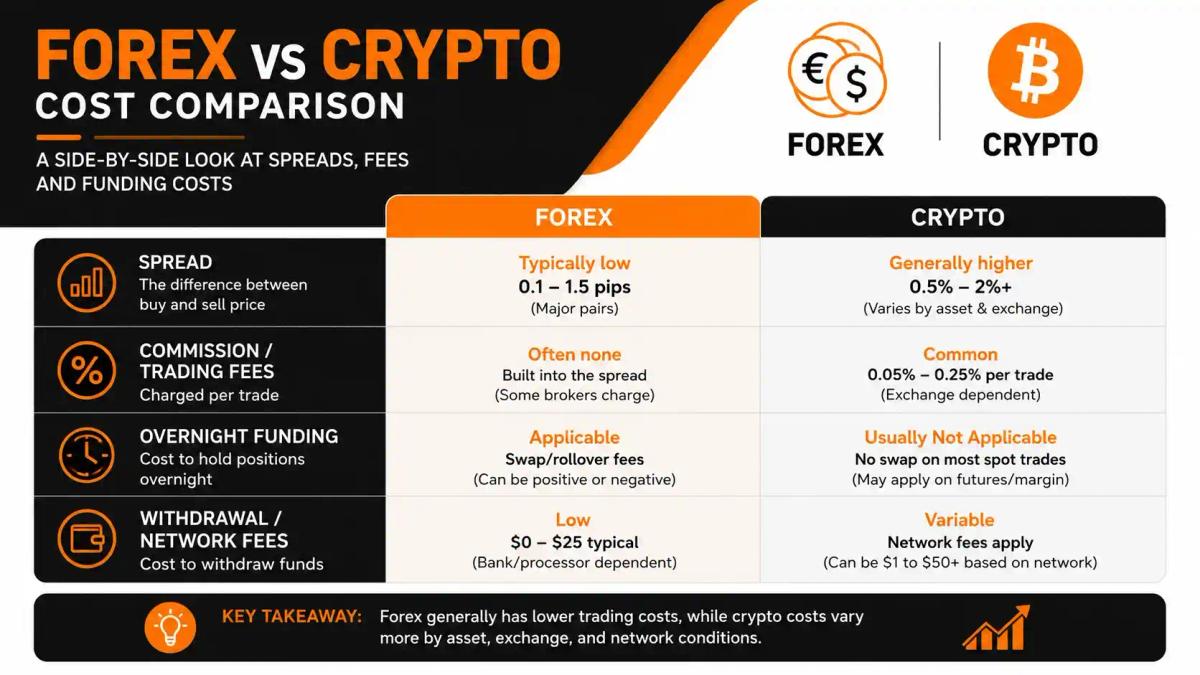
| Cost factor | Forex (major pairs) | Crypto |
|---|---|---|
| Spread | Typically tight on majors | Tight on large caps, wider on smaller tokens |
| Commission | Often a small per-lot fee or built into spread | Often a percentage trading fee per transaction |
| Overnight funding | Swap charged or credited on positions held overnight | Funding rate on leveraged positions, can be frequent |
| Withdrawal/network | Usually minimal | Network fees can apply and vary by asset |
The right cost comparison depends on your style. Frequent traders feel per-transaction fees and spreads most, while position traders care more about overnight funding. Read the full cost structure before you choose, because the market that looks cheapest on the surface is not always the cheapest to actually trade. Cost also depends on when, and how often, you can be at the screen.
Market Hours and Accessibility
When a market is open shapes the kind of life your trading fits into, and the two could hardly be more different. Forex runs around the clock on weekdays, while crypto never closes at all.
The forex market trades 24 hours a day, five days a week, following the major financial centres around the globe. That gives you flexibility while still offering a weekend break when the market is shut. Crypto trades 24 hours a day, seven days a week, with no close. The constant availability can be convenient, but it also means the market can move sharply while you sleep on a Sunday, with no pause to reset. Your schedule and temperament decide which rhythm suits you, which leads to the question that matters most.
Which Market Fits Which Trader
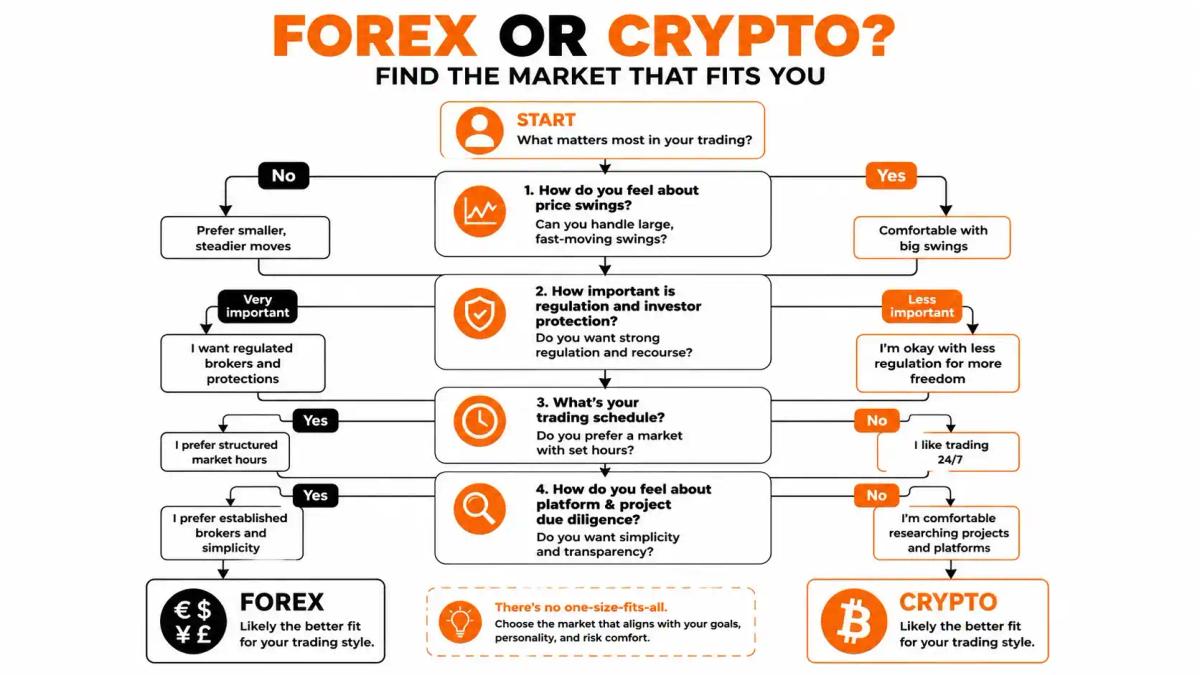
No market is universally better. The right one fits your tolerance for swings, your schedule, and your access to a safe platform. Here is how to think about which side you lean toward.
When Forex Makes More Sense
Forex tends to suit you better if:
- You prefer steadier, more predictable movement over dramatic swings
- You value established regulatory oversight and clearer fund protection
- You trade major pairs and want tight spreads with deep liquidity
- You want a defined weekly structure with a weekend pause
When Crypto Makes More Sense
Crypto tends to suit you better if:
- You can tolerate large drawdowns and size positions accordingly
- You want exposure to a fast-moving market with bigger daily ranges
- You are comfortable doing your own due diligence on platform safety
- You want a market that is open at any hour, including weekends
Many traders eventually touch both, but starting with the market that matches your risk tolerance spares you from learning expensive lessons early. The honest answer to which market is better is the one you can trade without losing your discipline.
Frequently Asked Questions
Which is more volatile, forex or crypto?
Crypto is generally far more volatile than the major forex pairs, often moving several percent in a day where majors move fractions of a percent. That larger range creates bigger opportunities and bigger drawdowns, so it demands tighter position sizing.
Which market is better for beginners?
Many beginners find major forex pairs easier to manage because the movement is steadier and the regulatory framework is more established. Crypto is accessible too, but its volatility and uneven platform safety can punish inexperience more quickly.
How do the regulations differ between the two?
Forex brokers in major jurisdictions operate under established rules covering fund segregation and conduct, while crypto regulation is uneven and still developing across regions. The protections available to you depend heavily on where you live and which platform you use.
How much capital do I need to start in each?
Both markets allow you to start small, and the right amount depends on your strategy and risk limits rather than the market itself. Focus on capital you can afford to lose entirely, and on sizing each trade to a small percentage of your account.
Should I trade both forex and crypto?
You can, and some traders run both, but spreading yourself across two very different markets early can dilute your focus. Building competence and discipline in one market first usually serves you better before adding the second.
About the authors


Put this into practice
Related articles

10 Forex Broker Red Flags to Watch Before Choosing a Forex Broker
Learn the 10 forex broker red flags that signal fraud or malpractice. Includes a step-by-step verification checklist and regulatory database links.

8 Signs That Indicate Currency Debasement (And What They Mean for Your Money)
Learn the key signs of currency debasement, from money supply expansion to purchasing power erosion, and what they mean for traders.

9 Key Reasons to Trade: Why People Enter the Financial Markets
Discover why millions trade financial markets. Explore the benefits of trading, from income potential and flexibility to skill development.
0 comments