



Financial Markets · Beginner · 8 min read
Crypto Trading Explained: Spot, Leverage, and Regulatory Considerations
Crypto trading is the buying and selling of digital assets like Bitcoin and Ethereum to profit from price movements, either by owning the coin (spot trading) or by taking a leveraged position on its price through derivatives. You can trade on centralised exchanges, decentralised protocols, or regulated brokers offering contracts for difference, subject to your jurisdiction's rules.
What is Crypto Trading and How Does It Work?
Crypto trading covers any transaction where you take a position on the price of a digital asset. In spot trading, you exchange fiat currency for coins and hold them in an exchange account or a personal wallet; your profit or loss is the difference between purchase and sale price. In derivative trading, you never own the coin: you trade a contract whose value tracks the underlying, often with leverage (borrowed exposure that multiplies both gains and losses).
The mechanics differ by venue. Centralised exchanges match buyers and sellers on an order book and custody your assets. Decentralised exchanges execute trades through smart contracts, so you keep custody. Regulated brokers offer CFDs (contracts for difference, a derivative that pays the price difference between opening and closing a trade) where local rules permit. Your choice determines who holds your funds, what protections apply, and what fees you pay.
Spot Trading vs Leverage Trading: Key Differences
Spot trading and leverage trading solve different problems. Spot buys you the coin outright: no liquidation risk, no funding cost, but you must commit the full purchase price. Leverage trading, sometimes called margin or derivative trading, lets you post a fraction of the trade value as collateral (margin) and control a larger notional position. If the market moves against you past a threshold, the platform liquidates your position to protect the lender.
The table below sets out the core differences you should weigh before choosing a route.
| Feature | Spot trading | Leverage trading |
|---|---|---|
| Ownership | You own the coin | You hold a contract only |
| Capital required | Full trade value | Margin only (e.g. 10-50%) |
| Liquidation risk | None | Yes, if margin is breached |
| Overnight cost | None | Funding rate or swap |
| Short selling | Not directly | Yes |
| Custody risk | Exchange or self-custody | Broker counterparty risk |
| Suits | Long-term holders, small accounts | Active traders comfortable with drawdown |
A drawdown (the fall from a capital peak to the trough before a new peak) of 30% is unremarkable in crypto. With 5x leverage, the same market move wipes an unhedged account. Match the product to your time horizon and how much loss you can absorb without exiting emotionally. Understanding position sizing in trading is essential to surviving leverage without catastrophic loss.
Popular Cryptocurrencies and Market Structure
Bitcoin and Ethereum dominate crypto trading by market capitalisation and by liquidity. Most retail traders concentrate on major pairs like BTC/USD and ETH/USD because spreads (the gap between the best bid and the best ask price) are tight and order books are deep, meaning large orders fill without moving the market much. Beyond the top two, thousands of altcoins trade across different use cases: stablecoins pegged to fiat, layer-1 protocols, DeFi tokens, and memecoins.
Smaller altcoins can produce dramatic moves, but liquidity is thin. A single large order can slip the price several per cent, and delisting risk on exchanges is real. Regulatory clarity is also weaker: many altcoins have unresolved status under US securities law, which affects whether US-facing brokers list them at all. For a retail trader building experience, sticking to majors reduces execution risk and keeps analysis tractable. If you want to compare how different markets behave, forex versus crypto risk-adjusted opportunities offers a structured comparison.
Risk Management and Position Sizing in Crypto Markets
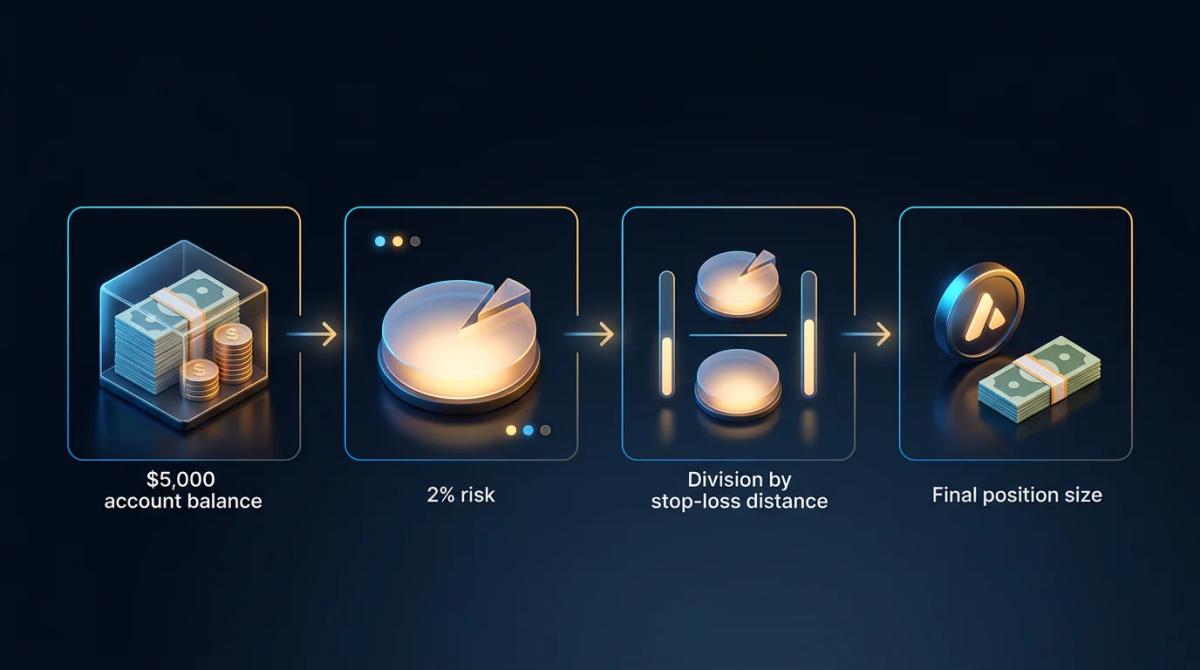
Crypto volatility routinely exceeds forex or equities, so position sizing is the difference between a viable trading account and a wiped one. A widely used rule is to risk no more than 1 to 2% of your account balance per trade. On a $5,000 account, that caps loss at $50 to $100 per position. To translate that into a trade size, you set a stop loss (a resting order that closes the trade at a defined loss) and divide the risk in dollars by the distance to the stop.
Leverage complicates this. A 5x position doubles your notional exposure relative to a 2.5x position for the same margin, so the same stop distance produces twice the loss. Calculate the pound or dollar loss at your stop before you enter. Add scenario tests for gap risk: crypto trades 24/7, but exchanges do halt and prices do jump. Assume your stop may fill worse than posted, particularly on altcoins. To avoid forced liquidation, learn what triggers a margin call and how to manage collateral.
Fees, Spreads, and Trading Costs
Crypto trading costs are rarely a single number. Centralised exchanges charge maker fees (for orders that add liquidity) and taker fees (for orders that remove it), commonly in the 0.1% to 0.5% range per side. Regulated brokers offering CFDs typically charge a spread or a commission per trade, plus an overnight funding rate on leveraged positions. Decentralised exchanges add network gas fees, which spike during congestion.
Over a year of active trading, these costs compound heavily. A trader taking 200 round-trip trades at 0.2% per side pays 0.8% per round trip, or roughly 160% of turnover in fees. Compare the total cost of ownership across venues before committing capital: headline spreads, funding rates, deposit and withdrawal fees, and any inactivity charges. Cheap headline pricing paired with expensive withdrawals is a common trap.
Regulatory Status and Compliance Across Jurisdictions
Crypto regulation is fragmented, and it defines what you can actually trade. In the UK, the Financial Conduct Authority (FCA) has prohibited the sale of crypto derivatives, including CFDs and futures on crypto assets, to retail consumers since January 2021 (FCA Policy Statement PS20/10). If you are a UK retail trader, an FCA-authorised firm cannot offer you crypto CFDs at any leverage. Spot crypto trading itself is not banned, but it sits outside the FCA's investor protection regime for regulated investments.
The European Union's Markets in Crypto-Assets Regulation (MiCA) began phasing in during 2024, introducing licensing for crypto asset service providers across member states. The United States splits oversight: the Commodity Futures Trading Commission regulates crypto futures, the Securities and Exchange Commission asserts jurisdiction over tokens it deems securities, and state regulators layer on their own rules. Offshore brokers may accept UK, EU, or US residents through non-domestic entities; if the entity onboarding you is not authorised in your country, local investor protections do not apply and complaints have limited recourse. Why your broker's regulation tier matters more than you think when choosing where to deposit. Check the register of your national regulator before depositing.
Tax Implications and Record-Keeping for Crypto Traders
In the UK, His Majesty's Revenue and Customs (HMRC) treats crypto as an asset, not as currency. Disposals, whether selling for fiat, swapping one token for another, or spending crypto on goods, trigger a capital gains tax event. You report the gain or loss per disposal, applying the annual CGT allowance and the share pooling rules HMRC sets out in its Cryptoassets Manual. Frequent traders may fall under income tax rules instead, though HMRC treats this as rare.
Record-keeping is where most retail traders fail. You need date, asset, quantity, GBP value at the moment of the trade, counter-asset, and any fees for every transaction, including internal transfers between wallets. Portfolio trackers such as Koinly or CoinTracker automate this by importing exchange APIs, but you remain responsible for accuracy. A crypto-literate accountant is worth the fee if you trade more than a handful of times a month.
Getting Started: Platform Selection and Account Setup
Platform choice depends on what you want to trade and where you live. Centralised exchanges like Kraken and Coinbase suit spot trading and offer straightforward onboarding for UK and EU residents. Regulated brokers such as IG or OANDA offer crypto exposure through CFDs where local rules permit, which excludes UK retail clients for crypto CFDs. Decentralised platforms like Uniswap require a self-custody wallet and give you full control at the cost of full responsibility for security.
Expect an identity verification process (KYC): passport or driving licence, proof of address, and sometimes source of funds. Fund the account through bank transfer or debit card, keep two-factor authentication on, and start with position sizes small enough that a total loss is a lesson, not a setback. Before you open an account anywhere, review the key questions to ask a broker to ensure the platform fits your needs.
This content is general information and not advice: every situation needs checking with a licensed professional in the relevant jurisdiction.
Frequently Asked Questions
Can UK retail traders trade cryptocurrency CFDs, and what are the restrictions?
No. The FCA prohibited the sale of crypto derivatives, including CFDs, options, and futures, to UK retail consumers from 6 January 2021 under Policy Statement PS20/10. An FCA-authorised firm cannot legally offer you a crypto CFD. Spot trading of crypto through an exchange registered with the FCA for anti-money-laundering purposes remains available, but sits outside the FCA's investor protection regime for regulated investments, so the Financial Services Compensation Scheme does not cover investment losses.
What is the difference between trading crypto on a centralised exchange and through a regulated broker?
A centralised exchange (Kraken, Coinbase, Binance) executes spot trades on an order book and custodies the coin for you. A regulated broker offers price exposure through derivatives such as CFDs, so you never own the underlying. Exchanges suit long-term holders and self-custody workflows; brokers suit traders wanting short-selling, integrated leverage, and unified accounts with other assets, subject to local rules. UK retail clients cannot access crypto CFDs from FCA-authorised brokers.
How much leverage can I use for crypto trading, and what are the risks?
Leverage on crypto varies by venue and jurisdiction. Offshore derivative exchanges have offered up to 100x, though most now cap retail users at 20x or lower. FCA-authorised brokers do not offer crypto CFDs to UK retail clients at any leverage. The main risk is liquidation: a small adverse move at high leverage wipes your margin. Funding rates on perpetual contracts add ongoing cost, and gap risk during volatile periods can cause fills worse than your stop.
What are the main fees I should expect when trading cryptocurrencies?
Expect maker and taker fees on centralised exchanges, typically 0.1% to 0.5% per side, tiered by volume. Brokers offering CFDs charge spreads or commissions plus a daily funding rate on leveraged positions. Decentralised exchanges add blockchain gas fees. Withdrawal fees, deposit charges on cards, and inactivity fees are common extras. Over an active year, total costs of 1 to 3% of turnover are realistic; compare all-in cost, not just headline spread.
Do I need to report my crypto trading gains to HMRC, and how do I calculate tax?
Yes. HMRC treats crypto as an asset, so disposals (sale, swap, spending, or gifting other than to a spouse) trigger capital gains tax. You calculate gain per disposal using share pooling rules set out in the HMRC Cryptoassets Manual, apply the annual CGT allowance, and pay tax on the balance at your applicable CGT rate. You must keep records of every transaction, including internal transfers, with GBP values at the trade date. Failure to report can incur penalties and interest.
About the authors


Put this into practice
Brokers we have reviewed
Scored on the same five dimensions. Here are three of them — the full list is on the brokers page.



Related articles
ETF vs Mutual Fund: Structure, Costs, and Tax Impact Compared
A structural comparison of ETFs and mutual funds covering pricing, costs, tax treatment, liquidity and which vehicle suits different investor profiles.

ETN vs ETF: Key Differences and Which One Fits Your Profile
ETNs and ETFs look similar on a trading screen, but one is debt and the other is ownership. Here is what that changes for your money.

Forex Market Sentiment: What It Is and How to Read It
A plain-English guide to forex sentiment: what buy-to-sell ratios mean, where to read them, and how to use extremes as contrarian setups.
0 comments