



Financial Markets · Beginner · 6 min read
Interesting facts about the stock market: history, mechanics and modern trading
The smallest price moves and biggest market shifts: what makes stocks tick
Supply and demand shifts drive every price change on an exchange, and while a fractional move per share sounds trivial, the picture changes once you factor in that millions of shares trade at once.
Modern exchanges are electronic networks matching orders in microseconds, though the underlying mechanic goes back to the twenty-four brokers who signed the Buttonwood Agreement on Wall Street in 1792. That continuity helps explain the sharp reactions markets show to earnings surprises, central bank statements and economic releases, because each new piece of information forces buyers and sellers to reprice risk in real time.
From the Buttonwood Agreement to algorithmic trading: how markets evolved
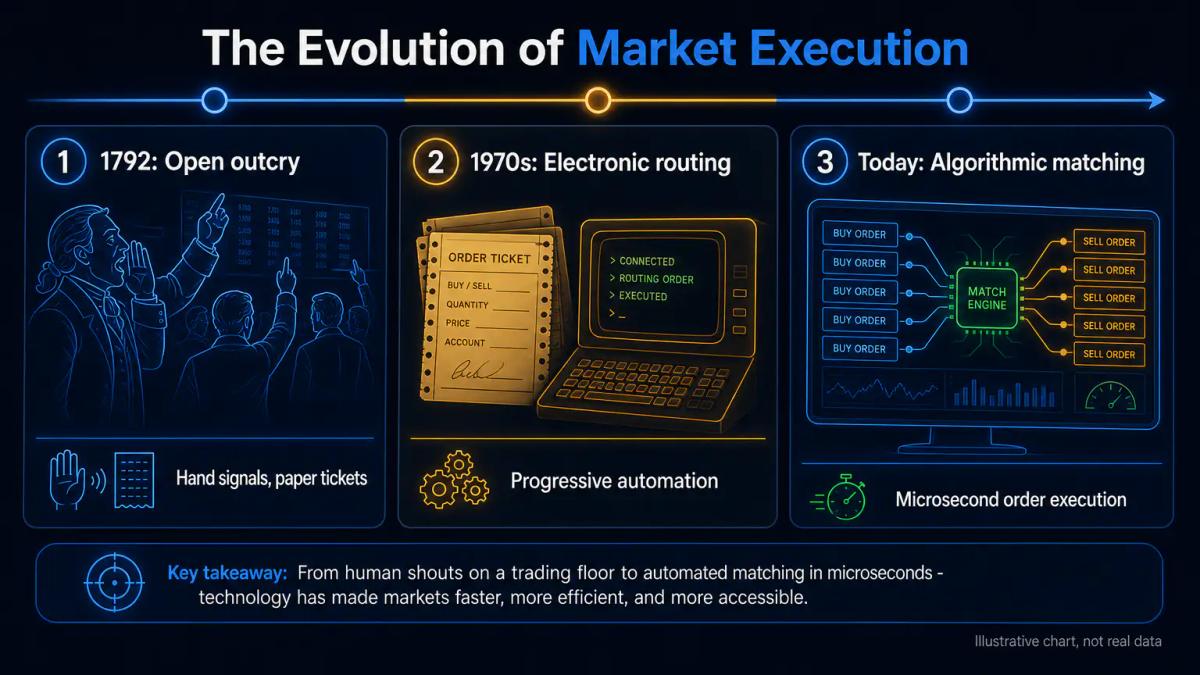
The New York Stock Exchange traces its origin to 1792, when twenty-four brokers gathered under a buttonwood tree on Wall Street and signed a pact setting commissions and priority for trading securities among themselves. For most of the following two centuries, orders were shouted on a physical floor in an 'open outcry' system, with hand signals and paper tickets. Full electronic order routing arrived progressively from the 1970s onward, and today most exchange volume is matched by algorithms on servers co-located next to the exchange.
Retail platforms mirror this shift. Charting software such as MetaTrader 4 (MT4), its successor MetaTrader 5 (MT5) and cTrader, all originally built for margin trading, now sit alongside broker-native apps that route orders directly to venues. For you as a retail trader, this evolution has produced tighter spreads (the gap between the buy and sell price), quicker execution and access to instruments once reserved for institutions. At the same time, it means competing for fills against algorithmic participants that measure latency in microseconds.
Why stocks exist and what they actually represent
A stock is a fractional ownership stake in a company: when you buy shares, you own a slice of that business and a claim on its future profits, whether paid out as dividends or retained to fund growth. Companies issue stock to raise capital without taking on debt, and investors buy in expecting either capital appreciation or income.
For that reason, stock prices reflect both past results and expectations about the future. Consider a company that beats earnings estimates yet issues weak forward guidance: the price can fall despite the strong report.
Two broad classes are worth understanding here. Common stock carries voting rights and a variable dividend that depends on company performance, while preferred stock typically has no vote but pays a fixed dividend and ranks above common in a liquidation.
Knowing which one you hold changes how you value the position.
Common beginner mistakes that cost traders real money
New traders tend to lose capital in a small number of repeatable ways, and naming them is the first step toward avoiding them.
- Chasing momentum: buying a stock only because it has already risen sharply, with no plan for the exit.
- Ignoring position sizing: risking too large a share of the account on one idea, so a single loss disables the strategy.
- Averaging down on losers: adding to a losing position without a thesis, hoping the price bounces back.
- Trading on tips: acting on a message-board post or a friend's recommendation instead of your own analysis.
- Confusing noise with trend: reacting to intraday wiggles as if they were structural moves.
The common thread running through these mistakes is the absence of a written plan. A plan specifies what you will buy, how much you will risk, where you will exit at a loss and where you will take profit. Without those four decisions set before you click 'buy', any position becomes little more than a guess dressed up as analysis.
How regulatory bodies keep markets fair and transparent
Stock markets operate under formal oversight, with several major authorities dividing responsibility by jurisdiction:
- In the United States, the Securities and Exchange Commission (SEC) enforces disclosure and anti-fraud rules.
- In the United Kingdom, the Financial Conduct Authority (FCA) supervises firms and market conduct.
- Across the European Union, the European Securities and Markets Authority (ESMA) coordinates rules between national regulators.
These bodies require listed companies to file periodic financial reports, prohibit trading on material non-public information (insider trading), and monitor order flow for manipulative patterns such as spoofing (placing orders you never intend to execute). In practical terms, the prices you see on screen come from venues subject to audit, and any broker that onboards you as a retail client must hold a licence from one of these authorities.
Seasonal patterns and timing: do they really predict stock moves?
One popular piece of stock market trivia is the idea that share prices follow calendar patterns, whether the 'January effect', 'sell in May' or end-of-quarter rallies. When these are tested rigorously across long time periods, the patterns turn out to be weak, unstable and often disappear once transaction costs are included.
Consider a retail trader who rotates in and out of the market based on the month: they end up paying spread, commission and possibly tax on every switch, and those frictions typically erase whatever edge the calendar was supposed to deliver. Disciplined investors therefore tend to focus on position sizing and holding period instead of trying to time the year.
Famous market crashes and what they teach us about risk
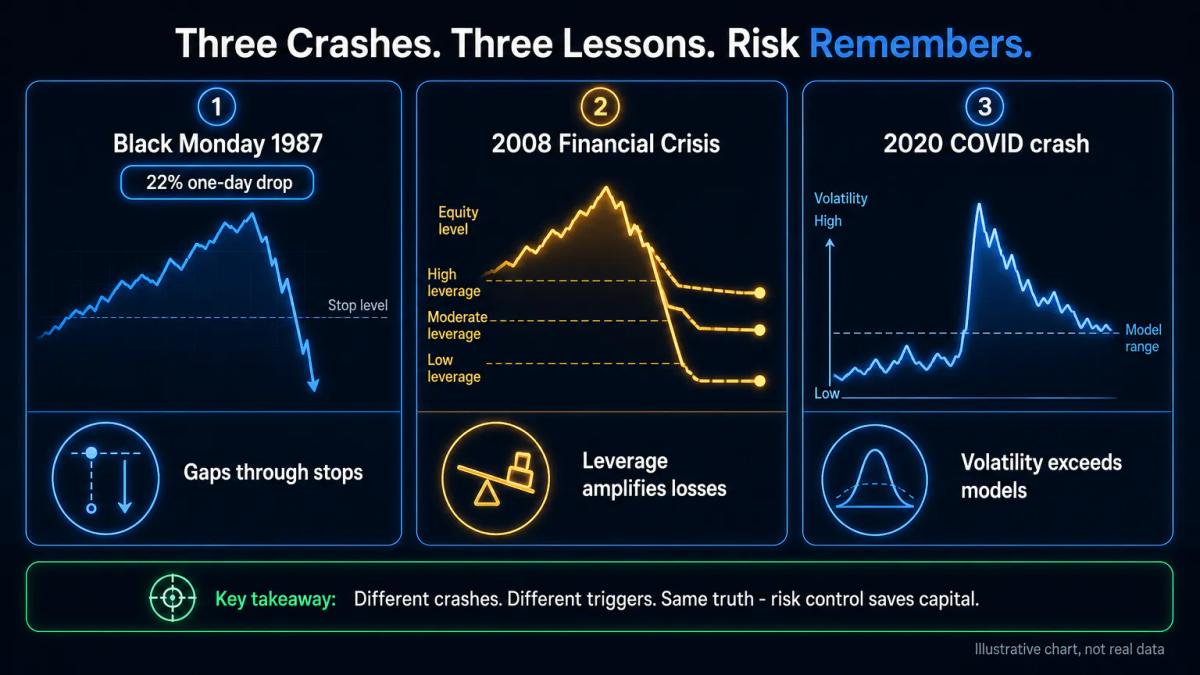
Three events in particular shape how modern risk management is taught, each illustrating a different failure mode in how markets behave under stress.
| Event | Date | What happened | Lesson for retail |
|---|---|---|---|
| Black Monday | October 1987 | One-day global equity crash | Markets can gap through stop-loss levels |
| Global Financial Crisis | 2007-2009 | Credit and equity collapse | Leverage amplifies drawdowns severely |
| COVID crash | March 2020 | Circuit breakers halted US trading multiple times | Volatility can spike faster than models expect |
The common lesson across all three is that even diversified portfolios can suffer severe drawdowns (the fall from a capital peak to the following trough). Position sizing and pre-set stop losses function as the mechanisms that let you survive an event you did not forecast, which is why experienced traders build them into the core of their process from day one.
Psychology, fear, and greed: why emotions drive stock prices
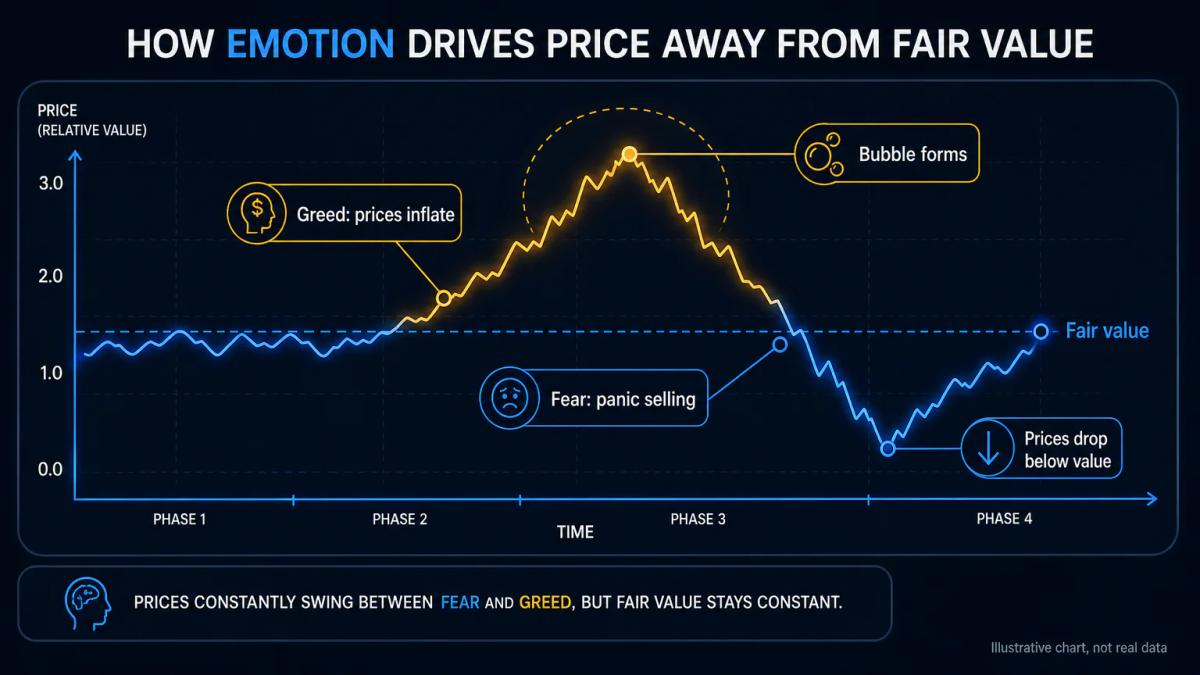
Prices are set by humans and by algorithms responding to humans, and human decisions carry emotional biases. Fear produces panic selling that pushes prices below fair value, while greed inflates bubbles where prices detach from earnings. Behavioural finance describes several recurring patterns worth being aware of:
- Buying after big rallies and selling after crashes.
- Holding losing positions too long while cutting winners too early.
- Overconfidence, which typically leads to excessive trading.
- Confirmation bias, which draws you toward news that supports positions you already hold.
Recognising these tendencies in yourself, and writing rules that force the opposite behaviour, is worth more than most technical indicators. For example, you might commit in advance to a stop loss you will not move and a position size you will not exceed under any circumstances.
Frequently Asked Questions
What is the oldest stock exchange in the world and when was it founded?
The Amsterdam Stock Exchange, established in 1602 to trade shares of the Dutch East India Company, is generally recognised as the oldest formal stock exchange. It introduced innovations such as continuous trading, short selling and dividend distribution that still define modern equity markets. The New York Stock Exchange, by comparison, dates from the 1792 Buttonwood Agreement.
How do stock prices get determined in real time?
Prices are set by an order book that matches buy orders (bids) and sell orders (asks) submitted by market participants. When the highest bid meets the lowest ask, a trade executes and that price becomes the latest quote. Prices move whenever new orders shift the balance of buyers and sellers, which happens continuously during trading hours.
What is the difference between common stock and preferred stock?
Common stock gives you voting rights at shareholder meetings and a variable dividend that depends on company profits and board decisions. Preferred stock typically carries no voting rights but pays a fixed dividend and ranks ahead of common stock if the company is liquidated. Preferred is closer to a hybrid between a bond and a share.
Why do stock markets sometimes halt trading during crashes?
Major exchanges use circuit breakers, automatic pauses triggered when an index falls by a set percentage in a session. The pause gives participants time to absorb information and prevents cascading algorithmic selling. In March 2020, US markets triggered these breakers several times in a single week as COVID-related volatility spiked.
Can individual investors actually beat the market consistently?
Consistently beating a broad index after costs and taxes is difficult; most active funds underperform their benchmarks over long horizons. Individual investors who succeed usually do so by controlling costs, holding for years and avoiding behavioural mistakes rather than by frequent trading or picking winners in every cycle.
About the authors


Put this into practice
Related articles

Most Volatile Stocks: How to Find and Trade Them
A practical guide for retail traders on where to find the most volatile stocks, why they swing, and how to trade them without blowing up your account.

Options Trading Explained: Calls, Puts, and Broker Approval
How options trading works for UK retail traders: calls, puts, strike prices, premiums, broker approval, risk limits, and tax reporting, in plain English.

Passively Managed Index Funds vs. Active Funds: Which Suits You Best?
A clear-eyed comparison of passively managed index funds and actively managed funds: mechanics, costs, tax drag, downturn behaviour, and how to choose.
0 comments