



Financial Markets · Beginner · 10 min read
Passively Managed Index Funds vs. Active Funds: Which Suits You Best?
Many investors are unsure whether to put their money in a fund that simply tracks the market or in one run by a professional trying to beat it. The choice sounds technical, but it shapes what you pay in fees, how much tax you hand over, and how your portfolio behaves in a downturn. In this article, we explain how index tracking actually works, how active and passive funds differ, what the long-run evidence says about performance and costs, and how to decide which approach fits your own goals and time horizon.
Passively managed funds: The mechanics of index tracking
Passively managed index funds are investment funds that track a market index such as the S&P 500 by holding the same securities in the same proportions, aiming to match the index return before fees. The manager's job is to replicate, which keeps costs low and the strategy simple.
An index (a rules-based list of securities that represents a slice of the market, like the S&P 500 for large US companies) becomes the fund's map. The fund buys every constituent in the same weight, and when the index changes, the fund rebalances.
[SEC Investor.gov]: A passive fund is a mutual fund, ETF or unit investment trust that follows an investment strategy designed to achieve approximately the same return as a particular index before fees.
A replication approach means the fund does not try to predict which stocks will rise. It owns the whole basket. That single design choice, replication instead of prediction, drives every downstream difference you will see with active funds: lower turnover, lower fees, and returns that closely mirror the market you chose to track.
What are actively managed investment funds and how do they differ
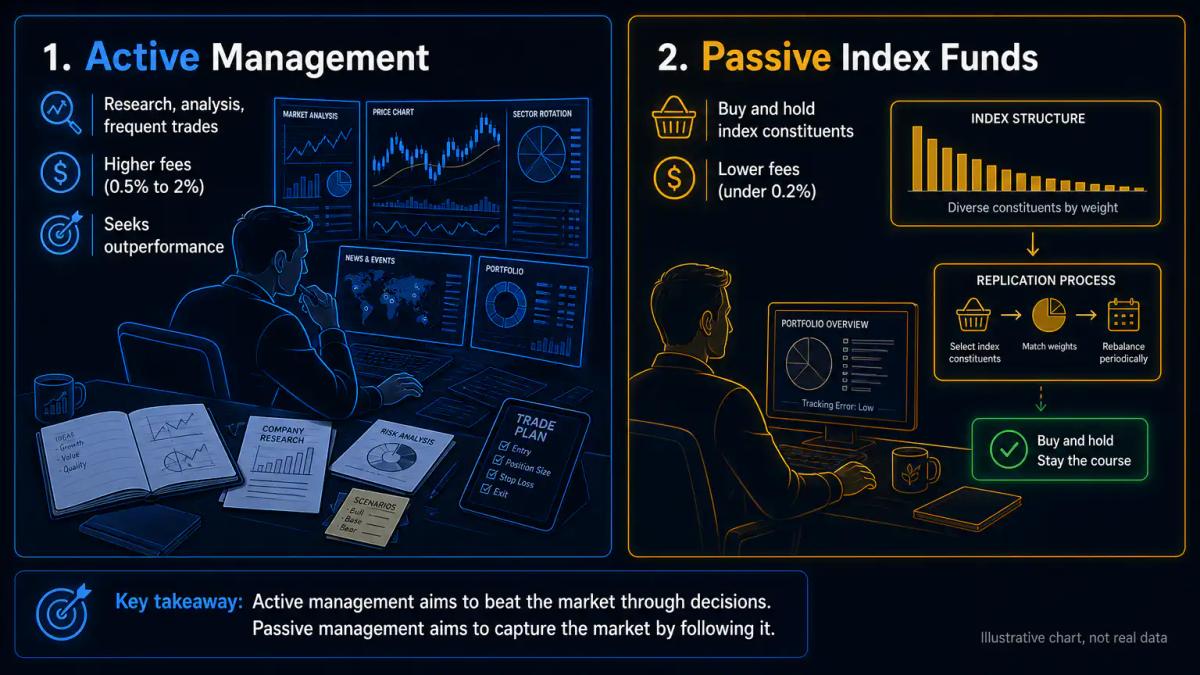
Managed investment funds pool money from many investors and hand it to a professional to run according to a stated strategy. The two main flavours are actively managed funds, where a manager picks stocks or bonds to try to beat a benchmark, and passively managed funds, which replicate an index by rule.
The core difference is decision-making.
- In active funds, a team researches companies, forecasts earnings, meets management, and buys or sells based on judgement. Every trade is a bet that the manager knows something the market has not yet priced in.
- In passive funds, the rulebook decides: if a stock enters the index, the fund buys it; if it leaves, the fund sells it.
That one distinction cascades into everything else. Active funds trade more, so they pay more in commissions and generate more taxable events. They employ larger research teams, so they charge higher management fees. They can concentrate in favoured stocks, so their returns can drift far above or far below the market. Passive funds trade rarely, employ smaller teams, and stay close to the index by design.
Both structures are legitimate. The right question is not which is better in the abstract, but which one fits how you want your money to behave over decades.
Active management: the pursuit of outperformance
Actively managed mutual funds employ professional managers who research holdings, time trades, and aim to deliver returns above their benchmark index. This hands-on approach carries higher fees, typically 0.5% to 2% annually, because you are paying for a manager's expertise, an analyst team, and a trading desk.
The pitch is simple: skilled managers can spot mispriced securities, avoid overvalued sectors, and protect capital in downturns. In theory, that skill should show up as returns above the index, net of fees.
The evidence is less flattering. According to the Wharton School, University of Pennsylvania (Executive Education), active managers of stock funds for large and mid-sized companies produced lower after-tax returns than their index-style competitors 97% of the time over a recent 10-year period.
Small-cap funds fare a little better, but not by much. The Wharton School, University of Pennsylvania (Executive Education) reports that small-cap active managers still trailed passive index competitors 77% of the time over a recent 10-year period on an after-tax basis.
Let's make something clear: active management is not a scam. Some managers do beat the market, sometimes by wide margins. The problem is identifying them in advance. You are paying a premium fee for a service that, on the balance of evidence, is more likely than not to deliver less than the plain index would have.
Passive index funds: lower cost, consistent tracking
Passive index funds charge minimal fees because the manager buys and holds the index constituents with almost no trading. You get broad market exposure, predictable costs, and no bet on a single person's stock-picking skill.
According to the Wharton School, University of Pennsylvania (Executive Education), many index-style mutual funds and exchange-traded funds charge less than 0.2% in annual fees, with some charging less than 0.1%.
- An expense ratio (the annual fee a fund charges as a percentage of your investment) of 0.1% means you pay £1 a year for every £1,000 invested.
- An active fund at 1.5% costs you £15 on the same balance. Over decades, that gap compounds into a life-changing sum.
Passive funds also come in many flavours.
- A broad market fund tracking the FTSE All-World gives you thousands of companies across dozens of countries in one holding.
- Sector funds narrow the exposure to technology, healthcare or energy.
- Bond index funds do the same job for fixed income.
You choose the map, the fund tracks it.
Performance: the evidence on active versus passive
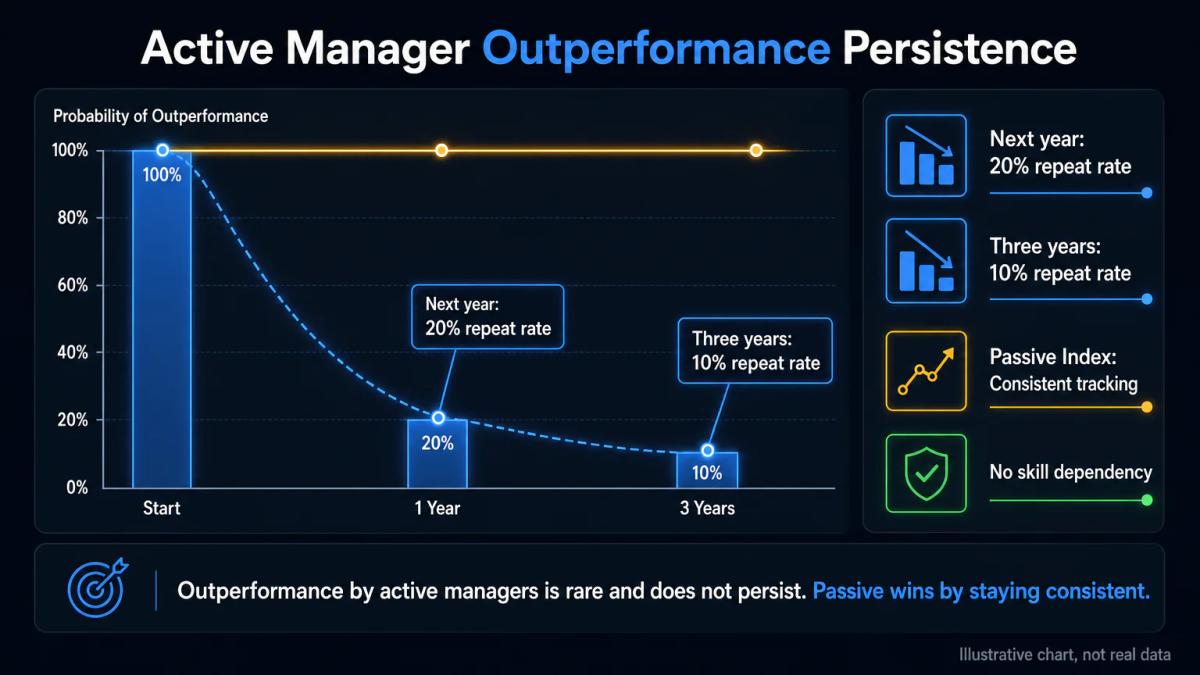
The long-run scoreboard favours passive. According to the Wharton School, University of Pennsylvania (Executive Education), active managers that outperformed the passive index had only a 20% chance of repeating the outperformance the following year, and just a 10% chance of beating the market three years in a row.
In other words, past outperformance is a weak predictor of future outperformance. A manager who beat the market last year is more likely than not to lag it next year. Picking active funds by looking at recent returns, the way most retail investors do, is close to picking by coin flip.
| Metric | Active funds | Passive index funds |
|---|---|---|
| Typical annual fee | 0.5% to 2% | Under 0.2%, often under 0.1% |
| 10-year win rate vs index (large/mid-cap) | 3% | 97% |
| Odds of beating index three years in a row | 10% | Not applicable, tracks the index |
| Turnover and taxable events | High | Low |
| Return dispersion | Wide, manager-dependent | Narrow, tracks index |
Passive funds do not always win. In a strong rally led by a handful of stocks, a concentrated active fund holding those names can shoot ahead. In sharp downturns, some active managers cushion losses by holding cash. But those episodes are hard to predict and hard to catch.
A passive index fund will not save you from a bear market (a period when the market falls by a fifth or more from its peak). Its job is to deliver the market's return, whatever that return happens to be.
When the S&P 500 falls 30%, so does a fund that tracks it. What passive investors gain is the certainty that when the market recovers, and historically it always has, their fund recovers with it, without the extra risk that the active manager sold at the bottom.
Costs, taxes, and the drag on returns
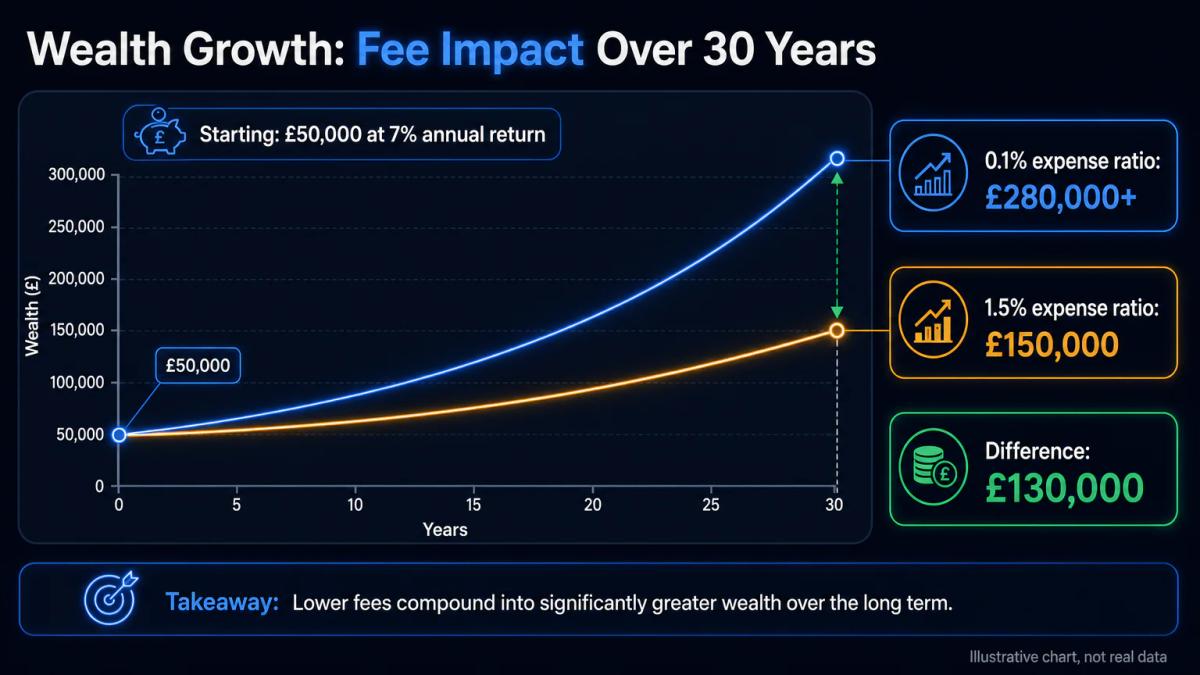
Every percentage point of fees compounds against you. On a £50,000 balance growing at 7% a year for 30 years, the difference between a 0.1% expense ratio and a 1.5% expense ratio is more than £130,000 in final wealth. That is not a rounding error, it is a house.
Taxes compound the same way. Active funds trade often, and each sale in a taxable account can trigger a capital gains bill you did not choose to pay. Passive funds trade rarely, so they defer gains until you sell your own units. In a taxable brokerage account, that difference alone can add roughly half a percentage point a year to your net return.
Passive investors also have a specific advantage in tax-loss harvesting: selling a broad index ETF that is down, booking the loss to offset gains elsewhere, and immediately buying a similar but not identical index ETF to keep the exposure. The strategy works cleanly with liquid, low-fee index products.
Tracking error matters too. According to the U.S. Securities and Exchange Commission (Investor.gov), an index fund may underperform its index because of fees and expenses, trading costs, and tracking error. The SEC's index-tracking definition and underperformance risk factors make clear that passive funds are not literally free money: they are the cheapest, most predictable path to the market's return.
[SEC Investor.gov]: Passive management usually translates into less trading of the fund's holdings, which means lower transaction costs and fewer taxable events for investors in taxable accounts.
Which approach fits your investor profile
Choose passively managed index funds if you want low maintenance, predictable costs, and long-term wealth building without timing the market. That describes most retail investors saving for retirement, a house deposit or a child's education over ten years or more.
- A young investor with 30 or 40 years ahead can hold a broad global equity index fund and let compounding do the work.
- A mid-career investor might blend a global equity index with a bond index fund to soften volatility.
- Someone within ten years of retirement typically shifts more into bond index funds and short-duration products, reducing the size of any bear-market hit at the moment it would matter most.
Geography is an important aspect to consider. A single-country index concentrates risk in one economy. Adding an international developed markets index and an emerging markets index spreads the exposure across dozens of countries and hundreds more companies.
Values are just as important: ESG index funds (funds that screen constituents on environmental, social and governance criteria) let you keep the passive structure while excluding sectors you do not want to fund, such as tobacco, thermal coal or controversial weapons.
Choose active management only if you have a specific, evidence-based reason to believe in a particular manager, and you accept that most active funds do not sustain outperformance.
Key takeaways for your investment decision
Passively managed index funds offer simplicity, low cost, and market-matching returns. They suit most retail investors building wealth over decades.
Active management carries higher fees and a poor track record of sustained outperformance, which makes it a harder sell unless you have a specific reason to believe in a manager's edge.
The practical starting point for most beginners is a broad, low-cost global equity index fund inside a tax-advantaged account, held with regular contributions and rebalanced once a year. Add bond index exposure as your horizon shortens. Consider international and emerging market index funds for geographic diversification. Layer in ESG screens if values matter to you.
Active funds can still play a role at the edges, for a niche market you cannot access cheaply through an index, or for a manager whose process you have genuinely studied. But the core of a retail portfolio, on the weight of the evidence, belongs in passive index funds.
This content is general information and not advice: every situation needs checking with a licensed professional in the relevant jurisdiction.
Frequently Asked Questions
What are passively managed mutual funds and who should invest in them?
Passively managed mutual funds are pooled investment vehicles that track a market index by holding the same securities in the same proportions, aiming to match the index return before fees. They suit investors who want broad market exposure, low costs and predictable behaviour, especially those saving for retirement or other long-term goals over ten years or more.
What are actively managed mutual funds and who should invest in them?
Actively managed mutual funds employ professional managers who choose securities to try to beat a benchmark index. Fees typically run from 0.5% to 2% a year. They may fit investors who have studied a specific manager's process, want exposure to niches that no cheap index covers, and accept that most active funds underperform their benchmark over long periods.
How do index funds track their benchmark and what causes them to underperform?
Index funds hold every constituent of the target index in the correct weight and rebalance when the index changes. According to the U.S. Securities and Exchange Commission, an index fund may underperform its index because of fees and expenses, trading costs, and tracking error, the small gap between the fund's holdings and the index at any given moment.
Can an active fund manager consistently beat the market over time?
The evidence says rarely. According to the Wharton School, an active manager who beats the passive index one year has only a 20% chance of doing it again the next year, and a 10% chance of beating the market three years in a row. Consistent outperformance exists but is hard to identify in advance.
What is the total cost difference between passive and active fund investing over 20 years?
On a $50,000 balance growing at 7% a year, the difference between a 0.1% expense ratio and a 1.5% expense ratio is tens of thousands of dollars over 20 years, and more than $130,000 over 30 years. Fees compound against you the same way returns compound for you, so the fee gap grows over time.
About the authors


Put this into practice
Brokers we have reviewed
Scored on the same five dimensions. Here are three of them — the full list is on the brokers page.


Related articles

Quant Firms Explained: Strategies, Structure, and Careers
A plain-English guide to quant firms: what they are, how HFT shops differ from quant hedge funds, the strategies they run, and what it takes to join one.

Stock Market Hours in Central Time: When US Markets Open and Close
A plain-English guide to US stock market hours in central time, covering the regular session, extended trading, holidays, DST and how to set alerts.

Stock Trading Basics: What Are Shares and How Do You Trade Them?
Learn what shares are and how stock trading works. This beginner guide explains how to buy stocks step-by-step, from choosing a broker to placing an order.
0 comments