



Financial Markets · Intermediate · 7 min read
Quant Firms Explained: Strategies, Structure, and Careers
Quant firms employ mathematicians, physicists and software engineers to build systems that trade faster and more systematically than any human desk, deploying capital across equities, futures, options, foreign exchange and, increasingly, digital assets.
What are quant firms and how do they operate?
Quant firms are trading businesses whose decisions come from code rather than intuition. A research team studies historical price data and alternative datasets, forms hypotheses about market behaviour, and translates them into models. Those models score instruments, generate signals, and hand orders to an execution system that decides how, when and where to trade. Risk managers cap exposures, and engineers keep the pipes running.
The distinguishing trait is repeatability. A discretionary trader may act on a chart pattern; a quant firm codifies that pattern into rules, backtests it across decades of data, measures the risk-adjusted return, and only then allocates capital. This lets the firm run the same logic across thousands of instruments simultaneously.
For a retail trader, the practical consequence is sharp: on liquid venues such as major forex pairs, index futures and US equities, you are trading against systems that see order flow, quote in microseconds and rebalance constantly.
Understanding that reality helps you pick strategies where speed is not the primary edge. Forex vs stocks trading shows how retail venues differ from institutional ones.
Types of quant firms: HFT, prop trading, and hedge funds

Quant firms fall into three broad categories that differ in capital source, holding period and regulation. High-frequency trading (HFT) firms hold positions for microseconds to minutes and profit from market-making and short-term inefficiencies. Proprietary trading firms deploy the partners' own capital, often across a range of horizons. Quantitative hedge funds and asset managers pool external investor capital and typically hold positions from days to months.
The table below summarises the practical differences a market participant sees.
| Feature | HFT firm | Prop trading firm | Quant hedge fund |
|---|---|---|---|
| Capital source | Partner and firm capital | Firm or partner capital | External investors |
| Typical holding period | Microseconds to minutes | Seconds to days | Days to months |
| Core edge | Latency, co-location | Strategy breadth | Research depth, scale |
| Fee model | None (principal trading) | Profit share to traders | 1 to 2% management, 15 to 30% performance |
| Key regulators | FCA, ESMA, SEC, CFTC | FCA, ESMA, SEC, CFTC | FCA, SEC (as investment adviser) |
| Retail impact | Tighter spreads, sharper liquidity | Liquidity provision | Slower absorption of mispricings |
Each category faces distinct rules. HFT firms in the UK register with the Financial Conduct Authority (FCA) and comply with the algorithmic trading requirements set under MiFID II. Hedge funds add investor-protection duties on top of trading rules, which shapes the strategies they can offer.
Major quant firms and their market presence
A short list of names dominates public discussion of the industry.
- Renaissance Technologies, founded by James Simons, built its reputation on the Medallion Fund's long-run track record in systematic trading.
- Citadel, run by Ken Griffin, operates both a multi-strategy hedge fund and Citadel Securities, one of the largest market-makers in US equities and options.
- Two Sigma is associated with machine learning and alternative data.
- Millennium Management runs a multi-manager platform of independent teams.
- Jane Street is best known for options market-making and exchange-traded fund (ETF) arbitrage, an ETF being a fund whose shares trade on an exchange like a stock.
These firms cluster geographically. New York and Chicago host most US options and futures market-makers; London anchors European quant activity under FCA supervision; Amsterdam is home to several derivatives specialists including Optiver and IMC; Hong Kong and Singapore serve Asia-Pacific flows. The regional split matters because each hub carries different tax treatment, talent pools and regulatory intensity.
Trading strategies used by quantitative firms
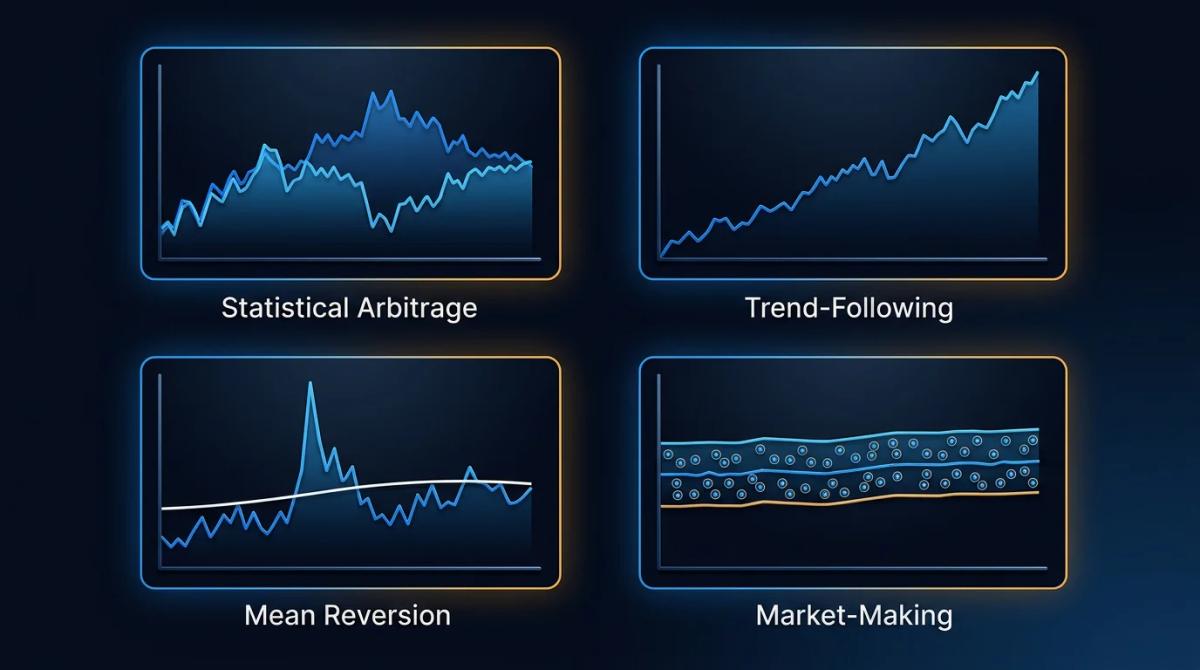
Quant firms deploy a limited set of strategy families, applied across many instruments. Statistical arbitrage exploits temporary price discrepancies between correlated assets, such as two shares in the same sector. Trend-following captures directional momentum in futures and foreign exchange. Mean reversion bets that a stretched price returns to its historical average. Market-making quotes both a bid and an offer, earning the spread while managing inventory. Machine learning models sit across all of these, filtering signals and sizing positions. What are trading signals explains how these systematic approaches generate entry and exit rules.
What separates a professional operation from a retail attempt is not the idea, it is the execution stack. A quant firm runs the same mean-reversion logic across 3,000 stocks, sizes each position against a live risk model, hedges the residual factor exposure, and pays fractional commissions thanks to volume. A drawdown (the fall from a capital peak to the trough before a new peak) in one strategy is offset by uncorrelated returns elsewhere. Risk-adjusted performance, usually measured by the Sharpe ratio, tends to be the internal yardstick rather than headline annual return.
Technology infrastructure and data requirements
Quant firms invest heavily in low-latency infrastructure, co-location services and alternative data. Co-location places the firm's servers inside the exchange's data centre, cutting round-trip time to microseconds. Custom hardware, field-programmable gate arrays and dedicated fibre routes shave further latency. Data teams ingest tick-level market data, corporate filings, satellite imagery, shipping records and payment flows, then clean and align them for research use.
These structural advantages explain why retail traders competing on speed lose to the machines. Where you can compete is on horizon: forex swing trading signals that play out over days or weeks are less latency-sensitive and more accessible to retail traders than microsecond arbitrage.
Regulatory environment and compliance for quant trading
Quant firms operate under strict oversight. In the UK, the FCA supervises algorithmic trading under MiFID II, requiring firms to maintain audit trails, pre-trade risk controls, kill switches and annual self-assessments. ESMA sets equivalent standards across the European Union. In the United States, the Securities and Exchange Commission (SEC) covers equities and the Commodity Futures Trading Commission (CFTC) covers futures, with Regulation SCI imposing systems-integrity requirements on major venues and participants.
Breaches carry material penalties. Regulators police market manipulation, spoofing and disorderly trading conditions, and firms must evidence that every algorithm has been tested and approved before deployment. Compliance costs and capital requirements form a real barrier: launching an authorised algorithmic trading firm in the UK typically requires seven-figure working capital plus a compliance function before a single trade is placed.
Career paths and compensation in quantitative trading
Quant firms recruit researchers, traders, engineers and risk managers, mostly from mathematics, physics, computer science, statistics and quantitative finance backgrounds. A typical path runs from junior researcher, building and testing models, to trader, running live strategies, to portfolio manager, owning a book. Engineers follow a parallel track in execution systems, data platforms and infrastructure.
Compensation stretches widely. In London, entry-level researchers at competitive firms earn base salaries in the range of £80,000 to £150,000, with bonuses that can multiply the base for strong years. Senior portfolio managers on profit-share arrangements at multi-manager platforms can earn several million in a good year and lose their seat in a bad one. New York packages skew higher in cash terms, Chicago pays strongly in options and futures market-making, and Amsterdam trades cash for lifestyle. The common denominator is that compensation is tied to measurable profit-and-loss.
Frequently Asked Questions
How do quant firms differ from traditional hedge funds and investment banks?
Quant firms make decisions through models and code, whereas traditional hedge funds often rely on discretionary managers and fundamental analysis. Investment banks primarily serve clients through market-making, underwriting and advisory, though their principal trading desks can look similar to a quant prop shop. The key differences are decision process, capital source and regulatory scope: quant firms lean on repeatable systematic rules, tighter risk models and, typically, a smaller headcount per unit of capital.
What skills and education do you need to work at a quantitative trading firm?
Most researcher and trader roles ask for strong mathematics, statistics or physics backgrounds, often at PhD level, plus programming in Python and C++. Engineering roles focus on low-latency systems, distributed data pipelines and reliability. Beyond credentials, firms test problem-solving under time pressure through numerical and coding interviews. Demonstrable projects, competitive programming, machine learning competitions or independent research, help candidates from adjacent fields make the jump.
Can retail traders use the same strategies as quantitative firms?
You can borrow ideas but not the infrastructure. Trend-following on daily or weekly bars, simple mean-reversion filters and factor-based portfolio construction are all accessible to retail traders through standard platforms. What you cannot replicate is co-located execution, tick-level data and multi-strategy diversification. The practical implication is to choose horizons and instruments where latency does not matter and to focus on risk sizing rather than signal complexity.
What regulatory restrictions apply to algorithmic and quantitative trading?
Under MiFID II in the UK and EU, firms running algorithms must document each strategy, run pre-trade risk controls, keep detailed audit trails and maintain kill switches. The FCA supervises UK firms and requires an annual self-assessment. In the US, the SEC and CFTC apply parallel standards, with Regulation SCI covering systems integrity at major venues. High-frequency market-makers face additional registration and capital rules depending on the venue.
How much capital do you need to start a proprietary quantitative trading firm?
Launching an authorised algorithmic trading business in the UK typically calls for seven-figure working capital before you place a trade, once you add regulatory capital, technology, data licences and a compliance function. Costs are lower if you trade through an existing prop firm's licence and infrastructure, and higher if you build your own market-making stack. Most successful launches raise external backing or spin out from an established firm.
About the authors


Put this into practice
Brokers we have reviewed
Scored on the same five dimensions. Here are three of them — the full list is on the brokers page.



Related articles

Stock Market Hours in Central Time: When US Markets Open and Close
A plain-English guide to US stock market hours in central time, covering the regular session, extended trading, holidays, DST and how to set alerts.

Stock Trading Basics: What Are Shares and How Do You Trade Them?
Learn what shares are and how stock trading works. This beginner guide explains how to buy stocks step-by-step, from choosing a broker to placing an order.

Stocks vs Indices: Risk, Diversification, and Trading Costs Compared
A direct comparison of stocks vs indices for retail traders: how each is priced, the risk profile, FCA leverage caps, costs, tax treatment and when to use which.
0 comments