



Financial Markets · Beginner · 7 min read
Forex vs Stocks Trading: Key Differences for Retail Traders
Forex and stocks differ in five concrete ways: forex runs 24 hours a day, five days a week, with leverage up to 1:30 on majors and tight spreads; stocks trade in fixed exchange hours with leverage capped at 1:5 for UK retail and commission-based costs. Your choice hinges on capital, risk tolerance, and whether you prefer macro or company-level analysis.
Trading hours and market access
Forex operates continuously from Sunday evening to Friday evening through overlapping sessions in Sydney, Tokyo, London, and New York, while stock exchanges keep fixed windows. The London Stock Exchange trades from 8:00 AM to 4:30 PM UK time, and the New York Stock Exchange runs from 9:30 AM to 4:00 PM Eastern. This structural gap matters: forex accommodates traders who work standard hours, since the London and New York overlap between 1:00 PM and 4:00 PM UK time concentrates liquidity.
Stock traders outside cash hours rely on pre-market and after-hours sessions, which carry wider spreads and thinner volume. If you plan to trade around a full-time job, forex sessions map more flexibly to evenings and early mornings. If you prefer defined start and end times, equities impose that discipline for you. Weekend gap risk exists in both, but forex reopens on Sunday, while stocks wait until Monday morning.
Liquidity, spreads, and trading costs
Forex is the deepest market in the world, and EUR/USD alone can trade with raw spreads from 0.1 pips (a pip is the smallest standard price movement in a currency pair, usually 0.0001) at institutional venues.
Retail spreads on majors typically sit between 0.6 and 1.5 pips all-in. Stocks vary sharply: FTSE 100 or S&P 500 constituents trade with penny-level spreads, while small-cap shares can show spreads of 1% or more of price.
Cost structures diverge. Forex brokers usually bake their fee into the spread, or offer raw-spread accounts with a commission of $3 to $7 per side per standard lot (100,000 units of the base currency). Stock brokers charge either a flat commission per trade, a percentage of notional, or zero-commission with payment-for-order-flow arrangements in some jurisdictions. The table below compares typical retail costs.
| Cost item | Forex (major pair) | Large-cap stock | Small-cap stock |
|---|---|---|---|
| Typical spread | 0.6 to 1.5 pips | 0.02% to 0.05% | 0.5% to 2% |
| Commission | $0 or $3-$7 per lot side | £5-£10 flat or 0.1% | £5-£10 flat or 0.1% |
| Overnight financing | Swap on rollover | Only if using CFDs or margin | Only if using CFDs or margin |
Leverage limits and regulatory constraints
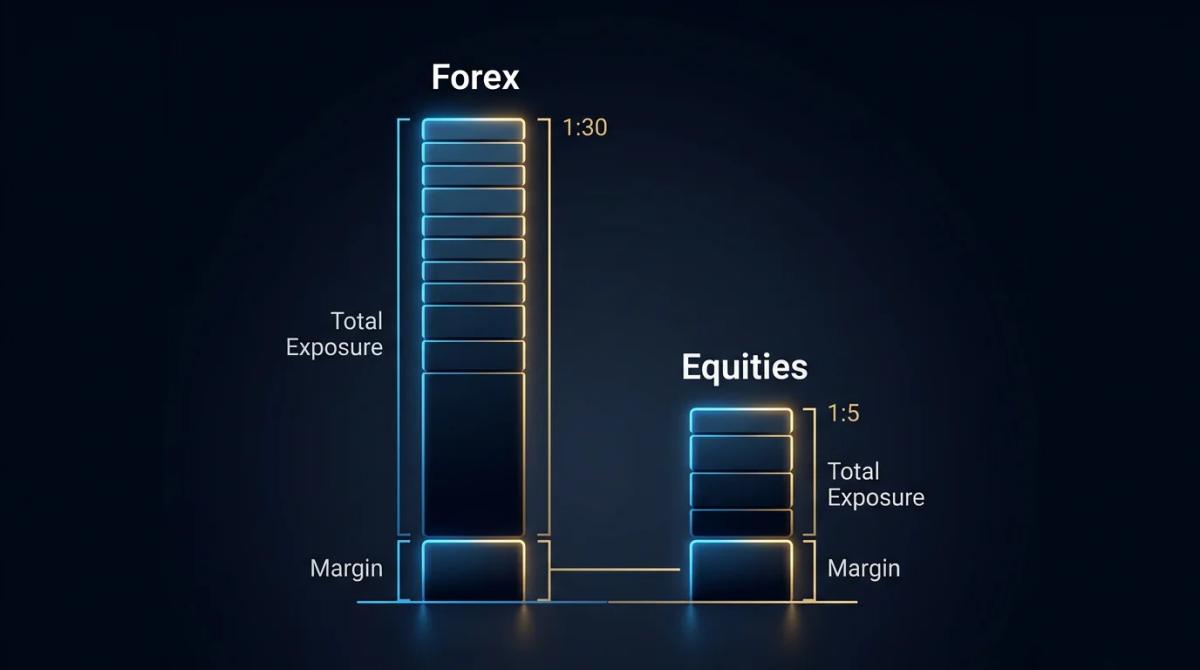
UK retail traders face strict leverage caps set by the Financial Conduct Authority: 1:30 on major currency pairs, 1:20 on non-major pairs and major indices, 1:10 on commodities other than gold, 1:5 on individual equities, and 1:2 on cryptoassets.
Contracts for difference on cryptoassets are prohibited for UK retail clients under FCA rules; only professional clients can access them. These caps exist because leverage magnifies losses as much as gains, and the historical data on unconstrained retail trading is grim.
Heimer and Simsek (2019) documented that the average high-leverage US retail forex trader lost 44% per month before the CFTC imposed limits. That figure is the single most important reason regulators cap leverage. If you open a forex account with a UK-authorised entity, you inherit the FCA framework; if the broker routes you to an offshore group entity, those protections disappear. Always check which entity signs your client agreement.
What drives price movement: macroeconomics vs fundamentals
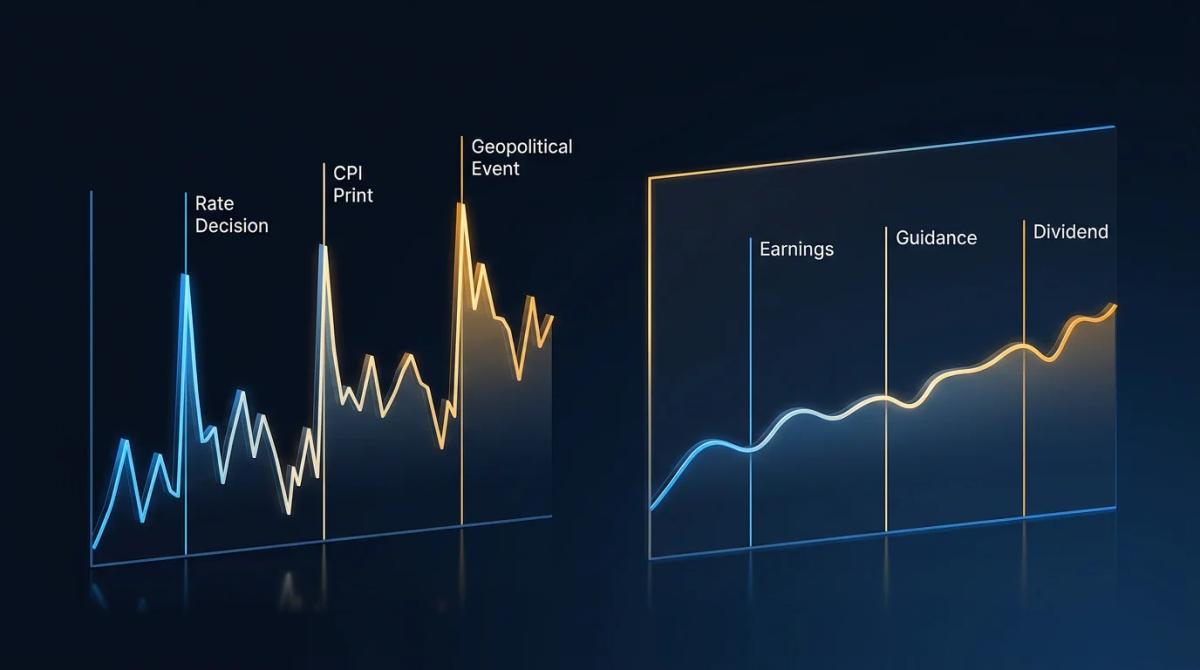
Forex prices move on interest rate differentials, inflation prints, central bank guidance, trade balances, and geopolitical shocks that affect entire currency zones. A rate decision from the Bank of England or the Federal Reserve can move GBP/USD by more than a percentage point within minutes. Stock prices, by contrast, respond to company earnings, guidance, sector rotation, share buybacks, dividend policy, and management changes, though they also react to macro drivers through their discount rate.
The analytical toolkit differs accordingly. A forex trader tracks the economic calendar, watches yield curves, and reads central bank minutes. A stock trader reads 10-K filings, models cash flows, and compares peer multiples. Neither skill transfers cleanly. Many retail participants underestimate how much macro literacy forex demands: a chart pattern on EUR/USD is worthless if you missed the ECB press conference that just repriced the pair.
Choose the market whose research routine you can sustain weekly, because both demand discipline and continuous learning.
Tax treatment and regulatory differences
Tax outcomes in the UK depend on the instrument, not just the underlying market. Spread bets on forex or stock indices are exempt from Capital Gains Tax and Income Tax for UK residents, because HMRC treats them as gambling. CFDs on either forex or shares are subject to Capital Gains Tax on profits, with the annual CGT allowance (£3,000 for the 2024/25 tax year) available before tax applies. Physically owned shares held in a Stocks and Shares ISA grow free of CGT and dividend tax within the annual £20,000 subscription limit.
This creates a meaningful gap that competitor articles rarely surface. A buy-and-hold equity investor using an ISA can compound tax-free, while an active forex CFD trader pays CGT on realised gains above the allowance. Frequent trading can also, in rare cases, be reclassified by HMRC as a trade rather than investment, changing the tax treatment entirely. Rules and thresholds change, so confirm current figures with HMRC or a qualified tax adviser before committing capital.
Which market fits your experience and capital
Beginners with small capital often gravitate to forex because 1:30 leverage lets them control a $10,000 position with roughly £250 of margin. That same leverage is why beginner accounts blow up. Stocks require more upfront capital to build a diversified basket, but the lower leverage and slower daily volatility give you more time to react and learn.
Beginner trading lessons from 10 years in the markets emphasise that starting small and learning the emotional discipline matters more than choosing the "right" market.
| Trader profile | Capital range | More suitable market | Why |
|---|---|---|---|
| First-year beginner | £250-£2,000 | Stocks in ISA or fractional shares | Slower pace, no overnight financing, tax-efficient |
| Active learner | £2,000-£10,000 | Either, with demo first | Can size down forex; can diversify stocks |
| Swing trader | £10,000+ | Both, blended | Combine macro forex trends with equity themes |
There is also an emotional dimension the search results largely ignore. Forex intraday moves reward fast decisions and can amplify loss-aversion bias; longer-horizon stock investing rewards patience and lets you step away from the screen. Match the market to the temperament you actually have, not the one you wish you had.
On the equities side, see individual names like Apple and Tesla.
Platform and technology considerations
Forex brokers overwhelmingly offer MetaTrader 4 (MT4), MetaTrader 5 (MT5), and cTrader, all built around leverage, expert advisors (automated strategies coded in MQL or C#), and tick-level charting. Stock brokers typically use proprietary web and mobile platforms, or route through TradingView and Interactive Brokers workstations, with deeper support for order types like VWAP (volume-weighted average price) and richer fundamental data feeds.
Execution models differ too. Forex brokers run either dealing-desk (market-maker) or straight-through-processing models, and the difference affects slippage and requote risk. Stock brokers route to exchanges or, in some markets, to internalisers under best-execution rules.
Before committing capital to either market, compare forex brokers and open a demo account to place at least twenty trades under live conditions to test spreads, execution speed, charting, and order-type coverage. A platform that cannot place a guaranteed stop, or that widens spreads around news, will cost you more than any commission difference you saved when choosing the broker.
This content is general information and not advice: every situation needs checking with a licensed professional in the relevant jurisdiction.
Frequently Asked Questions
Can I trade both forex and stocks on the same platform?
Yes, several multi-asset brokers offer forex, indices, and equities under one login, often through MT5 or a proprietary platform. Check that the broker is FCA-authorised for UK retail clients, and confirm which group entity holds your account, since offshore entities do not carry the same protections as the UK-authorised firm.
Is forex or stock trading more profitable for beginners?
Neither is inherently more profitable, and both show high failure rates among retail beginners. Stocks tend to be less punishing because leverage is lower and price moves are slower, giving beginners more time to react and learn. Forex can generate faster returns but also faster losses through leverage.
What is the minimum capital needed to start forex vs stock trading?
Many forex brokers accept deposits from £100 or $100 thanks to leverage and micro-lot sizing. Stock trading with fractional shares can start from as little as £1 with some UK brokers, though building a diversified basket typically needs several thousand pounds to avoid concentration risk in one or two names.
How do taxes differ between forex CFD trading and owning physical stocks?
In the UK, forex CFD gains are subject to Capital Gains Tax above the annual allowance. Physical shares held inside a Stocks and Shares ISA are free from CGT and dividend tax within the £20,000 annual subscription limit. Spread bets on either market are exempt for UK residents. Confirm current rules with HMRC.
Which market is less risky: forex or stocks?
Stocks bought outright and held long-term carry no leverage risk, only price risk, making them generally less risky than leveraged forex positions. Forex volatility per unit of price is lower than many stocks, but leverage of 1:30 amplifies that volatility. Risk depends more on position sizing than on the market itself.
About the authors


Put this into practice
Brokers we have reviewed
Scored on the same five dimensions. Here are three of them — the full list is on the brokers page.


Related articles

Geopolitical Risk Trading: What Trump’s War Policy Means for Your Positions
Learn how Trump's war policy affects forex, gold, and indices. A practical geopolitical risk trading guide for retail traders.

How Trading Income Is Taxed in the Philippines: A Trader's Guide
A working guide to Philippine trading taxation: brackets, capital gains, withholding, BIR forms, deductible expenses, crypto treatment and planning levers.

How to Evaluate a Prop Firm Before You Buy a Challenge
Learn how to evaluate a prop firm before buying a challenge. Use this due diligence framework to vet payouts, rules, and red flags.
0 comments