



Index Trading: What Are Stock Indices and How to Trade Them
When financial news reports that “the market” rose or fell, the reference is almost always to a stock index.
These benchmarks distill the performance of dozens or hundreds of companies into a single figure, like a snapshot of the general market health. However, for traders and investors, these stock indices provide far more value beyond representing more than headline numbers: they offer a way to gain exposure to entire markets without picking individual stocks.
In fact, index trading has become one of the more accessible routes into global equities. Even Warren Buffet said: “A low-cost index fund is the most sensible equity investment for the great majority of investors.”
Indeed, grasping how indices work and the methods available to trade them forms essential groundwork for market participation.
In this guide, you will learn what stock indices are, examine the major global benchmarks, and walk through the practical methods traders use to gain exposure.
What Is a Stock Index
A stock index is a tool that measures a section of the stock market. It tracks the performance of a defined group of stocks (known as constituents) selected according to specific criteria. The index value shifts throughout trading hours as constituent prices move.
Indices serve several purposes: They act as benchmarks for measuring portfolio performance, give economists a read on market health, and offer traders a way to speculate on broad market direction rather than individual company outcomes.
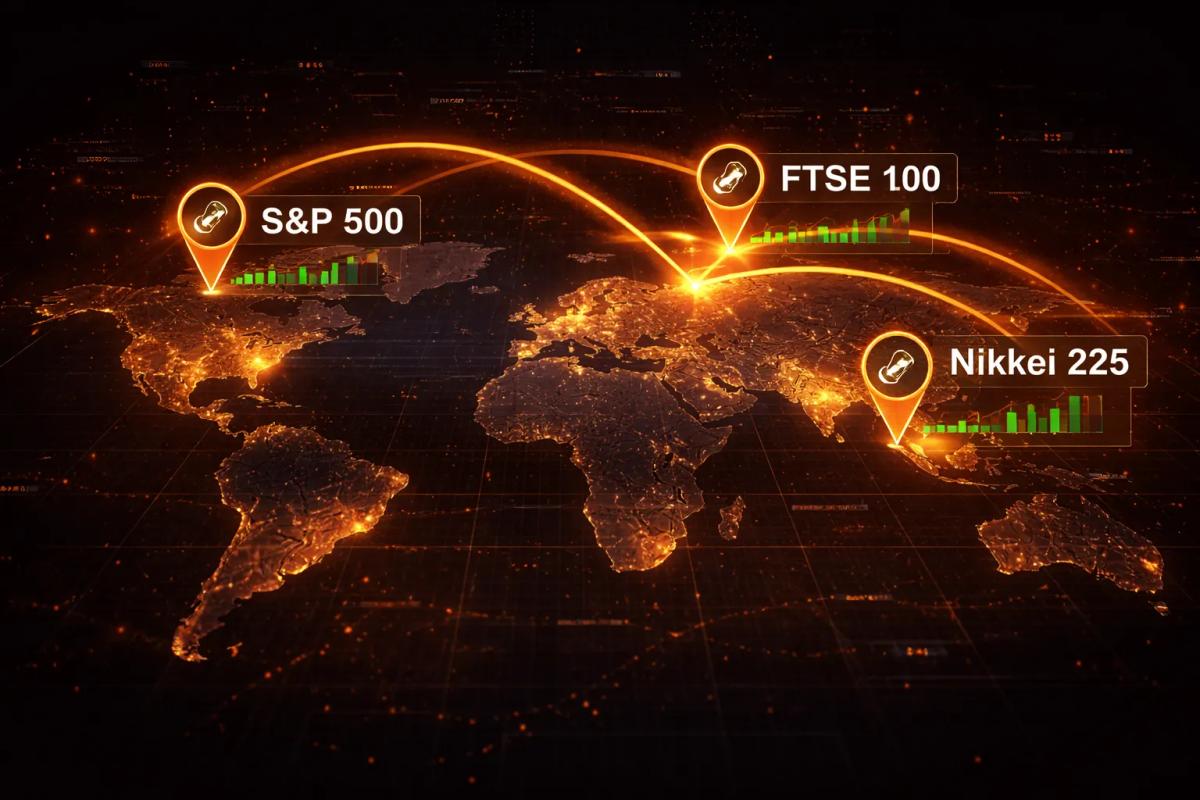
The S&P 500, for example, tracks 500 of the largest publicly traded companies in the United States. When commentators say the S&P 500 gained 1%, they mean the collective value of those 500 companies, as measured by the index’s calculation method, rose by that amount.
How Indices Are Calculated
Stock index providers use mathematical formulas to convert constituent stock prices into a single value. The calculation method determines how much weight each stock carries in the overall index movement.
Most indices begin with a base value set on a specific date. As constituent prices change, the index value adjusts proportionally. Divisor adjustments account for corporate actions like stock splits or changes in composition, keeping the index continuous over time.
There are two primary index value calculation methods: price-weighted and market cap-weighted. Now, let’s dive into how each one of them assign weight to each stock in an index.
Price-Weighted vs Market Cap-Weighted Indices
In a price-weighted index, stocks with higher share prices carry greater influence on the index value, regardless of the company’s total market value. The Dow Jones Industrial Average uses this approach. A stock trading at $300 per share affects the index three times as much as one trading at $100, even if the lower-priced company has a larger overall market capitalization.
On the other hand, market capitalization-weighted indices assign influence based on each company’s total market value (share price multiplied by shares outstanding). The S&P 500 and most modern indices follow this approach. A company worth $2 trillion moves the index more than one worth $200 billion, regardless of share price.
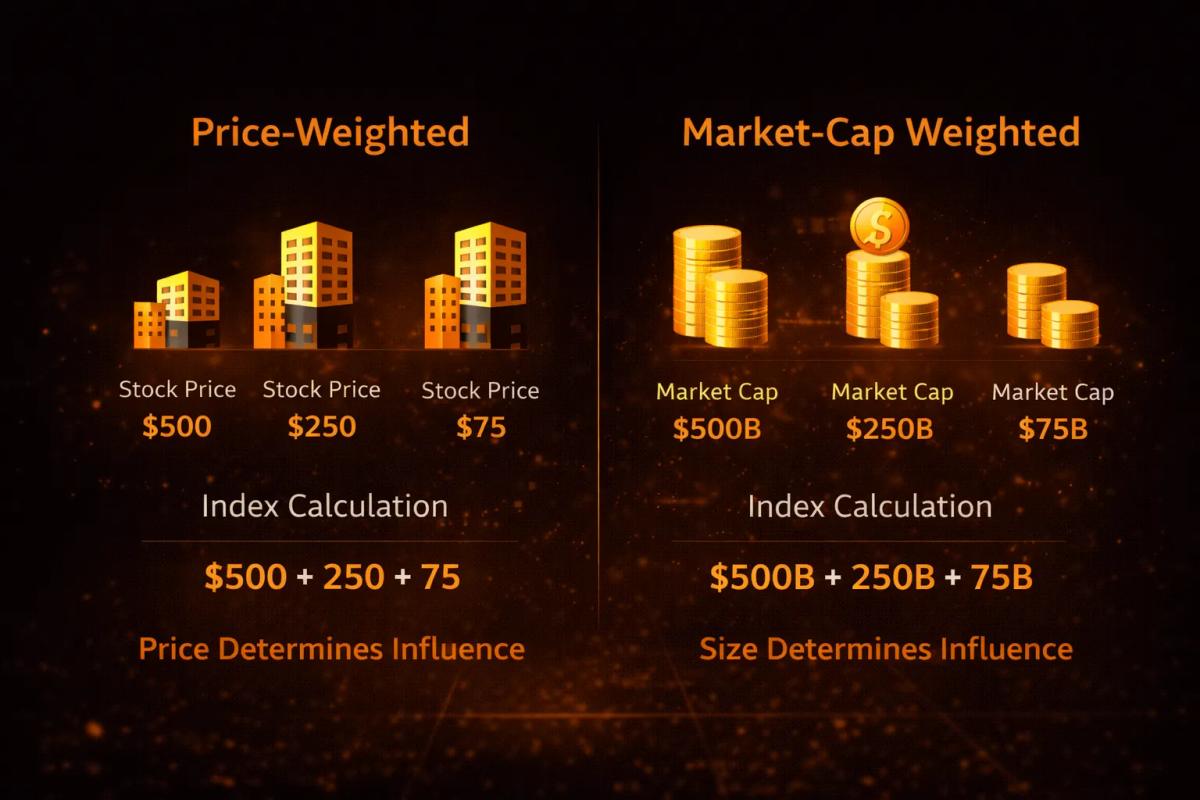
While these are the most popular methods, some stock indices use variations: free-float market cap weighting counts only shares available for public trading, while equal weighting gives each constituent identical influence regardless of price or size.
Major Global Stock Indices
Financial markets around the world maintain benchmark indices that track their largest and most liquid stocks. These often serve as indicators for the economic health of their respective regions.
US Stock Indices (S&P 500, Dow Jones, Nasdaq 100)
The S&P 500 is widely considered the primary benchmark for US equities. Maintained by S&P Dow Jones Indices, it tracks 500 large-cap American companies across all sectors using market cap-weighting. Its broad coverage makes it the yardstick many investors and fund managers measure themselves against.
The Dow Jones Industrial Average (often just “the Dow”) is among the oldest US market indices, first published in 1896. It tracks only 30 companies, yet its historical significance keeps it prominent in financial media. The price-weighted methodology means stocks like UnitedHealth Group or Goldman Sachs have historically carried outsized influence.
Finally, the Nasdaq 100 tracks the 100 largest non-financial companies on the Nasdaq exchange. Given Nasdaq’s historical ties to technology, this index tilts heavily toward tech, making it more volatile than broader measures and a good indicator of the sector.
European Stock Indices (FTSE 100, DAX 40, Euro Stoxx 50)
The FTSE 100 (pronounced “Footsie”) tracks the 100 largest companies on the London Stock Exchange by market capitalization. Because many constituents earn significant revenue abroad, the index often moves differently from the UK domestic economy.
Germany’s DAX 40 (expanded from 30 constituents in 2021) tracks major companies on the Frankfurt Stock Exchange. It spans industrial giants in automotive, pharmaceutical, and financial sectors, serving as a bellwether for European economic sentiment.
The Euro Stoxx 50 offers blue-chip representation of the Eurozone, drawing 50 stocks from 11 countries. This cross-border index provides exposure to the broader European economy rather than any single nation.
Asian Stock Indices (Nikkei 225, Hang Seng)
Japan’s Nikkei 225 is a price-weighted index covering 225 companies on the Tokyo Stock Exchange. Like the Dow, share price rather than company size determines influence. The index spans diverse sectors from electronics to retail.
The Hang Seng Index tracks the largest companies listed in Hong Kong, including both local firms and mainland Chinese companies with Hong Kong listings. It serves as a key benchmark for Asian markets and offers international investors access to Chinese corporate performance.
Why Trade Indices Instead of Individual Stocks
There are many good reasons why you might prefer index trading.
Diversification is the key advantage. Trading an index spreads exposure across dozens or hundreds of companies. Poor performance from a single constituent has limited impact on the overall position, unlike holding individual stocks, where company-specific events can cause sharp swings.
Stock indices also reduce the research burden. Rather than analysing financial statements and competitive dynamics for numerous firms, traders can focus on macroeconomic factors, sector trends, and sentiment that drive the index as a whole.
Major indices also offer strong liquidity. Products tracking benchmarks like the S&P 500 or FTSE 100 trade in enormous volumes, typically resulting in tight bid-ask spreads and reliable execution.
If you have a view on overall economic direction, indices provide a direct vehicle. For example, if you believe the US economy will strengthen, you may find broad S&P 500 exposure more practical than trying to identify which specific companies will benefit most.
Methods for Index Trading
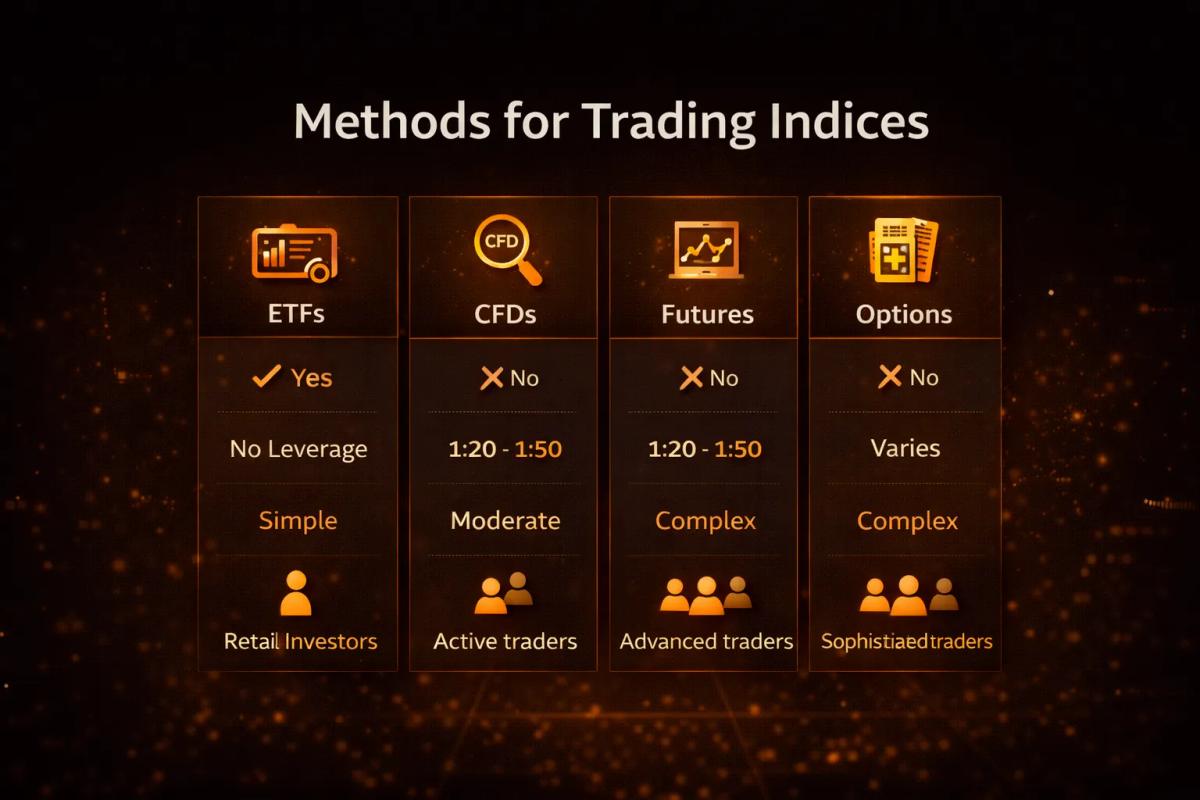
An index is a calculated value, not a tradeable asset. To gain exposure, you require instruments that track or derive their value from the index. Several methods exist, each with distinct characteristics around ownership, costs, complexity, and risk.
Index Funds and ETFs
Index funds and exchange-traded funds (ETFs) let investors buy shares in a fund holding the constituent stocks in proportionate amounts. These products aim to replicate the index’s performance as closely as possible.
Traditional index funds are mutual funds priced once daily after market close; investors buy and redeem shares directly from the fund company. ETFs trade on exchanges throughout the day like ordinary shares, offering intraday liquidity and typically lower expense ratios.
Purchasing an index ETF means gaining indirect ownership of the underlying stocks. Dividends from constituents flow through to fund holders. These products suit long-term investors seeking passive exposure without active management.
Popular examples include SPDR S&P 500 ETF (SPY), iShares Core FTSE 100 (ISF), and Invesco QQQ Trust tracking the Nasdaq 100.
Contracts for Difference (CFDs)
Contracts for difference are derivatives where a trader agrees with a broker to exchange the difference in an index’s value between opening and closing a position. CFDs involve no ownership of underlying assets.
CFDs typically offer leverage, allowing you to control larger positions with smaller capital. For example, you might control $10,000 of index exposure with $1,000 in margin. This leverage amplifies both gains and losses proportionally.
CFDs allow long positions (profiting if the index rises) and short positions (profiting if it falls) with equal ease. Extended trading hours may also be available depending on the broker.
Regulatory authorities in many jurisdictions have imposed restrictions on CFD trading given the risk and high proportion of retail traders who lose money. The European Securities and Markets Authority (ESMA), for instance, requires brokers to disclose what percentage of retail accounts lose money trading CFDs. Figures typically range from roughly 74% to 89% depending on the provider.
Index Futures
Futures contracts are standardised agreements to buy or sell a stock index at a predetermined price on a specified future date. These trade on regulated exchanges such as the Chicago Mercantile Exchange (CME) for US indices.
E-mini and Micro E-mini contracts have opened futures to individual traders. An E-mini S&P 500 contract represents a fraction of the full-sized contract, requiring less capital while still providing leveraged exposure.
Futures have expiration dates, requiring you to close positions or roll them into subsequent contract months. Pricing reflects expectations about future index values, interest rates, and dividends, so futures prices often differ from the current spot value.
Institutional traders frequently use futures to hedge portfolio risk or implement macro strategies. Retail traders, on the other hand, may find futures more demanding than ETFs or CFDs due to contract specifications, margin requirements, and expiration management.
Index Options
Options grant the right (but not the obligation) to buy (call) or sell (put) an index at a specific strike price before or on expiration. They trade on exchanges with standardised terms.
They allow you to express directional views, hedge existing positions, or build strategies around market volatility. The premium paid represents the buyer’s maximum loss, enabling defined-risk approaches.
Options pricing depends on several variables: the underlying index level, strike price, time to expiration, and implied volatility. This complexity means options demand more study than simpler instruments.
Most index options settle in cash: no physical stock delivery occurs. If an option expires in-the-money, the holder receives the cash difference between the index level and strike price.
Warning: Derivatives are advanced investment instruments, and you should study and understand them thoroughly before using them. You can learn more about financial and stock derivatives on our learn section.
How to Get Started With Index Trading
Moving from understanding indices to actively trading them involves practical steps. The right approach depends on your individual circumstances, objectives, and risk tolerance.
Choosing a Trading Method
The choice among ETFs, CFDs, futures, or options should align with trading goals and timeframes.
Long-term investors seeking passive exposure to market growth often find index ETFs most suitable. These require no leverage, carry lower costs over extended periods, and involve straightforward ownership.
Active traders pursuing short-term opportunities might consider CFDs or futures, which offer leverage and the ability to profit from falling markets. These instruments demand closer management and carry higher risk.
Options may suit those comfortable with complexity who want defined-risk positions or income strategies. They require understanding time decay and volatility dynamics.
Many beginners start with ETFs for their simplicity and transparency, exploring derivatives later as knowledge develops.
Selecting a Broker or Platform
Different products require different broker types. Stock brokers offer ETF trading. CFD brokers specialise in derivatives. Futures and options require access to derivatives exchanges.
When evaluating brokers, traders typically weigh regulatory status, fee structures, platform reliability, available markets, customer support, and educational resources. Oversight from authorities like the Financial Conduct Authority (FCA) in the UK or Securities and Exchange Commission (SEC) in the US provides certain investor protections.
Account minimums vary considerably. Some CFD brokers accept small deposits; futures trading may require several thousand dollars for margin.
If you’re having trouble choosing a broker, you can use MonkeyTrade’s matchmaking tool to fing one that meets your personal expectationes and criteria.
Understanding Margin and Leverage
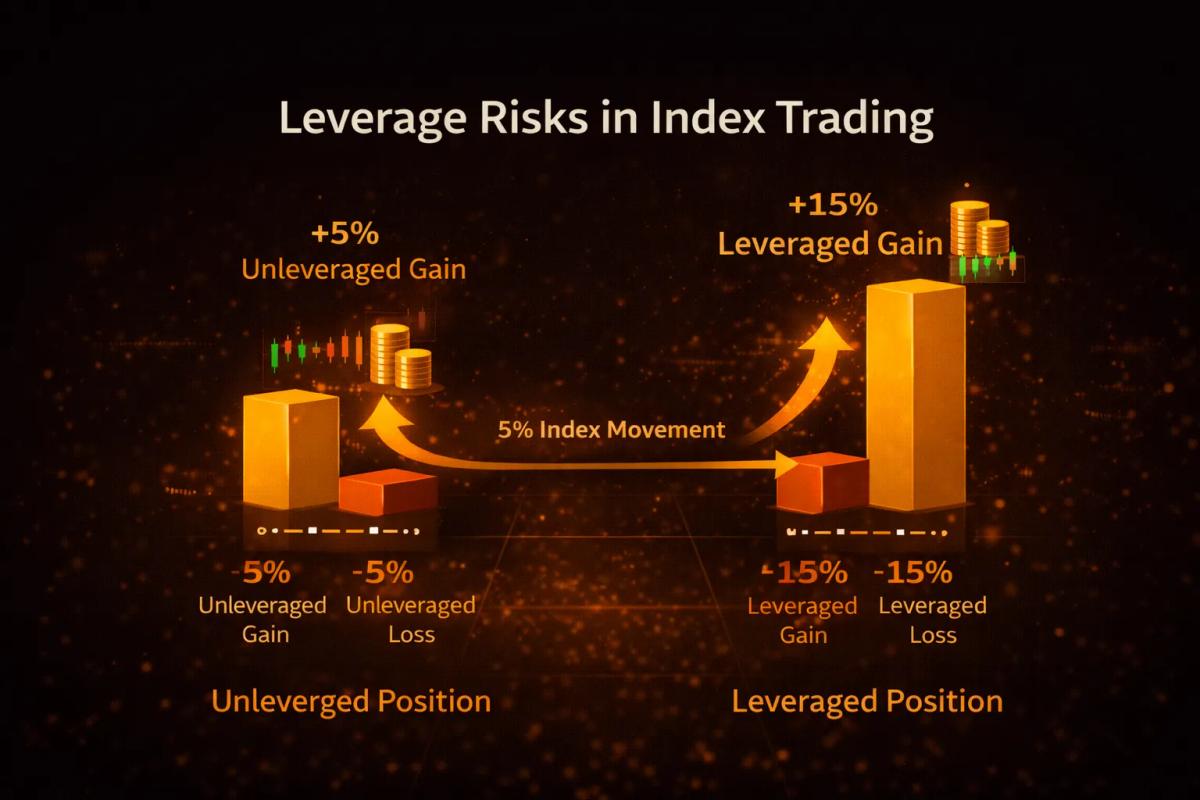
Leverage lets you control positions larger than your account balance through borrowing from the broker directly. A 10:1 ratio means $1,000 in margin can control a $10,000 position. While this magnifies potential profits, it equally magnifies potential losses.
Margin is collateral deposited with a broker to open and maintain leveraged positions. Initial margin opens the position; maintenance margin is the minimum needed to keep it open. If equity falls below maintenance margin, brokers issue margin calls requiring additional funds or position closure.
Leveraged products can produce losses exceeding the initial deposit at some brokers, though many retail platforms now offer negative balance protection in certain jurisdictions.
Those new to leverage may consider starting with small positions or paper trading to see how it affects outcomes before committing meaningful capital.
Risks of Index Trading
All forms of index trading carry risks worth understanding before committing capital.
Market risk affects every method. Indices can decline sharply during economic downturns, geopolitical shocks, or periods of stress. The S&P 500 has historically experienced drawdowns exceeding 50% in severe bear markets. Diversification within an index does not shield against broad declines.
Leverage risk applies to CFDs, futures, and certain options strategies. Leveraged positions can lose money faster than the underlying moves against them, and losses can exceed initial deposits in some cases.
Liquidity risk, while generally low for major indices, can surface during market disruptions. In periods of extreme volatility, spreads may widen and execution may become less predictable.
Counterparty risk exists with CFDs, where the broker is the counterparty to every trade. If the provider fails, traders may face losses. Regulated brokers typically maintain segregated client funds and participate in compensation schemes, though protection limits apply.
Tracking error affects ETFs and index funds. These products may not perfectly match index performance due to fees, transaction costs, and cash holdings. Small differences compound over time.
Currency risk arises when trading indices denominated in foreign currencies. A UK investor holding S&P 500 products faces both US equity risk and pound-dollar exchange rate movements.
Complexity risk increases with derivatives. Futures require managing expiration and rollovers. Options involve time decay and volatility factors. Misunderstanding these mechanics can lead to unexpected losses.
See how individual constituents behave inside their index — for example Apple, JPMorgan Chase and SAP.
Key Takeaways
- Stock indices measure the collective performance of groups of stocks, serving as benchmarks for markets and economies. The calculation methodology (price-weighted or market cap-weighted) determines how individual stocks influence the overall value.
- Major global indices like the S&P 500, FTSE 100, DAX 40, and Nikkei 225 act as primary benchmarks for their regions, giving traders access to broad market movements.
- Multiple methods exist for index trading: passive investment through ETFs and index funds, or active trading through CFDs, futures, and options. Each carries distinct characteristics around ownership, leverage, costs, and complexity.
- Leveraged instruments amplify both potential gains and losses, demanding careful risk management and capital appropriate for the trader’s situation.
- Those starting out may find simpler instruments like ETFs a sensible first step before moving to derivatives, taking time to understand the risks and mechanics of each product before committing capital.
Disclaimer: This article is for educational and informational purposes only and does not constitute financial advice. Trading and investing involve risk, including the potential loss of principal. Past performance does not guarantee future results. Readers should consider their own circumstances and consult qualified professionals before making financial decisions.

About the authors


Put this into practice
Related articles

Most Volatile Stocks: How to Find and Trade Them
A practical guide for retail traders on where to find the most volatile stocks, why they swing, and how to trade them without blowing up your account.

Options Trading Explained: Calls, Puts, and Broker Approval
How options trading works for UK retail traders: calls, puts, strike prices, premiums, broker approval, risk limits, and tax reporting, in plain English.

Passively Managed Index Funds vs. Active Funds: Which Suits You Best?
A clear-eyed comparison of passively managed index funds and actively managed funds: mechanics, costs, tax drag, downturn behaviour, and how to choose.
0 comments