



Stock Trading Basics: What Are Shares and How Do You Trade Them?
Did you know you can own a fraction of Apple or Amazon? When you buy a share, you become a part-owner of a company. Stock trading is nothing more than the buying and selling of these ownership stakes. It can seem intimidating at first, though the mechanics follow a logical sequence that anyone can learn.
In this guide, you will learn what shares are, how stock trading works, and the concrete steps you have to go through to buy your first stock. By the end, you should have a clear understanding of the stock trading process and know what to do next.
Warning: This content is for educational purposes only and does not constitute financial advice. Consider consulting a qualified financial professional before making investment decisions.

What Is a Share in Stock Trading?
Shares as Ownership Units
A share represents a unit of ownership in a company. When a business decides to raise capital by selling portions of itself to the public, it divides its ownership into many small pieces. These pieces are what we call shares. Purchase one of these, and you own a fraction of that company.
The size of your ownership stake depends on how many shares you hold relative to the total number issued. If a company has issued one million shares and you own 100 of them, you hold 0.01% of that company. In some cases, this ownership entitles you to a proportional claim on the company’s assets and earnings.
Shares are also referred to as stocks or equities. These terms are often used interchangeably in everyday conversation, although there are subtle distinctions we’ll explore later.
Common Shares vs. Preferred Shares
Most individual investors buy common shares. These typically come with voting rights, allowing shareholders to vote on certain company decisions, such as electing board members. In companies that distribute them, common shareholders also entitle you to receive dividend payments.
Preferred shares work differently. They carry no voting rights, but grant a higher claim on company assets and earnings. When a company pays dividends, preferred shareholders receive theirs first. In bankruptcy, preferred shareholders are also paid before common shareholders, though after bondholders and other creditors.
For beginners, common shares are the standard starting point and what most people mean when discussing stock trading.
Speaking of which, let’s dive into how you can acquire shares.
What Is Stock Trading?
Stock trading is simply buying and selling company shares.
When you purchase shares, you’re betting that the company will perform well and that the shares will become more valuable over time. When you sell, you convert your ownership stake back into cash, ideally at a higher price than you paid.
How Stock Exchanges Work
Now that you know what stock trading is, you might be wondering how it happens exactly. The answer is: through stock exchanges.
Stock exchanges are organized marketplaces where shares change hands. Major exchanges include the New York Stock Exchange (NYSE) and NASDAQ in the United States, with numerous others operating globally.
These exchanges serve as intermediaries, matching buyers with sellers. When you want to buy shares of a particular company, the exchange finds someone willing to sell at the same price you want to pay. This matching happens electronically and typically takes seconds.
Stock exchanges also provide price discovery: the process by which the market determines what a share is worth at any given moment based on supply and demand. More buyers than sellers pushes prices up. More sellers than buyers pushes them down.
Think of it like a busy fruit market. If mangoes are selling for $2 each and there is only 1 left, but 2 people want to buy it. One buyer might offer to pay $3 so that the vendors sell one of the remaining mangoes to him instead of the other buyer. That’s the new price. But if the next day nobody wants mangoes and vendors have too many that will spoil, they drop the price to $1 just to sell them. The “right price” at any moment is simply whatever buyers and sellers agree on based on how many people want to buy versus how many want to sell.
Stock trading works in the same way, but with thousands of participants constantly making new offers to buy and sell shares.
Now, how does a company get listed on an exchange? To “go public,” companies must meet specific requirements. These depend on the specific exchange but generally include standards for financial reporting, company size, and governance practices.
Market Hours and Trading Sessions
Stock exchanges keep set hours. The NYSE and NASDAQ, for example, operate from 9:30 AM to 4:00 PM Eastern Time on weekdays, excluding holidays.
Some brokers offer extended-hours trading: buying and selling before the market opens (pre-market) or after it closes (after-hours). Trading during these periods often involves lower liquidity, which can affect prices and your ability to execute trades where you want them.
Different global exchanges operate in their respective time zones, meaning somewhere in the world, a stock market is almost always open during the business week.
How to Buy Shares: Step-by-Step
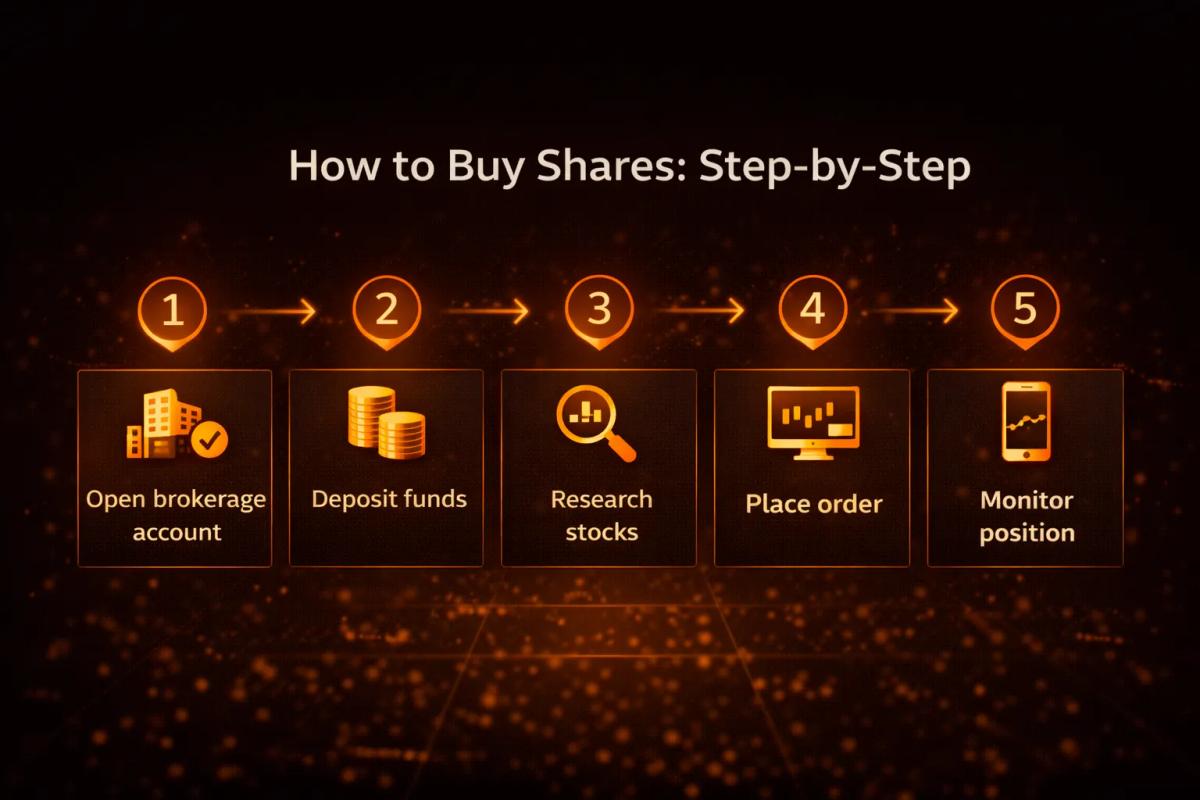
We’ve covered what shares are and how stock trading works. Now, let’s go over the specific steps you need to follow to start trading yourself.
You can also access our complete trading guide for beginners.
Choose a Brokerage Account
The first thing you need to get started with stock trading and buy company shares is a brokerage account. You cannot buy shares directly from a stock exchange as an individual, and a brokerage is a licensed firm that executes trades on your behalf.
Some brokerages provide extensive research tools, educational resources, and access to human advisors. Others focus on low-cost trading with streamlined digital platforms. Fees, available investment options, platform usability, and customer support are other aspects to take into account when choosing a trading platform.
Today, many brokerages now offer commission-free trading on stocks, though other fees may apply. Some also offer fractional shares, letting you buy a portion of a share if the full price exceeds what you want to invest.
Choosing a broker can be overwhelming. If you’re unsure about where to start, you can use MonkeyTrades’ matchmaking tool to find the best stock trading broker for you.
Fund Your Stock Trading Account
You need something to buy the shares with, right? Once your brokerage account is open, you need to deposit money before you get started with stock trading. Most brokerages accept bank transfers; some also allow debit card deposits or other funding methods.
Transfer times vary. Bank transfers might take one to several business days to clear, depending on the method and institutions involved and where they are physically located. Some brokerages offer instant deposits up to certain limits, letting you begin trading immediately while the transfer settles in the background.
Research and Select a Stock
Now, this part is absolutely critical if you’re a beginner. Before buying, spend time understanding what you’re purchasing. This means researching the company: what it does, how it makes money, its financial health, and its position within its industry.
Publicly traded companies file regular reports with regulatory bodies. These filings are publicly accessible and contain financial statements and other disclosures that illuminate the company’s situation. Many brokerages provide access to these reports, along with analyst research and news coverage.
There is no formula for selecting winning stocks, and reasonable people often disagree about whether a particular stock is worth buying. Take your time and make decisions based on your own understanding and risk tolerance.
Place Your Order
When you’re ready to buy, you’ll place an order through your brokerage platform. You’ll need to specify the stock (usually by its ticker symbol), the number of shares, and the type of order.
Order types determine the conditions under which your trade executes. We’ll explain the most common types in the next section.
After you submit, the brokerage sends your order to the exchange for execution. For most liquid stocks during market hours, this happens almost instantly. You’ll receive confirmation once your order fills.
Monitor and Manage Your Stock Trading Position
After purchasing shares, they appear in your brokerage account. You can track performance through your broker’s platform, which shows your current holdings, their market value, and your gains or losses. You can also use third-party portfolio tracking tools that provide even deeper insights.
How actively you monitor depends on your investment approach. Some investors check their portfolios frequently; others prefer longer-term approaches with less frequent review.
Eventually, you’ll need to decide whether to hold your shares, buy more, or sell. These decisions hinge on your financial goals, how the investment performs relative to your expectations, and your overall financial situation.
Types of Stock Trading Orders
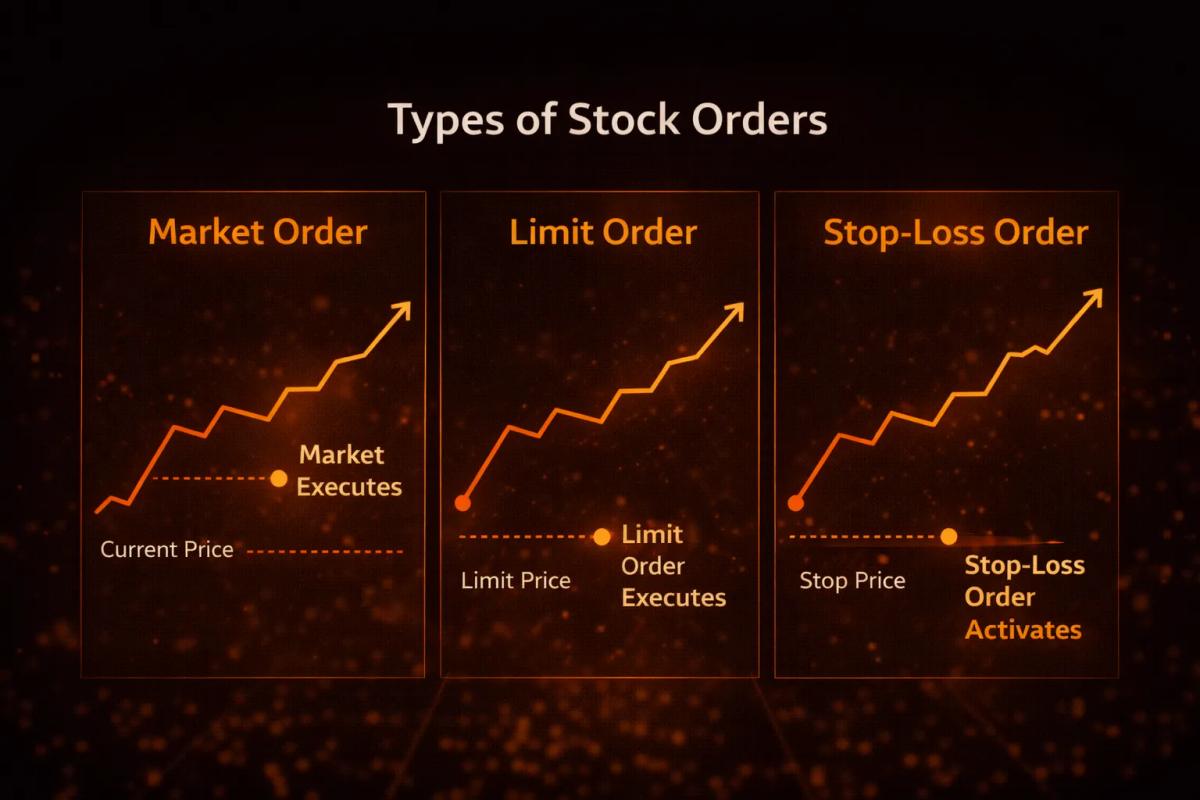
Most stock trading platforms allow you to place different types of orders. You should see these as tools that allow you to customize your trading strategy depending on your needs and preferences. Let’s go over each one of them.
Market Orders
A market order instructs your broker to buy or sell shares immediately at the best available current price. Here, speed of execution takes priority over price precision.
Market orders execute immediately during normal trading hours for liquid stocks. However, the disadvantage is that the price you receive might differ slightly from what you saw when placing the order, especially for less liquid stocks or during volatile conditions.
Limit Orders
A limit order sets a specific price at which you’re willing to transact. For a buy limit order, you specify the maximum price you’ll pay. For a sell limit order, you specify the minimum you’ll accept.
Limit orders give you price control, but don’t guarantee execution. If the market can’t find an opposite order to the one you place, your trade won’t happen. You can typically set an expiration date to your limit orders or let them remain active until cancelled.
Stop-Loss Orders
A stop-loss order aims to limit potential losses. You set a trigger price; if the stock falls to that level, your stop-loss converts into a market order to sell.
For example, if you buy a stock at $50 and set a stop-loss at $45, your shares will automatically be sold if the price drops to $45. This can help manage downside risk, though it doesn’t guarantee you’ll sell at exactly $45. This is because in fast-moving markets, the execution price may be lower.
Take-Profit Orders
Take-profit orders aim to lock in gains when a stock reaches your target price. You set a trigger price; if the stock rises to that level, your take-profit converts into a market order to sell.
For example, if you buy a stock at $50 and set a take-profit at $60, your shares will automatically be sold if the price rises to $60. This helps you secure profits without constantly monitoring the market. Again, the execution price may be slightly different because of high frequency or volatility.
Key Stock Trading Concepts Every Beginner Should Know
Bid and Ask Prices
Stock quotes show two prices: the bid and the ask. The bid is the highest price a buyer currently offers for the stock. The ask (also called the offer) is the lowest price a seller currently accepts.
If you place a market order to buy, you’ll typically pay close to the ask. Inversely, if you place a market order to sell, you’ll receive close to the bid.
Spread
The spread is the gap between bid and ask prices. A stock with a bid of $49.95 and an ask of $50.00 has a spread of $0.05.
Spreads tend to be tighter for heavily traded stocks and wider for less liquid ones. The spread represents a cost of trading: you effectively pay it when buying at the ask and later selling at the bid.
Dividends
Dividends are payments some companies make to shareholders, typically from profits. Not all companies pay them; as many reinvest earnings back into the business instead for a compounding effect.
Companies that do pay dividends usually do so quarterly, though schedules vary. The total amount you receive depends on how many shares you own.
One of the key advantages of dividends is that they provide income independent of share price appreciation. Even if the stock goes down, you will still receive your share of the profits.
Be careful: dividends may have tax implications. Make sure to check your residential jurisdiction’s tax laws to know whether you have to pay taxes.
Market Capitalization
Market capitalization (often abbreviated as market cap) is the total value of a company’s outstanding shares, calculated by multiplying the current share price by total shares issued.
A company’s market cap offers a quick gauge at the organization’s size. Companies are often categorized as large-cap, mid-cap, or small-cap.
Risks of Stock Trading

Like all other financial assets and investments, stock trading carries the possibility of losing money. Share prices can decline for company-specific reasons, such as poor financial results or management problems, or due to broader market conditions affecting many stocks at once, like nation-wide and sometimes even global crises.
Several factors contribute to risk:
- Market volatility: Stock prices fluctuate constantly and can move sharply in either direction within short periods.
- Company-specific risk: Individual companies can underperform, face scandals, or go bankrupt.
- Economic conditions: Recessions, interest rate changes, and other macroeconomic factors affect stock prices broadly.
- Liquidity risk: Some stocks trade less frequently, making it harder to buy or sell at desired prices.
- Emotional decision-making: Fear and greed can lead investors to making poor decisions, like buying high and selling low.
It’s important to remember that past performance, whether of any individual stock or the market as a whole, does not guarantee future results. Many investors, professionals included, underperform the broader market over time.
Before investing, consider how much you can afford to lose without affecting your financial stability or goals. Only invest money you don’t need for immediate expenses or emergencies.
Next Steps for New Traders
If you’re ready to move forward, here are concrete actions to guide you through the process and make sure your trading journey starts in the best way possible:
- Educate yourself further. This guide covers fundamentals, but there’s more to learn. Familiarize yourself with additional terminology and understand how different market conditions might affect your investments. We recommend diving into our learn section for more unique insights and tips on stock trading.
- Research brokerage options. Compare several brokerages based on the factors discussed earlier. Many offer demo accounts or paper trading that let you practice without risking real money.
- Start small. Consider beginning with a modest amount you can afford to lose entirely. This lets you learn trading mechanics with real stakes while limiting the damage from early mistakes.
- Develop a plan. Before buying any stock, think about why you’re buying it and under what circumstances you’d sell. Having criteria in advance helps prevent emotional decision-making. If you’re unsure about where to start, visit MonkeyTrade’s guide on building a trading plan.
- Consider professional guidance. A qualified financial advisor can provide personalized advice based on your specific situation, goals, and risk tolerance. This guide is educational and cannot replace individualized professional counsel.
Investing is a long-term activity for most people. Take your time, continue learning, and make decisions that align with your personal financial situation and objectives.

About the authors


Put this into practice
Related articles

Stocks vs Indices: Risk, Diversification, and Trading Costs Compared
A direct comparison of stocks vs indices for retail traders: how each is priced, the risk profile, FCA leverage caps, costs, tax treatment and when to use which.

The Crypto Market Has Matured: Here Is What Investors Are Watching in 2026
The crypto market has matured. Here is what institutional investors and informed traders are actually tracking in 2026.

Trading Halts Explained: Circuit Breakers, Suspensions, and Delays
Trading halts freeze a stock, or an entire market, when volatility, news or order imbalances threaten orderly pricing. Here is how they work and what they mean for your portfolio.
0 comments