



Financial Markets · Beginner · 5 min read
Stock Market Hours in Central Time: When US Markets Open and Close
Regular trading hours converted to central time
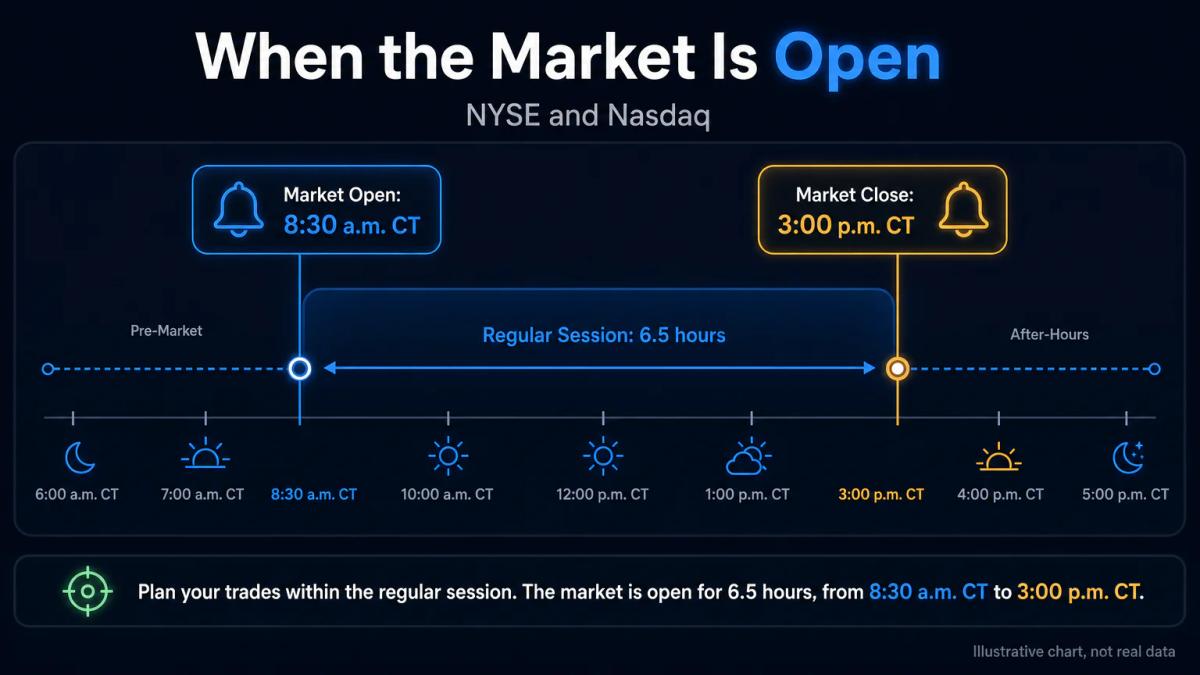
The New York Stock Exchange (NYSE) and Nasdaq run their regular session on New York time, with an opening bell at 9:30 a.m. ET and a close at 4:00 p.m. ET. For anyone watching from the central zone, that translates to 8:30 a.m. CT and 3:00 p.m. CT, giving you a 6.5-hour window during which shares of listed US companies change hands on the two main venues.
If your local clock is set to Chicago, Dallas, Houston or another central-zone city, the offset stays at one hour behind New York for most of the year, so the stock market open time in CST lands at 8:30 a.m. and the close at 3:00 p.m. Everything else in the trading day, from earnings releases to the closing auction, is anchored to those two points on the clock.
Pre-market and after-hours sessions in your time zone
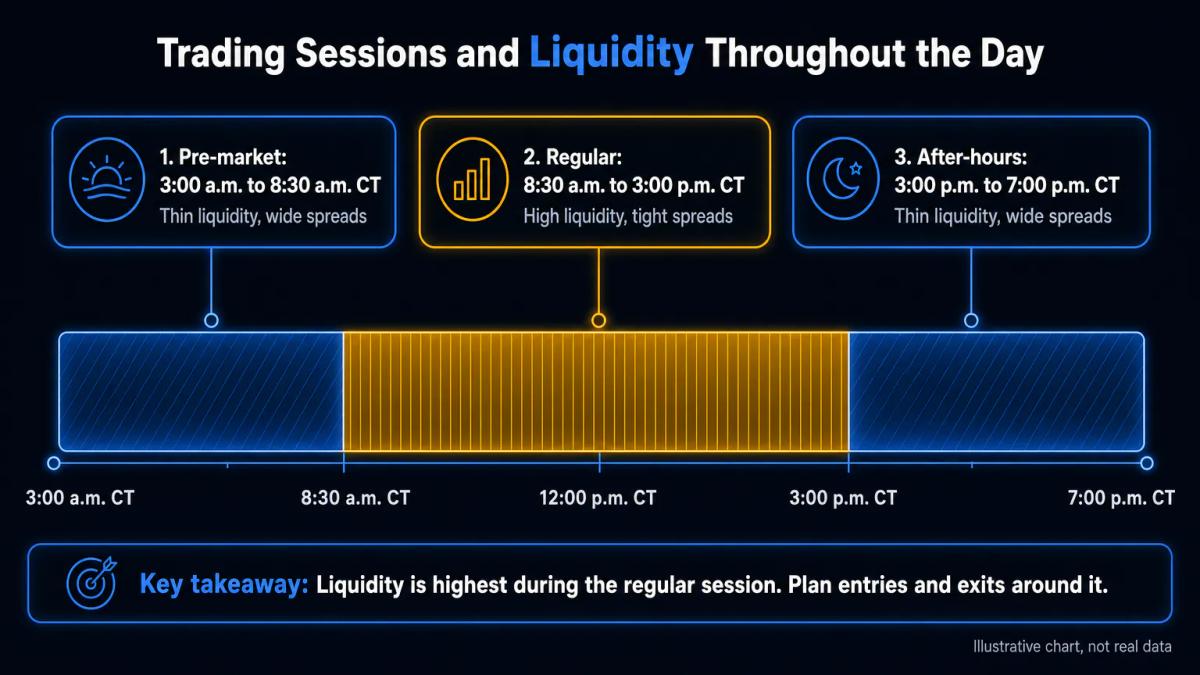
Extended hours give you access to US shares before the opening bell and after the close through electronic communication networks (ECNs, private venues that match buy and sell orders outside the main exchange). In central time, pre-market trading starts at 3:00 a.m. CT and runs until the regular open at 8:30 a.m. CT, while after-hours trading begins at 3:00 p.m. CT and extends to 7:00 p.m. CT on most retail brokers, with some venues staying open until 8:00 p.m. CT.
Liquidity in these windows tends to be thin, so spreads (the gap between the bid and ask) widen noticeably and order books show fewer resting orders. As a practical guideline, the first and last hour of the regular session, roughly 8:30 a.m. to 9:30 a.m. CT and 2:00 p.m. to 3:00 p.m. CT, carry the deepest volume and the tightest spreads, and that is generally where a newcomer to US equities will want to place their orders.
Why central time shapes your trading schedule
Most financial news outlets, broker platforms and charting tools default to Eastern Time. Imagine that you sit in the central zone and forget the one-hour adjustment: you log in at 9:30 a.m. local time expecting the opening bell, only to find the first hour of the session already behind you. Because the opening 30 minutes are typically the most volatile stretch of the day, missing that window means missing the moves that set the tone for everything that follows.
There is also a lifestyle angle to consider. An 8:30 a.m. CT open is convenient for anyone in the central zone: picture a trader watching the pre-market build from around 7:00 a.m. CT with a coffee in hand, taking the open live, and wrapping up by 3:00 p.m. CT. That schedule fits a working day rather more comfortably than the East Coast equivalent, which starts an hour earlier and finishes at 4:00 p.m. local time.
Market holidays and early closures in central time
On full US market holidays, both NYSE and Nasdaq close completely and no regular trading takes place. If any of these holidays falls on a weekend, the exchange usually observes the closest weekday. The recurring closures are listed below:
- New Year's Day
- Martin Luther King Jr. Day
- Presidents' Day
- Good Friday
- Memorial Day
- Juneteenth
- Independence Day
- Labor Day
- Thanksgiving Day
- Christmas Day
On the day before certain holidays, markets close early: the regular equity session ends at 1:00 p.m. ET, which is 12:00 p.m. CT, and the bond market often closes at 2:00 p.m. ET, or 1:00 p.m. CT. The typical early-close days are:
- The Friday after Thanksgiving
- Christmas Eve, when it falls on a weekday
- July 3rd, when the 4th falls on a weekday
| Session type | Regular open (CT) | Regular close (CT) | Early close (CT) |
|---|---|---|---|
| NYSE, Nasdaq stocks | 8:30 a.m. | 3:00 p.m. | 12:00 p.m. |
| Pre-market | 3:00 a.m. | 8:30 a.m. | 3:00 a.m. to 8:30 a.m. |
| After-hours | 3:00 p.m. | 7:00 p.m. | Reduced or closed |
Daylight saving time and central time trading shifts
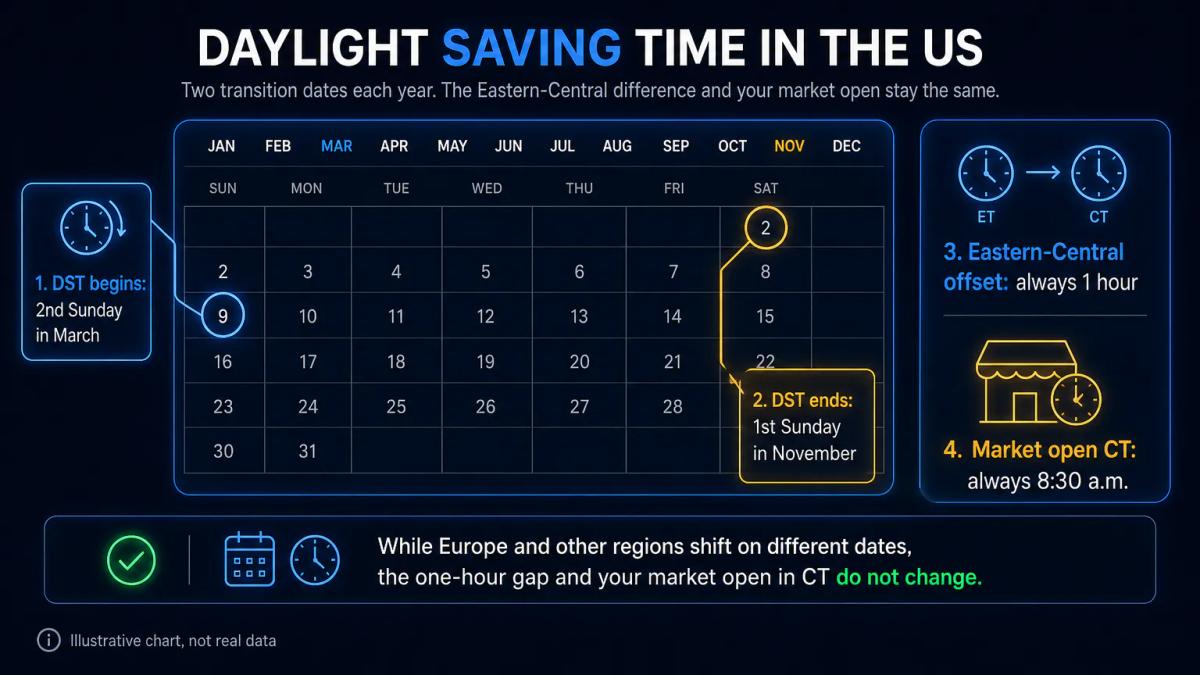
The US moves its clocks forward on the second Sunday of March and back on the first Sunday of November, while Europe and the UK shift on different weekends, in late March and late October. For roughly two weeks each spring and one week each autumn, the offset between the US and other regions changes accordingly, although the gap between Eastern and Central stays at one hour year-round inside the US.
The practical point comes down to your platform's clock. If your broker's servers are set to New York, your charts should update automatically with the US shift. Should the platform instead run on London time or your own machine's clock, take a moment to verify that the session start moves with the US calendar rather than your local one, because a one-hour mismatch on a candlestick chart shifts every session boundary and can invalidate any strategy built around the opening or closing range.
How to set up alerts and reminders for central time opens
Most brokers and charting platforms let you display times in your local zone, and it is worth switching once so you never have to convert in your head again. In MetaTrader 4, MetaTrader 5, cTrader and TradingView, the time zone setting sits in the preferences or chart-properties menu, and choosing America/Chicago will render every session marker in CT.
It also helps to add three calendar reminders to your working day:
- 8:15 a.m. CT for the pre-open news scan
- 8:30 a.m. CT for the opening bell
- 2:45 p.m. CT for the closing auction
The first 15 minutes and the last 15 minutes of the regular session are where a large share of daily volume prints, so these two windows deserve your attention. For a swing trader watching earnings, it is also worth adding a reminder for the after-hours window at 3:00 p.m. CT, since most large-cap companies release their results either just after the close or before the next open.
Frequently Asked Questions
What time does the stock market open in central time?
The regular US stock market session opens at 8:30 a.m. CT and closes at 3:00 p.m. CT, Monday through Friday, on non-holiday weekdays. This applies to both the NYSE and Nasdaq.
Is the stock market open right now in central time?
The regular session is open on weekdays between 8:30 a.m. and 3:00 p.m. CT, excluding US market holidays. Outside those hours you can still access pre-market from 3:00 a.m. CT and after-hours until 7:00 p.m. CT through most retail brokers.
What are the pre-market hours in central time?
Pre-market trading in central time runs from 3:00 a.m. CT until the regular open at 8:30 a.m. CT. Volume is thin and spreads are wider than in the regular session, so orders in that window fill less predictably.
Do stock markets close early on certain days in central time?
Yes. On several days each year the regular session ends at 12:00 p.m. CT instead of 3:00 p.m. CT. The recurring early closes are the Friday after Thanksgiving, Christmas Eve when it falls on a weekday, and July 3rd when the 4th is a weekday.
How do I convert Eastern Time to central time for market hours?
Subtract one hour from any Eastern Time quote to get central time. The offset stays at one hour year-round inside the US, so 9:30 a.m. ET is always 8:30 a.m. CT and 4:00 p.m. ET is always 3:00 p.m. CT.
About the authors


Put this into practice
Related articles

Stock Trading Basics: What Are Shares and How Do You Trade Them?
Learn what shares are and how stock trading works. This beginner guide explains how to buy stocks step-by-step, from choosing a broker to placing an order.

Stocks vs Indices: Risk, Diversification, and Trading Costs Compared
A direct comparison of stocks vs indices for retail traders: how each is priced, the risk profile, FCA leverage caps, costs, tax treatment and when to use which.

The Crypto Market Has Matured: Here Is What Investors Are Watching in 2026
The crypto market has matured. Here is what institutional investors and informed traders are actually tracking in 2026.
0 comments