



Financial Markets · Advanced · 6 min read
Taxes on Trading Income UK: CGT, Income Tax, and Allowances Explained
How trading profits are taxed in the UK
The starting point for any UK trader thinking about tax is HMRC's categorisation of the activity itself, since that single classification governs which regime applies, which allowances come into play, and how losses can be used. Someone treated as an investor falls within Capital Gains Tax on disposals, while someone whose activity amounts to carrying on a trade is assessed to Income Tax and Class 2/4 National Insurance on net profits. The categorisation follows the badges of trade, which look at several factors in combination:
- Frequency of transactions
- Degree of organisation
- Typical holding period
- The extent to which the proceeds support a livelihood
- The use of borrowed capital in financing positions
For individuals dealing on their own account, categorisation is almost never a matter of choice. HMRC's default position for private speculation on shares, CFDs and crypto places the activity within CGT, with Income Tax taking over once the pattern of dealing starts to resemble a business. That boundary carries knock-on effects across several areas:
- The applicable tax rates
- The allowances available
- The deductibility of expenses
- The mechanics of loss relief
Classification also determines whether the return runs through Self-Assessment on trading pages or on capital-gains pages, and whether payments on account are triggered for the following year.
This article is educational and does not constitute tax advice. Any individual position should be reviewed with a qualified UK tax adviser before filing.
Capital Gains Tax allowances and rates for traders
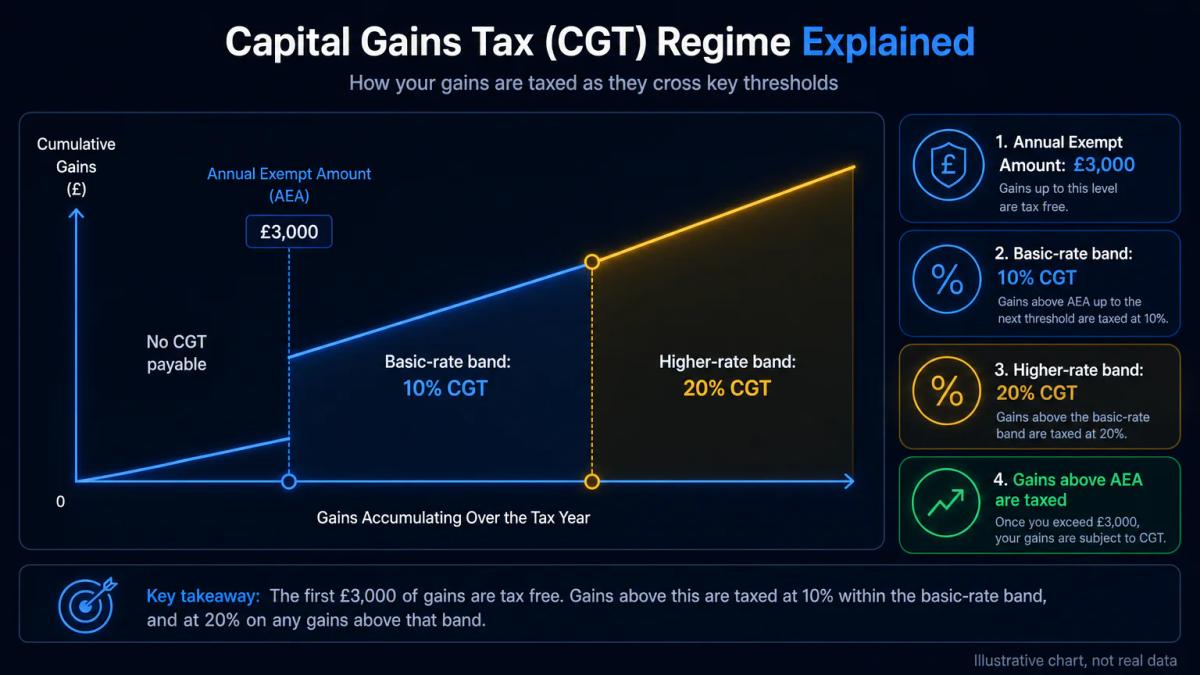
Under the investor regime, you pay CGT on net chargeable gains after the annual exempt amount. For 2024/25 the AEA is £3,000 for individuals, down from £6,000 in 2023/24 and £12,300 in 2022/23. Gains on non-residential assets, including listed shares and most CFD positions treated as capital, are charged at 10% within the basic-rate band and 20% above it, measured against the sum of taxable income plus gains.
Section 104 pooling applies to shares of the same class in the same company. The 30-day bed-and-breakfasting rule overrides the pool when a disposal is matched to a reacquisition within 30 days, and Section 10 TCGA residence tests govern exposure for non-UK residents, including temporary non-residents returning within five years.
Allowable losses are set against gains of the same year first, then carried forward indefinitely once claimed within four years of the end of the tax year in which they arose.
Income Tax when trading is your primary activity
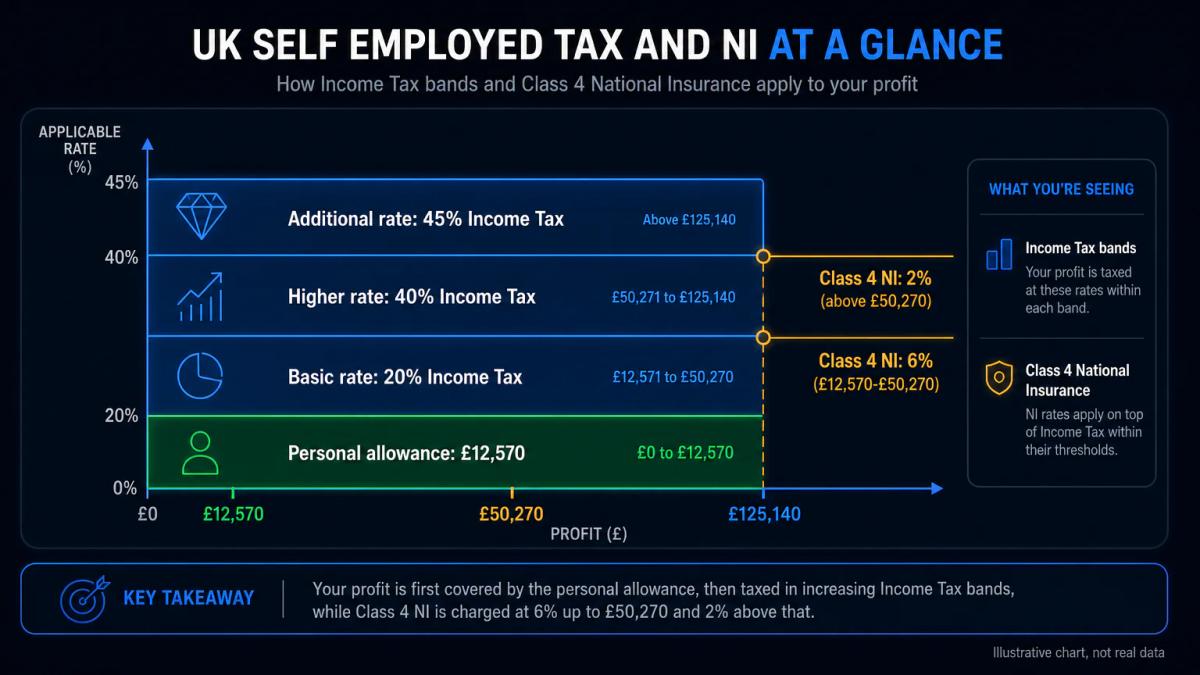
Where HMRC accepts trader status, profits are self-employment income taxed at 20%, 40% and 45% across the basic, higher and additional-rate bands, with the personal allowance of £12,570 tapering above £100,000. Class 2 NI was abolished for most profits from 6 April 2024; Class 4 NI applies at 6% on profits between £12,570 and £50,270, and 2% above, for 2024/25.
Trader status is a question of fact, and HMRC applies the badges of trade cumulatively. Several patterns of activity tend to push the assessment toward trading:
- Short holding periods
- High turnover
- A systematic method
- Use of leverage
- The absence of other employment income
Consider the contrast between a full-time scalper on futures with no other work and a part-time swing trader on equities alongside PAYE employment: even at similar annual profit, HMRC would be likely to reach different conclusions on each.
Incorporation through a UK limited company shifts the taxation of profits into the Corporation Tax regime, with extraction via salary and dividends then creating a second layer. The current rates run as follows:
- Main rate of 25% on profits above £250,000
- Small-profits rate of 19% on profits up to £50,000
- Marginal relief tapering the effective rate between £50,000 and £250,000
Deductible expenses and record-keeping for traders
Self-employed traders deduct wholly and exclusively incurred expenses against gross trading income. Typical categories include:
- Platform, exchange and data-feed subscriptions
- Commissions, financing charges and clearing fees not already netted in P&L
- Professional fees: accountancy, tax advice, legal
- Dedicated hardware and software, with capital allowances on qualifying plant
- A reasonable apportionment of home-office costs under the simplified flat rate or the actual-use method
- Trading-specific education and research where directly linked to the existing trade
Records must be preserved for at least five years after the 31 January submission deadline for self-employed taxpayers, extended where an enquiry is open. Expect to keep:
- Contemporaneous trade blotters
- Broker statements
- Bank reconciliations
- Expense invoices
HMRC's discovery window extends to four years for innocent error, six for carelessness and twenty for deliberate behaviour.
Tax treatment of different asset classes and trading vehicles
At the retail level, the wrapper and the instrument tend to be the dominant drivers of the applicable regime, with the identity of the underlying asset playing a secondary role. The table below sets out the default treatment for the vehicles UK retail traders use most often.
| Instrument | Default regime | Notes |
|---|---|---|
| Listed shares (direct) | CGT | 0.5% stamp duty reserve tax on purchase; dividends taxable separately |
| CFDs | CGT for investors; Income Tax if trading | No stamp duty; financing costs allowable |
| Spread betting | Outside Income Tax and CGT for retail punters | Treated as gambling; losses not relievable |
| Forex (retail CFD) | As CFDs | Section 988-style ordinary treatment does not apply in the UK |
| Crypto | CGT by default; Income Tax for mining, staking rewards and trade-level activity | HMRC's Cryptoassets Manual governs; same-day and 30-day matching rules apply |
| Futures and options (non-ISA) | CGT for investors; Income Tax if trading | Qualifying index options via recognised exchanges follow CGT |
The spread-betting exemption explains why many UK retail participants prefer the format to CFDs, keeping in mind that any losses carry no relief and that position sizing is constrained by the FCA retail leverage caps:
- 1:30 on major currency pairs
- 1:20 on major indices and gold
- 1:5 on individual equities
- CFDs on crypto prohibited for UK retail clients
ISAs and tax-advantaged accounts for traders
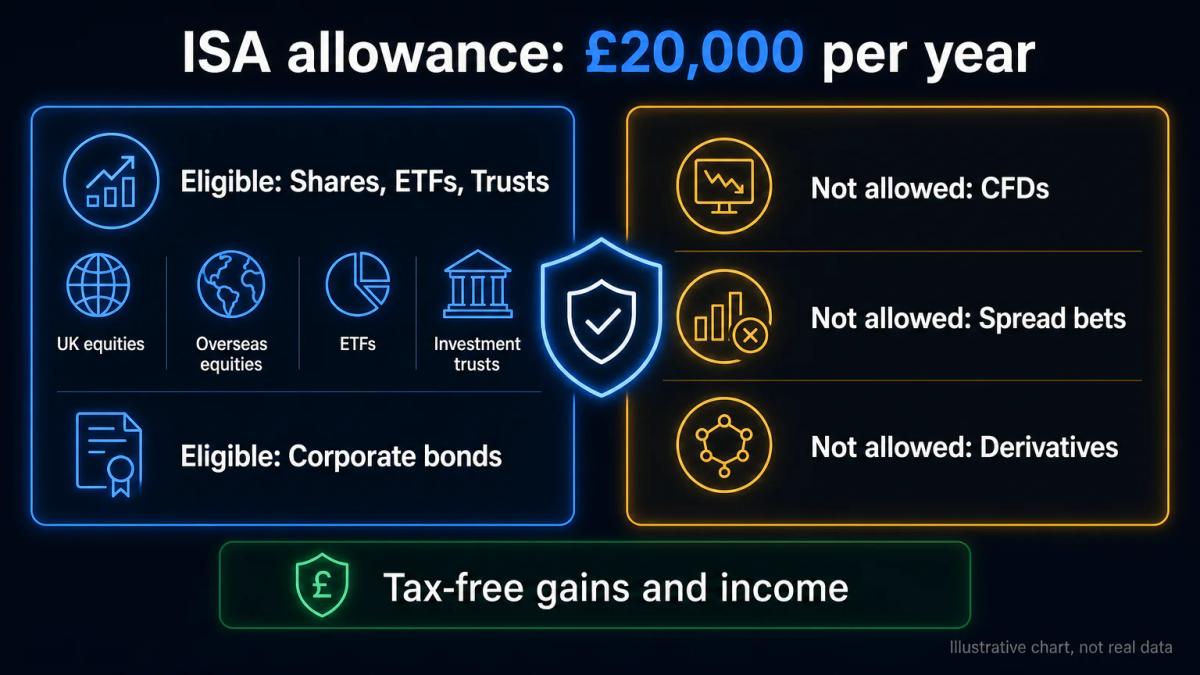
A Stocks and Shares ISA shelters £20,000 of subscriptions per tax year, with gains, dividends and interest outside both CGT and Income Tax. Eligible investments include:
- UK and most overseas listed equities
- Investment trusts
- OEICs
- ETFs with UK reporting status
- Corporate bonds
The following are not permissible:
- CFDs
- Spread bets
- Unlisted derivatives
- Most crypto
SIPPs defer Income Tax on contributions up to the annual allowance of £60,000, tapered for high earners, with 25% tax-free at crystallisation from age 55, 57 from April 2028. Both wrappers suit position trading and investing, with high-frequency CFD activity falling outside their scope.
Loss relief and carry-forward rules for trading losses
Capital losses have to be formally claimed within four years of the end of the tax year in which they arose, after which they carry forward indefinitely against future gains, with current-year gains absorbed first in the ordering. The regime for trading losses assessed under Income Tax offers wider options:
- Sideways relief against other income of the current or prior year under s.64 ITA 2007
- Carry-back of terminal losses on cessation of the trade
- Indefinite carry-forward against profits of the same trade under s.83
Sideways claims are capped at the greater of £50,000 or 25% of adjusted total income. Spread-betting losses sit outside both regimes above, which means they cannot be relieved against gains or income under any UK provision.
Self-Assessment filing and payment deadlines
Self-Assessment returns covering the tax year ending 5 April carry two filing deadlines depending on the format used:
- 31 October for paper returns
- 31 January for online returns
The balancing payment is also due on 31 January, with payments on account falling on 31 January and 31 July where the prior-year liability exceeded £1,000 and less than 80% of the tax was collected at source. Each payment on account comes in at 50% of the prior-year liability.
For advanced users operating at scale, Making Tax Digital for Income Tax Self-Assessment phases in from April 2026 for self-employed income above £50,000, with quarterly updates replacing a single annual return for in-scope taxpayers. Penalties follow the points-based regime, with the main components as follows:
- £100 fixed penalty for late filing of a return
- Daily penalties applied after three months of continuing default
- Separate interest and surcharge mechanics on top for late payment of tax
Frequently Asked Questions
Do I pay Capital Gains Tax or Income Tax on my trading profits in the UK?
Default treatment for private individuals dealing on their own account is CGT. HMRC applies Income Tax where the activity meets the badges of trade (frequency, organisation, holding period, reliance on proceeds, use of leverage). Classification is factual, not elective, and should be reviewed case by case.
How do I declare trading profits in the UK?
Through Self-Assessment. CGT disposals go on the capital-gains pages (SA108); self-employed trading profits go on the self-employment pages (SA103). The deadline is 31 October for paper and 31 January for online filing, with the balancing payment due 31 January.
How is forex trading taxed in the UK?
Retail forex via CFDs follows CFD treatment: CGT for investors, Income Tax for those meeting trader status. Forex via spread betting is outside both regimes for retail participants. No UK equivalent of US ordinary-income forex treatment applies by default.
Can I trade tax-free using an ISA?
A Stocks and Shares ISA shelters £20,000 per tax year across eligible instruments (listed shares, funds, UK-reporting ETFs, corporate bonds). CFDs, spread bets, unlisted derivatives and most crypto are not permissible, so ISAs suit position traders and investors rather than leveraged derivatives activity.
What happens if I make a trading loss?
Capital losses require a claim within four years and carry forward indefinitely against future gains. Trading losses under Income Tax allow sideways relief against other income (subject to the £50,000 or 25% cap), carry-back, and indefinite carry-forward against the same trade. Spread-betting losses are not relievable.
About the authors


Put this into practice
Brokers we have reviewed
Scored on the same five dimensions. Here are three of them — the full list is on the brokers page.


Related articles
Taxes on Trading Income in Australia: ATO Rules, Deductions and Compliance
A practical guide to how the ATO taxes trading income in Australia: classification, marginal rates, CGT discount, deductible expenses, crypto, forex and SMSF rules.

The Crypto Market Has Matured: Here Is What Investors Are Watching in 2026
The crypto market has matured. Here is what institutional investors and informed traders are actually tracking in 2026.
Trading Halts Explained: Circuit Breakers, Suspensions, and Delays
Trading halts freeze a stock, or an entire market, when volatility, news or order imbalances threaten orderly pricing. Here is how they work and what they mean for your portfolio.
0 comments