



Financial Markets · Advanced · 6 min read
Taxes on Trading Income in Australia: ATO Rules, Deductions and Compliance
How the ATO taxes your trading income
Your trading income in Australia follows one of two paths, and the Australian Taxation Office decides which. Where the ATO treats you as carrying on a business of trading, your profits are assessed at your marginal tax rate as ordinary income. Where you sit on the investor side, your realised profits are capital gains with their own rules on timing, discounts and losses. The classification is a factual question driven by what you actually do, so the rate applied, the expenses you can claim, the way losses interact with your other income, and your access to the 12-month capital gains tax discount all follow from it.
This article is general information for Australian retail traders and does not constitute tax, legal or financial advice. Each situation turns on facts the ATO weighs individually, and every reader should confirm their own position with a licensed tax professional in the relevant jurisdiction (a registered tax agent or qualified accountant in Australia) before lodging a return or acting on anything written here.
Trader versus investor: the ATO's classification test
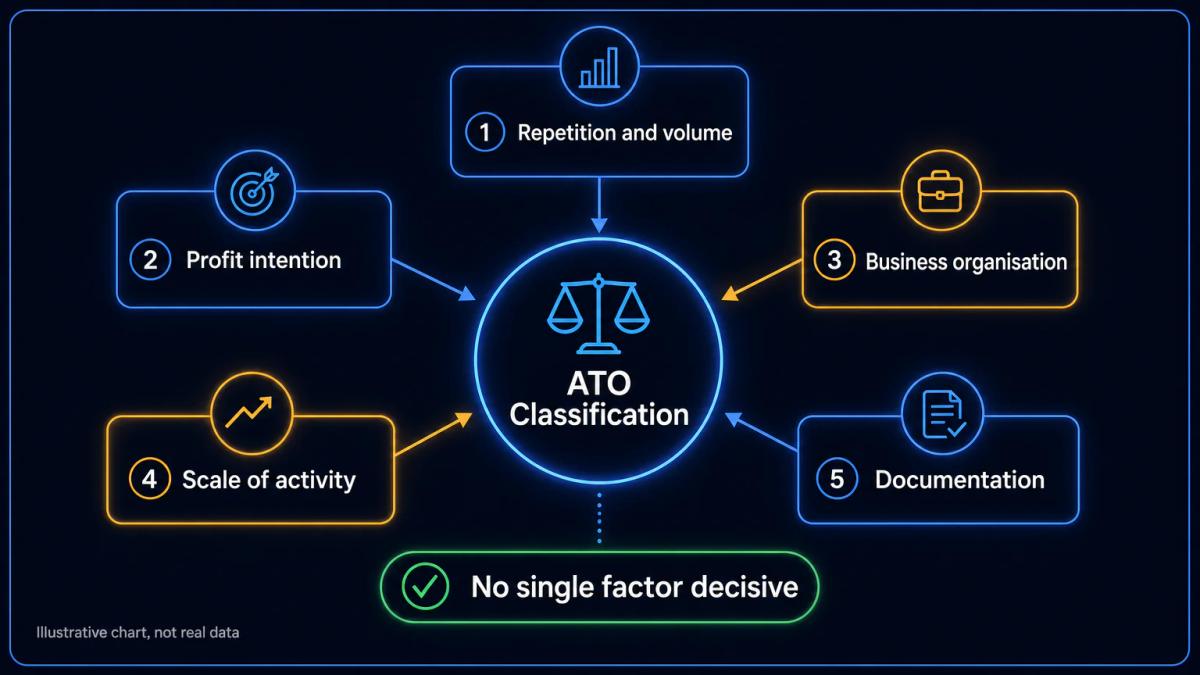
The ATO applies a multi-factor test drawn from case law and the principles in TR 97/11. No single factor settles the question on its own; the overall picture across the following elements determines whether you are carrying on a business.
The factors the ATO weighs include the following.
- Repetition, volume and regularity of trades.
- A clear profit-making intention on each trade, documented in a business plan.
- Organisation in a business-like manner: dedicated capital, systems, journals, separate accounts.
- Scale of activity relative to a professional operation.
- Time devoted to research, execution and review.
- Use of commercial trading infrastructure: direct market access, API, professional data feeds.
Consider two hypothetical taxpayers. If someone places a handful of trades a year with no system around them, they would normally sit on the investor side even where returns are strong. Should another trader run hundreds of round turns a month using a written strategy, a dedicated workstation and the habits of an active day trader, the ATO is more likely to assess them as carrying on a business. Where that business characterisation applies, gross trading profits are ordinary income under section 6-5 of ITAA 1997, and the trading stock rules in Division 70 apply to open positions at year end.
Capital gains tax and the 12-month discount
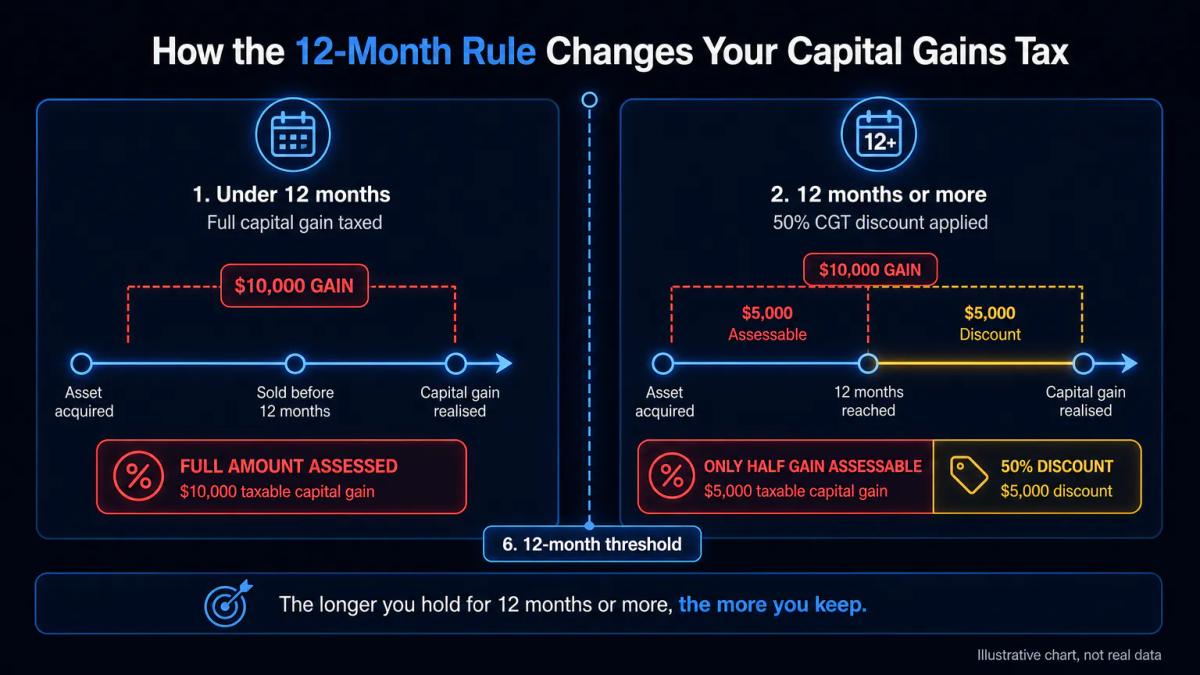
Investors realise a CGT event each time an asset is disposed of. A capital gain on an asset held for at least 12 months before disposal qualifies for the 50% CGT discount for Australian-resident individuals, so only half the gain is added to assessable income; shorter holding periods are taxed on the full gain. The discount is unavailable to companies and only partially available (one third) to complying superannuation funds.
The discount is not available to traders. In exchange, their profits are treated as ordinary income, their open positions are valued as trading stock at cost, market or replacement value, and their losses are fully deductible revenue losses that can offset other assessable income in the same year. That trade-off gives traders immediate loss utilisation and broader deductibility in place of the 50% concession.
Deductible trading expenses and record-keeping
If you are carrying on a business of trading, directly connected expenses are deductible under section 8-1. Typical categories include:
- Brokerage, exchange fees and financing costs on margin or CFDs.
- Platform and data subscriptions: TradingView, Bloomberg, exchange feeds.
- Charting and execution software, VPS hosting, API costs.
- A proportion of home-office running costs where a dedicated space is used.
- Professional development, books, courses and seminars with a clear nexus to the current activity, not initial-entry education.
- Accounting and tax-agent fees.
The ATO requires records sufficient to substantiate every item for five years from the date you lodge: contract notes, trade confirmations, bank and broker statements, invoices, a trading journal and a reconciliation of positions at 30 June. Reconstructing from a broker export alone is a frequent audit trigger, particularly for crypto and offshore CFD accounts.
GST is relevant where you provide services (education, signals, managed accounts) and your projected turnover from those services exceeds the $75,000 registration threshold. Trading on your own account in financial supplies is input-taxed, so GST registration purely for proprietary trading usually does not arise.
Tax rates and income tax brackets for Australian traders
Resident individuals pay tax at marginal rates ranging from 0% in the tax-free threshold up to 45% in the top bracket, plus the 2% Medicare levy for most residents and a Medicare levy surcharge for high earners without private hospital cover. The current bands and thresholds are published by the ATO and change by legislation; check the schedule for the income year you are filing.
How you declare trading profits depends on your classification and your structure. Investors report net capital gains at the CGT labels of the individual return, while traders report gross business income and claim deductions at the business schedule, with closing trading stock adjustments at 30 June. Entity rates and treatments vary as follows:
- Companies pay a flat 25% or 30% rate depending on turnover and base-rate entity status.
- Trusts distribute net income to beneficiaries, who are taxed at their own marginal rates.
- Self-managed super funds are taxed at 15% in accumulation phase on ordinary trading profits, though the sole-purpose test, the in-house asset rules and borrowing restrictions constrain how actively an SMSF can trade; derivatives generally require a documented risk-management strategy under SIS Regulation 4.09.
Trading losses in a business context can be offset against other income subject to the non-commercial loss rules in Division 35; investor capital losses are quarantined and carry forward against future capital gains. Tax-loss harvesting, realising unrealised capital losses before 30 June to offset gains already crystallised, is legitimate planning, but the ATO treats wash sales as a scheme under Part IVA.
Cryptocurrency and forex trading tax treatment
For investors, several common crypto transactions each trigger a separate CGT event:
- Crypto-to-crypto swaps.
- Crypto-to-fiat sales.
- Spending crypto on goods or services.
For traders, the same transactions generate ordinary income and the holdings are treated as trading stock. Staking rewards and airdrops are ordinary income at receipt, valued at market. Because the ATO data-matches exchange records against lodged returns, under-reporting on Australian exchanges is low-friction for the regulator to detect.
Forex tax in Australia follows the same classification logic. Spot FX held for investment falls under the forex measures in Division 775, with specific rules for forex realisation events and an election for the $250,000 limited balance exemption on certain accounts. Active retail traders using margin FX or CFDs on currencies are typically assessed on revenue account: profits are ordinary income, losses are deductible in the year incurred, and the CGT discount is not available.
Derivatives, options and leveraged products (CFDs, futures, warrants) are generally taxed on revenue account for anyone trading them with a profit-making purpose, following TR 2005/15 and the ATO's longstanding position on CFDs. The character of the instrument reinforces the trader classification.
Frequently Asked Questions
Do I have to pay tax on trading losses in Australia?
You do not pay tax on losses, but you must report them. Investor capital losses are quarantined and carried forward against future capital gains with no time limit. Trader losses are ordinary losses deductible against other assessable income in the same year, subject to the Division 35 non-commercial loss rules which can defer the deduction if your trading activity does not meet the required tests.
Can I claim trading losses against other income?
Only if you are carrying on a business of trading and you satisfy one of the Division 35 non-commercial loss tests (assessable income, profits, real property or other assets test), or you obtain the Commissioner's discretion. Investors cannot offset capital losses against salary or business income; those losses stay inside the CGT system and reduce future capital gains.
What happens if I trade through a company or trust instead of personally?
A company is taxed at 25% or 30% depending on base-rate entity status, has no CGT discount, and franking rules apply to distributions. A discretionary or unit trust streams net income to beneficiaries taxed at their own marginal rates and can access the CGT discount for individual beneficiaries. Setup, ongoing compliance and loss-trapping rules make entity choice a planning decision with a registered tax agent.
How do I report trading income to the ATO?
Investors report net capital gains at the CGT labels of the individual return and complete a CGT schedule where thresholds are met. Traders report gross business income and deductions at the business schedule, including trading stock on hand at year end. Entities file their own returns. PAYG instalments typically apply once the ATO sees recurring trading income, requiring quarterly payments.
Are there any tax-advantaged accounts for traders in Australia?
Australia has no equivalent of an ISA or Roth IRA for securities trading. Superannuation (including SMSFs) is the main concessionally taxed vehicle at 15% in accumulation and 0% on earnings supporting a retirement pension, but the sole-purpose test and in-house asset rules restrict how actively a fund can trade, and preservation locks capital until a condition of release is met.
About the authors


Put this into practice
Brokers we have reviewed
Scored on the same five dimensions. Here are three of them — the full list is on the brokers page.


Related articles

The Crypto Market Has Matured: Here Is What Investors Are Watching in 2026
The crypto market has matured. Here is what institutional investors and informed traders are actually tracking in 2026.
Trading Halts Explained: Circuit Breakers, Suspensions, and Delays
Trading halts freeze a stock, or an entire market, when volatility, news or order imbalances threaten orderly pricing. Here is how they work and what they mean for your portfolio.

Types of ETFs: a practical guide to equity, bond, commodity and specialty funds
The main types of ETFs, from broad market equity funds to leveraged and ESG options, and how to match each to your goals, costs and risk tolerance.
0 comments