



Financial Markets · Beginner · 7 min read
Types of ETFs: a practical guide to equity, bond, commodity and specialty funds
What ETFs are and how they're classified
An ETF (exchange-traded fund) is a basket of securities that trades on an exchange like a single share.
Types of ETFs are classified by three questions:
- What assets the fund holds.
- How it is managed.
- What strategy it follows.
The main asset categories are equity, bond, commodity and real estate ETFs.
Think of the classification as a decision tree.
- First, pick the asset class that matches your goal: growth (equities), income (bonds), inflation protection (commodities) or property exposure (REITs).
- Next, decide whether you want a passive index tracker or an actively managed fund.
- Finally, choose the strategy layer: broad market, sector, geographic, factor-based, ESG-screened, or a tactical tool like a leveraged or inverse product.
Across all major global exchanges there are several thousand listed ETFs, and the count grows every quarter as issuers launch new thematic and factor products. That variety cuts both ways. The label "ETF" hides very different risk profiles. A gilt tracker and a 3x leveraged tech fund are both ETFs, and they behave nothing alike.
If you want to understand how ETFs compare to other fund structures, see ETN vs ETF: Key Differences and Which One Fits Your Profile.
Equity ETFs: broad market, sector and geographic options
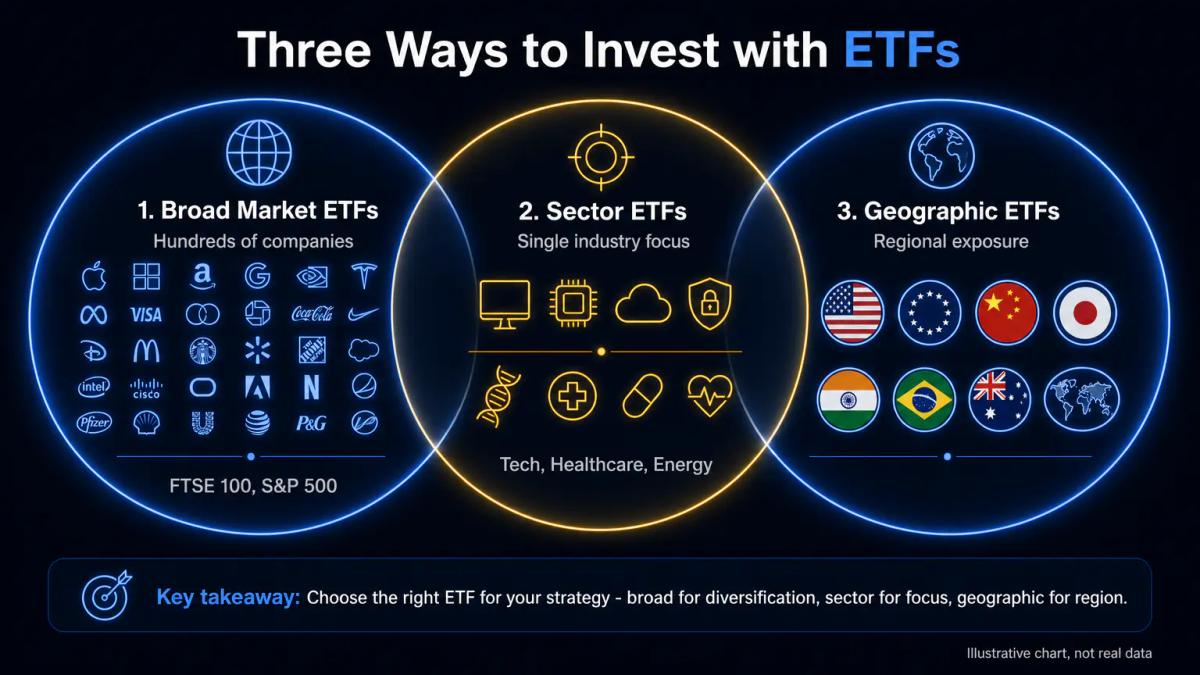
Equity ETFs hold shares of listed companies and are by far the most common category. They split into three practical groups: broad market funds, sector funds and geographic funds. Each answers a different portfolio question.
A broad market equity ETF tracks a wide index such as the FTSE 100, the S&P 500 or the MSCI World, giving you exposure to hundreds of companies in one line. Sector ETFs concentrate on a single industry, such as technology, healthcare, energy or financials, letting you tilt toward a theme without picking individual stocks.
Geographic ETFs cover a country or region, from a US total-market fund to an emerging markets or single-country product covering Japan, India or Brazil.
The table below shows how the three groups differ in the everyday features that matter when you shop for a fund.
| Feature | Broad market equity ETF | Sector ETF | Geographic ETF |
|---|---|---|---|
| Typical holdings | 100 to 3,000 stocks | 30 to 100 stocks in one industry | Stocks of one country or region |
| Diversification | High | Low to medium | Medium |
| Volatility | Lower | Higher | Varies by market |
| Typical expense ratio | 0.03% to 0.20% | 0.10% to 0.50% | 0.15% to 0.75% |
| Best used as | Portfolio core | Tactical tilt | Regional allocation |
Expense ratio means the annual fee the fund charges as a percentage of your holding, deducted daily from the fund's value.
Bond and fixed income ETFs
Bond ETFs hold debt securities and produce regular interest payments. They usually swing less than equity funds, which makes them the go-to option when you want steadier returns or income.
The main sub-types are government bond ETFs (UK gilts, US Treasuries, German bunds), corporate bond ETFs (investment-grade company debt), high-yield bond ETFs (also called junk bonds, higher risk and higher coupon), and municipal or aggregate bond ETFs.
To deepen your understanding of how bonds work as an investment vehicle, read How to Invest in Bonds: A Practical Guide for Retail Investors.
Duration, the sensitivity of a bond's price to changes in interest rates, is the other key filter. Short-duration bond ETFs move little when rates change, long-duration funds move a lot. According to the Bank of England, changes in Bank Rate are transmitted directly to bond yields, so the duration you pick decides how much a rate cycle affects your fund.
Commodity and real estate ETFs
Commodity ETFs give you exposure to physical assets such as gold, silver, oil or agricultural products. Some hold the metal in a vault (physically backed), others use futures contracts. Gold ETFs are the most popular because they act as an inflation hedge and often rise when equities fall.
For a fuller picture of how commodity markets work, see What Is Commodity Trading? A Beginner's Guide to Trading Commodities.
Real estate ETFs, usually called REIT ETFs, hold shares of real estate investment trusts (companies that own income-producing property). They pay out most of their rental income as dividends, so they behave like a mix of equity and bond funds. Both commodity and REIT ETFs are useful diversifiers because their returns are not tightly correlated with the broad stock market.
Index-based versus actively managed ETFs
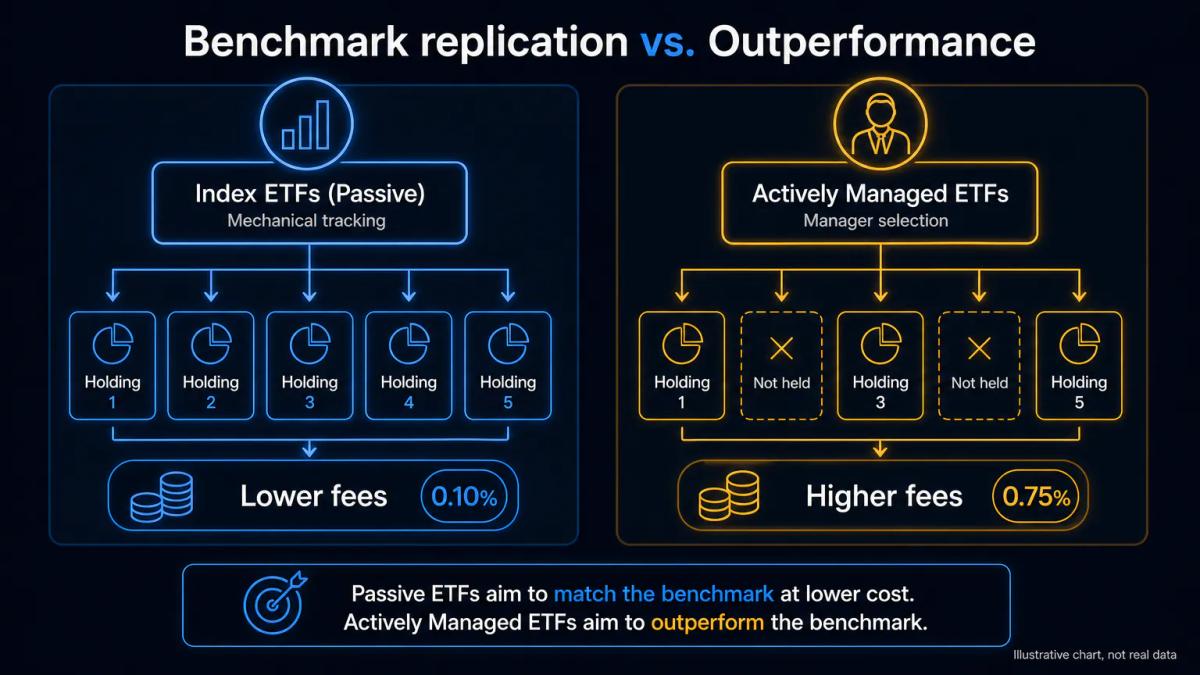
Index ETFs mechanically follow a benchmark such as the FTSE 100 or S&P 500, buying the same securities in the same weights. Actively managed ETFs employ a portfolio manager who selects holdings to try to beat that benchmark. The choice is largely a cost question.
For concrete guidance on which approach suits a buy-and-hold strategy, see Best ETFs for Long-Term Investing in the US: Core Holdings and Strategy.
According to the S&P Dow Jones Indices SPIVA report, the majority of active equity funds underperform their benchmark net of fees over ten-year periods, across US, European and UK markets. That is why index ETFs, with expense ratios often below 0.10%, tend to serve buy-and-hold investors better than active funds charging 0.50% or more.
Total cost of ownership is not only the expense ratio. It also includes the bid-ask spread (the gap between the price you buy at and the price you sell at) and any brokerage commission. Broad index ETFs with heavy daily volume have tight spreads, often a penny or two. Thin niche ETFs can have spreads of 0.5% or more, which quietly erodes returns if you trade often.
Leveraged and inverse ETFs for advanced strategies
Leveraged ETFs use derivatives to deliver a multiple of an index's DAILY return, typically 2x or 3x. Inverse ETFs deliver the opposite of the index's daily move, so they rise when the market falls. Both are tactical tools for short holding periods.
To understand the mechanics of derivatives and how they power these products, read What Are Derivatives? A Beginner's Guide to Derivative Instruments.
The reason is daily rebalancing decay. Because the leverage resets each day, a 3x fund does not deliver 3x the index's return over a week or a month, and choppy sideways markets can grind the fund lower even when the index ends flat. The FCA has repeatedly warned that complex, leveraged products are high-risk and can lead to rapid losses.
FCA guidance on complex ETPs: Leveraged and inverse exchange-traded products carry a high risk of rapid losses due to daily compounding and are not designed for buy-and-hold retail investors.
Use them only if you understand the mechanics, size positions small, and check them daily.
Smart Beta and factor-based ETFs
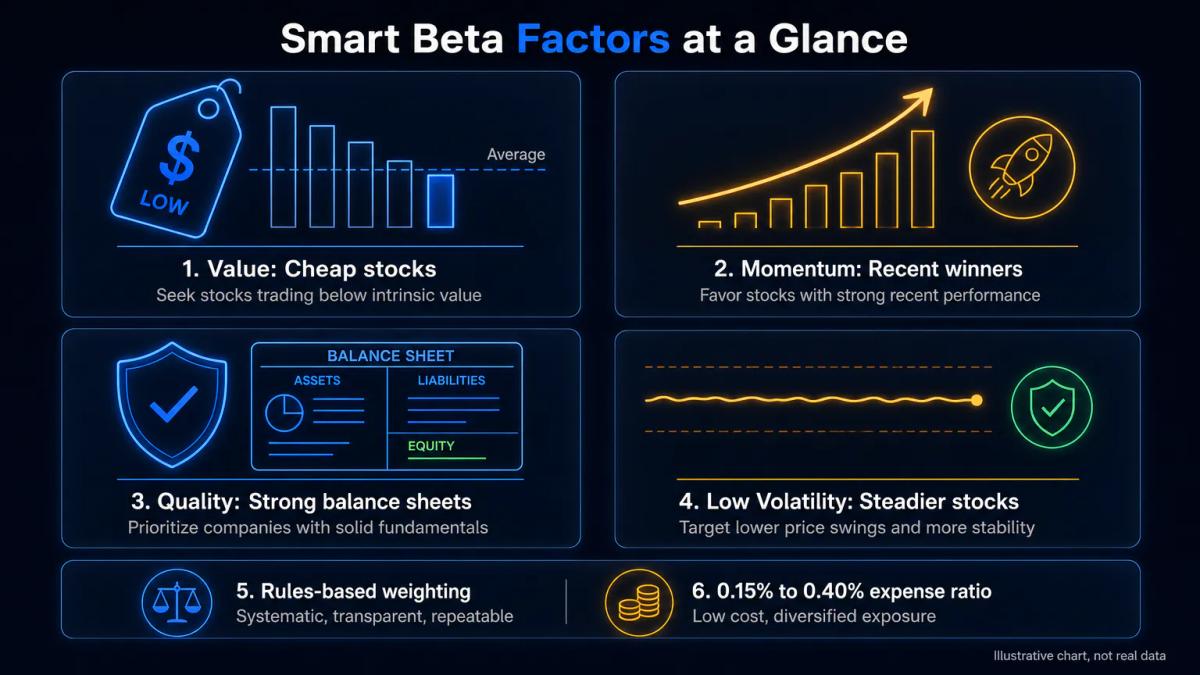
Smart Beta ETFs sit between passive and active. They follow a rules-based index that weights holdings by a factor rather than by market capitalisation. Common factors are value (cheap stocks), momentum (recent winners), quality (strong balance sheets), low volatility (steadier stocks) and dividend yield. A factor is simply a stock characteristic that academic research has linked to long-run return differences.
Smart Beta expense ratios usually sit between 0.15% and 0.40%: higher than a plain index tracker, lower than a discretionary active fund. They suit investors who want a specific tilt, for example toward value or dividend-paying companies, without paying full active fees.
ESG and socially responsible ETFs
ESG ETFs screen their holdings for environmental, social and governance criteria. Some exclude specific sectors such as tobacco, weapons or fossil fuels; others use "best-in-class" scoring to hold only the highest-rated companies in each industry. Selection criteria vary widely between issuers, so two funds labelled ESG can hold very different portfolios. If you are building a portfolio focused on steady returns and values alignment, explore Best Investments for Passive Income: A Retail Investor's Playbook.
Expect a modest cost premium, typically 0.05% to 0.20% above the equivalent conventional index ETF, and read the methodology document before buying. The trade-off between values and returns is real but usually small over long horizons, provided the fund keeps broad diversification.
Frequently Asked Questions
How many ETFs are there and how do I choose between them?
Several thousand ETFs are listed across major global exchanges, and the count grows every quarter. To choose between them, start with the asset class you need (equity, bond, commodity, REIT), then filter by expense ratio, fund size and average daily volume. Larger, more liquid funds usually have tighter bid-ask spreads and lower total holding costs.
What is the difference between dividend-paying ETFs and growth ETFs?
Dividend ETFs hold companies with a track record of regular cash payouts and prioritise current income. Growth ETFs hold companies that reinvest profits to expand, prioritising capital appreciation over cash distributions. Dividend funds tend to be less volatile; growth funds tend to swing more but can compound faster in bull markets.
Are ETF expense ratios the main cost, or are there hidden fees?
The expense ratio is the biggest visible cost, but total cost of ownership also includes the bid-ask spread when you trade, any brokerage commission, and tracking difference (the gap between the fund's return and its index). For niche or thinly traded funds, the spread can be larger than the annual fee.
Can I use leveraged or inverse ETFs in a long-term portfolio?
No. Leveraged and inverse ETFs reset their exposure daily, so their return over weeks or months is not a clean multiple of the index. In sideways or choppy markets they lose value even if the index ends flat. Treat them as short-term tactical tools with tight risk control, not buy-and-hold holdings.
What makes an ETF tax-efficient compared to a mutual fund?
ETFs use an in-kind creation and redemption process, where large trades swap securities rather than cash. This means the fund rarely has to sell holdings to meet redemptions, so it generates fewer taxable capital gains distributions than a comparable mutual fund. Tax rules still depend on your jurisdiction and the account you hold the fund in.
About the authors


Put this into practice
Related articles
What Are Derivatives? A Beginner’s Guide to Derivative Instruments
Learn what derivatives are, how they work, and why they matter. This beginner's guide covers futures, options, swaps, forwards, and key risks to understand.
What Is Commodity Trading? A Beginner’s Guide to Trading Commodities
Learn what commodities are, how commodity markets work, and the different ways to trade them, from futures and CFDs to ETFs and commodity stocks.
What Is Forex Trading and How Does It Work?
Learn what forex trading is, how the currency market works, and the essential concepts you need to understand before placing your first trade.
0 comments