



A bond is a loan you give to a government or company in exchange for regular interest payments and the return of your principal at maturity. Learning how to invest in bonds means understanding types, ratings, interest rate risk, and the buying methods available to you, from direct treasury purchases to funds and exchange-traded products.
What bonds are and why they matter to your portfolio
When you buy a bond, you become a creditor: the issuer owes you a fixed schedule of interest payments (called coupons) plus the face value at a set future date (the maturity). That contractual structure is what makes bonds behave differently from stocks, where you own a slice of a business and returns depend on profits and market sentiment.
[Investor.gov, SEC]: A bond is a debt security, like an IOU. Borrowers issue bonds to raise money. When you buy a bond, you lend money to the issuer in exchange for a promise of repayment with interest.
Bonds add a predictable cash flow line to a portfolio that would otherwise depend entirely on equity gains. Coupons arrive on a calendar, principal is returned on a known date, and price swings are usually smaller than those of shares. That predictability is the reason retirement portfolios, insurance reserves and university endowments all hold bonds alongside stocks: the two assets rarely fall at the same speed or for the same reason.
For investors seeking steady returns, bonds are a cornerstone of best investments for passive income.
The main types of bonds and how they differ
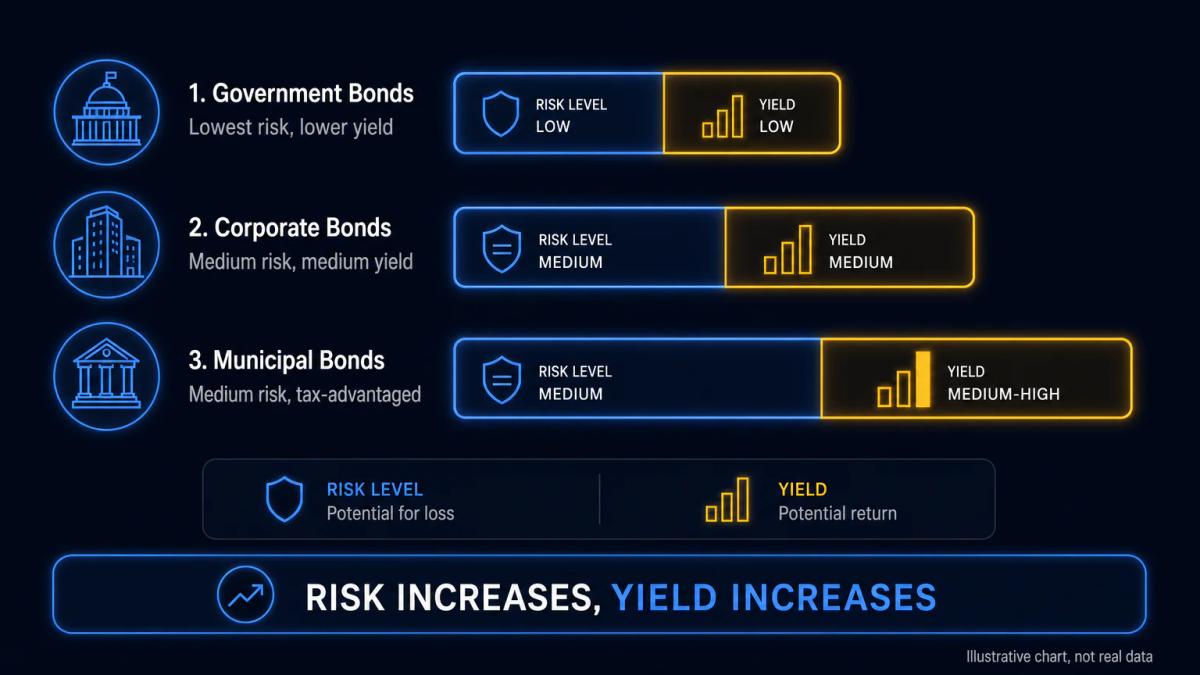
Bond types fall into three broad categories: government bonds backed by state treasuries, corporate bonds issued by companies, and municipal bonds issued by local authorities. Each carries a different risk level, tax treatment, and yield profile, and each is a distinct decision when you build a portfolio.
Government bonds are considered the lowest-risk end of the market. According to Investor.gov (U.S. Securities and Exchange Commission), in the United States Treasury bills mature in a few days up to 52 weeks, notes cover the intermediate range, and Treasury bonds typically mature in 30 years and pay interest every six months. Corporate bonds pay higher coupons to compensate for the risk that the company might miss payments. Municipal bonds are issued by cities, states or local agencies and often carry favourable tax treatment in the issuer's country.
| Bond type | Typical issuer | Risk level | Interest frequency |
|---|---|---|---|
| Treasury bill | Federal government | Very low | At maturity (discount) |
| Treasury bond | Federal government | Low | Every 6 months |
| Corporate bond | Public or private company | Medium to high | Every 6 months |
| Municipal bond | State, city, local agency | Low to medium | Every 6 months |
[Investor.gov, SEC]: Interest rate changes can affect a bond's value. If bonds are sold before maturity, their market price will fluctuate with interest rate changes. Bonds with longer maturities are more sensitive to interest rate changes than bonds with shorter maturities.
How interest rates affect bond prices and your returns
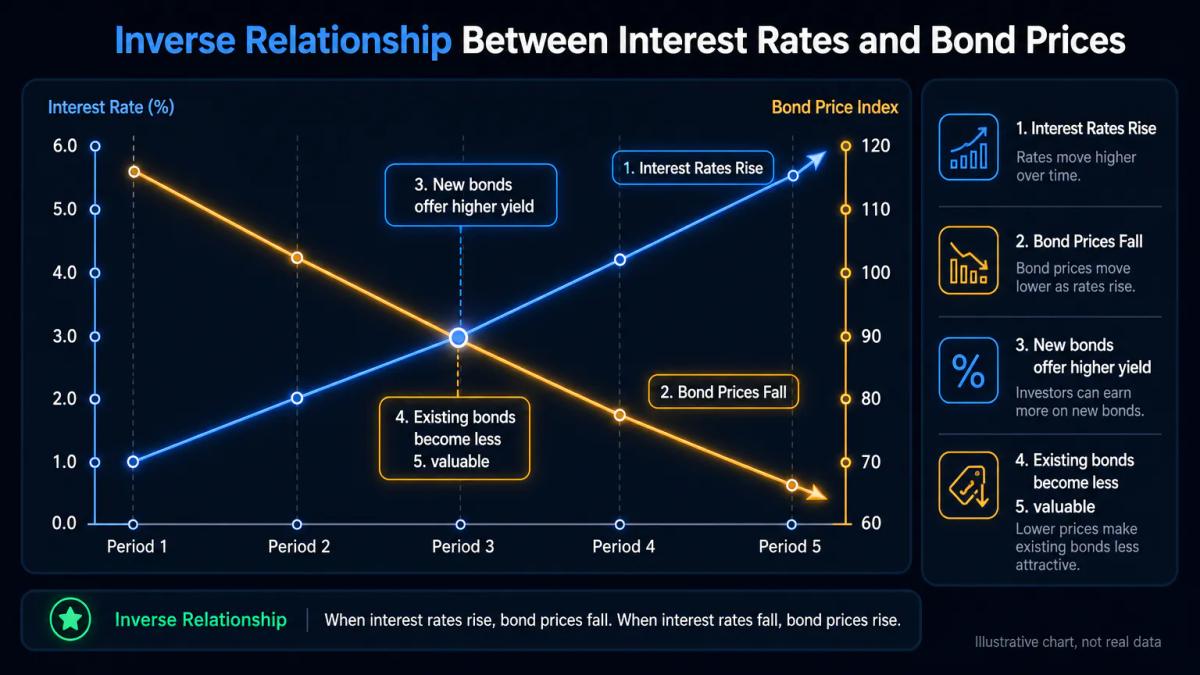
Bond prices move inversely to interest rates: when market rates rise, the price of bonds already in circulation falls, because new bonds are issued at the newer, higher coupon. If rates fall, existing bonds that pay the old, higher coupon become more valuable. This inverse relationship is the primary driver of bond market volatility and of the capital gains or losses you see between purchase and maturity.
[Reserve Bank of Australia]: The prices at which investors buy and sell bonds in the secondary market fluctuate based on changes in interest rates, credit conditions, and other economic factors.
The practical consequence is that timing matters if you plan to sell before maturity. A bond held to maturity returns its face value regardless of the price path in between, but a bond sold early is worth whatever the market pays that day.
Longer maturities are more sensitive to rate changes than shorter ones: a 30-year bond swings more in price for the same rate move than a 2-year note. That sensitivity is why many investors mix short and long maturities rather than concentrating in one.
Three practical ways to buy bonds
You can buy bonds directly from a government treasury, through a broker or investment platform, or via bond funds and exchange-traded funds (ETFs, funds that trade on a stock exchange like a single share). Each method has different minimums, fees, and convenience trade-offs, and beginners often use more than one.
Direct treasury purchases are the cheapest route for government securities. According to TreasuryDirect (U.S. Department of the Treasury), TreasuryDirect sells bills, notes, bonds, TIPS and savings bonds with no broker fee, and the annual purchase limit for Series I savings bonds is $10,000 per person. TreasuryDirect (U.S. Department of the Treasury) also quotes current Series I rates of 4.26% for the six-month period and 2.40% for the longer-term rate. Brokers open access to corporate and municipal bonds, usually with a per-trade commission or a mark-up built into the price. Bond funds and ETFs let you buy diversified baskets with a single order, useful when your capital is smaller than the typical $1,000 to $5,000 face value of an individual bond.
[TreasuryDirect, U.S. Department of the Treasury]: The annual purchase limit for Series I savings bonds in TreasuryDirect is $10,000 per person.
Understanding bond ratings and credit risk
Bond ratings from agencies such as Moody's and S&P signal the issuer's ability to repay. Higher-rated bonds (AAA down to BBB, called investment grade) carry lower default risk but pay lower yields; lower-rated bonds (BB and below, often labelled high-yield or junk) pay more but carry a real chance of missed payments or restructuring.
[Investor.gov, SEC]: Bonds carry credit risk (the issuer may default), interest rate risk (bond prices fall when rates rise), inflation risk (inflation erodes purchasing power), and liquidity risk (you may not find a buyer when you want to sell).
Credit risk is not the only risk you accept when buying a bond, but it is the one the rating directly addresses. A single downgrade can move a bond's market price several percentage points even if the coupon is still being paid. For beginners, sticking to investment-grade issuers is the standard advice: the extra yield on junk bonds rarely compensates a small portfolio for the concentration of risk it introduces. If you want higher yield with diversification, a high-yield bond fund spreads that risk across dozens or hundreds of issuers.
Building a bond strategy: laddering and tax efficiency
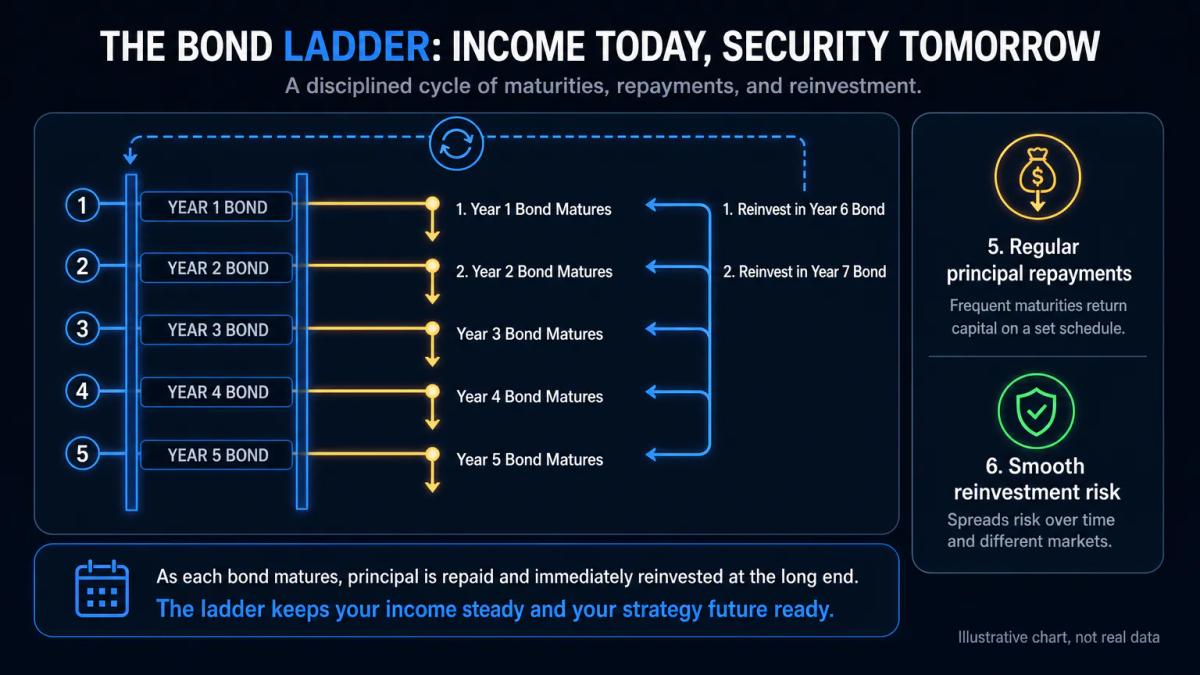
Bond laddering means splitting your capital across bonds with staggered maturity dates, for example one bond maturing each year for the next five years. Each year one bond matures and you reinvest the proceeds into a new long-dated bond at the current interest rate. The ladder delivers regular principal repayments, smooths reinvestment risk, and reduces the temptation to time the rate cycle. This approach mirrors the discipline of dollar-cost averaging explained, which spreads investment over time to reduce timing risk.
Tax efficiency is the second pillar. Municipal bonds often pay interest that is exempt from federal income tax in the issuer's country, which raises their after-tax yield for higher earners. Transparency has improved: according to Investor.gov (U.S. Securities and Exchange Commission), most municipal securities issued after July 3, 1995 must file annual financial information and event notices with the Municipal Securities Rulemaking Board (MSRB). Investor.gov (U.S. Securities and Exchange Commission) also notes that inflation-linked bonds such as TIPS are issued with maturities of 5, 10, and 30 years, adjusting principal with the Consumer Price Index to protect real purchasing power.
Comparing costs: individual bonds versus bond funds
Individual bonds have no ongoing management fee but demand larger capital, active monitoring and a plan for reinvestment. Bond funds and ETFs charge an annual expense ratio (a percentage taken from fund assets each year) that ranges from around 0.03% for large index ETFs to over 1.00% for actively managed funds. For long-term investors, best ETFs for long-term investing in the US offer a low-cost, diversified alternative to building a bond portfolio from individual securities.
| Vehicle | Typical minimum | Annual fee | Diversification |
|---|---|---|---|
| Individual bond | $1,000 to $5,000 per bond | None | Low (per bond) |
| Bond ETF | 1 share | 0.03% to 0.50% | High |
| Active bond fund | $500 to $3,000 | 0.40% to 1.20% | High |
This content is general information and not advice: every situation needs checking with a licensed professional in the relevant jurisdiction.
Frequently Asked Questions
What is the minimum amount needed to start investing in bonds?
Through a platform like TreasuryDirect you can buy U.S. savings bonds from $25. Individual corporate or municipal bonds usually have a face value of $1,000 to $5,000. Bond ETFs let you start with the price of a single share, often under $100, which makes them the lowest-capital entry point.
How do I know if a bond is safe to buy?
Check the credit rating assigned by agencies such as Moody's or S&P: investment-grade ratings (AAA to BBB) signal lower default risk. Also review the issuer's financial statements, coupon history, and maturity length. For municipal bonds issued after July 3, 1995, filings with the MSRB provide annual financial information you can consult.
Can I sell a bond before it matures, and what happens to my money?
Yes, most bonds trade on secondary markets, so you can sell before maturity through your broker. The price you receive depends on current interest rates, remaining maturity, and the issuer's credit standing. You may receive more or less than you paid, unlike holding to maturity, where you receive the face value.
Are bonds a better investment than stocks for retirement?
Bonds and stocks play different roles. Bonds deliver predictable income and lower volatility; stocks offer higher long-term growth potential with larger swings. Most retirement portfolios hold both, with the bond share typically rising as the investor approaches retirement to reduce sensitivity to equity drawdowns.
What is the difference between a bond fund and buying individual bonds?
An individual bond has a fixed coupon and returns its face value at a known maturity date. A bond fund holds many bonds continuously, has no single maturity, and its share price moves with the underlying portfolio. Funds add diversification and liquidity but charge an annual expense ratio.
About the authors


Put this into practice
Related articles
Passive Income for Beginners: A Realistic Guide to Your First Stream
Passive income for beginners explained: startup costs, timelines, tax rules by jurisdiction, risk assessment and the automation tools that keep streams running.

Popular American ETFs and Their European Equivalents
Can't buy SPY or QQQ in Europe? Find the closest UCITS ETF for each major US fund, with costs, tickers, and key differences explained.

QQQ European Equivalent: EQQQ and Nasdaq-100 UCITS ETFs Explained
EQQQ is the primary European equivalent of the US QQQ ETF, tracking the Nasdaq-100 under UCITS rules. Here is how it compares on cost, currency and access.
0 comments