



Financial Markets · Beginner · 6 min read
ETN vs ETF: Key Differences and Which One Fits Your Profile
ETNs and ETFs look similar on a trading screen, but one is debt and the other is ownership. Many traders fail to understand the key differences and suffer losses because of it. In this article, we'll explain what sets them apart, what they have in common, and which one is best for you depending on your profile.
The core difference: debt versus ownership
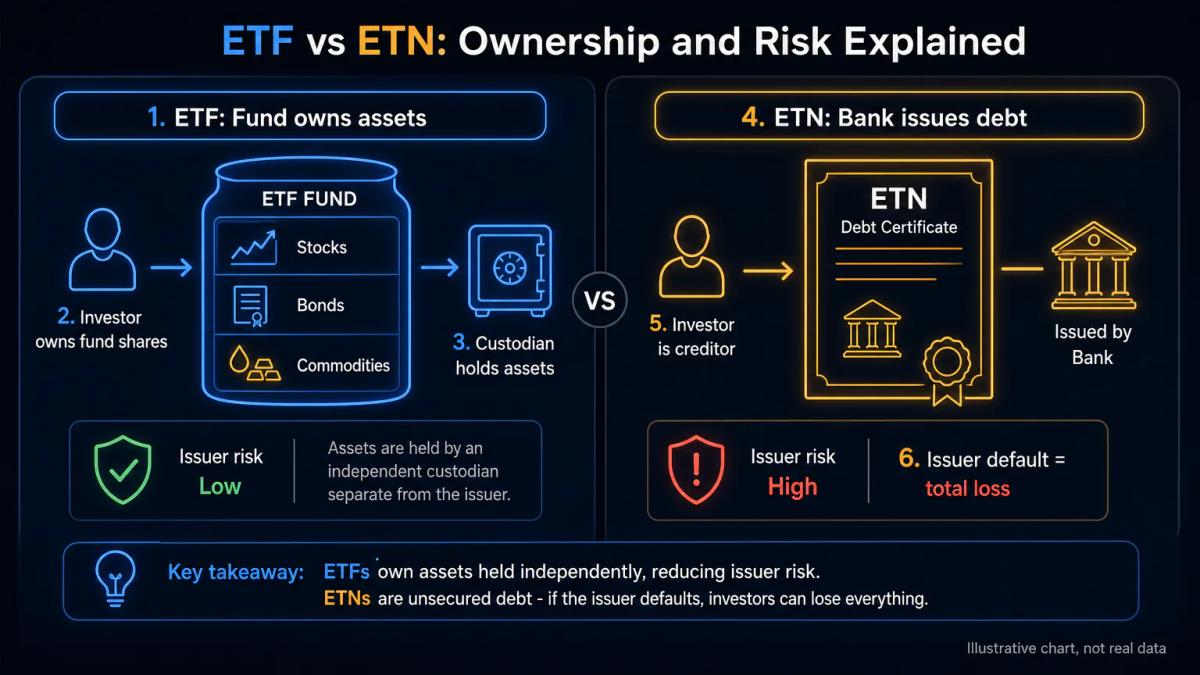
An ETF (exchange-traded fund) owns real assets on your behalf. An ETN (exchange-traded note) is an unsecured debt promise issued by a bank that pays you the return of an index. That single distinction, ownership versus IOU, drives every other difference in risk, tax and liquidity.
When you buy an ETF share, you own a slice of a pool of stocks, bonds or commodities held by an independent custodian. The fund's price tracks the value of those underlying assets. If you want a deeper walkthrough of how funds are built, see the ETF explainer.
An ETN works differently. You are lending money to the issuing bank, and the bank promises to pay you the performance of a chosen index at maturity or when you sell in the secondary market. According to the SEC Office of Investor Education and Advocacy, Investor Bulletin on Exchange-Traded Notes, ETNs are issued with maturities of 20 or 30 years and are generally not intended to be held to maturity, so returns typically arise from trading rather than from holding to the end.
How ETNs and ETFs trade on exchanges
Both products trade like ordinary shares during market hours, but the pricing transparency behind that screen quote is not the same. According to the SEC Office of Investor Education and Advocacy, Investor Bulletin on Exchange-Traded Notes, ETFs disseminate an estimate of portfolio value every 15 seconds during the trading day, known as the intraday indicative value (IIV). That live estimate keeps the market price of an ETF anchored to the value of the assets the fund holds.
ETNs do not own an asset pool, so their intraday reference is a calculated indicative value based on the tracked index, not a live portfolio. In practice, your fill price depends on the market maker's willingness to quote, which is usually the issuing bank itself. When the issuer steps back from new creations, the market price can drift away from the index value.
[SEC Investor Bulletin, 2015]: ETNs are unsecured debt obligations of financial institution
Issuer risk: the critical ETN vulnerability
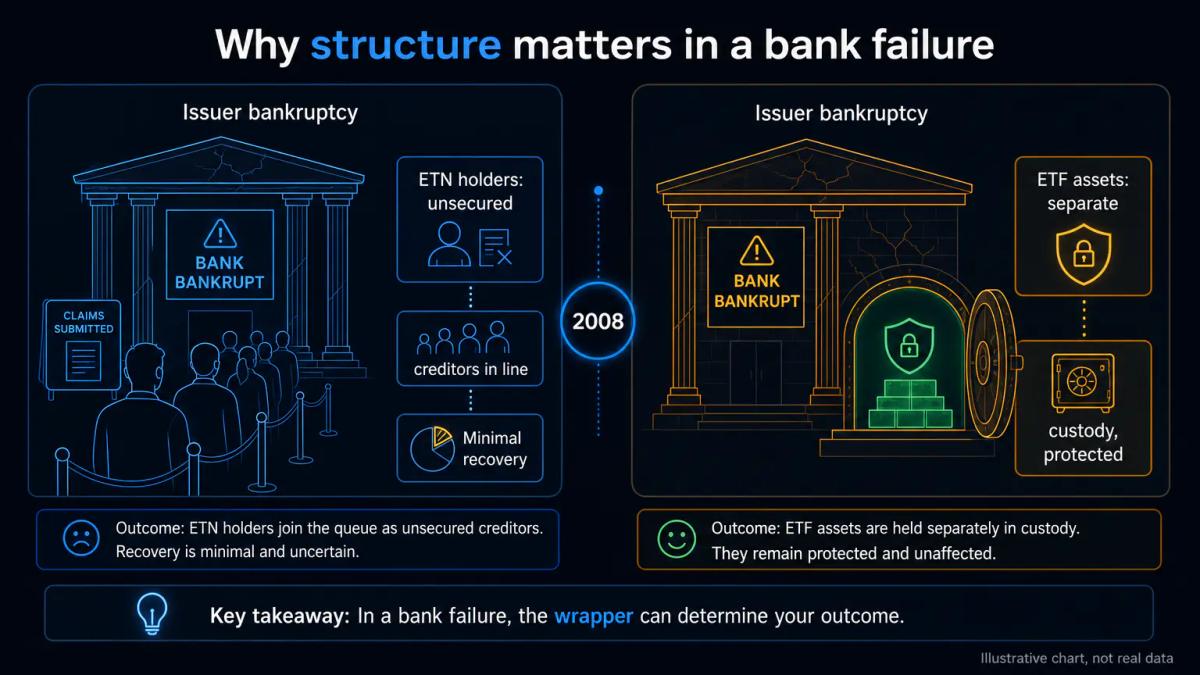
If an ETN issuer defaults, you can lose your entire investment even when the tracked index is intact. ETFs hold assets in a separate legal structure, so a failure at the sponsor does not wipe out your holdings; ETN holders are unsecured creditors standing in line at a bankruptcy.
The clearest historical warning is the 2008 collapse of Lehman Brothers. Its Opta ETNs stopped trading when the bank filed for bankruptcy, and holders recovered only a small fraction of face value years later as part of the general creditor pool. More recent episodes, including the closure of leveraged volatility ETNs after the February 2018 spike in the VIX and the redemption of oil-linked ETNs during the April 2020 crude price crash, showed that issuers can also trigger early redemption clauses at very unfavourable prices.
Assessing an issuer means reading the same things a bond investor reads: senior unsecured credit ratings from agencies such as S&P, Moody's and Fitch, capital ratios published in the bank's regulatory filings, and the spread on the issuer's credit default swaps as a market-based signal of default probability. Understanding how to invest in bonds will help you interpret these credit metrics and issuer fundamentals.
Tax treatment and fee structures
ETFs typically offer tax efficiency through in-kind redemptions, a mechanism where large investors swap fund shares for the underlying stocks without triggering a taxable sale inside the fund. That keeps capital gains distributions low. ETNs, being debt notes, do not have that mechanism, and every sale is a straightforward taxable event based on the difference between your purchase and sale price.
UK residents should check whether the specific ETN carries UK Reporting Fund status; without it, gains can be taxed as income rather than capital gains. For headline costs, ETFs charge a total expense ratio (TER, the annual fee taken from fund assets) that is disclosed and deducted daily. ETNs charge an investor fee embedded in the return calculation, and some also apply financing costs on leveraged strategies that compound daily and quietly erode the tracked exposure.
When building a long-term portfolio, best ETFs for long-term investing in the US offer transparent fee structures and tax-efficient mechanisms.
Which product fits your profile if you compare ETN vs ETF
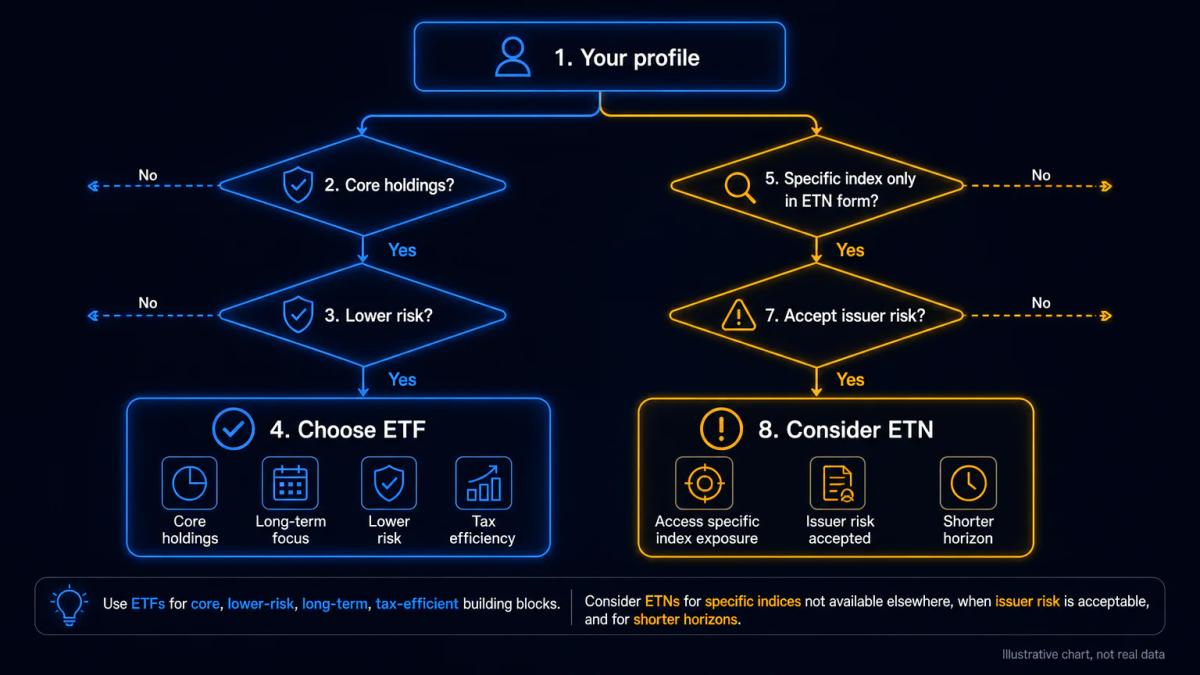
Choose ETFs for core, long-term holdings; consider ETNs only when you need a specific exposure that no ETF offers and you accept issuer risk. The table below summarises the trade-offs most retail investors actually weigh.
| Feature | ETF | ETN |
|---|---|---|
| Legal structure | Fund owning assets | Unsecured debt of issuer |
| Issuer default risk | Very low | High, total loss possible |
| Intraday pricing reference | IIV every 15 seconds (SEC) | Calculated indicative value |
| Tax on sale (UK, reporting status) | Capital gains | Capital gains if reporting; income otherwise |
| Typical fee disclosure | TER, deducted daily | Investor fee embedded in return |
| Best use case | Broad index, core allocation | Hard-to-access indices, some leveraged or inverse strategies |
Beginners with a long horizon and no need for exotic exposure are almost always better served by a plain, broad-market ETF. ETNs earn their place for specific tasks: single-commodity exposure without a futures account, access to niche indices, or precise leveraged and inverse positions where the note's structure delivers cleaner tracking than a daily-rebalanced fund. In every case, you should read the prospectus and know the issuer's name before you click buy.
Liquidity and bid-ask spreads in practice
ETF liquidity varies by fund size and asset class, but the largest equity ETFs quote bid-ask spreads of one or two basis points during normal hours. ETNs often show wider spreads because secondary market trading depends heavily on the issuer's own market-making desk, and creation activity is chunkier.
According to the SEC Office of Investor Education and Advocacy, Investor Bulletin on Exchange-Traded Notes, ETNs issue and redeem notes in creation unit sizes that generally range from 25,000 to 50,000 notes, so authorised participants create new supply less frequently than in a busy ETF. When creations pause, premiums to indicative value can open up quickly. As of April 2026, UK retail investors trading ETNs on the London Stock Exchange should check the visible order book depth and the issuer's stated market-making commitment before placing anything larger than a small order. Learning about index trading and stock indices will deepen your understanding of how these creation mechanisms work.
This content is general information and not advice: every situation needs checking with a licensed professional in the relevant jurisdiction.
Frequently Asked Questions
Can an ETN go to zero if the issuer fails?
Yes. An ETN is an unsecured debt of the issuing bank. If the issuer files for bankruptcy, note holders join the general pool of unsecured creditors and can recover only a fraction of face value, sometimes close to nothing, regardless of how the tracked index performed.
Why would anyone buy an ETN if ETFs are safer?
ETNs can offer cleaner tracking of specific exposures that are hard to replicate in a fund, such as single commodities without a futures account, niche indices, or leveraged and inverse strategies. They also avoid tracking error from rebalancing costs, since the return is a contractual promise rather than the result of a portfolio being managed daily.
Do ETNs and ETFs track the same index identically?
No. An ETN pays the index return minus an investor fee by contract, so tracking on paper is exact until fees. An ETF holds a real portfolio, so its return is the index minus fees, transaction costs and any sampling error, which usually produces a small tracking difference that varies with market conditions.
How do you assess the creditworthiness of an ETN issuer?
Check the senior unsecured credit rating from S&P, Moody's or Fitch, review the issuer's capital ratios and leverage in its most recent regulatory filings, and look at the market-implied signal from the spread on its credit default swaps. Concentration in one issuer across your portfolio is itself a risk to monitor.
Are ETNs banned or restricted in the UK?
ETNs are not banned for UK retail investors, but they sit under FCA rules on complex products and require appropriate risk disclosures. The FCA has separately banned crypto-linked derivatives and certain crypto ETNs for retail clients. Always confirm the specific product's UK availability and Reporting Fund status with your broker before trading.
About the authors


Put this into practice
Related articles

Forex Market Sentiment: What It Is and How to Read It
A plain-English guide to forex sentiment: what buy-to-sell ratios mean, where to read them, and how to use extremes as contrarian setups.

Forex brokers for Iranian residents: eligibility, sanctions and practical access
A factual guide for Iranian residents on which forex brokers can legally onboard them, how sanctions shape access, and what to check before depositing.

Forex vs Stocks Trading: Key Differences for Retail Traders
A direct comparison of forex vs stocks trading for UK retail traders: hours, leverage caps, costs, tax treatment, and platform differences.
0 comments