



Trading Strategies · Advanced · 9 min read
Day Trading vs Position Trading: Capital, Tax, and Edge
The core difference: holding period and profit capture
Picking a holding period is really picking an operation, because the two labels sit on top of workflows that share almost nothing day to day. Intraday operators flatten exposure before the session closes and work the tape for small moves that stack up across hours or minutes. A position book keeps risk open through evenings, weekends, and sometimes earnings cycles, targeting bigger directional swings that need time to resolve. That single call about how long you stay in the market cascades into capital rules, tax bands, screen time, and the toolkit you end up building around yourself.
Holding trades long term versus intraday also redefines what counts as a win. An intraday desk books P&L on tick-sized edges repeated hundreds of times a month, so execution quality and spreads tend to dominate the equation over any single idea. On a position book, you accept overnight gaps, swap financing, and headline risk in exchange for compounding on larger per-trade moves across longer windows. Trading styles by time horizon exist on a continuum, from scalping through swing trading to multi-quarter position holds, and the tax and regulatory treatment shifts as you move along it.
You cannot run both books with the same risk framework, the same account structure, or the same daily routine, which means choosing one is a precondition to building anything systematic around it.
Putting this into practice means opening an account: start with the best forex brokers our team reviewed.
Time commitment and lifestyle impact
Intraday trading sits much closer to a full-time occupation than most side pursuits allow for. You need continuous attention during the hours your instruments are liquid, which for US equities means roughly 09:30 to 16:00 Eastern, and for FX majors it means the London and New York overlap. Stepping away from the desk leaves open risk you cannot manage, and automation only partially solves the problem, since fills, slippage, and news events still demand a human review in the moment.
Position trading reshapes the economics of your calendar on the other side of that equation. You can check charts in the evening, place conditional orders, and go a full week without touching the platform at all. For a trader holding down a full-time job, that flexibility is often the only realistic path into markets. The patience tax arrives in return, because a thesis that takes six weeks to resolve will spend most of its life in drawdown, and your discipline is tested in slow motion over many sessions.
Capital requirements and margin rules
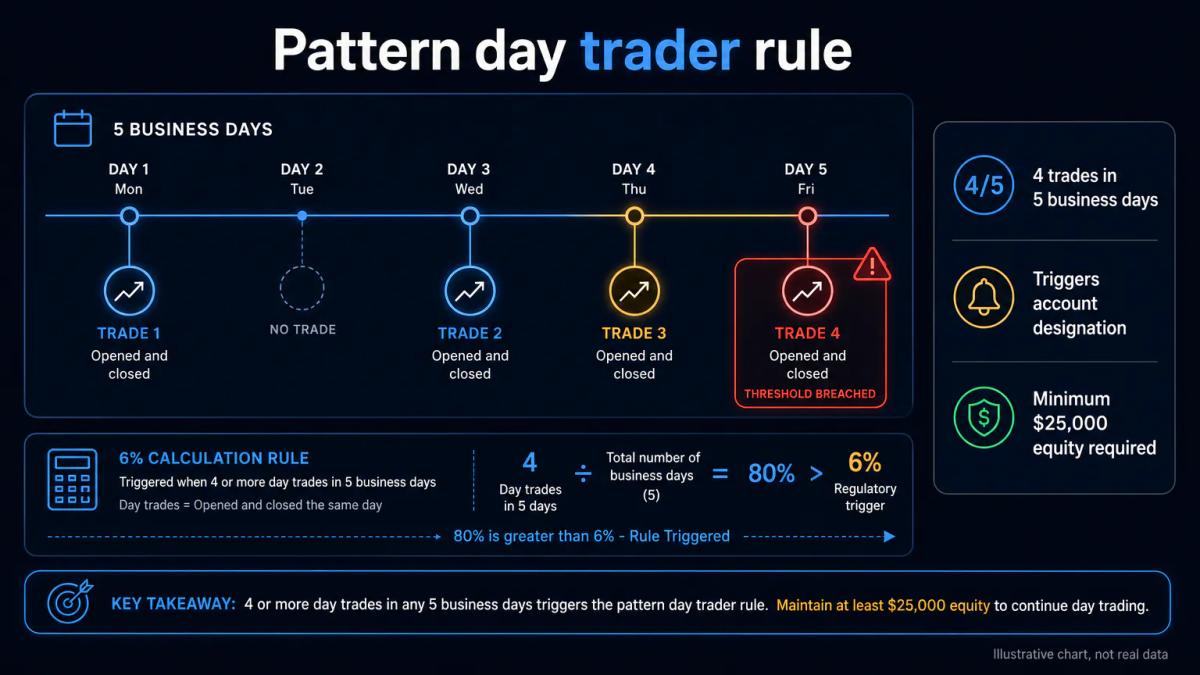
US equity day trading operates inside a specific regulatory cage. According to SEC Investor.gov, FINRA rules define a pattern day trader as any customer who executes four day trades in five business days, provided those day trades represent more than 6% of total trades in the margin account for that period. Once an account trips the threshold, the designation attaches automatically and remains until the broker reviews it.
According to SEC Investor.gov, customers designated as pattern day traders under the prior FINRA rules were required to maintain at least $25,000 in the account and could only trade in margin accounts, with any balance drop below the threshold freezing day-trading privileges until it was restored. FINRA's new intraday margin requirements, which replace the pattern day trader rules, take effect June 4, 2026, with a transition period for brokerage firms running until October 20, 2027. Review the final rulebook with your broker before relying on current thresholds.
Position trading carries no equivalent designation on the regulatory side. The practical constraint is position sizing against drawdown over multi-week horizons, since wider stops mean smaller units and swap financing on CFD or margin positions accumulates over time. Outside the US, the rules diverge in ways worth planning for. UK retail CFD leverage caps vary by instrument class, and those caps affect both styles while biting harder on intraday notional turnover:
- 1:30 on major FX pairs
- 1:20 on indices
- 1:5 on single stocks
The UK's FCA onboards retail clients through FCA-authorised entities, and offshore group entities carry different protections that should be treated as a separate tier of risk when selecting a broker.
Profit potential and trade frequency
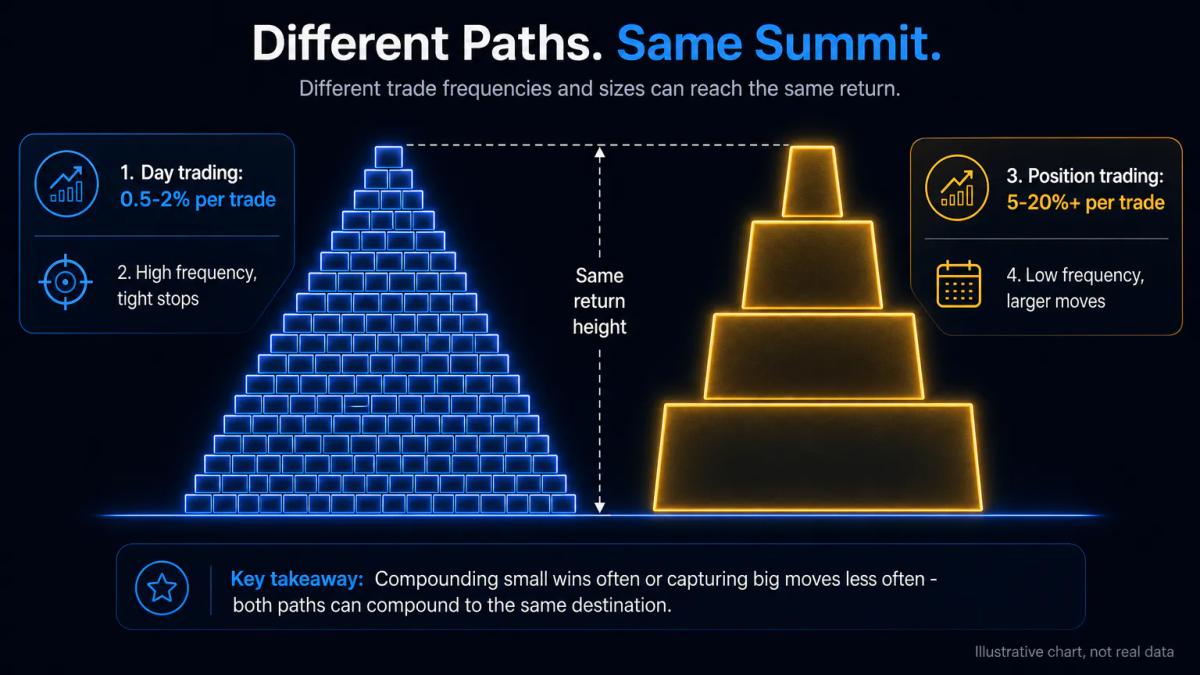
The two styles optimise different variables within the same equation. Intraday systems chase a high trade count at low per-trade expectancy, often around 0.5% to 2% of risked capital per winner, with win rates that can sit above 55% when stops are tight. Compounding happens through sheer repetition, which also compounds three cost lines you cannot ignore:
- slippage
- commission
- spread
Execution quality turns into a structural cost line that quietly shapes the whole P&L profile.
Position trades aim at 5% to 20% or more per winner, but they fire far less often across a year. Fewer samples means your edge takes longer to prove out statistically, while overnight exposure means gaps work in both directions: a positive earnings print can hand you a month of edge in one open, and a geopolitical headline can erase a quarter just as fast. Both paths demand a tested edge, a clear risk-per-trade rule, and the humility to size for the drawdown you actually experience in live markets rather than the one you originally modelled on paper.
Tax implications and reporting
Tax drag is a hidden axis of this comparison, and it moves the ranking of each style once you look at net returns. The information below is general and jurisdiction-dependent, and every point should be verified with a licensed tax professional for your country of residence before acting on it.
In the US, trades held under a year are generally taxed as short-term capital gains at ordinary income rates, which can reach a top federal marginal band well above long-term capital gains rates on holdings over 12 months. A trader electing mark-to-market status under IRC 475(f) changes the picture again, converting gains and losses to ordinary and removing wash-sale limitations. In the UK, CFD profits sit inside capital gains tax with an annual exempt amount that has been reduced in recent years, while spread betting is outside CGT for retail individuals under current HMRC treatment. EU regimes vary across member states:
- Germany applies a flat Abgeltungsteuer on investment income.
- France layers social charges on top of the flat prélèvement.
- Several jurisdictions apply financial transaction taxes or stamp duty on equity trades, which penalises frequency.
| Tax dimension | Day trading (typical) | Position trading (typical) |
|---|---|---|
| US holding-period band | Short-term, ordinary income marginal rate | Long-term CGT band if held over 12 months |
| UK CFD treatment | CGT on realised gains, annual exempt amount applies | CGT, same regime, lower turnover |
| Transaction taxes | Multiply with trade count | Minimal drag |
| Reporting burden | High: hundreds to thousands of lines | Low: dozens of lines |
| Loss relief | Wash-sale rules (US) can defer losses | Simpler loss carry-forward |
Psychological and emotional demands
The two styles stress-test different parts of the operator in very different ways. Intraday work compresses the decision cycle into seconds, with entries, stops, scale-outs, and exits all happening while new information keeps arriving on the tape. The familiar failure modes include revenge trading after a stop-out, oversizing after a win streak, and freezing when a thesis breaks mid-session. Discipline here is procedural in nature, built around a written plan, a maximum daily loss, and a firm rule to stop trading when either limit is hit.
Position trading stresses conviction and boredom tolerance in roughly equal measure. A thesis you entered three weeks ago will spend many sessions underwater before it resolves, and the temptation to exit at breakeven on a Monday morning becomes the single biggest tax on long-horizon returns. Common failure modes include early exits, moved stops, and thesis drift when a correlated asset moves first and plants doubt. Different strengths tend to predict success across the two styles: short-cycle traders usually profile high on reaction speed and rule adherence, while longer-horizon traders profile higher on patience, written-thesis discipline, and tolerance for unrealised drawdown.
Tools, analysis, and skill progression
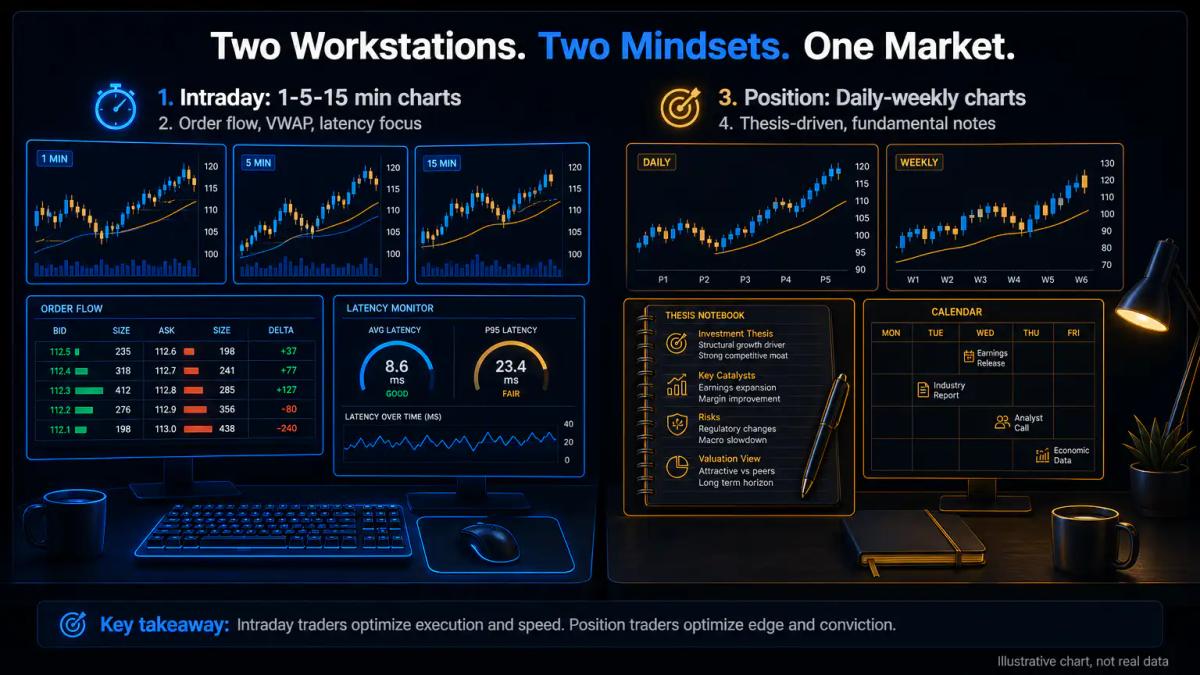
The toolkit tracks the holding period closely. An intraday workstation typically brings together several components that need to work in concert:
- 1-minute to 15-minute charts
- order-flow and depth-of-market data where available
- session VWAP
- execution routes chosen specifically for latency
Platforms like cTrader and MT5 handle the order management side, while TradingView often serves as the charting layer stacked on top. Latency, data feed quality, and commission structure stop being optional considerations and become part of the measurable edge.
A position-trading setup runs on daily and weekly charts, structural levels, relative strength across sectors or currency crosses, and a macro overlay for rate expectations and risk sentiment. Execution tends to be unhurried, and broker commission has a smaller impact on your P&L than overnight financing and the quality of the research pipeline feeding your theses.
- Start on daily and weekly charts, where a mistake costs days of time to recover.
- Build a journal with at least 50 closed trades before judging an edge.
- Add intraday only after you have proven positive expectancy on the longer timeframe.
- Treat the first six months of intraday work as tuition; size accordingly.
Many traders who skip the position-trading apprenticeship and begin on 5-minute charts tend to discover that pattern recognition under time pressure is a learned skill, closer to a craft refined through repetition than to a natural instinct you simply arrive with.
Which approach suits you?
The right choice is a function of four inputs:
- capital
- available hours
- tax jurisdiction
- temperament
Day trading tends to suit accounts above the applicable regulatory minimum, operators who can commit to full sessions at the screen, and personalities that work well under sustained procedural pressure. For position trading, the profile that fits best typically involves smaller accounts, part-time schedules, and operators who prefer written theses and slower cycles over screen-time intensity.
A blended book is often the pragmatic middle path for traders who want exposure to both styles. The idea is to allocate the majority of risk capital to position trades that compound slowly, while ring-fencing a smaller intraday sleeve inside its own account, with its own risk limit and its own P&L accounting. The two sleeves should never share stop-loss capacity, since a bad week on the intraday desk cannot be allowed to force an exit on a position thesis that is still intact on the chart. Imagine you run a $50,000 book. You could allocate $40,000 to position trades at 1% risk per idea, and ring-fence $10,000 for intraday work with a hard $300 daily loss limit and a weekly review. The two sleeves report separately, and the intraday sleeve is paused after two consecutive losing weeks.
Before committing capital, verify three things with your broker:
- which group entity will hold the account and under which licence
- what leverage caps apply to your residency
- how trade reporting is delivered for your tax filing
To see these conditions applied by a regulated broker, read our OANDA review.
Disclaimer: this article is general information for educational purposes, and nothing in it is tax, legal, or investment advice. Rules on margin, pattern-day-trader status, capital gains, and transaction taxes change over time and differ widely by country, so each situation needs review by a licensed professional in the relevant jurisdiction before any decision is acted on.
Frequently Asked Questions
What is the minimum account size needed for day trading versus position trading?
According to SEC Investor.gov, under the prior FINRA rules a pattern day trader in the US must maintain at least $25,000 in a margin account. New intraday margin requirements replacing those rules take effect June 4, 2026, so confirm current thresholds with your broker. Position trading has no equivalent regulatory floor; the practical minimum is whatever lets you size positions at 0.5% to 1% risk per trade without rounding below one unit. Outside the US, retail leverage caps and broker minimums vary by jurisdiction.
Can I switch between day trading and position trading with the same broker account?
Technically yes, but it is operationally fragile. Mixing intraday turnover with long-held positions in one account makes P&L attribution, risk accounting and tax reporting harder, and in the US can trip the pattern-day-trader designation on an account you did not intend to flag. A cleaner structure is two sub-accounts or two separate accounts, each with its own risk limit, its own position-sizing rule and its own performance review. Many brokers support this directly.
Which strategy is better for beginners: day trading or position trading?
Position trading is the lower-risk apprenticeship. The slower decision cycle gives you time to analyse setups, write theses and journal outcomes without the execution pressure of intraday work. It also requires less capital under US rules and is more compatible with a full-time job. Intraday trading demands fast pattern recognition, tight procedural discipline and tolerance for repeated small losses, which are learned skills rather than instincts. The common failure mode is starting on 5-minute charts before proving positive expectancy on daily charts.
How do taxes affect day trading profits compared to position trading profits?
In the US, trades held under one year are generally taxed as short-term capital gains at ordinary income marginal rates, which sit above the long-term CGT bands applied to holdings over 12 months. Mark-to-market election under IRC 475(f) changes the picture for qualifying traders. UK CFD profits fall under capital gains tax; spread betting is outside CGT under current HMRC treatment. Transaction taxes and stamp duty penalise high turnover. This is general information; a licensed tax professional in your jurisdiction should review your specific case.
What tools and indicators do day traders use that position traders do not?
Intraday operators rely on 1-minute to 15-minute charts, session VWAP, depth-of-market and order-flow data, and low-latency execution routes. Platforms are chosen for fill quality: cTrader and MT5 are common, with TradingView as a charting layer. Position traders work on daily and weekly charts, structural support and resistance, relative strength and macro overlays for rate and risk-sentiment context. Execution latency and tick-level data are irrelevant to a position book; overnight financing, research pipeline and broker commission structure dominate instead.
About the authors


Put this into practice
Brokers we have reviewed
Scored on the same five dimensions. Here are three of them — the full list is on the brokers page.



Related articles

Dollar-Cost Averaging Explained: Mechanics, Benefits and Real Performance Data
How dollar-cost averaging works, when it beats lump-sum investing, and how to apply it to stocks, ETFs and crypto with tax and automation in mind.

EMA Crossover Strategy: Setup, Signals and Execution
A plain-English guide to the EMA crossover strategy: how the fast and slow EMAs interact, which period pairs to pick, and how to size and manage each trade.

How to Trade Momentum Stocks: Entry, Exit, and Risk Rules
A plain-English guide to trading momentum stocks: how to screen, when to enter on pullbacks or breakouts, where to exit, and how to size positions safely.
0 comments