



Risk Management · Beginner · 12 min read
Taxable Brokerage Account: How It Works and When You Need One
The basics: how a taxable brokerage account differs from retirement accounts
A taxable brokerage account is a standard investment account with no contribution limits, no withdrawal restrictions, and no tax-deferred growth. You pay tax on gains, dividends, and interest each year, but you can trade almost any asset and take money out whenever you want. That combination of flexibility and annual tax visibility is what separates it from a 401(k) or IRA.
Retirement accounts trade flexibility for tax shelter. A traditional 401(k) or IRA (a tax-advantaged retirement account funded with pre-tax or deductible contributions) lets your investments grow tax-deferred, but caps how much you can add each year and penalises withdrawals before age 59.5. A Roth version taxes the contribution upfront and lets qualified withdrawals come out tax-free. A taxable account does none of that: the tax bill arrives every April, not decades later.
The practical consequence is that a taxable brokerage account behaves like a general-purpose investing envelope.
- You can hold it individually, jointly with a spouse, or as a custodian for a minor.
- You can trade stocks, bonds, exchange-traded funds (ETFs, baskets of securities that trade like a single share), mutual funds, options, and, if the broker allows it, margin positions.
- You can move money in and out at will. In exchange, every realised gain, dividend and interest payment shows up on a Form 1099 from your broker at year-end and has to be reported, even if you never touched the cash.
To trade with a firm's capital, compare the best prop firms and how their evaluations work.
Tax treatment: what you owe and when
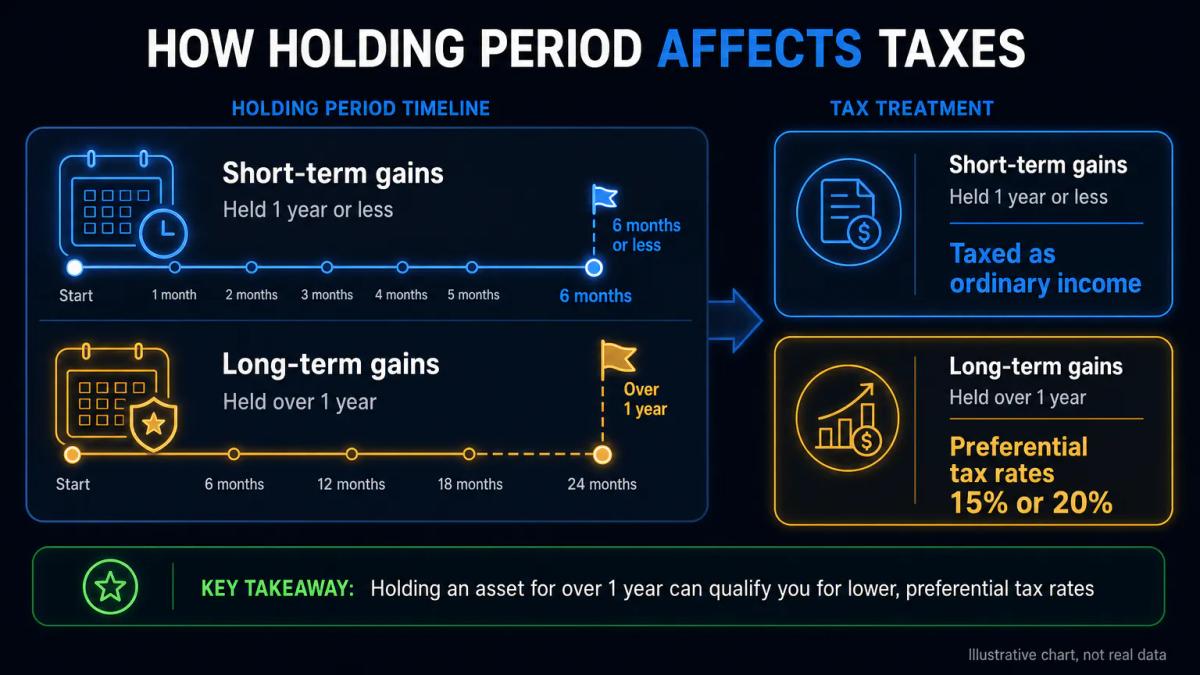
In a taxable account you report three streams of income every year: capital gains from selling investments at a profit, dividends paid by shares or funds you hold, and interest from bonds or cash balances. The tax is due whether you withdraw the money or reinvest it, because realising a gain is what triggers the liability, not moving the cash to your bank.
Capital gains split into two buckets.
- A short-term gain (from an asset held one year or less) is taxed at your ordinary income rate.
- A long-term gain (from an asset held more than one year) is taxed at the preferential long-term rate, which for most retail investors is 0%, 15% or 20% depending on total taxable income.
This gap is why holding period matters: selling the same winning position at month 11 versus month 13 can change the tax bill by a large margin.
- A qualified dividend (paid by most US corporations and certain qualifying foreign shares, held for the required period around the ex-dividend date) is taxed at the long-term capital gains rate.
- A non-qualified or ordinary dividend, common from real estate investment trusts and money market funds, is taxed as ordinary income. Interest from bonds, certificates of deposit and cash sweep balances is taxed as ordinary income too.
The reporting is document-driven. Your broker issues a Form 1099-B for sale proceeds and cost basis, a 1099-DIV for dividends, and a 1099-INT for interest. Miscellaneous items go on a 1099-MISC.
IRS, About Form 1099-MISC: Form 1099-MISC must be filed for payments of at least $10 in royalties or broker payments in lieu of dividends or tax-exempt interest, and at least $600 in rents, prizes and awards, or other income payments.
According to the IRS, About Form 1099-MISC, the filing thresholds are $10 for royalties and broker payments in lieu of dividends, and $600 for rents, prizes and other income. Even below those thresholds, you still owe tax on the income; the form is a reporting cue, not a tax exemption.
Individual, joint, and custodial accounts: which structure suits you
Taxable accounts come in three main forms, and the choice shapes both taxation and legal control. An individual account is owned by one person, and every gain, dividend and interest payment is reported under that person's tax identification number. If that person dies, the account passes through their estate, which can mean probate delays unless a transfer-on-death designation is in place.
A joint account is shared between two or more owners, most commonly spouses. Joint tenancy with right of survivorship means the account passes directly to the surviving owner outside probate. The tax reporting typically goes on one owner's number by default and is split by agreement, but adding a non-spouse as joint owner can be treated as a taxable gift once the transferred share exceeds the annual gift tax exclusion. That is a trap for parents who add an adult child to an account for convenience.
A custodial account, usually under the Uniform Transfers to Minors Act (UTMA) or Uniform Gifts to Minors Act (UGMA), is opened by an adult custodian on behalf of a minor. The custodian trades the account, but the assets legally belong to the child and the income is reported on the child's return. The kiddie tax rules can push a portion of that income up to the parent's rate. Once the child reaches the state age of majority (18 or 21 in most states), full control transfers to them, whatever the original intent.
Flexibility and investment range: what you can trade
Taxable accounts allow you to buy stocks, bonds, exchange-traded funds, mutual funds, options, and, where the broker approves it, margin positions and short sales. There are no contribution caps and no withdrawal penalties, which makes them the default vehicle for goals that sit outside the retirement bucket: a house deposit, a business, education for a child, an early exit from work.
The investment menu is broader than most retirement plans. A 401(k) offers a curated fund list chosen by the plan sponsor. A taxable account at a mainstream broker gives you the full public market: individual shares, corporate and municipal bonds, thousands of ETFs and mutual funds, listed options, closed-end funds, real estate investment trusts (REITs), and often futures and foreign shares.
Some assets carry tax quirks. Municipal bonds pay federally tax-exempt interest, which is one of the few structural tax advantages available inside a taxable account. Master limited partnerships issue a Schedule K-1 rather than a 1099 and can complicate filing.
Options and margin bring their own tax rules. Equity options generally follow standard short-term or long-term capital gains treatment based on holding period. Section 1256 contracts, which include broad-based index options and regulated futures, receive a mandatory 60/40 split: 60% long-term and 40% short-term regardless of how long you held them. That blended rate is often lower than the ordinary rate a short-term equity trade would attract, which is why active index option traders pay attention to contract classification. Margin interest paid to the broker is generally deductible as investment interest expense, but only against investment income and only if you itemise.
Tax-loss harvesting and cost management strategies
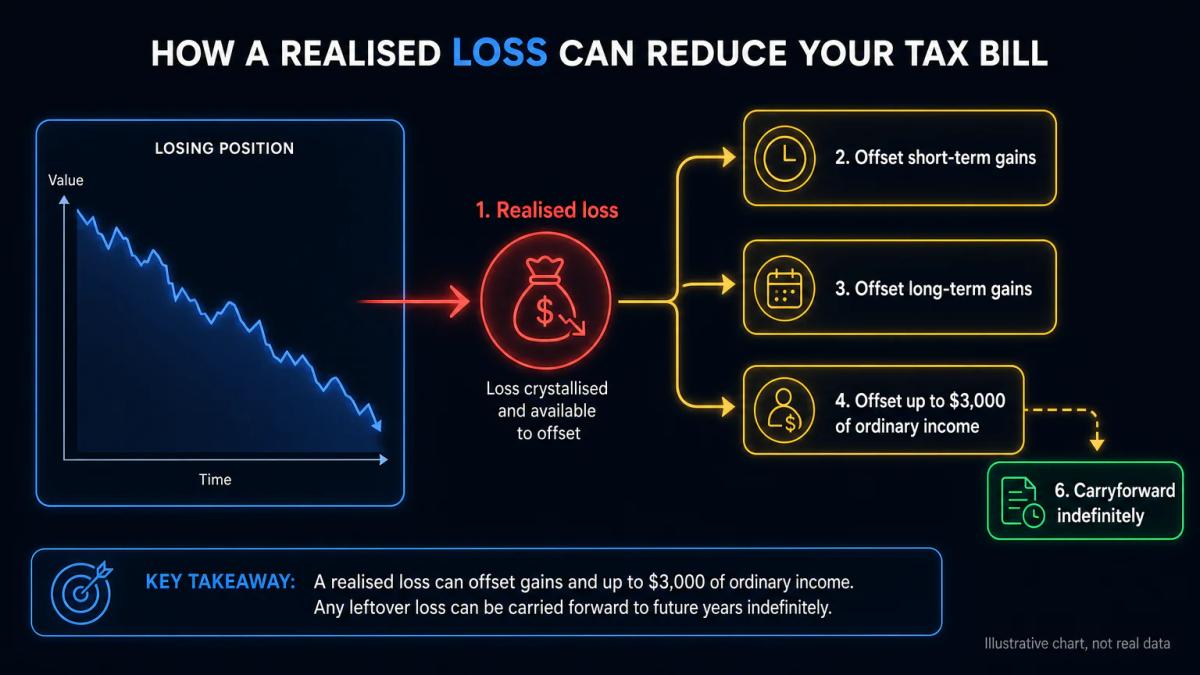
Tax-loss harvesting is the practice of selling a losing position to realise the loss on paper, then using that loss to offset capital gains elsewhere and, up to a limit, ordinary income. Realised capital losses first offset realised gains of the same character (short-term against short-term, long-term against long-term). Any remaining net loss can offset the opposite category, and then up to $3,000 per year of ordinary income for a single filer. Anything left carries forward indefinitely to future tax years.
The binding constraint is the wash-sale rule. If you sell a security at a loss and buy the same or a substantially identical security within 30 days before or after the sale, the loss is disallowed for the current year and instead added to the cost basis of the replacement shares. The 61-day window (30 before, sale day, 30 after) applies across all your accounts, including a spouse's account and, per IRS guidance, your own IRA. Buying the replacement inside an IRA permanently loses the deduction, because there is no future basis in a taxable account to inherit it.
A workable harvest looks like this: you hold an S&P 500 ETF down $4,000. You sell it, book the $4,000 loss, and immediately buy a different ETF that tracks a broadly similar but not substantially identical index, for example a total US market index rather than the S&P 500. You keep your market exposure, and after 31 days you can switch back if you prefer the original fund. The rule targets identical securities, not identical strategies, so swapping between different index families is the standard approach.
Harvesting works best when done throughout the year rather than in a December rush, because volatility creates transient losses that vanish once prices recover. It is also worth pairing with gain harvesting strategies: in a year when your taxable income falls into the 0% long-term capital gains bracket, deliberately realising long-term gains resets cost basis higher at no tax cost.
Margin, options, and estate planning considerations
Margin is money borrowed from the broker against the value of your securities, and it multiplies both gains and losses. Interest on that loan is charged daily against your account. Frequent margin trading typically produces short-term gains, which are taxed at ordinary income rates, so the tax cost of turnover can quietly outweigh the leverage benefit. Margin interest is deductible as investment interest expense on Schedule A, but only to the extent of net investment income and only if you itemise deductions rather than take the standard deduction.
Options strategies interact with the tax code in specific ways. Writing a covered call against a long share position can convert a would-be long-term gain into a short-term one if the call is deep in the money and triggers the qualified covered call rules. Constructive sale rules can be triggered by certain hedging positions, forcing recognition of a gain even without a real sale. Section 1256 contracts, as noted, get the 60/40 treatment and are marked to market at year-end, meaning open positions are treated as sold on 31 December for tax purposes. These are edge cases for a beginner, but worth flagging before you place the trade, not after.
Estate planning is where taxable accounts quietly shine. When you die, the cost basis of most assets in a taxable account is stepped up to the fair market value on the date of death. If you bought shares at $10,000 and they are worth $80,000 at your death, your heirs inherit them with an $80,000 basis. If they sell immediately, the taxable gain is close to zero. This step-up in basis does not apply inside a traditional IRA, where heirs inherit the deferred tax bill. That single feature can make a taxable account the more tax-efficient long-hold vehicle for assets you never intend to sell yourself.
When to use a taxable account alongside retirement savings
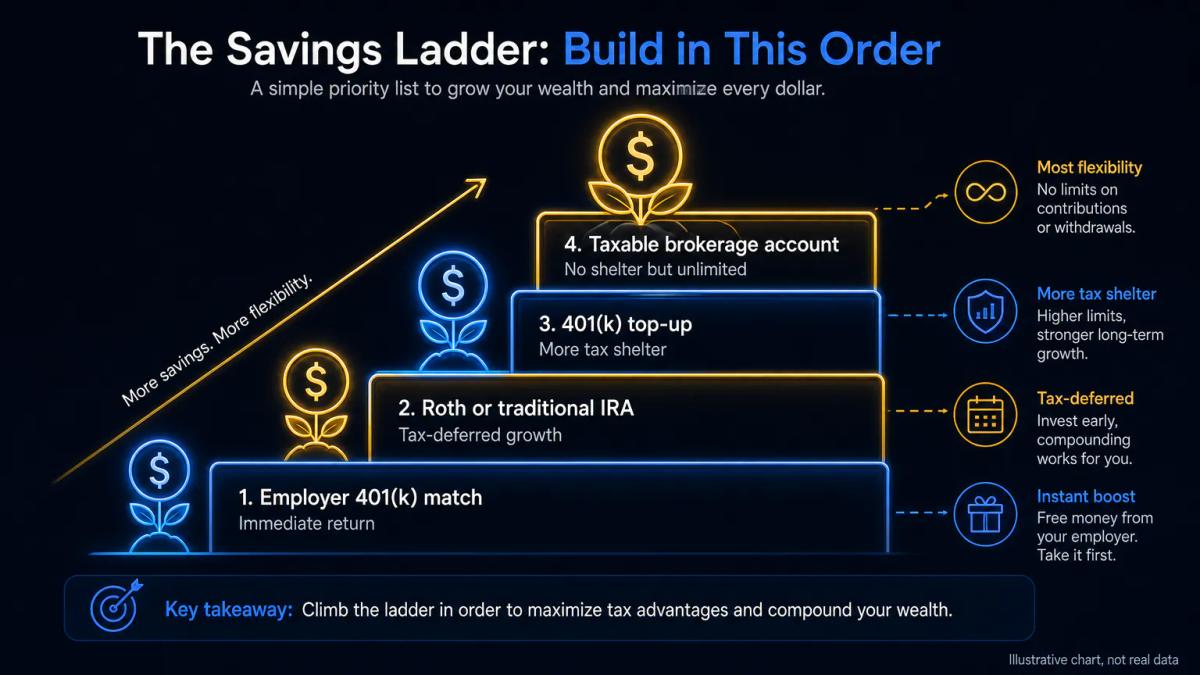
The standard ordering for a US saver is: capture any employer 401(k) match first (it is an immediate return you will not find elsewhere), fund a Roth or traditional IRA up to the annual limit if eligible, top up the 401(k) toward the annual employee contribution limit, and then direct additional savings into a taxable brokerage account. That order maximises tax shelter before opening the taxable envelope.
A taxable account also earns its place when the goal is not retirement. Money you might need before age 59.5, a home deposit, a career break, tuition for a child, funding a business, does not belong locked inside a retirement account, where early withdrawals typically trigger a 10% penalty on top of ordinary income tax. Taxable accounts have no such penalty. You sell what you need, pay the capital gains tax on the realised profit, and the rest stays invested.
There are two more situations where a taxable account is the right tool. First, if you earn too much to contribute to a Roth IRA directly and do not want to use the backdoor Roth conversion, a taxable account is the only alternative for post-tax investing. Second, if you plan to leave assets to heirs, the step-up in basis at death makes a taxable account more efficient than a traditional IRA for the same buy-and-hold portfolio. Highly appreciated shares, in particular, are often best left in a taxable account for that reason.
Brokerage fees, reporting, and international investing
Costs inside a taxable account come from three sources: commissions on trades, fund expense ratios on any ETFs or mutual funds you hold, and account-level fees such as inactivity or transfer charges. US retail brokers largely moved to zero commission on US-listed stocks and ETFs, but options still carry a per-contract fee (typically $0.50 to $0.65 per contract), and mutual funds outside a broker's no-transaction-fee list can cost $20 or more per trade. Expense ratios on ETFs range from around 0.03% for large index funds to well above 0.50% for active or thematic products, and they compound silently against your return every year.
| Cost item | Typical range at US retail brokers | Impact |
|---|---|---|
| US stock and ETF commission | $0 | None on cost, but check for payment for order flow |
| Options contract fee | $0.50 to $0.65 per contract | Adds up for frequent traders |
| Mutual fund transaction fee | $0 to $49.95 per trade | Avoidable via NTF lists |
| ETF expense ratio | 0.03% to 0.75% annually | Compounds against long-term returns |
| Account transfer out (ACAT) | $50 to $100 | One-off, at exit |
| Wire transfer out | $25 to $30 | Per transaction |
International investing adds another layer. Foreign shares often pay dividends net of a withholding tax from the source country. You can generally claim a foreign tax credit on your US return to avoid being taxed twice on the same income, subject to limits. Separately, if the total value of your foreign financial accounts exceeds $10,000 at any point in the year, you must file a Report of Foreign Bank and Financial Accounts (FBAR) with FinCEN. According to the IRS, Understanding your Form 1099-K, reporting thresholds include $20,000 and 200 transactions as key benchmarks. Larger balances may also require Form 8938 with the IRS. Holding foreign shares through a US-based broker in an ordinary taxable account does not usually trigger FBAR, but a directly held foreign brokerage account does.
This content is general information and not advice: every situation needs checking with a licensed professional in the relevant jurisdiction.
Frequently Asked Questions
What is the main difference between a taxable brokerage account and a 401(k) or IRA?
A 401(k) or IRA gives you tax-deferred or tax-free growth but caps annual contributions and penalises withdrawals before age 59.5. A taxable brokerage account has no contribution limits and no early-withdrawal penalty, but every realised gain, dividend and interest payment is taxed in the year it occurs. Retirement accounts prioritise tax shelter; taxable accounts prioritise flexibility.
How are capital gains taxed in a taxable brokerage account, and does it matter if I hold the investment for a long time?
Yes, holding period is central. Gains on assets held one year or less are short-term and taxed at your ordinary income rate. Gains on assets held more than one year are long-term and taxed at 0%, 15% or 20% depending on your total taxable income. Selling one day past the one-year mark can materially reduce the tax owed on the same gain.
Can I use tax-loss harvesting in a taxable account, and what is the wash-sale rule?
You can harvest losses to offset gains and up to $3,000 of ordinary income per year, with the rest carrying forward. The wash-sale rule disallows the loss if you buy the same or a substantially identical security within 30 days before or after the sale, across all your accounts including a spouse's and your own IRA. Swapping to a similar but not identical fund is the standard workaround.
What happens to a taxable brokerage account when I pass away, and do my heirs owe taxes on it?
Most assets in a taxable account receive a step-up in cost basis to the fair market value on the date of death. Heirs who sell immediately usually owe little or no capital gains tax on the pre-death appreciation. This step-up does not apply inside a traditional IRA, which is one reason taxable accounts can be efficient vehicles for long-term buy-and-hold assets intended for heirs.
Are there any restrictions on what I can trade in a taxable account, such as options or margin?
The account itself allows a wide range: stocks, bonds, ETFs, mutual funds, options and margin, subject to broker approval for the leveraged strategies. Options and margin require you to apply for the relevant permission level and meet suitability criteria. Tax rules differ by product: Section 1256 contracts get a 60/40 long-short split, and margin interest is deductible only against investment income if you itemise.
About the authors


Put this into practice
Related articles

Trading Discipline: Why It Matters and How to Build It
Learn why trading discipline is essential for consistent results. Discover practical techniques to follow your plan, control emotions, and build lasting habits.

Trading Plan Guide: What It Is and How to Create One
Learn what a trading plan is and how to create one step by step. This guide covers essential components, common mistakes, and a practical template framework.

Trailing Stop Loss: Definition and Usage
Learn how trailing stop losses work, when to use them, and how to set the right trail distance. Practical guide covering mechanics, advantages, and common mistakes.
0 comments