



Financial Markets · Beginner · 10 min read
Options Trading Explained: Calls, Puts, and Broker Approval
Options trading is the buying and selling of contracts that give you the right, but not the obligation, to buy or sell an underlying asset at a fixed price before a set date. Each contract typically represents 100 shares. You pay a premium upfront, and that premium is the most you can lose on a straightforward long call or long put.
What Is Options Trading and How Does It Work
Options trading lets you take a position on the future price of an underlying asset (a stock, index, ETF, or in some markets a currency or commodity) without owning it outright. A single options contract represents 100 shares of the underlying, and the price you pay for the contract is called the premium. Because the premium is a fraction of the cost of buying 100 shares, options offer built-in leverage: more market exposure per pound of capital.
Understanding how to manage this leverage is crucial, as leverage trading mistakes can quickly blow your account.
The trade-off is time. Every option has an expiration date, and once that date passes the contract is worthless unless it holds intrinsic value. A retail trader in the UK typically buys options through an FCA-authorised broker that offers equity or index options. The FCA classifies listed options as complex products, which means brokers must run an appropriateness assessment before granting access.
If the option expires out of the money, meaning the market never crossed your strike price in a useful direction, you lose 100% of the premium paid. If it expires in the money, you either exercise the contract or your broker settles it in cash.
Calls and Puts: The Two Core Option Types

A call option gives you the right to buy the underlying asset at a fixed strike price before expiration. A put option gives you the right to sell it at the strike.
- Calls are the tool for a bullish view: you profit when the market rises above the strike plus the premium you paid.
- Puts are for a bearish view: you profit when the market falls below the strike minus the premium.
Every options strategy, from the simplest long call to a four-leg iron condor, is built by combining calls and puts across different strikes and expirations. The direction you expect the market to take decides which side you buy or sell. A retail trader buying a single call on a UK-listed share is expressing the same bullish view as a share buyer, but with defined maximum loss (the premium) and an expiration clock ticking against them. That defined-loss feature is why some traders prefer long options to margin trading in cash equities.
You can explore how options fit within 5 trading strategies that work across multiple asset classes.
| Feature | Long call | Long put |
|---|---|---|
| Market view | Bullish | Bearish |
| Right | To buy at strike | To sell at strike |
| Maximum loss | Premium paid | Premium paid |
| Maximum profit | Unlimited above strike | Strike minus premium (down to zero) |
| Breakeven | Strike + premium | Strike, premium |
Strike Price, Expiration, and Premium Explained
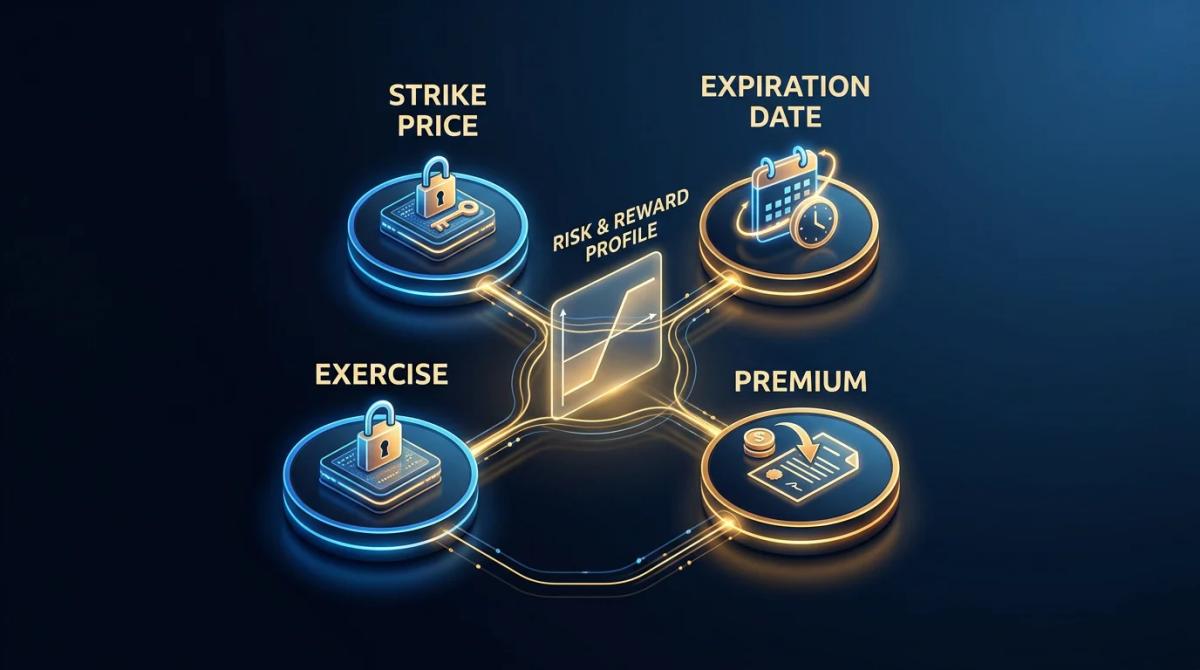
The strike price is the fixed price at which the option can be exercised. The expiration date is the last day the contract is valid. The premium is what you pay to own the contract. Together these three variables determine the position's economics.
Consider a call with a £50 strike on a stock trading at £48. That call is out of the money (the strike is above the current price for a call), so the premium is low, made up mainly of time value, the portion of premium that reflects the chance of the price moving above £50 before expiration. A call with a £45 strike on the same stock is in the money by £3, so the premium includes £3 of intrinsic value plus additional time value. The £45 call costs more upfront but has a higher probability of finishing profitable.
Expiration ranges from weekly contracts to LEAPS (Long-term Equity Anticipation Securities) that expire more than a year out. Shorter-dated options decay in value faster as expiration approaches, a phenomenon called theta decay or time decay. The nearer the expiration, the more each day erodes premium if the underlying does not move. This is why long option buyers face a race against the calendar, and why some traders prefer to sell options to collect that decay, accepting the higher risk in exchange.
Options as Derivatives: Leverage, Risk, and Capital Requirements
Options are derivatives: their value derives from the price of an underlying asset. Because you control 100 shares per contract for a fraction of their cost, options embed leverage. A £2 premium controls £4,800 of stock at a £48 share price, giving roughly 24x notional exposure per pound of premium. Small moves in the underlying can translate into large percentage moves in the option's price.
Leverage works both ways. On a long call or long put, your loss is capped at the premium paid, so the position has defined risk from the moment you open it. On short (sold) options, however, the loss can be far larger than the premium collected, and in the case of naked short calls it is theoretically unlimited. This is why UK retail brokers usually restrict short uncovered options to clients with higher permission levels or larger accounts.
The FCA does not apply the same 30:1 major-forex leverage cap to listed options because options are structurally different from CFDs (Contracts for Difference, over-the-counter leveraged bets). However, the FCA has banned the sale of CFDs on cryptoassets to UK retail clients and requires appropriateness testing for complex derivatives, including listed options. Any broker offering options to UK retail must be authorised by the FCA or passport in from another approved regulator. Offshore entities offering options to UK residents without FCA permission should be treated with caution.
Getting Started: Broker Approval and Platform Access
Not every broker offers options, and those that do usually gate access behind an approval process. Typical steps include disclosing your trading experience, income, net worth, and investment objectives; some brokers set graded permission levels (long options only, spreads, uncovered short options) based on your answers.
Under FCA rules, this appropriateness assessment is a legal requirement for complex products, not a marketing formality. Before you open an account, review the questions to ask before opening a trading account to ensure the broker meets your needs.
Once approved, you access options through the broker's trading platform. MT4 and MT5 (MetaTrader, popular retail platforms) rarely support listed equity options; cTrader is similarly focused on CFDs and forex. Most equity options trading in the UK happens on proprietary web or desktop platforms provided by equity-focused brokers, or on institutional platforms for professional clients. You need to learn to read an options chain, a table listing every available strike and expiration for a given underlying, with bid, ask, volume, and open interest for each contract. Many brokers offer a demo account or paper trading module where you can place simulated options trades before committing capital.
Basic Strategies: Long Calls, Long Puts, and Spreads
The simplest bullish position is the long call: buy one call, profit if the underlying rises above strike plus premium by expiration, lose the premium if it does not. The bearish equivalent is the long put. Both have defined loss and are the entry point for most retail traders.
Spreads combine two options to reduce cost and cap risk. A bull call spread involves buying a call at one strike and selling a call at a higher strike, both same expiration. The sold call reduces your net premium (making the position cheaper) but caps your maximum profit at the higher strike. A bear put spread mirrors this for a downside view.
| Strategy | View | Max loss | Max profit | Best when |
|---|---|---|---|---|
| Long call | Bullish | Premium | Unlimited | Big up-move expected |
| Long put | Bearish | Premium | Strike, premium | Big down-move expected |
| Bull call spread | Moderately bullish | Net premium | Difference in strikes, net premium | Modest up-move expected |
| Bear put spread | Moderately bearish | Net premium | Difference in strikes, net premium | Modest down-move expected |
Before entering, calculate breakeven, maximum profit, and maximum loss on paper. If those three numbers do not fit your risk tolerance, do not open the trade.
Risk Disclosure: How You Can Lose Money and What to Monitor
On a long call or long put, your maximum loss is the full premium. If the underlying never crosses your breakeven, the option expires worthless and 100% of what you paid is gone. This is a common outcome: many out-of-the-money options finish that way. Selling options (writing calls or puts) flips the risk profile: your gain is capped at the premium collected, but your loss can be many multiples of that if the market moves sharply against you.
Time decay works against long holders every single day. An option can lose value even when the underlying price does not move, simply because expiration is one day closer. Volatility also matters: a drop in implied volatility (the market's expectation of future price movement, priced into every option) can reduce your option's value even if direction goes your way. Always define an exit plan, whether that is a stop loss on the option's price, a percentage-of-premium rule, or a time-based exit before the final week of decay. Proper position sizing in trading helps you stay within your risk tolerance across all your positions.
Tax, Reporting, and Regulatory Considerations for UK Traders
In the UK, gains and losses from listed options are usually assessed under capital gains tax, but if HMRC classifies you as trading in the nature of a business, profits can be taxed as income instead. The distinction depends on frequency, organisation, and intent. According to HMRC's Business Income Manual, most individuals dealing in options for their own account are treated as investors, with gains falling under CGT rules. Keep every trade record: entry date, strike, expiration, premium paid or received, closing price, and any assignment or exercise events.
On the regulatory side, the FCA authorises and supervises brokers offering options to UK retail clients, requires appropriateness testing, and has banned CFDs on cryptoassets for retail. Listed equity and index options remain permitted for retail with proper approval. Where a broker group operates multiple entities, check which one holds your account: an FCA-authorised UK entity offers the strongest protection (FSCS coverage up to £85,000 for eligible claims), while an offshore group entity typically does not. Confirm the entity and licence on your account statement before funding.
This content is general information and not advice: every situation needs checking with a licensed professional in the relevant jurisdiction.
Frequently Asked Questions
Can I lose more money than I invest in options trading?
On long calls and long puts, no: your maximum loss is the premium you paid. On short (sold) uncovered options, yes: losses can be many times the premium collected, and on a naked short call the loss is theoretically unlimited. UK brokers usually restrict uncovered short options to clients with higher permission levels.
What is the difference between in-the-money and out-of-the-money options?
A call is in the money when the underlying price is above the strike, and out of the money when it is below. A put is in the money when the underlying is below the strike, and out of the money when it is above. In-the-money options have intrinsic value; out-of-the-money options are pure time value.
How do I know if I am approved to trade options at my broker?
Your broker will confirm your options permission level in writing after you complete their appropriateness questionnaire. Most brokers use tiered levels: long options only, vertical spreads, and uncovered short options. Log in to your account settings or contact client services to check your current tier.
What happens to my option if I do not close it before expiration?
If the option finishes out of the money, it expires worthless and you lose the full premium. If it finishes in the money, most brokers auto-exercise it, which for equity options usually means delivery of 100 shares per contract at the strike, or a cash settlement for index options. Check your broker's auto-exercise threshold.
Are options trading profits taxed differently than stock trading profits in the UK?
For most individual UK investors, listed options gains fall under capital gains tax, similar to shares. If HMRC classifies your activity as trading in the nature of a business, gains may be taxed as income instead. Confirm your status with a qualified tax adviser and reference HMRC's Business Income Manual.
About the authors


Put this into practice
Brokers we have reviewed
Scored on the same five dimensions. Here are three of them — the full list is on the brokers page.


Related articles

Passively Managed Index Funds vs. Active Funds: Which Suits You Best?
A clear-eyed comparison of passively managed index funds and actively managed funds: mechanics, costs, tax drag, downturn behaviour, and how to choose.

Quant Firms Explained: Strategies, Structure, and Careers
A plain-English guide to quant firms: what they are, how HFT shops differ from quant hedge funds, the strategies they run, and what it takes to join one.

Stock Market Hours in Central Time: When US Markets Open and Close
A plain-English guide to US stock market hours in central time, covering the regular session, extended trading, holidays, DST and how to set alerts.
0 comments