



Financial Markets · Advanced · 7 min read
Is Forex Trading Legal in India? Rules, Pairs and Penalties
The legal answer: what India's regulators allow
India permits forex trading within a narrow regulatory corridor defined by the Reserve Bank of India (RBI) and the Securities and Exchange Board of India (SEBI) under the Foreign Exchange Management Act (FEMA), 1999. A resident retail trader has access to four INR-quoted currency pairs (USD/INR, EUR/INR, GBP/INR and JPY/INR), executed through authorized dealers or SEBI-registered stockbrokers. Direct participation in the interbank market is closed to retail, and any venue outside this corridor sits outside the law.
The mechanics flow from that structure. Spot forex access runs through authorized dealers (banks and licensed non-bank entities under section 10 of FEMA), while retail speculative exposure is channelled into exchange-traded currency derivatives on the NSE and BSE. The Liberalised Remittance Scheme (LRS) permits remittances up to $250,000 per financial year for permitted purposes, with margin trading on offshore forex platforms falling outside that permitted list. Most retail traders cross that boundary without realising it, and it is where regulatory enforcement concentrates most heavily.
This article is general information, not tax or legal advice; your situation needs review with a licensed professional in India.
Which currency pairs can you actually trade?
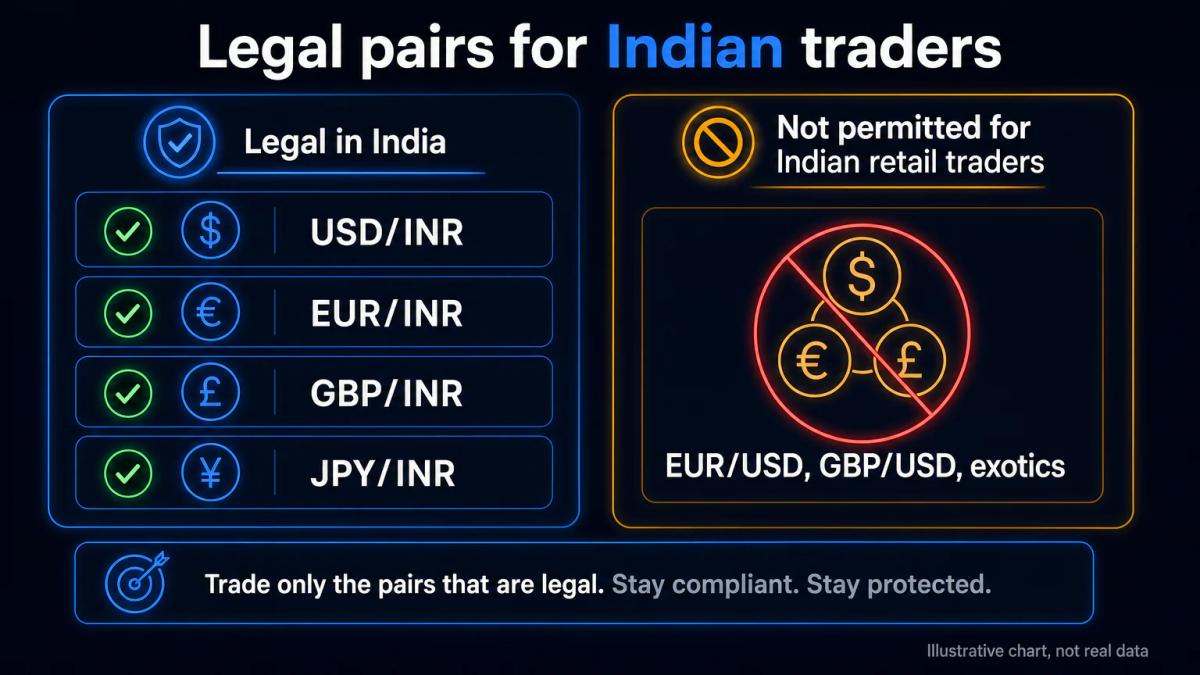
As a resident Indian retail trader, your permitted universe is four INR pairs:
- USD/INR
- EUR/INR
- GBP/INR
- JPY/INR
Cross-currency futures and options on EUR/USD, GBP/USD and USD/JPY were also enabled on recognised exchanges by SEBI. These sit in the exchange-traded derivatives category rather than spot forex, and they trade in standardised contracts.
Any broker offering spot EUR/USD, gold crosses, exotic pairs or CFDs on currencies to an Indian resident is operating outside the FEMA perimeter, regardless of how legitimate its foreign licence looks. This restriction functions as a capital-account control instrument the RBI uses to manage rupee volatility and offshore leakage, and the perimeter has stayed in place without any sign of loosening.
| Pair | Spot (authorized dealer) | Exchange futures/options | Notional per lot |
|---|---|---|---|
| USD/INR | Permitted | NSE, BSE | $1,000 |
| EUR/INR | Permitted | NSE, BSE | €1,000 |
| GBP/INR | Permitted | NSE, BSE | £1,000 |
| JPY/INR | Permitted | NSE, BSE | ¥100,000 |
| EUR/USD, GBP/USD, USD/JPY | Not permitted | NSE, BSE (cross-currency F&O) | Standardised |
Authorized dealers and registered brokers: where to trade legally
Two gateways carry the entire legal retail flow. Authorized dealers (AD Category I banks and a few AD Category II entities) are RBI-licensed and handle spot conversion and permitted hedging. SEBI-registered stockbrokers route you into the exchange-traded currency derivative segment on NSE or BSE, serving as the practical channel for speculative or directional trading.
Verification follows a procedural checklist that goes beyond brand recognition. Before funding any account, carry out three checks:
- Check the broker's SEBI registration number on the SEBI intermediary search.
- Confirm its membership of NSE or BSE in the currency derivatives segment.
- Cross-check any bank involved against the RBI's AD list.
Offshore platforms soliciting Indian residents, including names appearing on the RBI's Alert List of unauthorised entities, offer no legal recourse. Should funds disappear in such a case, no Indian regulator will adjudicate the dispute, and remittances to those platforms can themselves breach FEMA.
Currency derivatives: the legal alternative for retail traders
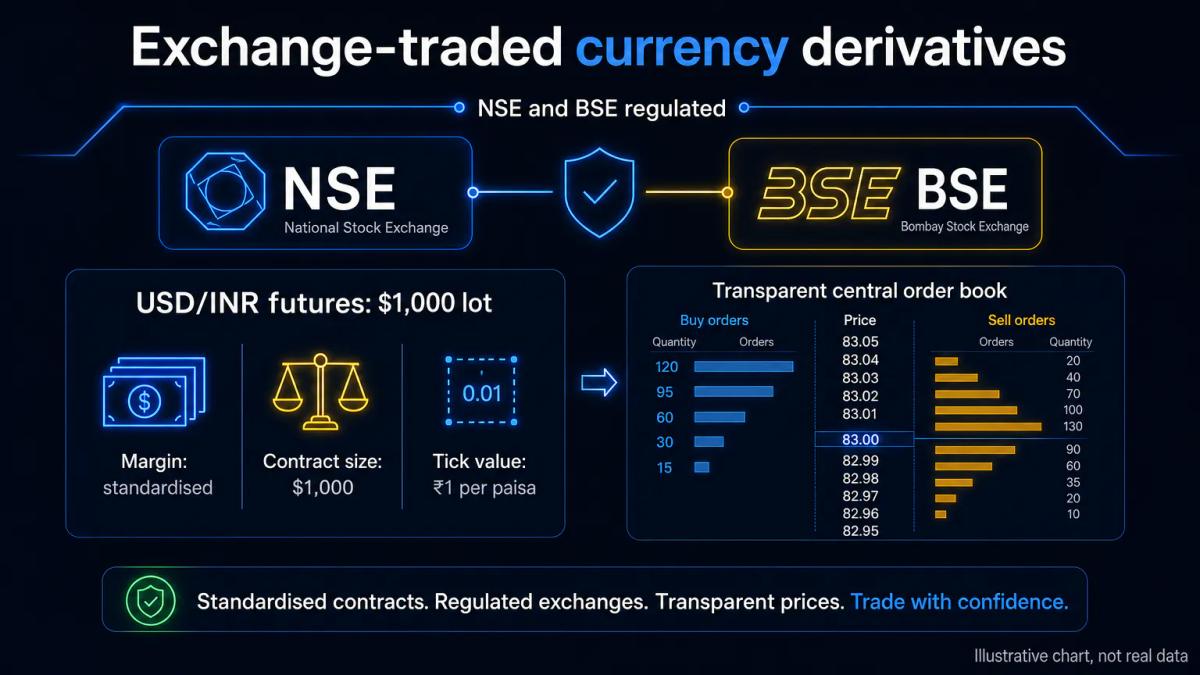
Exchange-traded currency futures and options are where most Indian retail traders actually operate. The segment carries four defining characteristics for regulated access: SEBI oversight, standardised contracts, counterparty risk held by the clearing corporation, and transparent pricing through the central limit order book. For an advanced trader, three features define the segment:
- Contract size is small enough for retail position sizing but large enough to carry meaningful delta: USD/INR futures move ₹1 per paisa per lot of $1,000.
- Margin requirements are set by SPAN plus exposure, translating into effective leverage typically in the 20:1 to 50:1 range on USD/INR, materially higher than spot access via a bank would allow.
- You need an underlying contracted exposure to exceed the position-limit threshold set by RBI and SEBI for proprietary (unhedged) positions, currently USD-equivalent $100 million or 15% of total open interest, whichever is lower, per client.
The operational workflow is straightforward. Follow these steps to set up a compliant account:
- Open a trading and demat account with a SEBI-registered broker that is a member of the currency derivatives segment.
- Complete KYC under the Prevention of Money-Laundering Act.
- Fund the account from a resident Indian bank account in INR.
No cross-border remittance is involved at any stage, which is what keeps the activity inside FEMA.
Consider a hypothetical position: a trader is long one USD/INR near-month future at 83.40 with SPAN plus exposure margin of roughly ₹1,900. Should the price move 20 paisa to 83.60, the mark-to-market gain would be ₹200 on a notional of $1,000. For position sizing in such a case, the trader would track the ratio of gain to margin rather than the ratio to notional.
Penalties for trading on unregistered platforms
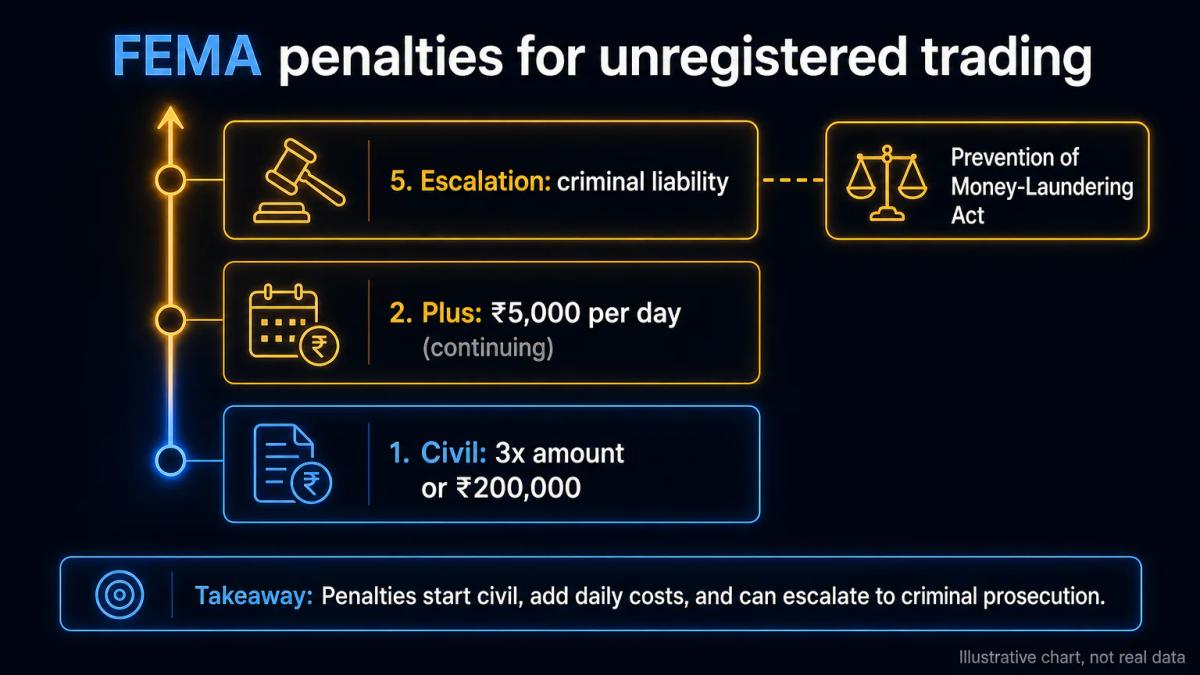
FEMA contraventions attract civil penalties of up to three times the sum involved where the amount is quantifiable, or ₹200,000 where it is not, with an additional ₹5,000 per day for a continuing contravention under section 13 of FEMA. The Enforcement Directorate (ED) can attach funds, and repeat or large-scale violations can escalate under the Prevention of Money-Laundering Act, which carries criminal liability.
The RBI publishes and periodically updates an Alert List naming entities not authorised to deal in forex under FEMA, and has instructed AD banks to monitor and report card and net-banking transactions suspected of funding such platforms. Payment aggregators have progressively blocked merchant codes linked to flagged brokers. On the ground, a retail trader caught in that enforcement net typically faces several outcomes at once:
- Account freezes at the funding bank.
- Show-cause notices from the ED.
- Loss of the deposited capital, with no appellate route to SEBI or the RBI, because the counterparty was outside their jurisdiction to begin with.
Tax reporting and compliance for forex traders
Tax treatment depends on how the trading activity is classified, and that classification in turn determines both the applicable rate and the set-off rules that apply to any losses. Exchange-traded currency derivatives qualify as non-speculative business income under section 43(5) of the Income Tax Act, 1961, because they are settled on a recognised stock exchange: profits are taxed at your slab rate, while losses can be set off against any head other than salary and carried forward for eight assessment years. Where turnover crosses the thresholds in section 44AB (currently ₹10 crore for digital transactions above the 95% threshold), a tax audit becomes mandatory.
Spot forex gains through an authorized dealer, where present, are typically taxed as business income or other sources depending on frequency and intent. Securities Transaction Tax does not apply to currency derivatives, but a Commodities Transaction Tax equivalent (CTT on currency options sell side at 0.05% of premium) and GST on brokerage do. Report all positions in Schedule BP of the ITR-3; disclose foreign assets in Schedule FA only where the trading account is actually offshore (which, as covered above, is the illegal case). Rate figures and thresholds here are indicative under current law and should be validated with a chartered accountant for your assessment year.
Recent RBI alerts and regulatory changes affecting traders
The perimeter has continued to tighten over the past two years. The RBI's Alert List was first published in September 2022 and has been expanded multiple times since, naming unauthorised electronic trading platforms (ETPs) and offshore forex brokers. Supervisory action has extended into the payment layer, with AD banks, card networks and payment aggregators directed to decline transactions to flagged merchants, which is why cross-border card funding of offshore brokers now fails more often than it clears.
For the retail trader, two operational consequences follow. Banks are increasingly asking for the purpose code and underlying documentation on LRS remittances, and margin trading is not an eligible purpose. Exchange-side rules on cross-currency pair position limits and client-level margin reporting have been refined, which affects how large a book you can run before compliance scrutiny kicks in. The direction of travel points toward three shifts:
- More granular reporting across the funding and execution chain.
- Faster payment-layer interdiction of flagged brokers.
- No regulatory appetite for liberalising retail spot forex access.
Frequently Asked Questions
Can I trade forex on MT4 or MT5 in India legally?
You can use MT4 or MT5 as a terminal if a SEBI-registered broker provides it connected to NSE or BSE currency derivatives. Using MT4 or MT5 to trade spot forex or CFDs on an offshore broker's server is outside the FEMA perimeter, regardless of the platform.
What is the difference between spot forex and currency derivatives in India?
Spot forex is a bilateral FX transaction with an authorized dealer, used mainly for actual currency conversion and permitted hedging. Currency derivatives are standardised futures and options on recognised exchanges, cleared through the clearing corporation, and are the regulated route for retail speculative or directional positioning on INR pairs.
How much leverage can I use for forex trading in India?
On exchange-traded currency futures, SPAN plus exposure margin typically translates into effective leverage of about 20:1 to 50:1 on USD/INR, with lower on less liquid pairs. Spot forex through a bank is not a margin product for retail. Offshore platforms advertising 1:500 to Indian residents are operating outside FEMA.
What happens if I trade on an unregistered forex broker in India?
You face a FEMA contravention with civil penalties up to three times the amount involved, possible ED attachment, bank account freezes at the funding institution, and no regulatory recourse against the broker because it was never authorized. In serious or large cases, PMLA proceedings can add criminal liability.
Do I need to report forex trading income to the income tax department?
Yes. Exchange-traded currency derivatives are non-speculative business income under section 43(5) and are reported in Schedule BP of the ITR-3; turnover above the section 44AB thresholds triggers a tax audit. Validate the specifics with a chartered accountant, as thresholds and treatment can shift year on year.
About the authors


Put this into practice
Brokers we have reviewed
Scored on the same five dimensions. Here are three of them — the full list is on the brokers page.



Related articles

Is Forex Trading Legal in the UK? FCA Rules and Your Rights
Forex trading is legal in the UK through FCA-authorised brokers. Understand leverage caps, product restrictions, FSCS protection and the risks of offshore firms.

Most Volatile Stocks: How to Find and Trade Them
A practical guide for retail traders on where to find the most volatile stocks, why they swing, and how to trade them without blowing up your account.

Options Trading Explained: Calls, Puts, and Broker Approval
How options trading works for UK retail traders: calls, puts, strike prices, premiums, broker approval, risk limits, and tax reporting, in plain English.
0 comments